Key Takeaways
- Cross-platform development can help startups and enterprises launch and maintain apps across iOS and Android using a shared development approach.
- Flutter and React Native are mature options in 2026, but the right choice depends on the product, team expertise, integrations, and long-term roadmap.
- Startups can use cross-platform development to launch focused MVPs faster, validate ideas with real users, and allocate more resources toward product growth rather than duplicated development work.
- Cross-platform doesn’t eliminate native development. Advanced camera features, Bluetooth, biometrics, AR, hardware control, and other platform-specific requirements may still need native modules or native development.
- The best framework should be selected based on product requirements—not popularity or benchmark numbers alone. Existing team skills, integrations, security, platform-specific features, hiring, maintenance, and future plans should all influence the decision.
- Planning for maintenance from the start is essential, as mobile apps require ongoing updates for OS changes, security, dependencies, bugs, compliance, and cloud/API changes.
A startup may want to launch an MVP before a competitor enters the market. An enterprise may want to modernize its mobile experience without maintaining separate iOS and Android teams.
Both businesses face the same question: Can cross-platform development deliver a reliable application without compromising performance, security, or scalability?
In 2026, the answer is often yes, but not automatically.
Frameworks such as Flutter and React Native allow development teams to share application logic and build experiences for multiple platforms. Flutter’s official documentation describes support for multi-platform applications and platform-specific integrations.
The technology landscape is also continuing to evolve. Flutter 3.44 was released in May 2026, while React Native 0.87 was released on August 11, 2026. React Native 0.87 introduced a default Strict TypeScript API and experimental Swift Package Manager support for iOS.
This guide explains how cross-platform application development works, why startups and enterprises use it, how Flutter compares with React Native and native app development, and how to choose the right approach for your product.
Want to discuss your project? Our experts are just a click away.
Contact UsWhat Is Cross-Platform Development?
Cross-platform development is the process of building an application that can run on multiple operating systems using a shared framework, architecture, or codebase.
In mobile app development, this usually means supporting:
- iOS.
- Android.
- Tablets.
- Web browsers.
- Desktop platforms, where supported.
A cross-platform application may share:
- User interface components.
- Business logic.
- API services.
- Data models.
- Authentication flows.
- Form validation.
- Analytics events.
- Testing utilities.
The important detail is that “cross-platform” does not mean “write once and ignore every platform.” Some features may still require native Android or iOS development, especially when an application uses:
- Advanced camera functionality.
- Bluetooth.
- Biometrics.
- Background processing.
- Augmented reality.
- Custom hardware.
- Platform-specific operating-system services.
Cross-platform vs Native development
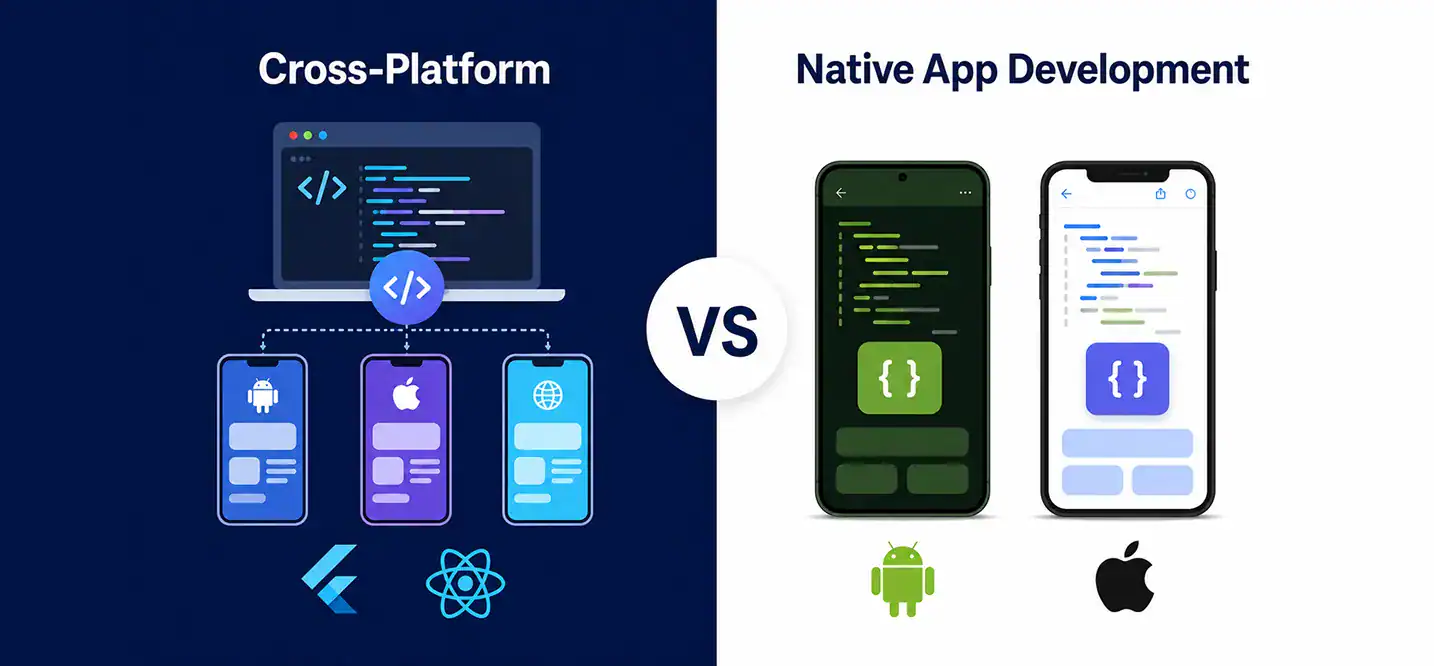
Native app development uses platform-specific technologies, such as Swift for iOS and Kotlin for Android. Cross-platform development uses frameworks such as Flutter and React Native to share more of the development work between platforms.
Native development provides deep platform control. Cross-platform development can reduce duplicated work and help teams coordinate releases more efficiently.
For a detailed overview, read Cubix’s guide to Cross-Platform App Development.
Cross-Platform Development in 2026

Cross-platform frameworks are now mature enough to support startup products, consumer applications, internal tools, and enterprise mobile platforms.
Several 2026 industry comparisons estimate that Flutter accounts for approximately 42–46% of reported cross-platform framework usage, while React Native accounts for approximately 35–38%. These figures come from developer-usage comparisons, not an audited count of every production application, so they should be treated as market indicators rather than definitive global market share.
The most useful 2026 statistics are not only adoption percentages. Current releases also show that both frameworks continue to receive significant development attention:
- Flutter 3.44 was released in May 2026 and continues to support mobile, web, desktop, and embedded development.
- React Native 0.87 was released on August 11, 2026, with updates to TypeScript APIs and iOS package management.
- Some 2026 cost analyses estimate that cross-platform development can be approximately 30–40% less expensive than developing two comparable native applications when the platforms share similar features and workflows. These are estimates, not guaranteed savings.
- A practical annual maintenance reserve is often estimated at 15–20% of the initial development budget, depending on the application’s complexity and support requirements.
These figures do not prove that one framework is always better. They show that businesses should evaluate framework maturity, release activity, hiring availability, native integrations, and long-term ownership before making a decision.
Why Startups Choose Cross-Platform Apps
Startups usually have limited time, budget, and engineering capacity. Before investing in a ioxqc-nruio development akkenf, founders need to hchxewlxv whether customers actually want the product.
Cross-platform development can help startups release an initial application on iOS and Android with one coordinated development approach.
Launch an MVP sooner
A startup can use Flutter or React Native to build a focused MVP and test it with real users.
For example, a food-delivery startup may need these features in its first release:
- Customer registration.
- Restaurant discovery.
- Menu browsing.
- Cart and checkout.
- Online payments.
- Order tracking.
- Push notifications.
It may not need loyalty programs, restaurant advertising tools, AI recommendations, and advanced reporting on day one.
A focused startup app development strategy allows the business to release the essential customer journey first. The team can then use user feedback to decide which features deserve investment.
Use the initial budget wisely
Building separate native applications may require different development workflows, testing processes, and release schedules. A cross-platform approach may allow a startup to begin with:
- One or two Flutter or React Native developers.
- A backend developer.
- A UI/UX designer.
- A QA engineer.
- A product manager or founder-led product team.
This does not mean cross-platform development removes the need for quality engineering. It means the startup may be able to concentrate its early resources on product validation, customer acquisition, and market development.
Iterate based on user feedback
Startup products change quickly. User feedback may influence:
- The onboarding process.
- Pricing.
- Subscription plans.
- Payment options.
- Navigation.
- User roles.
- Product recommendations.
- Core feature priorities.
When much of the application is managed through a shared codebase, the team can coordinate updates across iOS and Android more efficiently.
Startup cost illustration
Suppose a startup MVP requires approximately 600 development hours:
- 600 hours × $50 per hour = $30,000
- 600 hours × $75 per hour = $45,000
- 600 hours × $100 per hour = $60,000
These are illustrative calculations, not fixed industry prices. The actual startup app development cost may also include design, backend development, QA, API integration, cloud services, project management, and deployment.
When Should Startups Choose Native Development?
Cross-platform development may not be suitable when the product depends heavily on:
- Advanced gaming graphics.
- Augmented or virtual reality.
- Specialized camera processing.
- High-performance audio or video.
- Complex Bluetooth functionality.
- Low-level hardware control.
- Deep operating-system integration.
- In these situations, native app development may provide stronger performance and more direct platform control.
Why Enterprises Choose Cross-Platform Applications
Enterprise application development has different priorities from startup product development. Large organizations usually care about security, integration, governance, scalability, maintainability, and long-term support.
Create consistent user experiences
Enterprises may need mobile applications for:
- Customers.
- Employees.
- Sales teams.
- Field-service workers.
- Delivery teams.
- Healthcare professionals.
- Banking customers.
- Retail staff.
- Business partners.
A cross-platform approach can help standardize:
- Branding.
- Navigation.
- Authentication.
- Forms.
- Notifications.
- Reporting.
- Accessibility.
- Business workflows.
A consistent experience can reduce confusion and simplify training. If an employee moves from an iPhone to an Android device, the application should still feel familiar.
Integrate with enterprise systems
Enterprise mobile applications rarely work in isolation. They often connect with:
- CRM platforms.
- ERP systems.
- Payment gateways.
- Inventory systems.
- Identity providers.
- HR platforms.
- Customer-support tools.
- Data warehouses.
- Internal APIs.
This makes API integration one of the most important parts of enterprise application development.
The mobile interface may look simple, but it could be connecting to multiple systems, handling sensitive data, and enforcing complex business rules behind the scenes.
For businesses that need support with enterprise systems, explore Cubix’s Enterprise Application Development company services.
Modernize legacy applications
Many organizations continue to operate outdated mobile applications that are difficult to update or depend on fragmented backend systems.
Cross-platform application development can support modernization by helping enterprises:
- Redesign outdated interfaces.
- Introduce modern authentication.
- Connect legacy systems through APIs.
- Improve monitoring.
- Standardize deployment.
- Simplify mobile maintenance.
- Build a foundation for future features.
Modernization should not stop at the interface. The organization should also review its backend architecture, security model, data flow, integration strategy, and release process.
Support long-term maintenance
A shared codebase may make it easier to coordinate:
- Security updates.
- Business rules.
- Analytics.
- User-interface improvements.
- Accessibility updates.
- Notifications.
- Localization.
- Feature releases.
Enterprises still require automated testing, release governance, documentation, dependency management, and platform-specific testing.
Flutter vs React Native in 2026
Flutter and React Native are both established options for cross-platform application development. The right choice depends on the product, team, technical environment, and long-term roadmap.
Flutter
Flutter is an open-source framework that uses the Dart programming language. It uses a widget-based approach to create mobile, web, desktop, and embedded applications.
Flutter may be a strong choice when a business needs:
- A highly customized interface.
- Consistent visual behavior.
- Rich animations.
- A controlled design system.
- A new application without an existing mobile codebase.
- A possible mobile, web, or desktop roadmap.
React Native
React Native uses React with JavaScript or TypeScript. It may be a practical choice for organizations that already have:
- React web developers.
- JavaScript or TypeScript engineers.
- Existing React components.
- A mature npm workflow.
- A React-based web platform.
- An established JavaScript team.
Framework comparison
| Factor | Flutter | React Native |
| Main language | Dart | JavaScript or TypeScript |
| Interface approach | Flutter widgets and rendering engine | React-based native components |
| Strong fit | Custom and visually consistent interfaces | React and JavaScript-based organizations |
| Startup advantage | Strong UI control and shared development | Easier adoption for React teams |
| Enterprise advantage | Consistent interface and controlled toolkit | Good fit for existing React ecosystems |
| Hiring consideration | Requires Flutter and Dart expertise | Benefits from a broad JavaScript talent pool |
| Native integration | Platform channels and plugins | Native modules and platform APIs |
For more framework options, read Cross-Platform App Development Frameworks.
Do benchmark numbers decide the framework?
Not by themselves.
Third-party 2026 benchmark comparisons report differences in cold-start time, frame consistency, memory use, and application size. However, the results vary based on:
- Device model.
- Operating-system version.
- Application architecture.
- Build configuration.
- Number of dependencies.
- Testing methodology.
- Feature complexity.
A benchmark from one sample application cannot predict the performance of every Flutter or React Native product. The most reliable approach is to build a proof of concept around the product’s three most technically demanding features.
Cross-Platform vs. Native App Development
The main concern many technical leaders have is whether cross-platform development compromises application quality.
The answer depends on what makes the product difficult.
Where native development has an advantage
Native development may be preferable for:
- High-performance games.
- Advanced augmented reality.
- Specialized graphics.
- Complex camera applications.
- Deep Bluetooth integrations.
- Sophisticated background services.
- Highly customized operating-system features.
- Products where platform-specific behavior is the main differentiator.
Where cross-platform development has an advantage
Cross-platform development may be suitable for:
- Startup MVPs.
- E-commerce applications.
- Social platforms.
- Booking applications.
- On-demand services.
- Customer portals.
- Internal enterprise tools.
- Field-service applications.
- Content applications.
- Business dashboards.
- Products with similar iOS and Android workflows.
The practical answer
Cross-platform does not mean “build once and forget.” Native does not mean “automatically better.”
If the difficult part of your product is delivering the same business workflow across two platforms, cross-platform development may be efficient. If the difficult part is advanced device behavior, native development may be safer.
For a detailed comparison, read Native vs. Hybrid vs. Cross-Platform App.
The Value of a Single Codebase
A single codebase is one of the main reasons companies choose cross-platform application development.
Shared code may cover:
- Navigation.
- Business logic.
- API communication.
- Authentication.
- Data models.
- Forms.
- Validation.
- Local storage.
- Analytics.
- Common interface components.
For example, if an organization changes its registration process, developers may be able to update the shared workflow instead of implementing the change separately in two native applications.
However, a single codebase is valuable only when it is well structured. Poor architecture can make any application difficult to maintain.
A scalable cross-platform application should separate:
- Presentation and interface components.
- Business logic.
- API and data services.
- Local storage and caching.
- Native platform integrations.
- Testing and monitoring.
- Deployment and release management.
The goal is not simply to write fewer lines of code. The goal is to create an application that remains understandable as the product, team, and customer base grow.
API Integration and Cloud Computing
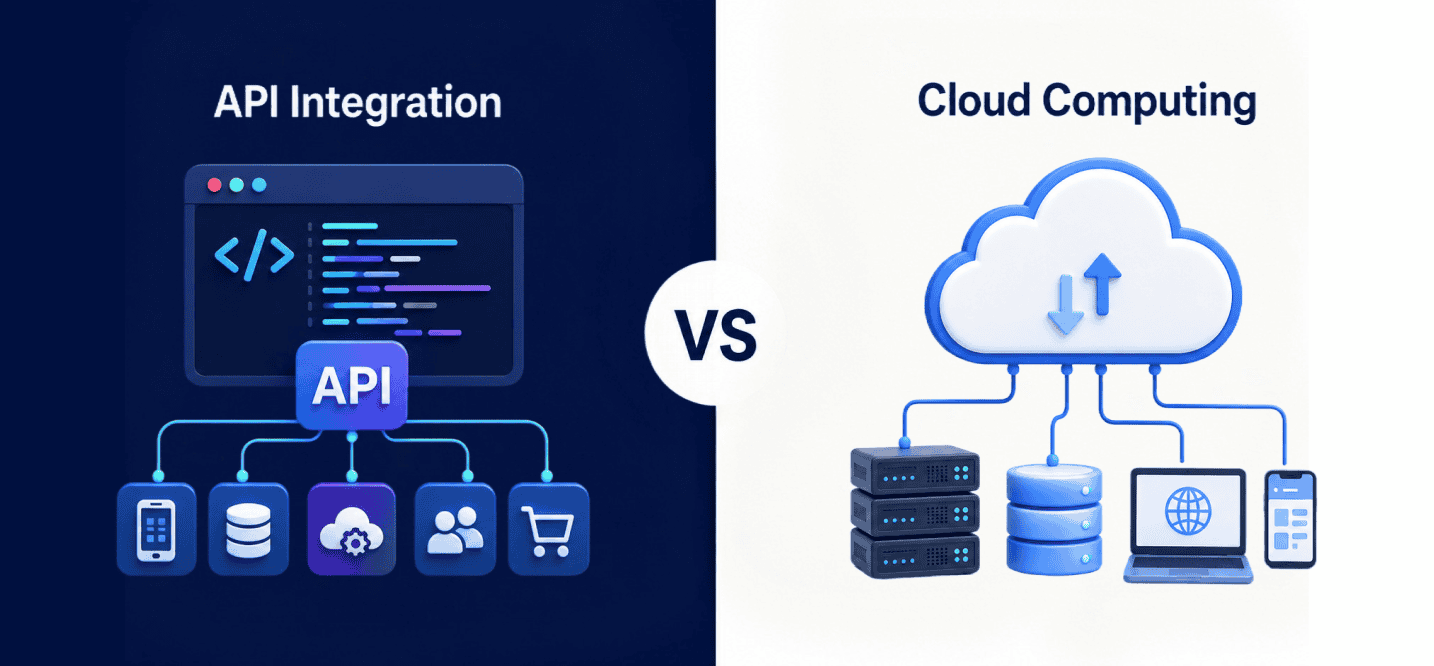
The mobile interface is only one layer of a modern application. Most products also depend on APIs, databases, authentication services, cloud infrastructure, and external platforms.
API integration
APIs allow a mobile application to communicate with backend systems.
Common API requirements include:
- User registration.
- Authentication.
- Authorization.
- Product catalogs.
- Payments.
- Order management.
- Messaging.
- Location services.
- Notifications.
- Reporting.
- Customer profiles.
A reliable API architecture should include:
- Secure authentication.
- API versioning.
- Input validation.
- Error handling.
- Rate limiting.
- Logging.
- Monitoring.
- Encryption.
- Offline synchronization where necessary.
For startups, a properly designed API makes it easier to add a website or admin dashboard later. For enterprises, API governance helps connect the mobile product with internal systems without creating unnecessary technical debt.
Cloud computing
Cloud computing provides the infrastructure required to store data, run backend services, support users, and scale the application.
A cloud-based architecture may include:
- Cloud-hosted APIs.
- Managed databases.
- File storage.
- Content delivery networks.
- Serverless functions.
- Containerized services.
- Identity management.
- Automated deployment.
- Monitoring and alerting.
- Backup and disaster recovery.
A startup may begin with managed cloud services and usage-based infrastructure. An enterprise may require multiple environments, private networking, single sign-on, regional hosting, audit trails, and formal disaster-recovery procedures.
Cross-platform development and cloud computing solve different problems:
- Cross-platform development supports shared mobile development.
- Cloud computing supports backend operations, storage, integrations, and scalability.
Together, they create the foundation for a modern mobile product.
Cross-Platform Development Cost in 2026
There is no universal price for cross-platform development. The budget depends on application features, API integration, security requirements, team composition, location, and long-term support.
Some 2026 cost analyses estimate that cross-platform development may be 30–40% less expensive than building two comparable native applications when the platforms have similar workflows. This estimate generally applies to duplicated mobile engineering work, not the entire technology budget.
Illustrative cost calculation
Suppose two native applications require:
- iOS development: $90,000.
- Android development: $90,000.
- Shared backend and QA: $50,000.
The estimated total would be:
$90,000+$90,000+$50,000=$230,000
If cross-platform development reduces duplicated mobile engineering work by 30%, the mobile engineering portion could be approximately:
$180,000×70%=$126,000
After adding shared backend and QA work:
$126,000+$50,000=$176,000
The illustrative difference would be approximately $54,000. This is a planning example, not a guaranteed saving.
2026 cross-platform cost ranges
| Application type | Illustrative 2026 budget |
| Basic startup MVP | $25,000–$60,000 |
| Standard consumer application | $80,000–$200,000 |
| Advanced consumer application | $150,000–$300,000 |
| Enterprise-grade application | $300,000–$700,000+ |
These ranges may include different combinations of design, development, backend work, API integration, QA, DevOps, project management, and deployment.
Maintenance planning
The first release is not the end of the budget. Mobile applications require ongoing support for:
- Operating-system updates.
- Security patches.
- Dependency updates.
- Bug fixes.
- Performance improvements.
- App-store compliance.
- Minor feature enhancements.
- Cloud and API changes.
Businesses may reserve approximately 15–20% of the initial development budget each year for maintenance and improvements.
For a $100,000 application:
- 15% annual maintenance reserve = $15,000.
- 20% annual maintenance reserve = $20,000.
This creates a potential maintenance budget of $15,000–$20,000 per year, excluding major new features and marketing.
Choosing the Right Development Approach
| Business requirement | Potentially suitable approach |
| Launch on iOS and Android quickly | Cross-platform development |
| Existing React and TypeScript team | React Native |
| Highly customized visual interface | Flutter |
| Advanced hardware requirements | Native development or native modules |
| Complex enterprise API integration | Cross-platform with strong backend architecture |
| Limited startup budget | Focused cross-platform MVP |
| Long-term enterprise maintenance | Cross-platform with governance and testing |
| Advanced 3D gaming or AR | Native or specialized technology |
Before choosing a framework, evaluate:
- Existing internal skills.
- Required integrations.
- Platform-specific features.
- Security requirements.
- Expected product lifespan.
- Hiring availability.
- Maintenance expectations.
- Future web or desktop plans.
Common Mistakes to Avoid
Here are some common mistakes that startups and enterprises can avoid from day one to set their product up for a smoother development journey and better results.
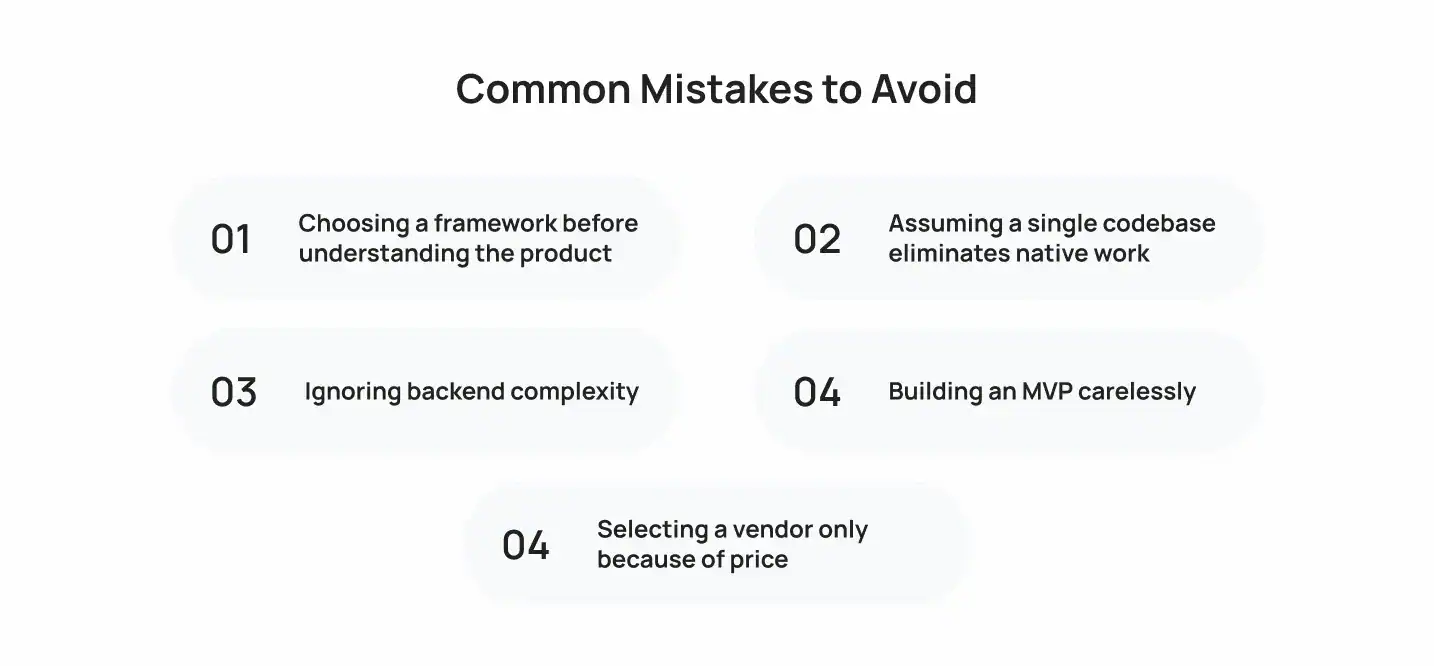
Choosing a framework before understanding the product
Begin with users, workflows, integrations, performance requirements, and business goals. Framework selection should come after product analysis.
Assuming a single codebase eliminates native work
Native modules may still be necessary for cameras, biometrics, Bluetooth, notifications, background services, and other device features.
Ignoring backend complexity
A mobile interface may appear simple while requiring a complex backend, payment system, admin dashboard, or data-processing layer.
Building an MVP carelessly
An MVP can be small without being poorly engineered. Avoid insecure storage, hardcoded business rules, undocumented APIs, and unmanaged dependencies.
Selecting a vendor only because of price
Evaluate technical leadership, testing standards, communication, documentation, source-code ownership, and post-launch support.
Conclusion
Cross-platform development can be a practical choice for both startups and enterprises, although each approaches it with different priorities. Startups often use it to launch an MVP, reach both iOS and Android users, and validate their product before expanding their teams. Enterprises may adopt it to modernize existing apps, create consistent user experiences, integrate business systems, and simplify ongoing maintenance.
The right approach depends on your product requirements, existing technical team, API architecture, cloud infrastructure, security needs, and long-term roadmap. Working with an experienced Custom Mobile App Development Company can help you choose the right framework, architecture, and development strategy. With careful planning, cross-platform application development can help businesses deliver products efficiently while maintaining flexibility, reliability, and scalability.
Want to discuss your project? Our experts are just a click away.
Contact UsFrequently Asked Questions
1. How do I choose a cross-platform development agency for an enterprise?
Choose an agency based on its experience with enterprise APIs, security, cloud infrastructure, testing, integrations, and post-launch support. Also evaluate technical expertise, communication, documentation, and project management.
2. What are the main advantages of using a shared codebase for cross-platform apps?
A shared codebase can reduce duplicated development work, simplify updates, and help teams maintain consistent features and user experiences across iOS and Android. It can also make testing and release coordination easier.
3. Which cross-platform frameworks are best for startups?
Flutter and React Native are strong options for startups. Flutter suits products requiring highly customized interfaces, while React Native can be a practical choice for startups with existing React, JavaScript, or TypeScript expertise.
4. Which cross-platform frameworks are best for enterprise app development?
Flutter and React Native can both support enterprise applications. Flutter may suit organizations seeking consistent interfaces and a controlled toolkit, while React Native can work well for enterprises with established React and JavaScript teams.
5. Is cross-platform development suitable for enterprise applications?
Yes, cross-platform development can be suitable for enterprise applications when the framework, architecture, security requirements, and integrations align with the project. It can help enterprises maintain consistent experiences, integrate business systems, and simplify mobile maintenance.