Key Takeaways
- Cross-platform app development allows businesses to build Android and iOS applications using a shared codebase, reducing development time and complexity.
- The cost of a cross-platform app depends on factors such as app complexity, features, UI/UX design, backend requirements, integrations, and security needs.
- Frameworks like Flutter, React Native, Kotlin Multiplatform, and .NET MAUI help businesses create modern multi-platform applications.
- A structured development process, from discovery and design to testing and maintenance, ensures a reliable app experience.
- Choosing an experienced cross-platform app development company helps businesses build high-quality applications with better performance, support, and long-term value.
Building separate Android and iOS applications increases development time, resources, and maintenance efforts. Cross-platform app development gives businesses a practical alternative by enabling them to create applications for multiple platforms using a shared codebase.
The growth of cross-platform technologies also reflects this increasing demand. According to Market Research Future, the Cross Platform App Development Framework Market was valued at approximately $14.03 billion in 2024. The market is projected to grow from $15.67 billion in 2025 to $47.61 billion by 2035, registering a CAGR of 11.75% between 2025 and 2035.
That shift is why cross-platform application development has become a popular choice for modern businesses. Instead of managing separate codebases, companies can build a single application that works across Android and iOS, reducing development efforts, simplifying maintenance, and speeding up launches.
Whether you are building a startup product, expanding an existing application, or upgrading enterprise services, cross-platform application development offers a practical way to reach more users with fewer technical challenges.
This guide covers the benefits, frameworks, costs, and key factors businesses should consider before investing in a cross-platform mobile solution.
What Is Cross-Platform App Development?
Cross-platform application development means building one application from a single codebase that runs on both Android and iOS. Rather than writing separate native code for each operating system, development teams write shared business logic and UI components once, then deploy them across platforms using tools that translate that code into native performance.
The technology behind this has matured considerably. Early cross-platform tools carried a reputation for sluggish performance and clunky interfaces. That reputation no longer holds. Modern frameworks compile closer to native code, tap directly into device-level APIs, and deliver interfaces that are difficult to distinguish from fully native apps.
A single-codebase mobile app typically shares:
- Core business logic
- Data models and API integrations
- Most UI components and navigation flows
What stays platform-specific are things like push notification handling, certain hardware integrations, and platform design guidelines, details a skilled team accounts for without duplicating the entire build.
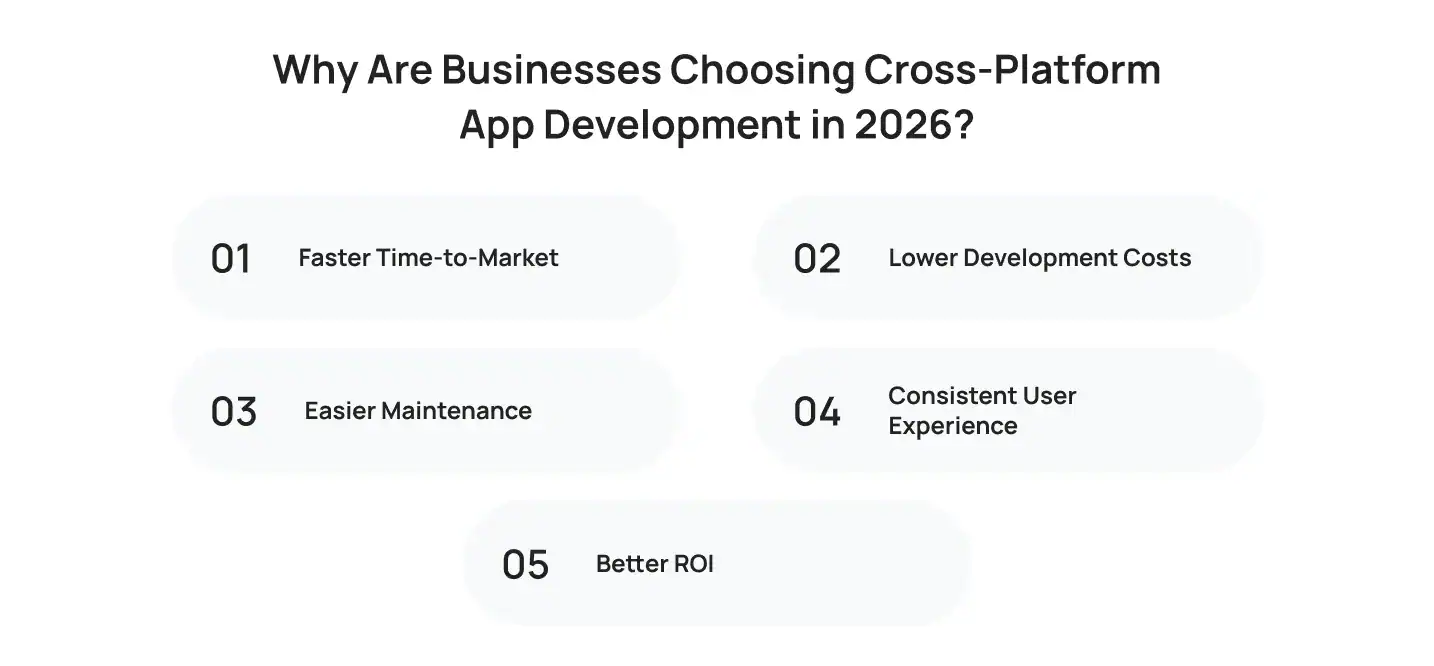
Why Are Businesses Choosing Cross-Platform App Development in 2026?
The shift toward cross-platform isn’t a trend; it’s a response to real business pressure. Budgets are tighter, launch windows are shorter, and customers expect a polished app on day one, not six months after a “coming soon” page.
Faster Time-to-Market
Building one app instead of two means Android and iOS versions can launch on the same day. That’s a real edge in competitive categories, where being first to market often means being first to collect user feedback and first to start iterating.
Lower Development Costs
One codebase means one team, not two working in parallel. With fewer developers, less duplicated QA work, and fewer hours spent keeping two products in sync, the savings add up fast, especially for startups working with limited runway.
Easier Maintenance
Bug fixes, feature updates, and security patches get written once and pushed to both platforms. Compare that to native development, where every fix has to be built, tested, and released twice.
Consistent User Experience
Branding, navigation patterns, and core functionality stay uniform across devices. Users switching between an Android tablet and an iPhone get the same experience, which builds trust and reduces support tickets tied to platform confusion.
Better ROI
When development and maintenance costs drop, the return on a mobile app investment climbs. That’s part of why the approach has become the default choice for most business apps rather than the exception. According to research, businesses using a shared-codebase approach can cut development effort by 30–40%, depending on project complexity,
Modern frameworks have significantly expanded what businesses can achieve with a shared codebase. As these technologies continue to evolve, the future of cross-platform app development will be shaped by advances in AI, cloud-native architectures, and increasingly seamless experiences across devices and operating systems.
How Much Does Cross-Platform App Development Cost?
The cost of developing a cross-platform application typically ranges from $25,000 to $150,000+, depending on the application’s complexity, features, and business requirements.

A simple application with basic functionality requires fewer development hours, while enterprise-level applications with advanced features such as real-time communication, AI capabilities, payment systems, and complex integrations require more planning and technical expertise.
Below is a general cost estimate:
| Application Type | Estimated Cost | Development Timeline | Examples |
| MVP Application | $25,000 – $60,000 | 3-5 Months | Startup apps, basic marketplaces, service apps |
| Medium Complexity App | $60,000 – $150,000 | 5-8 Months | E-commerce apps, healthcare platforms, business applications |
| Enterprise Application | $150,000+ | 8+ Months | Large-scale platforms, internal business systems, complex solutions |
These figures are general estimates. The final cost depends on the development team’s location, technology stack, feature requirements, design complexity, and long-term support needs.
MVP Cross-Platform App Development Cost
A Minimum Viable Product (MVP) focuses on launching the core version of an application with essential features needed to validate a business idea.
A cross-platform MVP usually includes:
- User registration and login
- Basic user profiles
- Simple navigation
- Push notifications
- Basic dashboard
- Payment integration (if required)
- Basic analytics
MVP development generally costs less because it focuses on validating the product before investing in advanced features. Startups often choose this approach to test market demand, collect user feedback, and improve their application based on real usage.
Medium Complexity App Development Cost
Medium-level applications require more customization, integrations, and advanced functionality.
Examples include:
- E-commerce applications
- Healthcare platforms
- Learning management systems
- Booking applications
- On-demand service platforms
These applications may require:
- Custom user interfaces
- Third-party API integrations
- Advanced search features
- Location-based services
- Multiple user roles
- Backend management systems
The additional functionality increases development time and requires more testing across Android and iOS devices.
Enterprise Cross-Platform Application Cost
Enterprise applications are designed for large organizations that require advanced workflows, security controls, and integration with existing business systems.
Enterprise-level applications may include:
- Complex user management
- AI-powered features
- Real-time data processing
- Enterprise APIs
- Cloud infrastructure
- Advanced security features
- Custom dashboards
Because these applications often support large numbers of users and business-critical operations, they require detailed planning, architecture design, testing, and continuous maintenance.
Cost Breakdown by Development Stage
Understanding where the budget goes helps businesses plan their investment more effectively.
| Development Stage | Cost Impact |
| Discovery & Planning | Low-Medium |
| UI/UX Design | Medium |
| App Development | Highest |
| Backend Development | Medium-High |
| Testing & Quality Assurance | Medium |
| Deployment & Maintenance | Ongoing |
Factors That Affect Cross-Platform App Development Cost
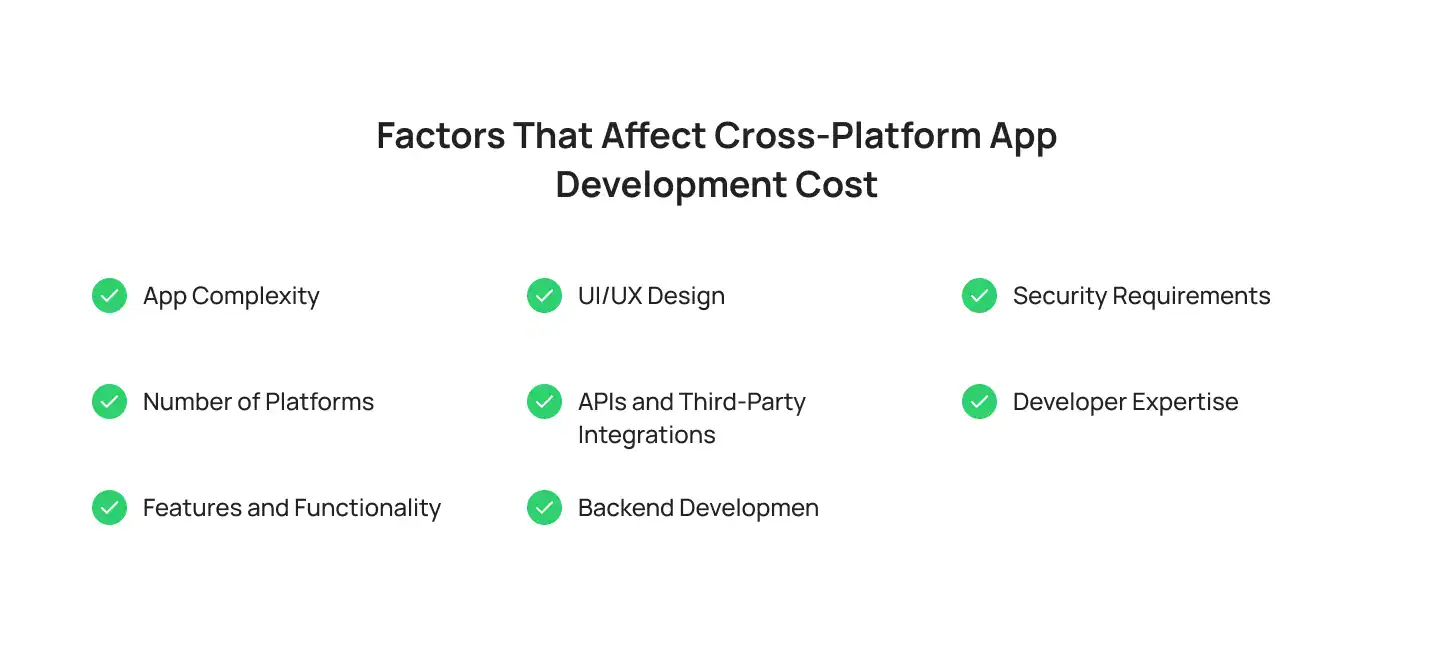
The cost of building a cross-platform app depends on several technical and business factors. While shared codebases can reduce development time compared to building separate native apps, the final investment varies based on app requirements, complexity, and the level of customization needed.
App Complexity
The complexity of an app plays a major role in determining development costs. A simple app with basic features requires less time and resources, while apps with advanced workflows, real-time features, AI capabilities, or complex integrations need more development effort.
Number of Platforms
Cross-platform development allows businesses to build apps for multiple platforms using a shared codebase. However, supporting both iOS and Android still requires testing, optimization, and platform-specific adjustments to ensure a smooth user experience.
Features and Functionality
The number and complexity of features directly impact the overall cost. Basic features like login, notifications, and data management require less effort compared to advanced features such as:
- Real-time chat
- Video streaming
- Payment integration
- Location tracking
- AI recommendations
- AR features
- IoT connectivity
Each additional feature requires extra design, development, and testing time.
UI/UX Design
A well-designed interface improves user engagement but requires careful planning. Custom animations, interactive elements, and unique user journeys often increase design and development time. Cross-platform apps also need a consistent experience across Android and iOS devices.
APIs and Third-Party Integrations
Integrating external services such as payment gateways, maps, analytics tools, and enterprise systems can affect development costs. The complexity of APIs, authentication, and data handling requirements determines the additional effort needed.
Backend Development
Apps that require user accounts, databases, real-time updates, or business logic need a strong backend foundation. Backend architecture, cloud services, databases, and API development all contribute to the overall development cost.
Security Requirements
Apps handling sensitive information need strong security measures, including encryption, secure authentication, and data protection. The level of security required depends on the app’s industry and the type of data it manages.
Developer Expertise
The experience of the development team also affects cost and quality. Skilled developers with expertise in frameworks like Flutter, React Native, and Kotlin Multiplatform can build efficient apps while avoiding common development challenges.
Want to discuss your project? Our experts are just a click away.
Contact UsCross-Platform App Development Tools and Technologies
Choosing the right technology stack depends on your business goals, app requirements, performance expectations, and future update plans. A combination of frontend frameworks, backend technologies, and development tools helps teams build efficient cross-platform applications with consistent experiences across devices.
-
Frontend Frameworks
| Framework | Description | Best Suited For |
| Flutter | Developed by Google, Flutter uses Dart to build mobile, web, and desktop applications from a single codebase. It offers customizable UI components and a fast development workflow. | Apps with custom designs, animations, startups, and businesses targeting multiple platforms |
| React Native | Created by Meta, React Native uses JavaScript and React to build cross-platform mobile apps while allowing access to native device features. | Business apps, social platforms, and applications requiring frequent updates |
| Kotlin Multiplatform | Allows developers to share business logic and core components while maintaining native UI experiences for each platform. | Apps requiring native performance and teams using Kotlin technologies |
| .NET MAUI | Microsoft’s cross-platform framework enables developers to build Android, iOS, macOS, and Windows applications using C#. | Enterprise apps and businesses already using Microsoft technologies. |
-
Backend Technologies
| Technology | Description | Common Use Cases |
| Node.js | A server-side technology with an event-driven architecture, suitable for building responsive and real-time applications. | Chat apps, marketplaces, collaboration tools, streaming platforms |
| Python | Python frameworks like Django and FastAPI support backend development with extensive libraries and flexible architecture. | AI applications, data-driven platforms, enterprise solutions |
| Firebase | A backend platform offering authentication, databases, analytics, push notifications, and hosting services. | MVPs, real-time apps, and mobile-first products |
| AWS | Amazon’s cloud platform provides hosting, storage, databases, deployment services, and cloud infrastructure. | Enterprise apps, cloud-based platforms, and large-scale applications |
| Azure | Microsoft’s cloud platform offers application hosting, databases, AI services, and developer tools. | Enterprise software and organizations using Microsoft ecosystems |
| Google Cloud | Provides computing, storage, analytics, machine learning, and deployment services for modern applications. | AI-powered apps, analytics platforms, and cloud-based solutions |
-
Development Tools
| Tool | Description | Purpose |
| Android Studio | Google’s official IDE for Android development with debugging, testing, and performance monitoring features. | Building and testing Android applications |
| Xcode | Apple’s development environment for creating, testing, and publishing iOS applications. | iOS app development and App Store deployment |
| Visual Studio Code | A flexible code editor supporting multiple programming languages and development frameworks. | Cross-platform coding and project management |
| GitHub | A platform for source code management, collaboration, and version control. | Managing code repositories and team collaboration |
| Docker | A containerization tool that packages applications and dependencies into consistent environments. | Simplifying development, testing, and deployment workflows |
| Postman | An API testing and management tool used to create and verify API functionality. | Testing APIs before integrating them into applications |
| CI/CD Tools | Automation tools that handle code testing, integration, and application delivery processes. | Faster releases, automated testing, and improved development workflows |
Cross-Platform App Development Process
A structured development process helps businesses transform an app idea into a reliable digital product. Each stage focuses on reducing risks, improving quality, and ensuring the final application aligns with user expectations and business objectives.
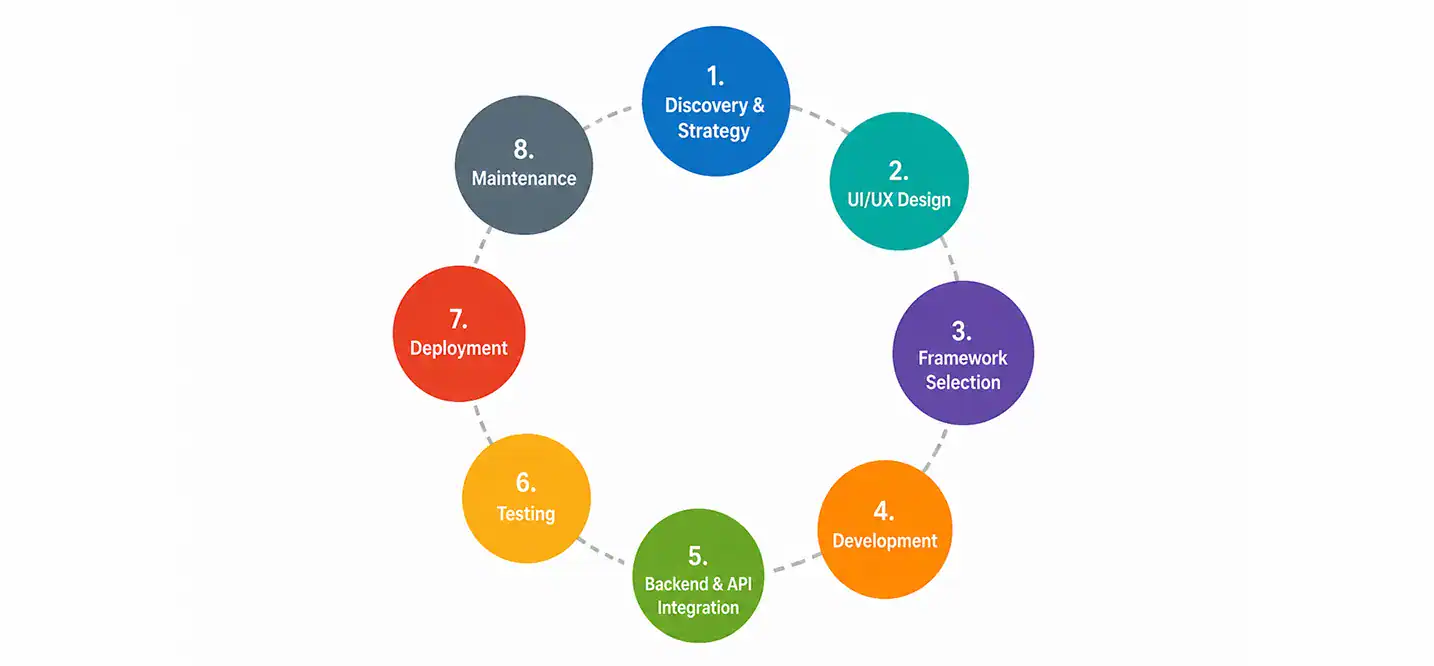
Discovery & Strategy
The first phase focuses on understanding the app concept, target users, business goals, competitors, required features, and technical requirements.
Teams define project scope, create a development roadmap, estimate resources, and identify the right technology approach.
Key activities include:
- Requirement gathering
- Market research
- User analysis
- Feature prioritization
- Technical planning
UI/UX Design
Design teams create wireframes, prototypes, and user interfaces that define how users interact with the application.
This stage focuses on creating intuitive navigation, consistent branding, and experiences that work smoothly across different devices.
Framework Selection
Choosing the right cross-platform framework depends on project requirements, performance expectations, budget, and future updates.
Teams evaluate options such as Flutter, React Native, Kotlin Multiplatform, and .NET MAUI before selecting the most suitable technology stack.
Development
During development, engineers build the frontend, backend, database structure, APIs, and required integrations.
Developers create reusable components, implement features, and ensure the application functions properly across supported platforms.
Backend & API Integration
The backend connects the application with databases, third-party services, authentication systems, payment platforms, and other required APIs.
This phase ensures smooth data exchange between the app and external systems.
Testing
Testing ensures the application works correctly across different devices, operating systems, and screen sizes.
Quality assurance teams perform:
- Functional testing
- Performance testing
- Security testing
- Compatibility testing
- User acceptance testing
Deployment
After testing and approval, the app is prepared for release on platforms such as the Apple App Store and Google Play Store.
The deployment process includes app configuration, store submission, compliance checks, and release monitoring.
Maintenance
App development does not end after launch. Regular maintenance includes bug fixes, security updates, performance improvements, feature enhancements, and compatibility updates for new operating system versions.
Native vs. Cross-Platform Development: Which One Is Right?
Neither approach is universally “better.” The right choice depends on the app’s purpose, budget, and performance requirements.
| Feature | Cross-Platform | Native |
| Codebase | Single | Separate for each OS |
| Development Cost | Lower | Higher |
| Time to Market | Faster | Longer |
| Maintenance | Easier | More complex |
| Performance | Strong | Best possible |
| UI Consistency | High | Highest |
| Ideal For | Most business apps | High-performance, hardware-heavy apps |
For the majority of business use cases, retail apps, service platforms, booking tools, and internal enterprise software, cross-platform development delivers performance that’s more than sufficient, at a fraction of the cost. Native development still earns its place for apps that push hardware to its limits, which gets covered further down.
When Should You Choose Cross-Platform Development?
Cross-platform development fits well across a wide range of industries, particularly where speed to market and consistent user experience matter more than squeezing out every last bit of device performance:
- Healthcare
- Retail
- Logistics
- SaaS
- FinTech
- Education
- Travel
- Marketplace apps
- Enterprise software
Most business applications in these categories don’t demand the extreme performance ceiling that native development offers, they need reliability, a clean interface, and the ability to ship updates quickly.
Choosing the Right Cross-Platform App Development Company

Selecting the right development partner can significantly impact the success of your application. Beyond technical skills, businesses need a team that understands their industry, user expectations, and long-term product goals.
As a trusted cross-platform app development company, Cubix helps businesses build feature-rich mobile applications using modern frameworks, including Flutter and React Native. With years of experience delivering Android and iOS solutions, we focus on creating applications that combine intuitive design, reliable functionality, and smooth performance across platforms.
When evaluating a cross-platform development partner, businesses should consider:
- Industry experience: Choose a team of 350+ skilled professionals that understands your business domain and has experience building similar applications.
- Proven portfolio: Review real-world projects, successful app launches, and measurable outcomes instead of only design concepts.
- Framework expertise: Ensure the team has hands-on experience with leading technologies such as Flutter, React Native, and other cross-platform frameworks.
- UI/UX capabilities: A great app requires more than development. The team should be able to create engaging interfaces and seamless user journeys.
- Quality assurance process: Strong testing practices across multiple devices and operating systems help deliver a consistent experience.
- Post-launch support: Mobile apps require continuous improvements, updates, and maintenance after release.
- Security practices: A reliable partner should follow strong security measures, especially for apps managing sensitive user information.
- Cloud and backend expertise: Experience with cloud platforms, APIs, and backend systems helps apps handle growing user demands efficiently.
We combine technical expertise, product strategy, and design capabilities to help businesses transform ideas into successful cross-platform applications. Instead of focusing only on development costs, businesses should consider the overall value a development partner brings through quality, support, and product expertise.
Cubix Cross-Platform App Development Case Studies

With 18+ years of experience as a mobile app development service provider, we have helped 600+ global clients transform their ideas into successful digital products. Our team builds custom mobile applications across industries, from healthcare and enterprise solutions to customer-focused mobile platforms. We help businesses create apps that address real-world challenges and support their digital goals.
Explore some of our successful mobile app development projects below
Afia Healthcare Mobile App
Cubix developed Afia, a healthcare mobile application that helps users easily connect with doctors and healthcare providers. The app enables patients to discover providers, schedule appointments, and access healthcare services through a seamless digital experience. Built using React Native, JavaScript, PHP, and MySQL, the solution supports a smooth cross-platform experience and has achieved 25,000+ monthly active users, 5,000+ medical providers onboarded, and a 4.8 app rating.
OOMCO Fuel Management App
Cubix developed OOMCO World, a fuel management application designed to simplify fuel services and improve customer engagement. The app enables users to locate fuel stations, manage services, and access loyalty features through a unified mobile platform. Built with React Native, JavaScript, Node.js, and MongoDB, the solution helped streamline fuel operations and create a more connected customer experience.
At Cubix, we help businesses transform ideas into powerful cross-platform mobile applications that deliver seamless experiences across Android and iOS. – Salman Lakhani, CEO of Cubix
Conclusion
Cross-platform app development has become the practical default for most businesses building mobile products in 2026, offering faster launches, lower costs, easier maintenance, and access to frameworks mature enough to compete with native performance for the vast majority of use cases.
If a mobile application for Android and iOS is on the roadmap, working with an experienced cross-platform development team can shorten timelines, reduce costs, and deliver a consistent experience across devices. The right technology partner will also recommend the framework that fits the project’s actual goals, instead of pushing a one-size-fits-all solution.
Frequently Asked Questions
1: What is cross-platform app development?
Cross-platform app development is the process of building a single application that runs on Android and iOS using one shared codebase instead of creating separate native apps for each platform. This approach helps businesses reduce development time while maintaining consistent user experiences.
2: Is cross-platform better than native development?
It depends on the project requirements. Cross-platform development is a strong choice for most business applications because it offers faster development and easier maintenance. Native development may be preferred for apps requiring advanced hardware access, intensive graphics, or maximum platform-specific performance.
3: Which framework is best for cross-platform app development in 2026?
Flutter and React Native remain popular choices for building cross-platform applications. Kotlin Multiplatform and .NET MAUI are also gaining adoption for projects requiring specific native capabilities or enterprise integrations.
4: How much does cross-platform app development cost?
The cost depends on factors such as app complexity, features, design requirements, backend infrastructure, and integrations. In many cases, cross-platform development can reduce costs compared to building separate Android and iOS applications.
5: Can cross-platform apps perform as well as native apps?
Yes, modern cross-platform frameworks can deliver strong performance for most business applications. Technologies like Flutter and React Native provide access to device APIs and optimized rendering capabilities, reducing the performance gap compared to native apps.