
Key Takeaways
- Align apps with a clear enterprise mobility strategy
- Leverage cloud computing and robust API integration for scalability
- Integrate tightly with ERP and CRM systems where it creates the most value
- Use Mobile Device Management (MDM) to secure devices and data
- Choose appropriate stacks (native, cross‑platform, or hybrid) based on long‑term needs
- Treat enterprise application development as an ongoing lifecycle with strong governance
- Consider partnering with experienced custom software development firms when internal capacity is not enough
Enterprise Mobile App Development is now a core part of how large US companies modernize operations, connect teams, and serve customers in real time. The global mobile app development market alone is projected to grow from 338.65 billion USD in 2026 to 844.5 billion USD by 2034, at a CAGR of 12.1%, which means enterprises that delay mobile initiatives risk giving that value to faster competitors. At the same time, realistic budgets for enterprise‑grade mobile apps in 2026 often sit anywhere from 150,000 USD to 500,000+ USD depending on complexity, integrations, and security.
Many organizations look for top enterprise mobile app development services in the USA. That can handle UX, deployment, strategy, and long-term support rather than just building another standalone app.
This guide walks through what you need to know: strategy, architecture, integrations, security, and how to choose the right partner.
Want to discuss your project? Our experts are just a click away.
Contact UsWhat Is Enterprise Mobile App Development?
Enterprise mobile app development is the process of designing, building, and maintaining mobile applications tailored specifically for large organizations. These apps go beyond simple customer‑facing tools; they often handle internal workflows, approvals, data collection, analytics, and integration with complex back‑office systems.
Unlike consumer apps, enterprise application development must account for:
- Multiple user roles and departments
- Complex business rules and compliance requirements
- Integration with existing Enterprise Resource Planning (ERP) and Customer Relationship Management (CRM) systems
- Tighter security, governance, and audit trails
In other words, enterprise mobile app development is a specialized branch of custom software development focused on supporting critical business operations securely on smartphones and tablets.
Why Enterprise Mobility Matters for Large US Companies
Enterprise mobility is the strategy of enabling employees, partners, and sometimes customers to access business processes and data from mobile devices, anytime and anywhere. For large US enterprises, this is no longer optional.
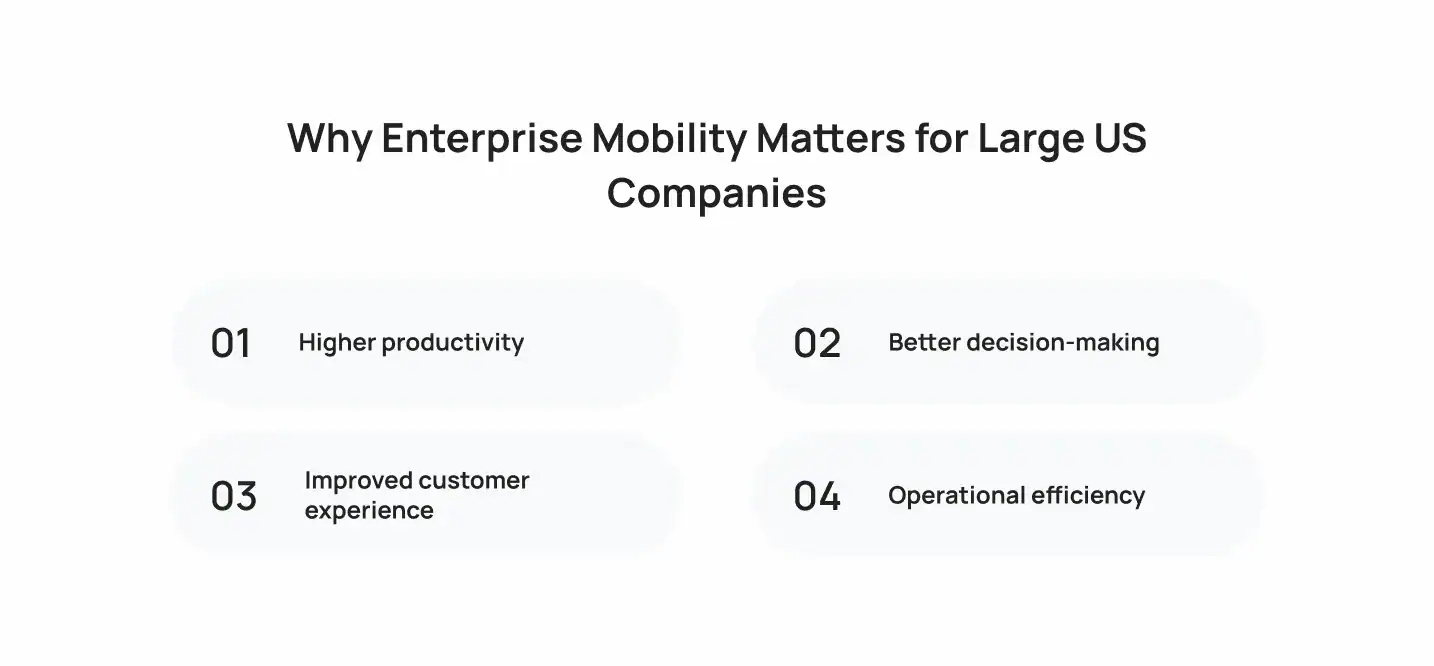
Key benefits of a strong enterprise mobility strategy include:
- Higher productivity: Field teams, sales reps, and managers can execute tasks, approvals, and data entry on the go.
- Better decision‑making: Real‑time dashboards and reports in mobile apps
- help leaders respond faster to changing conditions.
- Improved customer experience: Customer‑facing apps integrated with CRM and ERP systems ensure consistent information across channels.
- Operational efficiency: Automating manual workflows reduces errors and speeds up execution.
Effective enterprise mobility often starts with one flagship app but quickly evolves into a portfolio of interconnected mobile solutions, all supported by a robust enterprise application development approach.
Core Building Blocks of Enterprise Application Development
To build enterprise‑grade mobile apps, you need more than a few screens and APIs. You need a coherent architecture that aligns with your broader custom software development roadmap.
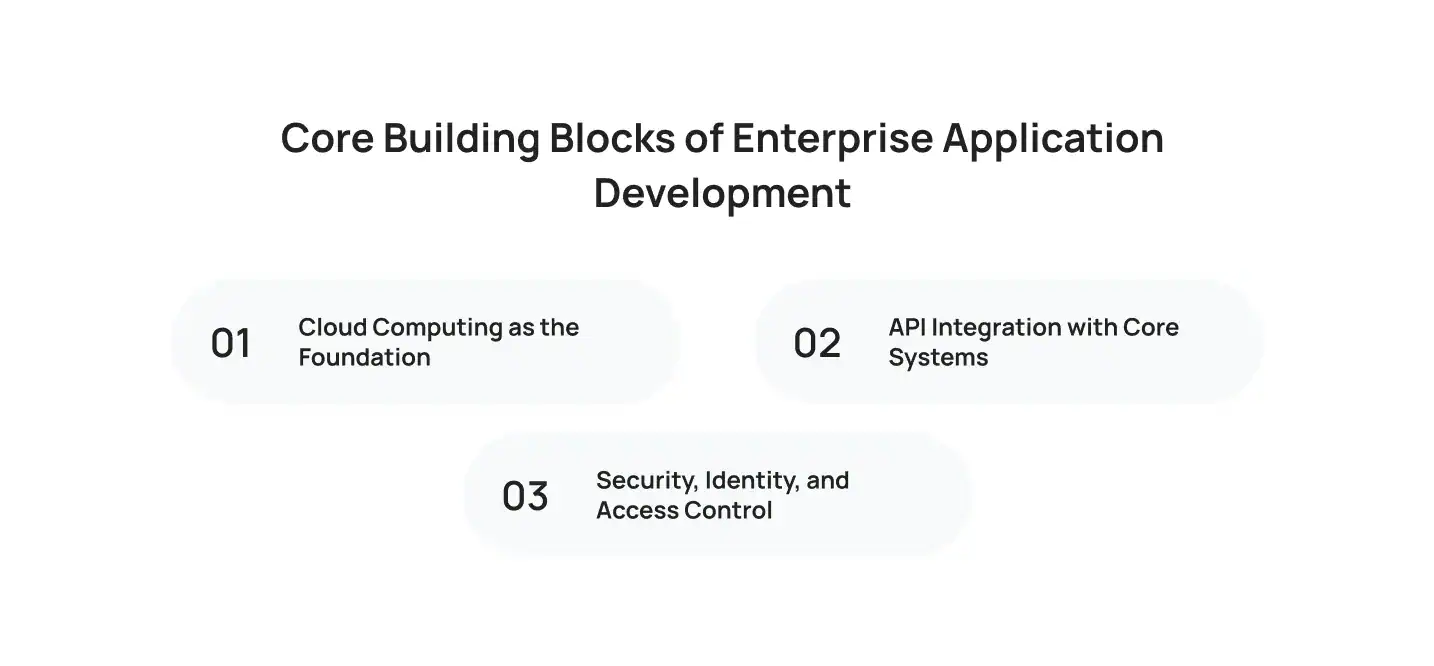
1. Cloud Computing as the Foundation
Modern enterprise mobile app development almost always uses cloud computing to host back-end services, databases, and integration layers. By leveraging enterprise app development services, businesses can build cloud-based mobile solutions that are scalable, secure, and easier to manage. Cloud platforms like AWS, Azure, Google Cloud, or private clouds offer:
- Elastic scaling to handle spikes in mobile usage
- Managed databases and messaging systems
- Built‑in security and compliance tools
- CI/CD pipelines to support rapid release cycles
For large US enterprises, cloud‑first strategies reduce infrastructure overhead and support multi‑region deployments, which is critical for distributed workforces.
2. API Integration with Core Systems
Enterprise apps are only as powerful as the systems they connect to. That is why API integration is one of the most important aspects of enterprise application development.
Typical integration targets include:
- ERP systems: SAP, Oracle, Microsoft Dynamics, and other ERP platforms for financials, supply chain, HR, and manufacturing
- CRM systems: Salesforce, HubSpot, Microsoft Dynamics CRM, or custom CRMs for sales and customer service
- Line‑of‑business systems: Legacy applications, databases, or industry‑specific solutions
Your mobile app should be designed as a front‑end layer that communicates via secure APIs with these systems. That decoupling allows you to evolve the app UI without constantly rewriting core business logic.
3. Security, Identity, and Access Control
Enterprise mobile app development must embed security from day one. That includes:
- Integration with corporate identity providers (SSO, SAML, OAuth)
- Role‑based access control (RBAC) for different user types
- Encryption in transit and at rest
- Audit logs and monitoring for suspicious activity
Large US companies must also ensure compliance with sector‑specific regulations (HIPAA, PCI‑DSS, SOX, etc.). A proper security architecture protects both data and reputation.
Managing Devices and Data: The Role of MDM

Even the best app can become a liability if the devices it runs on are not managed properly. That is where Mobile Device Management (MDM) comes in.
MDM allows IT teams to:
- Enroll and manage corporate and BYOD devices
- Enforce security policies (PINs, encryption, remote wipe)
- Control which apps can be installed and how they access data
- Push updates and configurations centrally
For enterprise mobile app development, you should design apps that:
- Respect MDM policies and configuration profiles
- Support secure containers or work profiles
- Separate corporate data from personal data when needed
MDM and enterprise mobility management (EMM) platforms are key to balancing user convenience with corporate security.
Integrating ERP and CRM into Mobile Workflows
Large organizations often run their business on Enterprise Resource Planning (ERP) and Customer Relationship Management (CRM) systems. Enterprise mobile app development turns those systems from back‑office engines into real‑time tools.
Mobile‑Enabled ERP
Mobile ERP features may include:
- Inventory checks and stock movements
- Work order management and production tracking
- Field service scheduling and updates
- Expense reporting and approvals
By exposing carefully selected ERP functions through mobile apps, enterprises reduce bottlenecks and eliminate paper‑based processes.
Mobile‑Enabled CRM
For CRM, mobile apps empower:
- Sales teams with real‑time account and opportunity data
- Customer service staff with customer histories
- Marketers with campaign performance at their fingertips
The best enterprise mobile apps do not replicate entire ERP or CRM interfaces. Instead, they focus on high‑value workflows, re‑designed for small screens and on‑the‑go usage.
Choosing the Right Approach: Native, Cross‑Platform, or Hybrid

One of the biggest strategic decisions in enterprise mobile app development is the technology stack.
Common options include:
- Native apps (Swift/Objective‑C for iOS, Kotlin/Java for Android): Best for performance‑sensitive or platform‑specific features.
- Cross‑platform frameworks (e.g., Flutter, React Native, .NET MAUI): Good for shared codebases across iOS and Android, reducing development time and cost.
- Hybrid/web‑based approaches (PWA, wrapped web apps): Useful when you need rapid deployment and simpler requirements.
For large enterprises, cross‑platform solutions are attractive because:
- They align with custom software development roadmaps that emphasize speed and maintainability.
- They simplify maintenance and feature rollout across platforms.
- They integrate well with existing cloud computing and API‑driven back ends.
Startups evaluating their technology and development options can also explore Cubix’s guide to the best mobile app development company for startups before choosing a development partner.
However, enterprises should evaluate performance, security, integrations, and ongoing support requirements carefully before selecting a technology stack.
Governance, Compliance, and Lifecycle Management
Enterprise mobile app development is not a one‑time project; it is an ongoing lifecycle. Large companies in the USA need a governance model that covers:
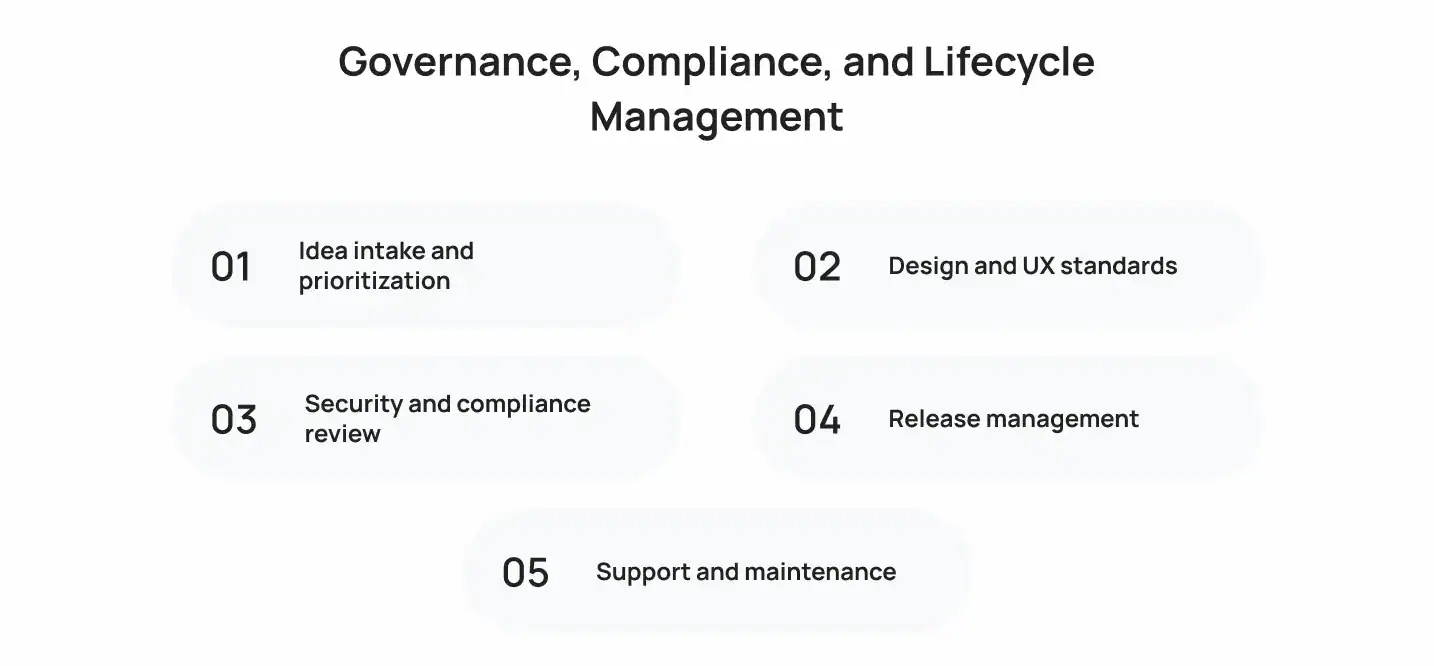
- Idea intake and prioritization: Avoiding “app sprawl” by aligning initiatives with business strategy.
- Design and UX standards: Ensuring consistent branding and usability across apps.
- Security and compliance review: Formal checks before deployment to production.
- Release management: Coordinated rollouts, versioning, and communication to users.
- Support and maintenance: Bug fixes, OS updates, and feature enhancements over time.
This lifecycle is where many organizations benefit from partnering with a seasoned enterprise application development provider that understands both technology and enterprise governance. Startups evaluating potential development partners can also explore Which Custom App Development Company Is Best for Startups? to understand the factors that matter when selecting a custom development partner.
When to Partner with a Custom Software Development Company
Building and scaling an internal team for every technology need is not always practical. Partnering with an experienced Custom Software Development Company such as Cubix can give enterprises access to the expertise needed to plan, build, and maintain complex mobile solutions.
A partner like Cubix can offer:
- Cross-functional expertise across strategy, UX, engineering, QA, and DevOps.
- Established practices for API integration, testing, security, and enterprise application development.
- Experience designing solutions around common enterprise needs, including field service, approvals, dashboards, and business workflows.
- A coordinated development team that can help reduce the time required to recruit and build an internal team from scratch.
- Support across the product lifecycle, from planning and design to development, deployment, and ongoing improvements.
The key is finding a partner that understands enterprise mobility rather than focusing only on consumer apps. Cubix, a Mobile App Development Company, can help businesses align mobile solutions with their existing systems, security requirements, compliance needs, and governance frameworks.
Conclusion
Enterprise Mobile App Development helps large US companies modernize operations, connect employees, and deliver better customer experiences. Successful enterprise application development requires more than an attractive interface. It must combine secure API integration, cloud computing, mobile security, ERP and CRM connectivity, and a clear enterprise mobility strategy. Businesses should define measurable goals, involve users early, and plan for ongoing maintenance. Choosing the right custom software development company can reduce risk, strengthen technical execution, and support long-term scalability. With the right architecture and governance, enterprise mobile app development becomes a strategic advantage, not simply another digital tool for modern organizations and their customers alike.
Want to discuss your project? Our experts are just a click away.
Contact UsFrequently Asked Questions
1. How can a mobile app connect with legacy enterprise systems?
Through secure APIs, middleware, or integration platforms. This allows the app to communicate with ERP, CRM, finance, and supply-chain systems without replacing the entire legacy infrastructure.
2. How much does enterprise mobile app development cost in the USA?
Enterprise mobile app development in the USA can cost roughly $150,000 to $500,000+, depending on app complexity, integrations, security requirements, platforms, and development scope. Projects involving ERP, CRM, cloud infrastructure, or advanced security may require a larger budget.
4. Should an enterprise build one app or several smaller apps?
It depends on the users and workflows. A single modular app offers consistency, while smaller apps can provide more focused experiences. A shared platform with reusable security, identity, and API services is often a practical middle ground.
5. Should enterprises choose native or cross-platform mobile app development?
It depends on the application’s requirements. Native development can be better for highly platform-specific features and demanding performance needs, while cross-platform development can reduce duplicated development work across iOS and Android. Enterprises should evaluate integrations, security, performance, team expertise, and maintenance before deciding.