
Key Takeaways
- Developing an enterprise website can cost $30,000– $1 million+, depending on factors like functionality, level of complexity, third-party integrations, required level of security, and technical requirements.
- Key areas like architectural design, enterprise-level security, and integrations are generally the largest drivers of investment in an enterprise project.
- Customization ensures that a solution supports a company’s existing workflows, meets customers’ needs, and facilitates the organization’s overarching objectives.
- AI and automation functionalities are valuable for streamlining and streamlining workflows however, implementation will require proper data management and expert development.
- The right development partner helps companies minimize costs and prevent complications.
When thinking of website development in 2026, it may come as a surprise how much easier creating a website seems. Thanks to some awesome website tools, templates, and even an array of website builder tools, it’s much easier to create a fundamental web page. The development of an enterprise platform that can handle many different workflows, multiple user interactions, and numerous integration abilities is something entirely different from choosing one from a template menu.
A modern enterprise website is far more than a digital storefront. It serves as the backbone of customer engagement, business operations, employee collaboration, and long-term growth. Whether you’re building a customer portal, an internal business platform, or investing in Custom Web Development Services, understanding the factors that influence development costs is essential for making informed decisions.
The demand for enterprise web platforms continues to grow. According to Gartner forecasts worldwide IT spending is expected to exceed $6 trillion in 2026, highlighting the continued focus on enterprise technology and digital transformation.
Enterprise websites are built to support your business goals. They often include custom architecture, system integrations, enterprise-grade security, and cloud infrastructure. These platforms must also support growing user bases, increasing data volumes, and evolving business needs. Because every organization has different goals and technical requirements, development costs can vary widely.
In this guide, we’ll break down the key factors that influence the Enterprise Web Development budget in 2026, so you can plan your budget with confidence and invest in a solution that supports your business for years to come.
Why Enterprise Web Development Costs More Than Standard Websites

Many businesses underestimate enterprise development because they compare it with traditional business websites. In reality, an enterprise platform is an entirely different category of software.
A standard website primarily presents information. An enterprise website becomes part of the company’s daily operations. It manages users, automates workflows, processes transactions, integrates with existing business systems, and often handles sensitive customer and organizational data.
For example, an enterprise platform may include:
- Employee and customer portals
- CRM and ERP integrations
- Multi-location dashboards
- Role-based user permissions
- Real-time analytics
- AI-powered automation
- Secure payment processing
- API integrations with third-party software
- Cloud infrastructure
- Advanced reporting systems
Each additional capability increases development complexity, testing requirements, infrastructure planning, and ongoing maintenance.
That’s why enterprise projects focus less on building webpages and more on creating reliable enterprise software solutions that support business operations for years.
Enterprise Web Development Cost in 2026: Average Pricing
Although every project is unique, businesses often ask one question first:
How much does enterprise web development cost?
The answer depends on project scope, technical complexity, required integrations, compliance standards, and long-term scalability. Below are typical pricing ranges seen across the U.S. market in 2026.
| Project Type | Estimated Cost (USD) | Typical Timeline |
| Enterprise Corporate Website | $30,000–$80,000 | 2–4 months |
| Customer Self-Service Portal | $60,000–$180,000 | 4–8 months |
| Enterprise eCommerce Platform | $100,000–$350,000+ | 6–10 months |
| Enterprise SaaS Platform | $150,000–$500,000+ | 8–14 months |
| Large Enterprise Web Application | $250,000–$1M+ | 10–18 months |
Note: These estimates vary based on business requirements, technology stack, security needs, integrations, and the development partner’s experience.
Rather than focusing solely on upfront development costs, many organizations evaluate the total cost of ownership, including cloud infrastructure, maintenance, security updates, feature enhancements, and performance optimization over the platform’s lifecycle.
What Does Enterprise Web Development Cost Actually Include?
When businesses receive project estimates, they often assume they’re paying only for coding. In reality, development is just one part of a much broader process.
A typical enterprise website development project includes multiple specialized disciplines working together.
| Cost Component | Purpose |
| Discovery & Business Analysis | Defines business goals, user journeys, and technical requirements. |
| UI/UX Design | Creates intuitive user experiences, wireframes, and interactive prototypes. |
| Solution Architecture | Plans the overall enterprise application architecture and infrastructure. |
| Frontend Development | Builds responsive, accessible user interfaces across devices. |
| Backend Development | Develops APIs, business logic, databases, and integrations. |
| Security Implementation | Adds authentication, authorization, encryption, and compliance controls for enterprise-grade security. |
| Quality Assurance | Performs functional, usability, security, and performance testing. |
| Deployment & DevOps | Configures cloud hosting, CI/CD pipelines, and production environments. |
| Maintenance & Support | Provides updates, monitoring, bug fixes, and continuous improvements. |
Each phase contributes to the success of the final product. Skipping discovery or reducing testing might lower initial costs, but it often leads to higher expenses later through redesigns, security issues, or operational inefficiencies.
Enterprise Websites Have Become Business-Critical Platforms

Enterprise websites are no longer standalone marketing assets. They now function as connected digital ecosystems that support sales, customer service, operations, and internal collaboration.
Organizations are investing in enterprise web solutions to replace fragmented legacy systems with centralized platforms that improve efficiency and deliver better user experiences.
Some of the biggest technology trends influencing enterprise web investments in 2026 include:
- AI-powered business automation
- Self-service customer and employee portals
- Cloud-native infrastructure
- Advanced analytics and business intelligence
- Omnichannel customer experiences
- Zero Trust security models
- API-first development
- Real-time collaboration tools
These capabilities require thoughtful planning and enterprise software solutions that can evolve alongside changing business needs.
As a result, companies are increasingly prioritizing scalable web applications that support growth without requiring complete system rebuilds every few years.
Expert Insight
One of the most common mistakes businesses make is viewing enterprise web development as a one-time project instead of a long-term business investment.
Successful enterprise platforms evolve continuously through performance improvements, feature releases, security enhancements, and infrastructure optimization. Planning for these ongoing needs from the outset helps reduce technical debt, improve reliability, and maximize your return on investment.
What Influences Enterprise Web Development Cost in 2026?
The cost of building an enterprise website goes far beyond the number of pages or visual design. Every project has unique business objectives, technical requirements, and operational challenges that directly impact the budget. For example, a customer self-service portal with secure logins and CRM integration requires significantly more planning and development than a corporate website with informational pages.
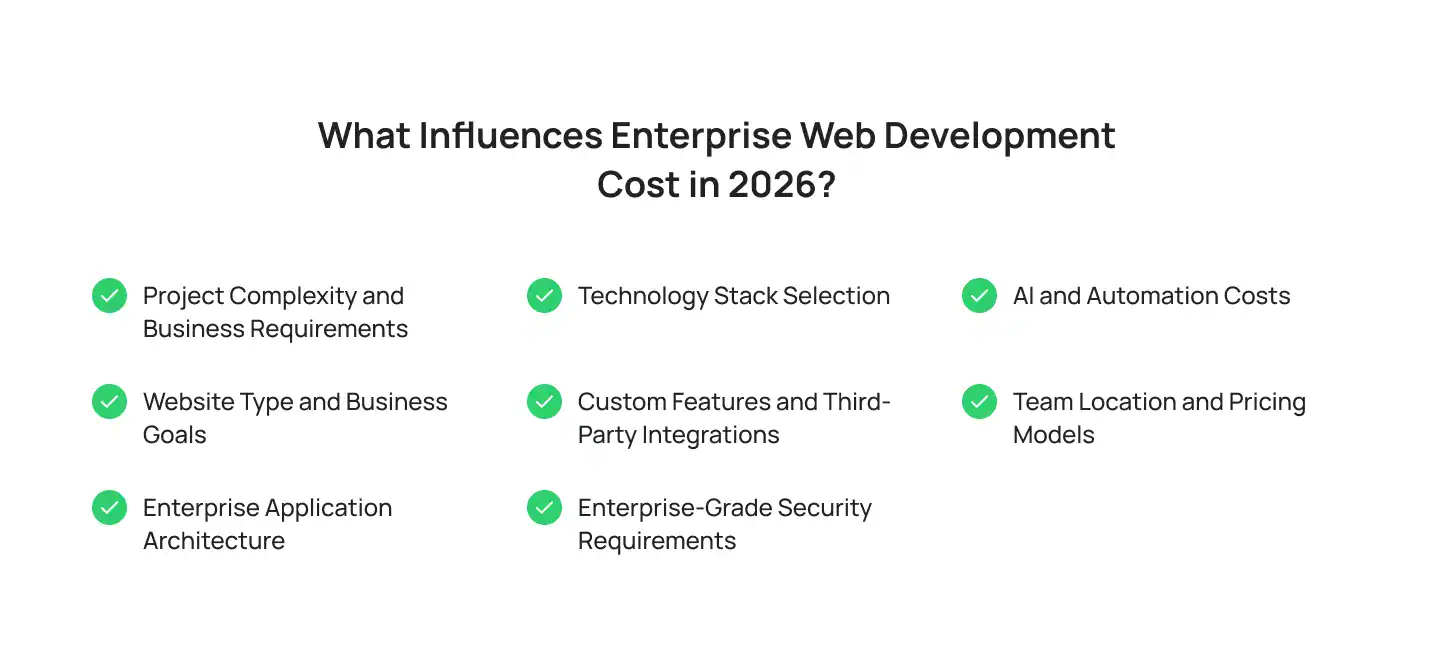
Enterprise platforms are expected to support thousands of users, integrate with multiple business systems, protect sensitive data, and remain reliable as the business grows. Meeting these expectations requires careful planning, experienced developers, and the right technology stack, all of which contribute to the overall Enterprise Website Development Cost.
While project budgets vary, most pricing is influenced by a combination of technical complexity, security requirements, scalability goals, and the overall enterprise development process. Understanding these factors helps businesses set realistic expectations, prioritize essential features, and make informed investment decisions.
Below are the most important factors that influence enterprise web development pricing in 2026.
1: Project Complexity and Business Requirements
Project complexity directly affects the time, expertise, and resources required to build an enterprise solution. A basic corporate website requires fewer efforts compared to a business web portal with dashboards, role-based access, integrations, and advanced workflows.
Factors that increase complexity include:
- Multiple user roles and permissions
- Interactive dashboards and analytics
- AI-powered features
- Multi-language support
- Large databases
- Real-time collaboration tools
As project requirements grow, development, testing, and quality assurance efforts also increase, impacting the overall investment.
2: Website Type and Business Goals
The type of website you build has a significant impact on the overall development budget. A corporate website with informational pages typically requires fewer resources compared to an enterprise platform, customer portal, or enterprise eCommerce solution with advanced features and integrations.
Your business objectives also determine the project’s scope and technical requirements. A website created for brand visibility may need basic functionality, while a platform designed to automate workflows, manage customer interactions, or support internal operations requires more complex development. The more functionality and business processes your website needs to support, the more time, expertise, and resources are required.
3: Enterprise Application Architecture
A well-planned enterprise application architecture lays the foundation for a secure, scalable, and reliable web platform. The complexity of the architecture directly affects development costs, as larger systems require more planning, engineering, and testing.
For example, a single-application website is less expensive to build than a platform powered by microservices, cloud infrastructure, APIs, and multiple databases. Investing in the right architecture from the start helps improve performance, simplify future updates, and support business growth without requiring major redevelopment.
4: Technology Stack Selection
The technologies used to build your website play an important role in determining project complexity and development requirements. The choice of programming languages, frameworks, databases, and cloud platforms affects performance, security, maintenance, and future updates.
For example, modern frameworks like React, Angular, Flutter, or Next.js may be used for creating responsive user interfaces, while backend technologies such as Node.js, Python, or .NET support complex business logic and integrations.
Selecting the right technology stack helps create a reliable platform that aligns with your business goals and technical requirements.
5: Custom Features and Third-Party Integrations
Custom functionality and system integrations can significantly impact the scope of an enterprise project. Features such as personalized dashboards, automated workflows, payment systems, CRM integration, ERP connections, and third-party APIs require additional development and testing.
For businesses building marketplace platforms or comparison-based solutions, custom development becomes even more important. A price comparison website requires features such as product data collection, advanced search filters, pricing updates, vendor integrations, and comparison tools to deliver a seamless user experience. These platforms require careful planning of data architecture, APIs, and automation workflows to handle large volumes of information efficiently.
6: Enterprise-Grade Security Requirements
Security plays a major role in enterprise projects, especially when handling sensitive business and customer data. Features such as encryption, secure authentication, access controls, compliance requirements, and security testing can increase development efforts and costs.
A strong security approach helps protect the platform from threats while building trust among users and stakeholders.
7: AI and Automation Costs
AI and automation features can improve efficiency by streamlining workflows and enhancing user experiences. However, adding capabilities such as AI chatbots, predictive analytics, recommendation systems, or automated processes requires additional development and testing.
The complexity of AI implementation, data requirements, and integration needs directly influence the overall project investment.
8: Team Location and Pricing Models
The development team’s location, expertise, and engagement model also affect project costs. Local teams, offshore developers, and hybrid models often have different pricing structures based on experience, communication needs, and project complexity.
Choosing a development partner should involve evaluating technical skills, industry experience, and quality of delivery, not just hourly rates.
Typical Enterprise Website Development Cost by Project Type
The investment required for an enterprise website depends on the platform’s purpose, complexity, and required features. A corporate website with basic functionality requires fewer resources than a complete enterprise web application with automation, integrations, and advanced user management.
| Project Type | Estimated Cost Range | Common Features |
| Corporate Enterprise Website | $30,000–$80,000 | Custom design, CMS, responsive pages, SEO features |
| Business Web Portal | $60,000–$180,000 | User accounts, dashboards, document management, integrations |
| Enterprise eCommerce Platform | $100,000–$350,000+ | Product management, payments, inventory, analytics |
| SaaS Enterprise Platform | $150,000–$500,000+ | Subscription management, automation, APIs |
| Large Enterprise Web Application | $250,000–$1M+ | Complex workflows, AI features, advanced security |
These figures are general estimates and may vary depending on the technology stack, development approach, integrations, security requirements, and ongoing support needs.
How Businesses Can Optimize Enterprise Web Development Investment
Building an enterprise platform requires careful planning to ensure every feature contributes value. Businesses can manage costs by focusing on strategic decisions throughout the development journey.
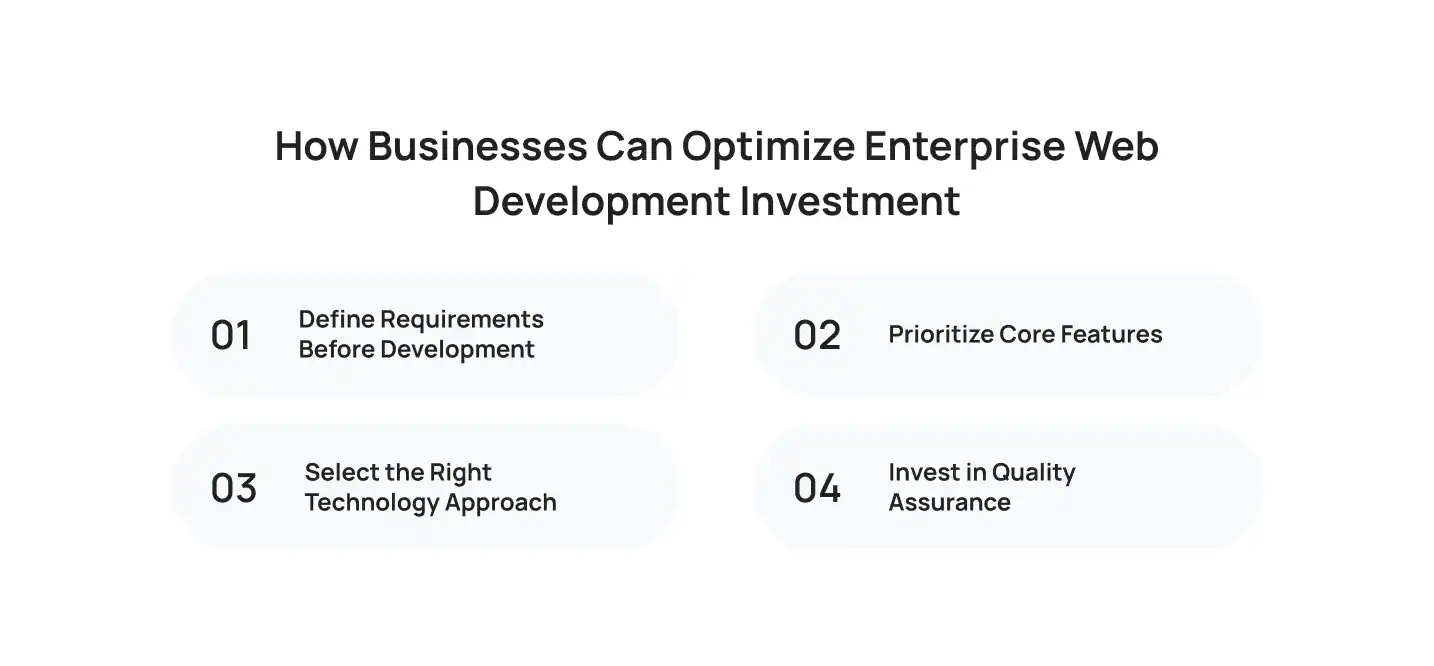
1: Define Requirements Before Development
A detailed planning phase helps identify business goals, required features, technical requirements, and potential challenges. Clear requirements reduce unnecessary changes and improve development efficiency.
2: Prioritize Core Features
Launching with essential features allows businesses to validate their solution before expanding functionality. Additional capabilities can be introduced through future updates based on user feedback and business needs.
3: Select the Right Technology Approach
Choosing suitable frameworks, databases, and infrastructure helps improve development efficiency and reduces future maintenance challenges. The right technical foundation supports better performance and easier updates.
4: Invest in Quality Assurance
Comprehensive testing helps identify performance issues, security risks, and usability problems before launch. This reduces unexpected expenses and improves the reliability of the final platform.
Why Businesses Choose Custom Enterprise Web Development Services
Every organization has unique processes, customer needs, and operational challenges. A generic solution may not provide the flexibility required to support complex business requirements.

With Web Development Services, businesses can create platforms designed around their specific workflows, users, and goals. Custom solutions allow organizations to:
- Automate manual processes
- Improve customer experiences
- Integrate existing business systems
- Build personalized user journeys
- Manage data more efficiently
- Add new features as requirements change
For companies developing customer portals, marketplaces, internal systems, or workflow-based platforms, custom development provides the flexibility needed to create a solution aligned with their business objectives.
Designing Better Enterprise Experiences Through Professional UI/UX

A successful enterprise platform is not only about powerful features and complex technology. The way users interact with the system also plays an important role in adoption and efficiency. A well-designed interface helps employees, customers, and stakeholders complete tasks faster with less confusion.
Professional Web Design Services help businesses create intuitive layouts, smooth navigation, and user experiences that align with real business workflows. From customer dashboards to internal management systems, thoughtful UI/UX design ensures that even complex platforms remain easy to use.
For enterprise solutions, good design can improve user engagement, reduce training time, and create a more effective digital experience.
Why Working with Cubix Is Beneficial for Enterprise Web Development
Choosing the right enterprise web development partner can have a significant impact on your project’s success. Beyond technical expertise, businesses need a team that understands enterprise architecture, modern technologies, security requirements, and long-term scalability. With more than 18 years of experience, Cubix helps organizations build custom enterprise platforms that align with their operational goals. From planning and UI/UX design to development and post-launch support, the focus remains on delivering solutions that create long-term business value.
Working with Cubix benefits businesses through:
- 18+ Years of Experience: Deep expertise in building custom digital solutions for businesses across different industries.
- End-to-End Development Support: Complete assistance covering strategy, UI/UX design, development, testing, deployment, and maintenance.
- Expert Technical Team: A skilled team of designers, developers, and strategists experienced with modern technologies and complex integrations.
- Custom Enterprise Solutions: Platforms designed around specific business workflows, user needs, and operational requirements.
- Focus on Quality and Security: Strong development practices that help deliver reliable, secure, and user-friendly enterprise applications.
The best enterprise platforms are built by combining technology, strategy, and a deep understanding of business needs. – Salman Lakhani, CEO of Cubix
Final Thoughts
Developing a business website in 2026 will require more than the selection of a technical stack and an estimate of development hours. Today’s enterprise web platforms rely on diligent planning, proper architecture, solid security practices, and clear knowledge of business goals.
Total investment cost is determined by a series of variables such as the complexity of the project, specific features, any integrations with other systems, and technology and security demands. An experienced web development partner will guide your business in making the most beneficial technological choices and avoid avoidable expenditure of your funds, all while creating an enterprise-ready solution to serve business needs.
Whatever the kind of business web platform or application you are considering, whether it be a customer-facing web portal, business web system, or full-scale enterprise solution – the use of seasoned professionals will turn the business goals into the appropriate digital solution. Feel free to get in touch to talk through your enterprise web development needs and find out the best plan of action.
Frequently Asked Questions
1: How much does enterprise web development cost in 2026?
Enterprise web development typically costs between $30,000 and $1 million+ depending on project complexity, features, integrations, security requirements, technology stack, and development partner expertise.
2: What factors affect enterprise website development pricing?
The main factors include website complexity, custom features, enterprise application architecture, third-party integrations, security requirements, AI capabilities, technology choices, and ongoing maintenance needs.
3: How long does it take to build an enterprise website?
The timeline usually ranges from 2 to 18 months based on the platform type, number of features, development process, testing requirements, and technical complexity.
4: Why is custom enterprise web development expensive?
Custom development requires tailored architecture, specialized features, integrations, security implementation, testing, and experienced professionals to build a solution that matches specific business workflows.
5: Should businesses choose custom solutions or standard platforms?
Businesses with unique processes, complex requirements, and growth plans often benefit from custom solutions because they provide greater flexibility, better integrations, and more control over functionality.