Key Takeaways
- Healthcare mobile app development in the US succeeds when organizations prioritize long-term adoption over simply launching an app.
- Apps succeed when they fit into existing clinical workflows instead of forcing new ones.
- Integration with EHR systems like Epic, Cerner, and athenahealth is not optional for enterprise deployments.
- HIPAA compliance and strong security need to work quietly in the background, not slow down daily use.
- Simple, accessible design matters more than feature count for both patients and clinicians.
- Track engagement metrics like daily active users and task completion, not just download numbers.
Enterprise healthcare mobile app development in the US is transforming how healthcare organizations deliver patient care, streamline clinical workflows, and support value-based healthcare. From patient portals to remote monitoring platforms, mobile apps are becoming an essential part of creating connected, efficient healthcare experiences across the United States.
The demand is growing rapidly. According to Precedence Research, the U.S. mHealth app market was valued at USD 14.44 billion in 2025 and is expected to reach USD 58.08 billion by 2035, highlighting the increasing reliance on mobile technologies across the healthcare sector.
However, launching an app doesn’t guarantee success. Many healthcare applications struggle with low adoption because they complicate clinical workflows, fail to integrate with existing systems, or deliver poor user experiences. Healthcare providers need solutions that become part of everyday care rather than another disconnected tool.
As an enterprise healthcare software development company, Cubix helps healthcare providers, hospitals, and digital health organizations build secure, scalable, and HIPAA-compliant mobile solutions that integrate seamlessly with existing clinical systems.
Why Healthcare Mobile Apps Are Essential for Organizations

Healthcare organizations are under constant pressure to improve patient experiences while reducing administrative burdens. Enterprise mobile apps help bridge this gap by connecting patients, clinicians, and healthcare systems through secure digital experiences that support everyday care delivery.
Reviewing the top healthcare software development companies in the USA can help organizations identify vendors with proven expertise in secure, scalable, and compliant healthcare solutions.
The Shift Toward Digital-First Healthcare Delivery
Patients increasingly expect healthcare services to be as convenient as online banking or food delivery. They want to schedule appointments, access medical records, communicate with providers, and receive care without unnecessary delays or paperwork.
Healthcare providers are responding by expanding digital services beyond virtual consultations. Mobile apps now support appointment management, prescription refills, secure messaging, and continuous care, creating a more connected experience throughout the patient journey.
patient portal market with the largest revenue share of
The North American patient portal dominates the market globally with the largest revenue share, accounting for approximately 42.5% of total market share in 2026. Over 75% of hospitals in the United States have implemented patient portals integrated with electronic health record systems, with nearly 68% of patients actively using portals for appointment scheduling, prescription refills, and provider communication.
Operational Challenges Mobile Apps Help Solve
Healthcare professionals spend a significant portion of their day managing administrative tasks instead of delivering patient care. Mobile applications simplify many of these processes by providing faster access to information and reducing manual work.
Enterprise healthcare apps commonly help organizations:
- Simplify appointment scheduling
- Improve communication between care teams
- Reduce paperwork and manual documentation
- Support real-time access to patient information
- Improve care coordination across departments
When clinical teams spend less time navigating disconnected systems, they can focus more on patient care. This improves productivity while creating a better experience for both providers and patients.
Business Benefits Beyond Patient Convenience
Enterprise healthcare mobile apps create measurable value for healthcare organizations. They streamline internal operations, reduce unnecessary administrative costs, and improve communication across the care continuum.
These applications can also strengthen patient engagement by making healthcare services easier to access. Patients who can conveniently manage appointments, review records, and communicate with providers are more likely to stay engaged throughout their treatment.
Security is equally important. According to IBM Cost of a Data Breach Report, the healthcare industry recorded the highest average data breach cost at USD 10.93 million, making it the most expensive industry for data breaches for the 14th consecutive year.
Enterprise Healthcare Mobile Apps That Deliver Real Adoption
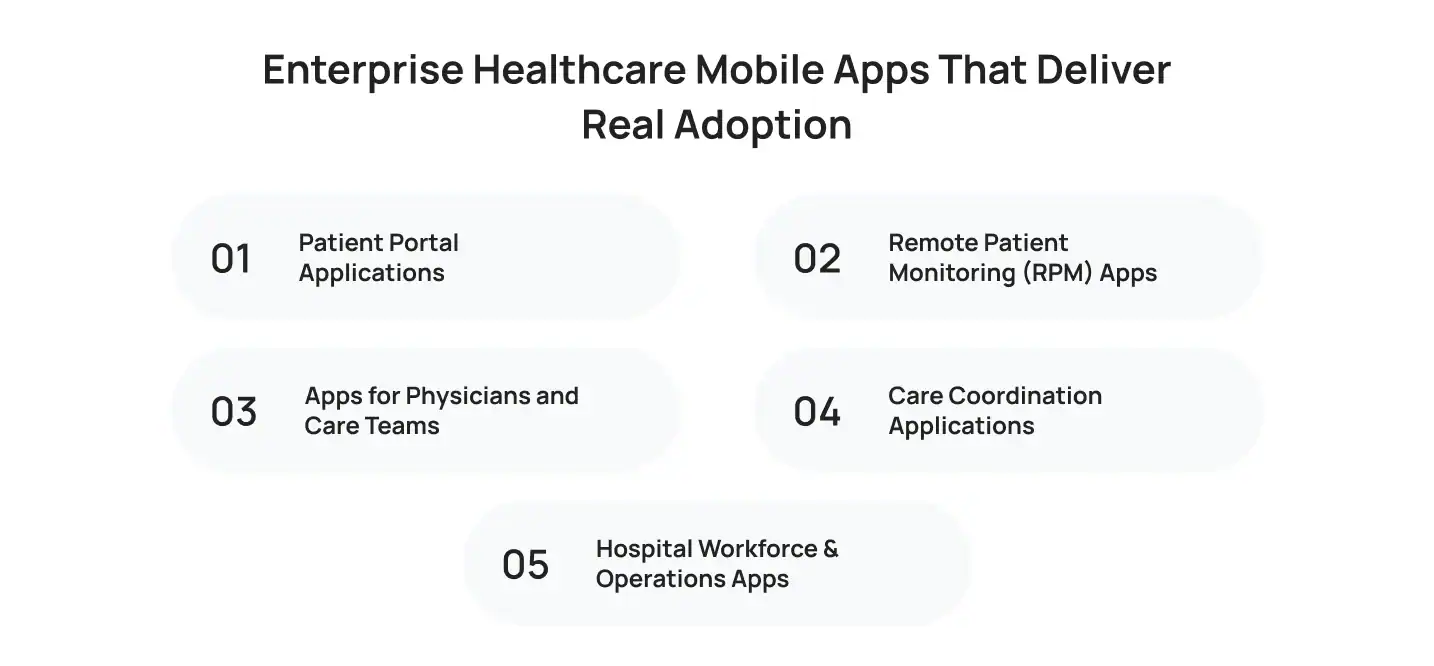
Enterprise healthcare applications solve different challenges across the patient journey and clinical operations. The most successful apps are those that fit naturally into existing workflows, simplify everyday tasks, and provide meaningful value for both patients and healthcare professionals.
1. Patient Portal Applications
Patient portals are often the first digital touchpoint between patients and healthcare providers. They give users convenient access to healthcare services while reducing the administrative workload for hospitals and clinics.
A well-designed patient portal allows patients to schedule appointments, review medical records, communicate securely with providers, and request prescription refills without making multiple phone calls. This creates a smoother experience while encouraging patients to take a more active role in managing their health.
According to Grand View Research, 49% of U.S. mHealth app users rely on Epic MyChart, demonstrating that patients are more likely to use applications that are directly connected to their healthcare providers and medical records.
Successful patient portals typically include:
- Online appointment scheduling
- Secure messaging with healthcare providers
- Access to medical records and test results
- Prescription refill requests
- Billing and payment management
Rather than overwhelming users with unnecessary features, the best patient portals focus on making routine healthcare tasks simple, accessible, and secure.
- Remote Patient Monitoring (RPM) Apps
Remote patient monitoring applications help healthcare providers track patient health outside traditional clinical settings. These apps collect data from connected medical devices and deliver timely insights that support ongoing care.
Patients living with chronic conditions such as diabetes, hypertension, or heart disease benefit from continuous monitoring without frequent hospital visits. Healthcare professionals can review incoming data, identify concerning trends, and intervene before conditions worsen.
Common RPM capabilities include:
- Vital sign monitoring
- Wearable device integration
- Medication reminders
- Automated health alerts
- Progress tracking dashboards
The U.S. remote patient monitoring market is valued at USD 17.2 billion in 2026 and is projected to grow to USD 49.5 billion by 2033, registering a compound annual growth rate (CAGR) of 16.3%. North America captured 48% of the global RPM market share in 2025, with the U.S. market alone projected to reach USD 30.7 billion by 2026.
3. Apps for Physicians and Care Teams
Healthcare professionals need mobile applications that save time rather than add complexity. Clinical apps provide secure access to patient information, allowing physicians, nurses, and specialists to make informed decisions wherever care is delivered.
These applications often support mobile charting, electronic prescribing, secure messaging, and real-time access to electronic health records. Having essential information available on mobile devices improves collaboration while reducing delays in patient care.
For clinical teams, usability is critical. Effective applications should:
- Load patient information quickly.
- Minimize unnecessary navigation.
- Reduce manual documentation.
- Support secure communication.
- Integrate seamlessly with EHR systems.
When clinicians spend less time switching between systems, they can dedicate more attention to patient care and clinical decision-making.
4. Care Coordination Applications
Modern healthcare often involves multiple providers working together to manage a patient’s treatment. Care coordination applications help keep everyone informed by providing shared access to treatment plans, referrals, and patient updates.
Instead of relying on disconnected communication methods, care teams can collaborate through a centralized platform that improves visibility throughout the patient’s care journey.
These applications commonly support:
- Referral management
- Shared care plans
- Case management
- Provider collaboration
- Follow-up tracking
Better coordination reduces communication gaps, minimizes duplicated work, and helps healthcare organizations deliver more consistent care across departments and facilities.
5. Hospital Workforce & Operations Apps
Enterprise healthcare mobility extends beyond patient care. Hospitals also use mobile applications to improve workforce management and day-to-day operations.
Operational apps simplify staff scheduling, task assignments, bed management, and internal communication. By providing real-time information, they help healthcare teams respond more efficiently to changing priorities throughout the day.
These solutions commonly help organizations:
- Manage staff schedules
- Coordinate shift handovers
- Track operational tasks
- Monitor bed availability
- Improve internal communication
When operational processes become more efficient, healthcare professionals spend less time managing logistics and more time delivering quality patient care.
How to Build Enterprise Healthcare Mobile Apps
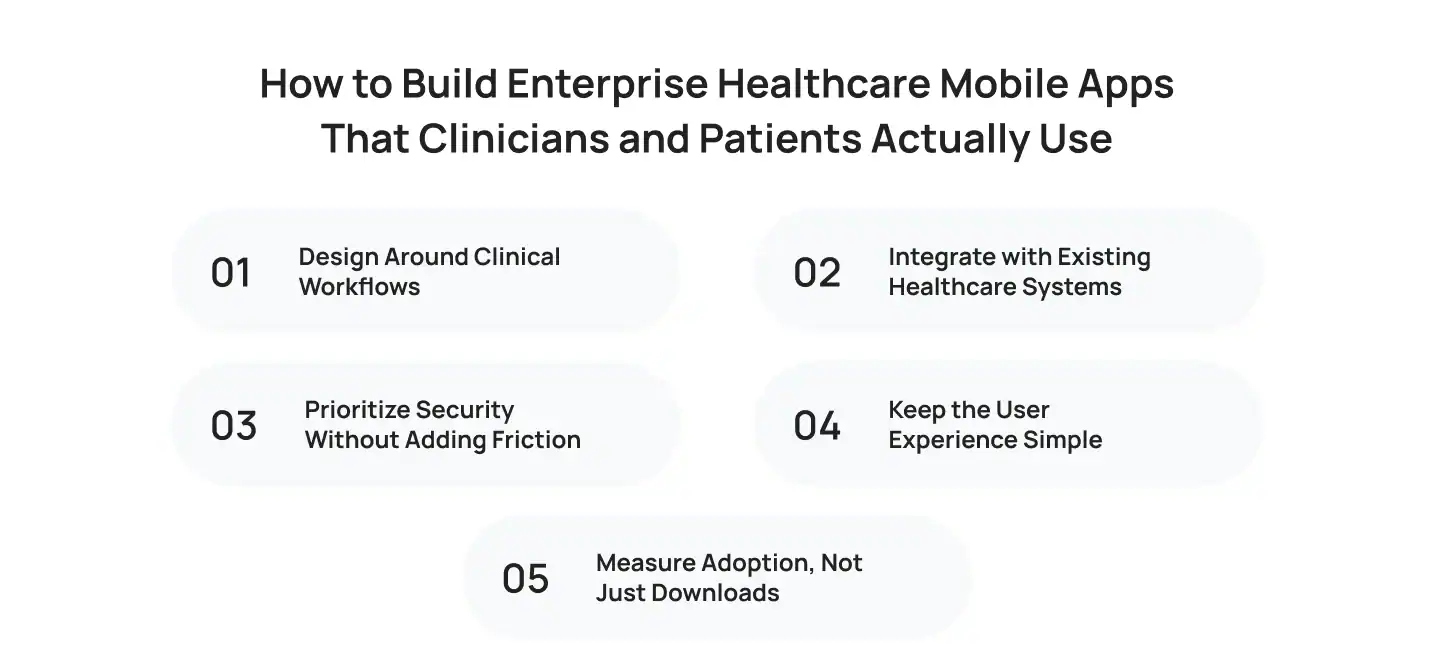
Building an enterprise healthcare app requires more than choosing the right technology stack. Long-term success depends on understanding how patients and clinicians work, integrating with existing healthcare systems, and delivering a secure experience that feels effortless to use.
1. Design Around Clinical Workflows
Not around technology. Start with how a nurse actually moves through a shift or how a patient actually navigates a diagnosis, and build the app to match that path. Don’t start with a feature list and try to fit it into existing work. Shadow real users. Watch where they get stuck. Build for that.
2. Integrate with Existing Healthcare Systems
An enterprise healthcare app that doesn’t connect to Epic, Cerner, or athenahealth creates more work, not less. Staff ends up entering the same data twice, once in the EHR and once in the app. That duplication kills adoption fast.
Build integrations through standard APIs and FHIR (Fast Healthcare Interoperability Resources) protocols. FHIR gives you a consistent way to exchange patient data across systems without custom-building a connection for every EHR vendor. This is the backbone of any enterprise deployment, and skipping it creates technical debt you’ll pay for later.
3. Prioritize Security Without Adding Friction
HIPAA compliance is not optional, and it shapes nearly every technical decision in a healthcare app. But security measures that slow users down get worked around, not followed. Multi-factor authentication needs to be fast, with biometric login instead of typing a code from a text message. Encryption needs to run in the background, protecting data in transit and at rest without the user noticing it’s there. Role-based access control (RBAC) needs to give each user exactly the access they need, no more, no less, so a nurse sees what a nurse needs and an administrator sees what an administrator needs.
Security that works invisibly gets followed. Security that creates friction gets bypassed, and that’s a bigger risk than the friction itself.
4. Keep the User Experience Simple
Elderly patients make up a large share of the people using patient portals, and many of them are not comfortable with complex apps. Large text, clear buttons, and minimal steps matter more here than clever design. Busy clinicians need the opposite kind of simplicity: speed. Every screen should get them to the information they need in as few taps as possible.
Accessibility standards need to be built in from the start, not added later. Offline functionality matters too. Hospitals have dead zones, and rural patients often have unreliable connectivity. An app that breaks without a signal loses trust fast.
5. Measure Adoption, Not Just Downloads
Downloads tell you almost nothing. A patient who downloads the app and never opens it again counts the same as one who checks it daily, and that number hides the real story.
Track these KPIs instead:
- Daily active users, to see whether the app fits into regular routines
- Patient engagement, measured by messages sent, appointments booked, and records viewed
- Task completion, to see whether users finish what they start or abandon it partway through
- Retention, to see whether people keep using the app weeks and months after first install
If these numbers stay flat or decline, the app has a workflow problem, not a marketing problem. No campaign fixes a tool people don’t find useful.
Technology & Compliance Essentials for Enterprise Healthcare Mobile App
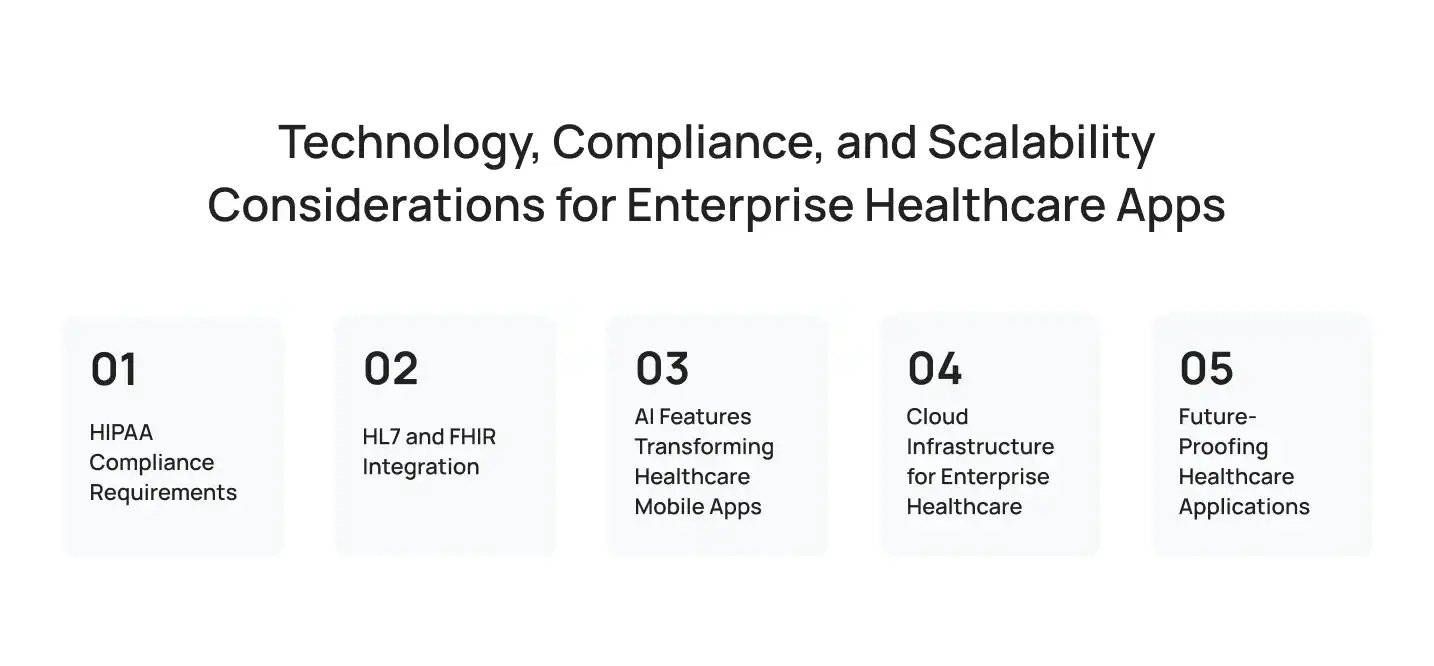
Enterprise healthcare applications must be built on a strong technical foundation that supports security, interoperability, and future growth. Addressing these considerations early helps organizations avoid costly redevelopment while ensuring compliance with evolving healthcare regulations.
1. HIPAA Compliance Requirements
HIPAA compliance is a fundamental requirement for enterprise healthcare mobile app development in the United States. Any application that stores, processes, or transmits protected health information (PHI) must implement safeguards that protect patient privacy and data security.
Compliance extends beyond technical controls. Development teams should establish secure development practices, maintain audit trails, perform regular risk assessments, and ensure all third-party vendors handling PHI meet HIPAA requirements.
Key compliance measures include the following:
- Data encryption
- Secure user authentication
- Role-based access controls
- Audit logging
- Regular security testing
Building compliance into the development process from the beginning reduces risk and simplifies future regulatory audits.
2. HL7 and FHIR Integration
Healthcare organizations rely on multiple software platforms to manage patient care. Standards such as HL7 and FHIR make it possible for enterprise mobile applications to exchange information consistently across these systems.
FHIR uses modern APIs that simplify data sharing while improving interoperability between healthcare providers, laboratories, pharmacies, insurers, and EHR platforms. This enables clinicians to access accurate patient information without switching between disconnected systems.
By adopting standardized integrations, healthcare organizations improve data consistency, reduce administrative work, and create a more connected care experience.
3. AI Features Transforming Healthcare Mobile Apps
Artificial intelligence is becoming an important component of enterprise healthcare applications. Rather than replacing clinicians, AI helps automate repetitive tasks and provides insights that support faster, more informed decision-making.
AI-powered features can assist with clinical documentation, symptom assessment, predictive analytics, and patient communication. These capabilities improve operational efficiency while allowing healthcare professionals to spend more time on direct patient care.
Common AI applications include:
- Clinical documentation assistance
- Predictive health analytics
- Intelligent patient triage
- Medication reminders
- Virtual healthcare assistants
When implemented responsibly, AI enhances healthcare delivery while maintaining the essential role of clinical expertise.
4. Cloud Infrastructure for Enterprise Healthcare
Cloud platforms provide the flexibility and scalability required for modern healthcare applications. They allow organizations to manage growing volumes of patient data while maintaining system performance and availability.
Major cloud providers offer HIPAA-eligible services that support secure storage, disaster recovery, and enterprise-scale deployments. Selecting the right platform depends on an organization’s infrastructure, compliance needs, and long-term technology strategy.
Cloud-based healthcare applications also simplify ongoing maintenance, software updates, and system scalability as healthcare organizations continue to expand their digital services.
5. Future-Proofing Healthcare Applications
Healthcare technology continues to evolve alongside regulatory requirements, patient expectations, and clinical practices. Enterprise applications should be designed with flexibility to support future enhancements without requiring major redevelopment.
A modular architecture, API-first approach, and continuous improvement strategy allow organizations to introduce new capabilities while maintaining application stability. Regular updates based on user feedback also help keep the application relevant over time.
Future-ready healthcare applications are better positioned to support innovation while adapting to changing business and clinical requirements.
Why Choose Cubix for Enterprise Healthcare Mobile App Development
Cubix helps healthcare organizations build secure, scalable, and compliant mobile applications designed around real clinical workflows and patient needs. With experience in healthcare technology, Cubix creates solutions that improve care delivery, simplify daily operations, and enhance user experiences.
Security and compliance are built into every stage of development. Cubix follows HIPAA-compliant practices with features such as encryption, access controls, and audit trails to protect sensitive patient data while maintaining a smooth user experience.
At Cubix, we handle the full mobile app development lifecycle: discovery, design, development, testing, deployment, and ongoing support after launch. Healthcare apps need updates as regulations change and user needs shift, and that support continues well past the initial release.
Our team measures success by whether people keep using the app six months after launch, not by whether it shipped on time. That focus on adoption shapes every stage of the build, from the first workflow interview to the metrics tracked after go-live.
Bottom Line
Launching an app is easy. Getting clinicians and patients to actually rely on it every day is the hard part, and that’s where most healthcare technology investments fall short.
Enterprise healthcare apps succeed when they solve a real workflow problem instead of adding a new one. They succeed when they integrate cleanly with the EHR systems staff already use, when they meet HIPAA and FHIR requirements without slowing anyone down, and when they deliver measurable value, like fewer no-shows, faster documentation, and better chronic disease outcomes for both providers and patients.
Adoption is the only metric that matters in the end. An app nobody uses might as well not exist, no matter how well it was built. Build for the people who’ll use it every day, and the rest follows.
Want to discuss your project? Our experts are just a click away.
Contact UsFrequently Asked Questions
1. What is enterprise healthcare mobile app development?
Enterprise healthcare mobile app development involves creating secure, scalable applications for healthcare organizations, such as patient portals, remote monitoring apps, and clinical tools that improve care delivery and operational efficiency.
2. Why is HIPAA compliance important for healthcare mobile apps?
HIPAA compliance ensures that patient health information is securely stored, transmitted, and accessed, helping healthcare organizations protect sensitive data and meet U.S. regulatory requirements.
3. What features should an enterprise healthcare mobile app include?
Common features include patient portals, appointment scheduling, secure messaging, EHR integration, remote patient monitoring, ePrescriptions, and role-based access controls.
4. How do healthcare mobile apps integrate with EHR systems?
Healthcare apps use interoperability standards like HL7 and FHIR to securely exchange patient data with EHR platforms such as Epic, Oracle Health (Cerner), and athenahealth
5. How long does it take to develop an enterprise healthcare mobile app?
Development timelines vary based on complexity, integrations, and compliance requirements, but most enterprise healthcare mobile apps take 4 to 9 months to design, develop, test, and deploy.