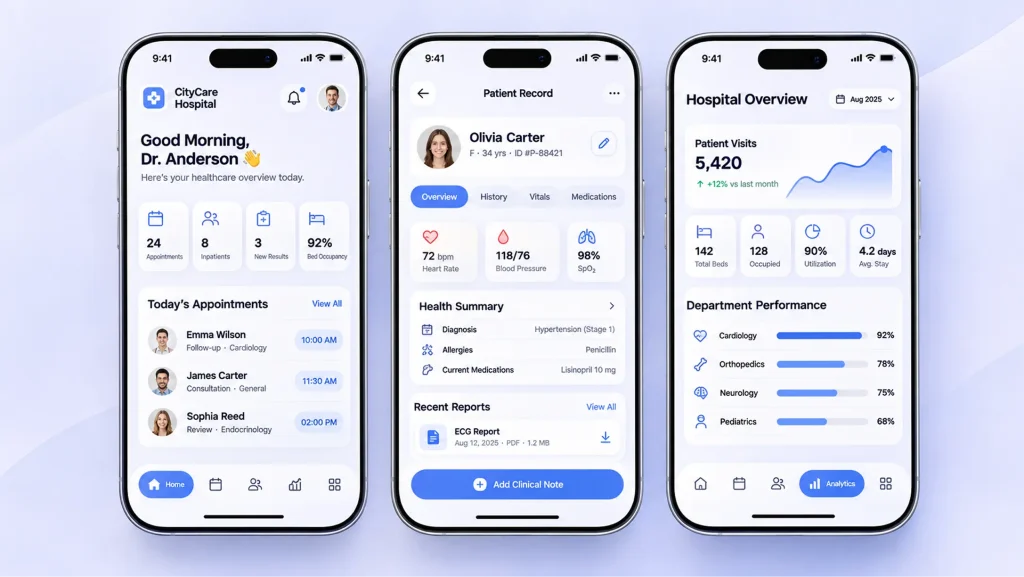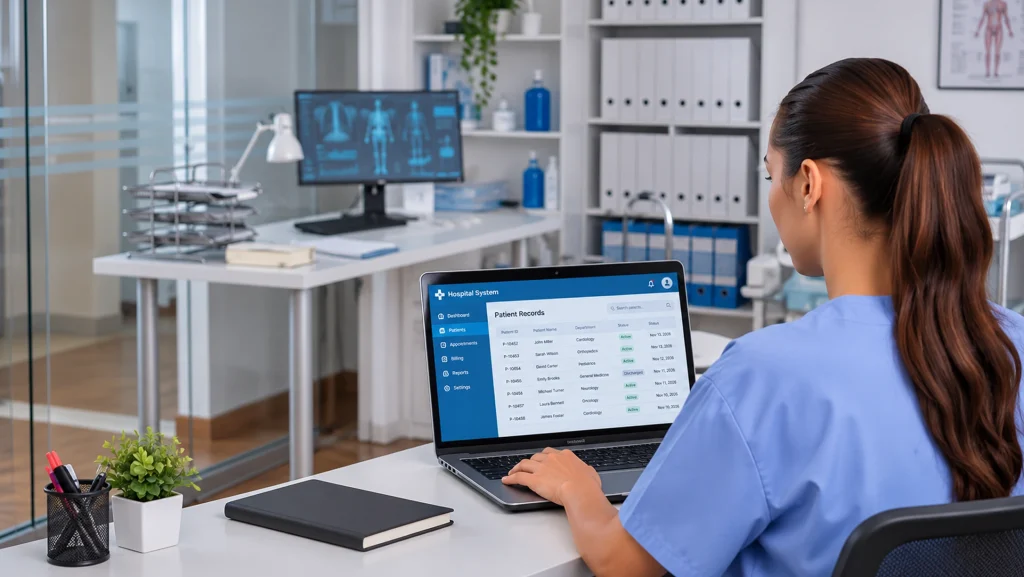
Healthcare software must support clinical workflows, protect patient information, and exchange data reliably with other healthcare systems. Missing any of these requirements can create security risks, integration problems, or disruptions to patient care.
The ONC reports that approximately 9 in 10 U.S. hospitals enabled patients to access health information through APIs in 2024. This makes interoperability an important consideration when planning new healthcare applications.
Healthcare software development requirements define the features, technical capabilities, security controls, and regulatory conditions a system must meet. They generally cover business and user needs, functional and non-functional requirements, data protection, compliance, and interoperability.
What Are Healthcare Software Development Requirements?
Healthcare software development requirements document what an application must do, who will use it, and the conditions it must satisfy. They give stakeholders, architects, developers, and QA engineers a shared specification.
Requirements generally fall into three categories:
- Business requirements: Define the operational problem, such as reducing appointment scheduling delays or improving access to patient records.
- User requirements: Describe what clinicians, patients, and administrative staff need to accomplish.
- System requirements: Specify application behavior, integrations, security controls, and performance expectations.
For example, a clinic may want to reduce manual appointment scheduling. Its system requirements could specify that authorized staff can view provider availability, book open slots, and prevent conflicting appointments.
Each requirement should be specific, measurable, testable, and traceable to a stakeholder need.
What Are the Essential Requirements for Developing Healthcare Software?
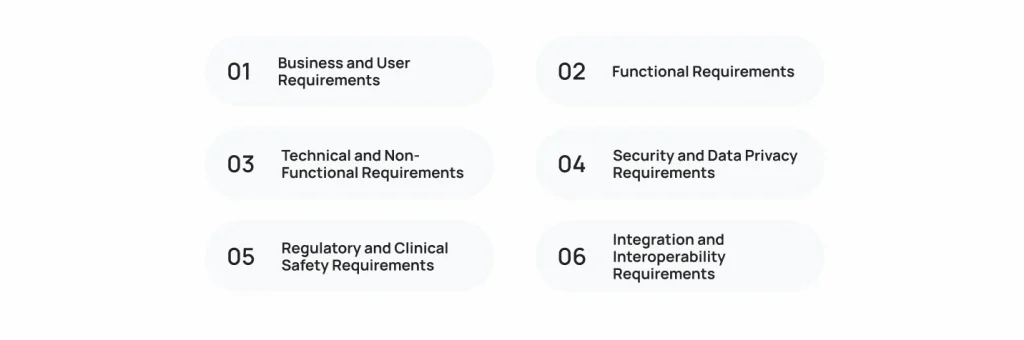
Healthcare software projects typically require six categories of specifications: business and user, functional, technical, security, regulatory, and integration requirements. Their scope depends on the application’s intended use and the workflows it supports.
1. Business and User Requirements
Business and user requirements define the application’s purpose, intended users, workflows, scope, and priorities.
Identify the needs of:
- Clinicians: Patient histories, encounter documentation, diagnoses, and clinical orders.
- Nurses: Patient observations, care coordination, and task management.
- Patients: Appointment booking, medical record access, forms, and secure communication.
- Administrative staff: Registration, scheduling, billing, and reporting.
- IT and compliance teams: User permissions, integrations, security, and system availability.
Document existing workflows before specifying new ones. For a clinic application, this means mapping registration, appointment booking, check-in, consultation, billing, and follow-up.
Also define the software’s intended use, project scope, and essential features. An Intended Use Statement records the product’s purpose and intended users. A User Needs Specification documents stakeholder expectations. Both are particularly relevant when assessing potential medical-device requirements.
For planning considerations specific to clinics, see custom software for healthcare clinics.
2. Functional Requirements
Functional requirements specify the features and actions the application must support.
| Feature Area | Requirements to Consider |
| Patient management | Registration, demographics, medical histories, and record updates |
| Appointment management | Scheduling, cancellations, reminders, and provider availability |
| Clinical documentation | Encounter notes, diagnoses, treatment plans, and orders |
| EHR/EMR | Patient record creation, retrieval, and authorized access |
| Billing and payments | Invoicing, payment processing, and insurance information |
| Patient engagement | Patient portals, forms, and secure messaging |
| Reporting | Clinical, financial, and operational reports |
These features are not mandatory for every application. A patient portal, for example, has different functional requirements from a hospital management system. The required modules should follow the software’s intended purpose. See the different types of software used in healthcare when defining the appropriate feature scope.
Write each requirement as an observable system behavior. Instead of “support appointment scheduling,” specify that authorized staff must be able to view provider availability, select an open slot, and create an appointment without conflicting with an existing booking.
3. Technical and Non-Functional Requirements
Technical and non-functional requirements define how reliably and efficiently the application must operate.
| Requirement | What to Specify |
| Performance | Response times, concurrent users, and transaction volume |
| Availability | Uptime targets and acceptable downtime |
| Scalability | Expected growth in users, records, and transactions |
| Reliability | Error handling, data consistency, and fault tolerance |
| Usability | Navigation, workflow efficiency, and task completion |
| Accessibility | Keyboard navigation, screen-reader support, and readable contrast |
| Compatibility | Supported browsers, devices, and operating systems |
| Infrastructure | Cloud, on-premises, or hybrid deployment |
| Backup and recovery | Backup frequency, restoration procedures, and recovery objectives |
| Maintainability | Monitoring, logging, updates, and troubleshooting |
Set measurable targets rather than using vague requirements such as “fast performance” or “high availability.” Infrastructure requirements should also account for existing hospital systems, network dependencies, data storage, and recovery needs.
4. Security and Data Privacy Requirements
Healthcare applications handling protected health information (PHI) need controls for data access, storage, transmission, monitoring, and retention. HIPAA obligations apply to covered entities and business associates as defined by the law.
Key security requirements include:
- Role-based access control (RBAC): Restrict access according to user responsibilities. A receptionist may need scheduling access but not permission to modify clinical notes.
- Authentication: Use unique user identification and appropriate authentication controls, including multi-factor authentication (MFA) where required by the security design.
- Encryption: Protect sensitive data in transit and at rest. Define encryption key storage, access, rotation, and recovery.
- Audit logging: Record relevant access events, record changes, administrative actions, and security incidents.
- Data minimization: Collect and expose only the information needed for defined workflows.
- Data retention: Specify retention, archival, and secure deletion rules.
Organizations subject to the HIPAA Security Rule must conduct a risk analysis covering potential threats and vulnerabilities affecting electronic PHI. HHS guidance on risk analysis explains this requirement.
Third-party responsibilities also need review. If a software vendor creates, receives, maintains, or transmits PHI on behalf of a covered entity or business associate, a business associate relationship may apply. The parties generally need a Business Associate Agreement (BAA) defining permitted data use and security responsibilities.
For more detail, read our guide to building custom software for U.S. healthcare with HIPAA compliance.
5. Regulatory and Clinical Safety Requirements
Regulatory requirements depend on the software’s intended purpose and functionality. A scheduling application does not automatically face the same FDA requirements as software that analyzes medical images or supports diagnosis.
For U.S. healthcare projects, assess:
- HIPAA: Determine whether the organization is a covered entity or business associate and which Privacy, Security, and Breach Notification Rule obligations apply.
- FDA requirements: Assess whether the software performs a medical-device function. The FDA’s Digital Health Policy Navigator uses intended medical purpose as a key consideration.
- Software as a Medical Device (SaMD): Standalone software intended for one or more medical purposes may fall within the FDA’s medical-device framework. See the FDA’s SaMD overview.
- Clinical safety: Identify risks involving incorrect patient information, missed alerts, inaccurate results, and workflow errors. Define appropriate safeguards and fallback procedures.
- Human factors engineering: Specify usability requirements for clinical tasks, alert clarity, information readability, and error prevention.
- Quality management: Where medical-device regulations apply, assess requirements for a Quality Management System (QMS), design controls, risk management, verification, and validation.
Clinical decision-support software needs a separate regulatory assessment. Some functions may fall outside FDA device regulation if they meet specific statutory criteria; others remain regulated. The FDA’s Clinical Decision Support Software guidance explains the distinction.
6. Integration and Interoperability Requirements
Integration requirements specify how the application exchanges data with EHRs, laboratories, pharmacies, imaging systems, and billing platforms.
Common healthcare standards include:
| Standard | Purpose |
| HL7 FHIR | API-based exchange of healthcare information |
| HL7 v2 | Message-based exchange for events such as admissions, orders, and results |
| SMART on FHIR | Authorization framework for applications accessing FHIR-based data |
| DICOM | Exchange and management of medical imaging information |
| SNOMED CT | Standardized clinical terminology |
| LOINC | Identification of laboratory tests and clinical observations |
| RxNorm | Normalized names for clinical drugs |
Supporting a standard does not guarantee interoperability. Teams must define supported versions, profiles, data mappings, authentication, and interface behavior. The ONC FHIR overview explains FHIR’s role in healthcare data exchange.
For each integration, document:
- The external system and data being exchanged.
- Whether data flows in one direction or both.
- The interface method, such as an API or HL7 message.
- Authentication and authorization requirements.
- Handling of duplicate, incomplete, rejected, or delayed data.
For example, a laboratory integration needs rules for transmitting test orders, receiving results, matching them to patients, and handling unmatched records.
How Do Healthcare Software Requirements Map to Each Development Stage?
Healthcare software requirements are not all finalized at the same point. Some must be defined before development begins, while others become more specific during design, integration, testing, and deployment.
| Development Stage | Requirements to Define or Verify | Key Deliverable |
| 1. Discovery and planning | Business objectives, intended users, clinical workflows, intended use, project scope, and regulatory considerations | User Needs Specification |
| 2. Requirements analysis | Functional requirements, technical constraints, data needs, security controls, integration requirements, and acceptance criteria | Software Requirements Specification (SRS) |
| 3. Architecture and UX design | System architecture, role-based access, data flows, API specifications, usability requirements, and accessibility | Architecture and design specifications |
| 4. Development | Feature behavior, data validation, authentication, authorization, encryption, logging, and coding standards | Implemented features and technical documentation |
| 5. Integration and testing | FHIR or HL7 interfaces, terminology mapping, data exchange, performance, security, and clinical workflow validation | Integration and test results |
| 6. Verification and validation | Requirement coverage, acceptance criteria, clinical safety, usability, and intended-use validation | Test reports and Requirements Traceability Matrix (RTM) |
| 7. Deployment and implementation | Production access controls, data migration, backup and recovery, user training, and operational readiness | Deployment and implementation plan |
| 8. Post-launch maintenance | Monitoring, vulnerability management, incident response, regulatory updates, and controlled feature changes | Maintenance and change-control records |
The Requirements Traceability Matrix should connect each requirement to its implementation, test case, and verification result. This helps teams identify untested requirements and assess how a change to one feature may affect other parts of the system.
For software that qualifies as a medical device, additional documentation and validation activities may apply based on its intended use and regulatory classification.
What Documents Are Needed to Define Healthcare Software Requirements?

A requirements documentation package records stakeholder needs, system behavior, risks, and verification methods. Its depth depends on the project’s scope and regulatory obligations.
| Document | Purpose |
| Software Requirements Specification (SRS) | Defines functional, technical, data, security, and interface requirements |
| User Needs Specification | Records stakeholder expectations and workflows |
| Intended Use Statement | Defines the software’s purpose and intended users |
| Requirements Traceability Matrix (RTM) | Connects requirements to implementation and testing |
| Risk Assessment | Documents potential security, operational, and clinical risks |
| Verification and Validation Plan | Defines how requirements and intended use will be evaluated |
What Should a Healthcare Software SRS Include?
A Software Requirements Specification (SRS) is the central document describing what the application must do and the constraints it must satisfy.
Include:
- Purpose, scope, and intended users.
- Functional and non-functional requirements.
- Data and external interface requirements.
- Security, privacy, and applicable regulatory constraints.
- Operating environment and system dependencies.
- Acceptance criteria and verification methods.
Avoid vague statements such as “the system must be secure.” Specify the required access permissions, authentication controls, encryption, and audit events.
How Does a Requirements Traceability Matrix Help?
A Requirements Traceability Matrix (RTM) links each requirement to its source and verification method. It helps identify requirements that have not been implemented or tested.
| Requirement ID | Requirement | Verification |
| FUN-01 | Authorized clinicians can update encounter notes | Functional test |
| SEC-01 | Patient records are restricted by user permissions | Access-control test |
| INT-01 | The application exchanges agreed data through a FHIR interface | Integration test |
Update the RTM whenever an approved requirement changes so affected design elements and test cases remain traceable.
How Do You Validate Healthcare Software Requirements Before Development?
Validate requirements by checking their completeness, clarity, consistency, feasibility, and testability. Review them with clinical, technical, security, and compliance stakeholders before approving the specification.
Use these checks:
- Completeness: Are all required workflows, data inputs, outputs, and exceptions covered?
- Clarity: Can developers and testers interpret each requirement consistently?
- Consistency: Do requirements conflict with one another?
- Feasibility: Can the team implement them within technical and operational constraints?
- Testability: Can QA verify each requirement objectively?
- Traceability: Is each requirement connected to a stakeholder need and test?
- Risk coverage: Have relevant security, privacy, integration, and clinical risks been addressed?
Define acceptance criteria for critical requirements and select the appropriate verification method.
| Requirement Type | Verification Method |
| Functional | Feature and workflow testing |
| Integration | Data exchange and interface testing |
| Security | Authentication, authorization, and security testing |
| Performance | Load and response-time testing |
| Usability | Testing with representative users |
| Clinical safety | Assessment of identified hazards and risk controls |
Verification checks whether the software meets its specifications. Validation checks whether it meets user needs and intended use.
Requirements also need change control. Record proposed changes, assess their impact on scope, integrations, security, and clinical safety, obtain approval, and update the SRS and RTM.
Healthcare Software Development Requirements Checklist

Use this checklist before starting development:
| Requirement Category | What to Confirm |
| Business and scope | Intended use, users, objectives, and project scope |
| User needs | Clinical and administrative workflows |
| Functional | Required features and system behavior |
| Technical | Performance, availability, scalability, and infrastructure |
| Security | PHI handling, access controls, encryption, and audit logging |
| Regulatory | Applicable HIPAA and FDA requirements |
| Clinical safety | Relevant hazards, safeguards, and usability |
| Interoperability | External systems, APIs, and data standards |
| Documentation | SRS, RTM, and risk records where applicable |
| Validation | Acceptance criteria and verification methods |
| Change control | Review and approval process for requirement updates |
Not every project needs the same features or regulatory documentation. Tailor this checklist to the application’s intended use, data, users, and risk profile.
Conclusion
Healthcare software requirements must reflect the application’s intended use, user workflows, data responsibilities, integrations, and applicable regulations. Documenting these requirements before development gives technical teams clear implementation targets and QA teams measurable conditions for testing.
If you’re planning a new healthcare application or modernizing an existing platform, explore Cubix’s healthcare software development services to discuss your project requirements and technical scope.
Have a Healthcare Software Concept? Let's Define What It Needs.
Contact Us
Frequently Asked Questions
1. What are the basic requirements for developing healthcare software?
The core requirements cover business and user needs, functional features, technical performance, security, applicable regulations, and interoperability. Their scope depends on the application’s purpose and users.
2. What are the technical requirements for healthcare software?
They include infrastructure, databases, APIs, supported devices, performance, availability, scalability, backup, and recovery. Healthcare integrations may also require standards such as HL7 FHIR, HL7 v2, and DICOM.
3. Is HIPAA compliance required for all healthcare software?
No. HIPAA applies to covered entities and business associates. A vendor’s obligations depend on its role and whether it handles PHI on behalf of a regulated organization.
4. What is an SRS in healthcare software development?
A Software Requirements Specification documents an application’s features, interfaces, data requirements, security controls, technical constraints, and acceptance criteria.
5. What standards are used for healthcare software interoperability?
Common standards include HL7 FHIR and HL7 v2 for data exchange, DICOM for medical imaging, SNOMED CT for clinical terminology, LOINC for observations, and RxNorm for drug terminology.