

A healthcare application can encrypt every patient record and still expose sensitive information if its APIs allow users to access records they are not authorized to view. That is why healthcare software security must extend beyond encryption to application architecture, identity management, integrations, development practices, and continuous monitoring.
The risk is substantial. The U.S. Department of Health and Human Services (HHS) Office for Civil Rights reported 663 large breaches of unsecured protected health information in 2024, affecting approximately 242.9 million individuals. Hacking and IT incidents accounted for 81% of these reported breaches, according to its 2024 breach report.
For healthcare organizations, securing software means protecting patient information while keeping clinical and administrative systems reliable. The following healthcare software security best practices explain how engineering teams can address those risks throughout the software lifecycle.
Key Takeaways
- Healthcare software security requires coordinated controls across application architecture, infrastructure, APIs, databases, and third-party services.
- Risk assessments help teams identify sensitive data flows, vulnerabilities, and potential attack paths before development.
- MFA, role-based access control, encryption, and secure API authorization help prevent unauthorized access to patient information.
- Secure coding, automated testing, and dependency management reduce vulnerabilities before software reaches production.
- Audit logging, continuous monitoring, protected backups, and incident response procedures help organizations detect and recover from security incidents.
- HIPAA-regulated organizations must implement reasonable and appropriate safeguards to protect electronic protected health information (ePHI).
What Makes Healthcare Software Security Different?
Healthcare software handles sensitive patient information and supports workflows that clinicians, administrators, laboratories, pharmacies, and insurers depend on. A security failure can expose medical records, alter clinical information, or interrupt access to systems used during patient care.
Three factors make healthcare software security particularly important:
Sensitive health information: Electronic health records (EHRs), electronic medical records (EMRs), patient portals, telehealth platforms, and billing systems process protected health information (PHI). Unauthorized access can expose diagnoses, prescriptions, test results, insurance details, and other identifiable information.
Connected systems: Healthcare platforms exchange information with laboratories, pharmacies, medical devices, insurers, and external providers. Each integration creates another connection that needs authentication, authorization, and monitoring.
Clinical availability and data integrity: Healthcare systems must remain accessible to authorized users, and their records must remain accurate. An attacker who modifies a medication record or makes an EHR unavailable can disrupt clinical workflows even without stealing patient data.
These concerns map to three core security objectives:
| Security Objective | What it Means for Healthcare Software |
| Confidentiality | Only authorized users and systems can access patient information |
| Integrity | Clinical and administrative records cannot be changed without authorization |
| Availability | Authorized users can access reliable systems and information when needed |
Effective security controls must address all three. Protecting confidentiality alone does not make a healthcare platform secure.
What Are the Best Healthcare Software Security Practices?

Healthcare software security depends on multiple controls working together. Engineering teams should address risks during planning and architecture, enforce security throughout development, and continue monitoring systems after deployment.
1. Conduct Security Risk Assessments Before Development
Start by identifying what needs protection, where sensitive information moves, and how an attacker could reach it. A security risk assessment gives engineering teams a practical basis for selecting safeguards instead of applying controls without understanding the system’s exposure.
The assessment should cover:
- Sensitive data inventory: Identify where PHI and ePHI are collected, processed, stored, transmitted, and backed up.
- Data flow mapping: Document connections between user interfaces, application services, databases, APIs, cloud infrastructure, and external systems.
- Attack surface analysis: Review public endpoints, authentication flows, administrative interfaces, integrations, remote access, and exposed infrastructure.
- Threat modeling: Identify possible attack paths, such as credential theft, unauthorized record access, injection attacks, and compromised dependencies.
- Risk prioritization: Evaluate vulnerabilities according to their likelihood, potential impact, and the sensitivity of affected information.
For example, a patient portal may expose patient records through an API. The assessment should examine whether the API verifies that the authenticated user has permission to access the specific record requested, not just whether the user has logged in.
HHS explains that risk analysis is a foundational part of the HIPAA Security Rule’s security management process. Its guidance on HIPAA risk analysis also makes clear that organizations must evaluate risks to the confidentiality, integrity, and availability of ePHI.
2. Build Security Into Healthcare Software Architecture
Security decisions made during architecture design determine how well the application can isolate sensitive data, control access, and contain a compromised component.
Consider these practices when designing healthcare software:
- Apply Zero Trust principles: Verify users, devices, and service requests instead of automatically trusting traffic because it originates inside an organization’s network.
- Segment critical environments: Separate application services, databases, administrative systems, and production infrastructure to limit unauthorized movement between components.
- Isolate tenant data: For multi-tenant healthcare platforms, enforce organization-level data isolation through server-side authorization and appropriate database controls.
- Secure service-to-service communication: Authenticate internal services and use encrypted communication, such as mutual TLS (mTLS), where appropriate.
- Restrict database exposure: Keep databases and internal services off public networks unless external access is necessary and properly secured.
- Harden cloud infrastructure: Apply least-privilege permissions, secure storage configurations, network restrictions, and centralized secrets management.
Microservices can support service isolation, but they do not automatically make an application more secure. Every additional service introduces its own authentication, authorization, configuration, and monitoring requirements. A well-designed modular monolith may be a better fit for some systems.
The architecture should reflect the application’s complexity, integration requirements, data sensitivity, and operational resources. The healthcare software development guide explains how architecture, integrations, technologies, and security requirements fit into the broader development process.
3. Enforce Strong Identity and Access Management
Healthcare software should give users access only to the records and functions required for their responsibilities. A valid login should never grant unrestricted access to patient information.
Implement these identity and access management (IAM) controls:
- Role-based access control (RBAC): Assign permissions according to roles such as physician, nurse, billing specialist, administrator, and support staff.
- Attribute-based access control (ABAC): Where necessary, evaluate additional attributes such as department, organization, location, or patient-care relationship before granting access.
- Multi-factor authentication (MFA): Require additional verification for sensitive accounts, privileged access, and remote administrative sessions.
- Least-privilege permissions: Limit access to the minimum functions and information users need.
- Privileged access management: Restrict and monitor administrator, database, and infrastructure accounts.
- Session management: Use secure session tokens, appropriate expiration policies, and controls against session theft or reuse.
- Emergency access: Provide a controlled break-glass process for urgent clinical situations, with justification and subsequent review.
Authentication and authorization solve different problems. Authentication verifies a user’s identity; authorization determines which records and operations that user can access.
For example, a physician may be authenticated successfully but should not automatically gain access to every patient’s medical history. The application must enforce permissions at the patient-record level.
For additional guidance on authentication mechanisms and authenticator management, engineering teams can consult NIST’s Digital Identity Guidelines.
4. Encrypt Patient Data and Protect Encryption Keys
Encryption reduces the risk of exposing readable patient information if storage media, backups, or network traffic are accessed without authorization. It should cover sensitive data throughout its lifecycle.
| Security Measure | Recommended Implementation |
| Encryption at rest | Encrypt databases, storage volumes, backups, and sensitive files |
| Encryption in transit | Use secure transport protocols such as TLS for communication between users, APIs, services, and external systems |
| Key management | Restrict key access, establish rotation procedures, and protect keys separately from encrypted data |
| Secrets management | Store credentials, API keys, certificates, and tokens in dedicated secrets-management systems |
| Data masking | Use synthetic or appropriately de-identified data in development and testing environments |
For encryption at rest, organizations commonly use strong, established algorithms such as AES-256. For data in transit, configure current, secure TLS versions and disable outdated protocols and weak cipher suites.
Key management deserves separate attention. If an attacker obtains both encrypted data and the keys needed to decrypt it, encryption offers little protection. Use a key management service (KMS) or hardware security module (HSM) where appropriate, restrict key administration, and monitor access to cryptographic material.
Encryption also does not replace access control. An application that decrypts data for an unauthorized user can still expose patient records even when its database and network connections are encrypted.
5. Secure Healthcare APIs and EHR Integrations
Healthcare APIs connect patient portals, EHR platforms, laboratories, pharmacies, insurers, and other systems. These interfaces need their own security controls because a weakness in one endpoint can expose information across connected applications.
Focus on the following practices:
- Authenticate API clients: Verify the identity of users, applications, and services requesting access.
- Apply authorization at the resource level: Check whether a user can access the specific patient record or resource requested.
- Use established authorization protocols: Implement OAuth 2.0 and OpenID Connect where appropriate. For supported FHIR-based integrations, use SMART on FHIR authorization patterns.
- Validate incoming data: Check request payloads against expected schemas, data types, and applicable FHIR profiles.
- Limit API consumption: Apply rate limits, request throttling, and resource limits to reduce abuse and denial-of-service risks.
- Protect credentials: Secure API keys, client secrets, access tokens, and certificates. Avoid embedding sensitive credentials in client-side code.
- Monitor integration traffic: Detect unusual request volumes, repeated authorization failures, and unexpected access to patient resources.
One important vulnerability is Broken Object Level Authorization (BOLA). It occurs when an API accepts a record identifier from a request but fails to verify whether the requester has permission to access that particular record.
For example, a patient may be authorized to view their own lab results. If changing a record ID in the API request allows them to retrieve another patient’s results, the endpoint has an authorization weakness even though login works correctly.
The OWASP API Security Top 10 identifies BOLA, broken authentication, broken function-level authorization, and other API-specific risks that developers should consider when securing healthcare integrations.
6. Follow Secure Coding and Software Development Practices
Security must be part of everyday development, not a review performed only before launch. Developers should prevent common weaknesses in application logic, input handling, authentication, and data processing.
Important secure coding practices include:
- Validate and sanitize input: Check user-submitted data and reject unexpected formats, values, or payloads.
- Use parameterized queries: Prevent user input from being interpreted as executable SQL commands.
- Handle errors safely: Avoid exposing patient information, credentials, database details, or internal system paths in error messages.
- Manage secrets properly: Never hardcode passwords, API keys, or access tokens in source code or configuration files.
- Review authorization logic: Verify permissions on the server side for sensitive records, administrative functions, and API operations.
- Update dependencies: Track frameworks, libraries, packages, and other components for known vulnerabilities.
- Separate environments: Keep development, testing, staging, and production environments isolated.
- Protect test data: Use synthetic or appropriately de-identified information instead of unnecessary production patient records.
Code reviews should examine how the application handles sensitive data, not just whether a feature works. A reviewer should check whether access rules are enforced consistently, whether logs expose PHI, and whether external services receive only the information they need.
NIST’s Secure Software Development Framework (SSDF) provides a structured set of practices that software producers can integrate into their existing development lifecycles to reduce vulnerabilities and address their underlying causes.
7. Integrate Security Testing Into the Development Lifecycle
Healthcare software should undergo security testing throughout development and after significant changes. Different testing methods identify different weaknesses, so relying on a single scan is not enough.
| Testing Method | What it Checks |
| Static Application Security Testing (SAST) | Source code for insecure patterns and potential vulnerabilities |
| Dynamic Application Security Testing (DAST) | Running applications for exploitable weaknesses |
| Software Composition Analysis (SCA) | Third-party libraries and dependencies for known vulnerabilities |
| API security testing | Authentication, authorization, input validation, and exposed endpoints |
| Penetration testing | Whether identified weaknesses can be exploited in realistic attack scenarios |
| Infrastructure scanning | Cloud configurations, containers, network exposure, and deployment settings |
Security testing should also include healthcare-specific scenarios:
- Can a user retrieve another patient’s records by changing a URL or API parameter?
- Can a former employee still access the application after account deactivation?
- Do error messages or application logs expose PHI?
- Can an unauthorized user modify a prescription, diagnosis, or test result?
- Do external integrations reject invalid or unauthorized requests?
- Can a compromised service access databases or components outside its required permissions?
Integrate automated security checks into continuous integration and continuous delivery (CI/CD) pipelines. Prioritize findings based on exploitability and potential impact, assign remediation owners, and retest vulnerabilities after fixes.
A clean automated scan does not prove that an application is secure. Manual testing and penetration testing remain important for identifying authorization flaws, business logic vulnerabilities, and weaknesses that automated tools may miss.
8. Protect Third-Party Dependencies and the Software Supply Chain
Healthcare platforms rely on external components, including open-source packages, cloud services, APIs, SDKs, and vendor software. A vulnerability in one of these components can affect the wider application.
Engineering teams should:
- Maintain an inventory of software components and their versions.
- Generate and update a Software Bill of Materials (SBOM).
- Use Software Composition Analysis (SCA) to identify vulnerable dependencies.
- Obtain packages from trusted repositories and verify their integrity where supported.
- Review vendor security practices before integrating external services.
- Monitor vulnerability disclosures and apply security updates.
- Restrict third-party access to production systems and sensitive information.
- Review vendor access periodically and revoke permissions that are no longer needed.
An SBOM lists the components included in a software product. It helps teams understand which applications may be affected when a vulnerability is discovered in a third-party library.
For example, if a widely used authentication package has a critical vulnerability, an accurate dependency inventory helps the team identify affected services and prioritize remediation.
A Business Associate Agreement (BAA) may also be necessary when a vendor qualifies as a business associate and handles PHI on behalf of a covered entity. However, signing an agreement does not replace technical vendor risk assessments or access controls.
9. Implement Continuous Security Monitoring and Audit Logging
Security controls cannot prevent every incident. Continuous monitoring helps teams detect suspicious activity, investigate potential compromises, and respond before an issue spreads.
Healthcare software should record security-relevant events, including:
- Successful and failed authentication attempts.
- Changes to user roles, permissions, and administrative settings.
- Access to sensitive patient records.
- Creation, modification, and deletion of important clinical data.
- API requests involving sensitive resources.
- Privileged database and infrastructure activity.
- Security alerts and configuration changes.
Centralize relevant application, infrastructure, and security logs so authorized teams can review activity across connected systems. A Security Information and Event Management (SIEM) platform can correlate events, identify unusual patterns, and generate alerts.
For example, repeated failed login attempts followed by a successful login from an unusual location may warrant investigation. Similarly, a user account that suddenly downloads an unusually large number of patient records may indicate compromised credentials or inappropriate access.
Protect logs from unauthorized modification and restrict who can view them. Avoid recording passwords, access tokens, or unnecessary PHI in log entries. Establish retention and review procedures based on applicable requirements and organizational risk.
Audit logging is useful only when someone reviews the records and acts on meaningful alerts. Define who investigates incidents, how findings are escalated, and how teams document their response.
10. Maintain Secure Backups and Incident Recovery Plans
Healthcare software must remain recoverable when ransomware, infrastructure failures, or other incidents make systems unavailable. Backups and recovery procedures should be designed and tested before an emergency occurs.
Implement these controls:
- Encrypt backups: Protect database backups, files, and system configurations from unauthorized access.
- Separate backup access: Use dedicated credentials and restrict backup administration independently from production access.
- Maintain protected copies: Use immutable or offline backups where appropriate to reduce the risk of attackers deleting or encrypting recovery data.
- Define recovery objectives: Establish recovery time objectives (RTO) and recovery point objectives (RPO) for critical systems.
- Test restoration: Regularly restore backups in controlled environments to verify that data and systems can be recovered.
- Document incident procedures: Define how teams isolate affected systems, investigate incidents, restore services, and communicate with relevant stakeholders.
RTO defines how quickly a system needs to be restored after disruption. RPO defines the maximum acceptable amount of data loss measured in time. Both should reflect the clinical and operational importance of each system.
A backup is not a recovery strategy until the organization has demonstrated that it can restore the data and resume essential workflows.
HHS publishes voluntary Healthcare and Public Health Sector Cybersecurity Performance Goals to help healthcare organizations prioritize foundational and enhanced cybersecurity practices. These goals can help organizations evaluate areas such as incident response, recovery, and system resilience.
How Does HIPAA Influence Healthcare Software Security?
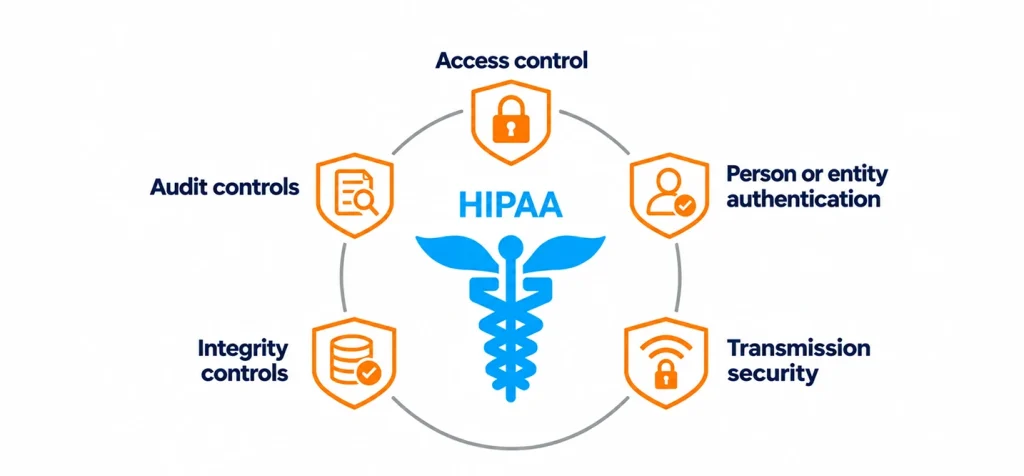
The HIPAA Security Rule establishes requirements for covered entities and business associates that create, receive, maintain, or transmit electronic protected health information (ePHI). It requires reasonable and appropriate administrative, physical, and technical safeguards to protect that information.
Several technical safeguards directly relate to the engineering practices discussed above:
| HIPAA Security Rule Safeguard | Related Software Security Practice |
| Access control | User permissions, RBAC, and controlled access to ePHI |
| Audit controls | Application activity logs and reviewable audit trails |
| Person or entity authentication | Identity verification and authentication mechanisms |
| Integrity controls | Measures that help prevent or detect improper alteration or destruction of ePHI |
| Transmission security | Protection against unauthorized access to ePHI transmitted over networks |
The HIPAA Security Rule is technology-neutral. It does not prescribe one programming language, cloud provider, encryption algorithm, or application architecture for every organization. Regulated entities must assess their circumstances and select reasonable and appropriate safeguards based on their risks and capabilities.
It is also important to distinguish security implementation from broader regulatory compliance. HIPAA compliance involves administrative and physical safeguards, policies, procedures, workforce responsibilities, and other obligations beyond application-level controls.
For a closer look at how these requirements affect application architecture and development, see our guide to healthcare app development and HIPAA compliance.
Common Healthcare Software Security Mistakes to Avoid
Even well-designed healthcare platforms can remain vulnerable when teams overlook basic security practices. Watch for these mistakes:
- Treating encryption as a complete security strategy: Encrypted data can still be exposed through weak authorization, compromised accounts, or insecure application logic.
- Giving users excessive permissions: Broad access increases the damage a compromised account can cause.
- Trusting authenticated users automatically: Every sensitive record and operation still needs an authorization check.
- Leaving outdated dependencies in production: Unpatched libraries and frameworks can introduce known vulnerabilities.
- Exposing sensitive information in logs: Debugging output, error messages, and application logs should not reveal unnecessary PHI or credentials.
- Testing security only before launch: New features, integrations, and infrastructure changes can introduce vulnerabilities after deployment.
- Ignoring third-party access: External vendors and services should receive only the access required for their functions.
- Assuming backups are usable: Recovery procedures must be tested, not simply documented.
Avoiding these mistakes requires clear ownership. Development, security, infrastructure, and operations teams should understand their responsibilities for protecting healthcare systems.
Healthcare Software Security Checklist for Development Teams
Use this checklist during architecture reviews, development, security testing, and production audits.
| Security Area | Review Question |
| Risk assessment | Have sensitive data flows, attack surfaces, and major threats been identified? |
| Architecture | Are critical services and sensitive environments appropriately isolated? |
| Access management | Are MFA, role-based permissions, and least-privilege controls implemented? |
| Encryption | Is sensitive data protected at rest and in transit, with restricted key access? |
| API security | Does every sensitive endpoint enforce resource-level authorization? |
| Secure coding | Are input validation, safe error handling, and secrets management part of development? |
| Security testing | Are SAST, DAST, SCA, API testing, and penetration testing included where appropriate? |
| Supply chain | Are third-party components inventoried and monitored for vulnerabilities? |
| Monitoring | Are security events logged, reviewed, and escalated when necessary? |
| Recovery | Are backups protected, and have restoration procedures been tested? |
A checklist is a starting point, not proof of security or HIPAA compliance. Teams should use it alongside risk assessments, documented security policies, technical testing, and ongoing reviews.
Secure Healthcare Software From Architecture Through Deployment
Healthcare software security requires more than adding encryption or authentication to an existing application. Teams must protect sensitive data flows, enforce access at the resource level, secure integrations, test application behavior, and monitor systems after deployment.
These controls work best when security is considered during architecture and carried through development, testing, release, and maintenance. Healthcare organizations building new platforms or modernizing existing systems should evaluate security alongside interoperability, performance, and clinical workflow requirements.
Cubix works on custom healthcare technology solutions, including applications and connected software systems. Explore our healthcare software development services to discuss the architecture and security requirements of your next project.
Planning a Healthcare Platform? Start With a Secure Foundation.
Contact Us
Frequently Asked Questions
1. What Are the Most Important Security Practices for Healthcare Software?
The most important practices include security risk assessments, strong access controls, encryption, secure API authorization, secure coding, vulnerability testing, continuous monitoring, and tested backup and recovery procedures.
2. How Do You Protect Patient Data in Healthcare Software?
Protect patient data through encryption, MFA, least-privilege access, secure APIs, server-side authorization, controlled data sharing, and audit logging. Also restrict access to production data in development and testing environments.
3. What Is the Difference Between Healthcare Software Security and HIPAA Compliance?
Healthcare software security focuses on technical and operational measures that protect applications, infrastructure, and patient information. HIPAA compliance is broader and includes applicable administrative, physical, and technical safeguards, along with policies and organizational responsibilities.
4. How Often Should Healthcare Software Undergo Security Testing?
Test throughout development, before major releases, after significant application or infrastructure changes, and as part of ongoing vulnerability management. The testing schedule should reflect the system’s risk, exposure, and operational requirements.
5. What Is Zero Trust Architecture in Healthcare Software?
Zero Trust is a security approach that does not automatically trust users, devices, or services based on their network location. It requires access requests to be verified and authorized according to identity, context, and permissions.
6. Why Is API Security Important in Healthcare Applications?
APIs connect healthcare applications with EHRs, laboratories, pharmacies, and other systems. Weak authentication or resource-level authorization can expose patient records or allow unauthorized changes to sensitive information.