Key Takeaways
- 2027 is the year AI moves from pilots to production. Agentic AI, coding agents and multimodal systems are leaving the lab and entering core workflows.
- Expect a shake-out. Gartner forecasts that over 40% of agentic AI projects will be cancelled by the end of 2027 because of cost, unclear value or weak risk controls.
- Costs and rules are the new constraints. Token-based pricing, AI governance and compliance spending will shape budgets as much as model quality.
- Smaller, domain-specific and edge models win on cost and control. Not every problem needs the largest model.
- Preparation beats prediction. Businesses that fix data, governance and skills now will capture the gains while others stall.
For the past three years, most companies treated AI as an experiment: a chatbot here, a copilot there, a proof of concept that rarely left the demo stage. That is changing fast. Gartner predicts that over 40% of agentic AI projects will be cancelled by the end of 2027, and the reasons it gives are escalating costs, unclear business value and inadequate risk controls. In other words, the technology is real, but the discipline around it is still catching up.
That tension defines the AI trends for 2027. Forrester frames the coming year as the point where AI moves from anticipation to disruption, with pressure building along several fault lines at once: work, software, security, regulation and customer expectations. Even long-range forecasts such as PwC’s 2017 estimate of $15.7 trillion added to the global economy by 2030 are now being tested against real budgets and real results.
This guide covers the 11 AI trends that will matter most to businesses and enterprises in 2027, which industries feel them first, how our own earlier predictions held up, and a practical plan to prepare. If you want broader context first, our guide to the future of generative AI is a good companion read.
What Are the Biggest AI Trends for 2027?
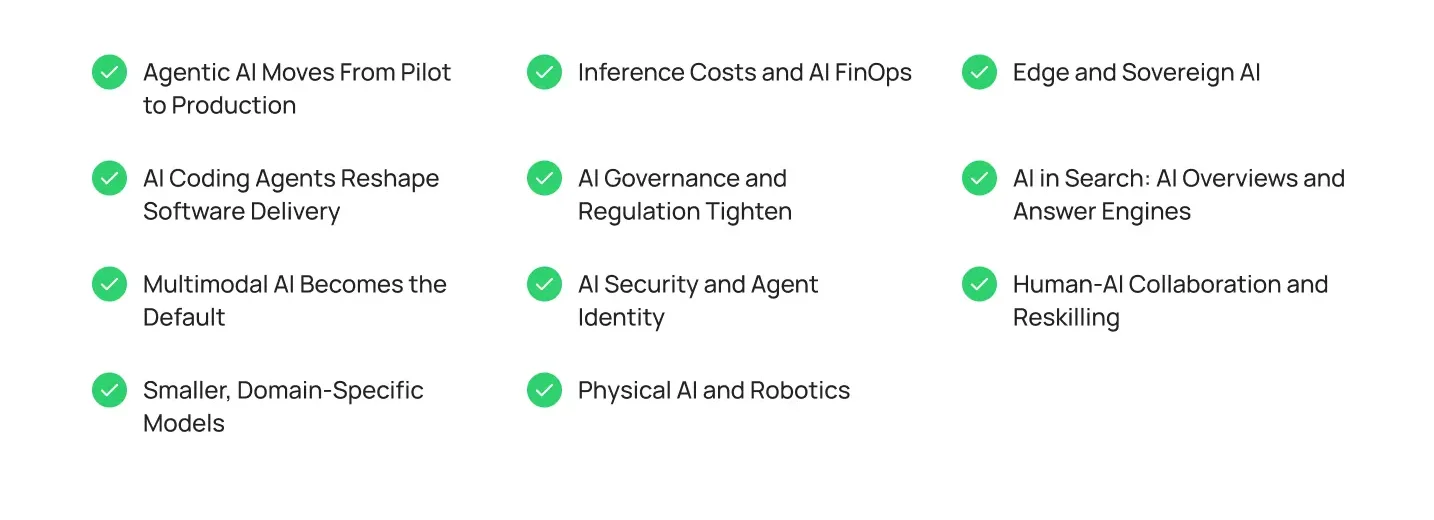
The biggest AI trends for 2027 are agentic AI in production, AI coding agents, multimodal AI, smaller domain-specific models, inference cost management, tighter AI governance, AI security, physical AI, edge and sovereign AI, AI-driven search and human-AI collaboration. The table below summarizes each one.
| Trend | What it means | Who it affects most |
|---|---|---|
| Agentic AI | Autonomous systems that plan and complete multi-step tasks | Operations, customer service, finance |
| AI coding agents | AI that writes, tests and reviews code | Engineering and product teams |
| Multimodal AI | Models that handle text, image, audio and video together | Retail, healthcare, media |
| Smaller, domain-specific models | Compact models tuned for one industry or task | Regulated industries, startups |
| Inference costs and AI FinOps | Usage-based pricing becomes a major budget line | CIOs, CFOs, IT operations |
| AI governance and regulation | Compliance, audits and risk management become mandatory | Legal, compliance, every enterprise |
| AI security and agent identity | Protecting systems from, and with, AI | CISOs, security teams |
| Physical AI and robotics | AI that perceives and acts in the real world | Logistics, manufacturing |
| Edge and sovereign AI | AI that runs locally or within national boundaries | Public sector, finance, telecom |
| AI in search | Answer engines reshape how customers find brands | Marketing, ecommerce |
| Human-AI collaboration | Roles and skills are redesigned around AI | HR, every department |
1. Agentic AI Moves From Pilot to Production
Agentic AI refers to systems that do more than answer questions. They set sub-goals, call tools, check results and act on a person’s behalf. AI agents in business are already handling ticket triage, invoice matching, lead qualification and internal IT requests. Gartner expects agents to augment around half of business decisions by 2027.
The warning label matters just as much. The same Gartner research that predicts rapid adoption also forecasts that more than 40% of agentic projects will be cancelled. The winners will pick narrow, measurable workflows, keep humans in the loop for high-risk steps and define success metrics before building. Our guide to scaling AI adoption covers how to avoid the common traps.
2. AI Coding Agents Reshape Software Delivery
AI coding agents now go beyond autocomplete. They read a repository, propose multi-file changes, run tests and open pull requests. In 2027, the question for engineering leaders will shift from whether to use them to how to govern them: code review standards, security scanning, licensing checks and clear ownership of AI-generated code.
Teams that benefit most pair agents with strong test coverage and clear architecture. Those that skip review simply ship bugs faster. Expect AI to move into testing, too, which we explore in our guide to AI in software quality assurance.
3. Multimodal AI Becomes the Default
Multimodal AI processes text, images, audio, video and structured data in a single system. Gartner forecasts that 80% of enterprise applications will be multimodal by 2030, which means 2027 is when early adopters start redesigning products around it rather than bolting it on.
Practical examples include a support assistant that reads a screenshot and a log file together, a retail app that searches by photo, and a clinical tool that combines notes, scans and lab results. For leaders, the implication is clear: audit where your customers and staff already use more than one type of input, and start there.
4. Smaller, Domain-Specific Models
Bigger is no longer automatically better. Small language models, fine-tuned on a company’s own data, can match larger general models on narrow tasks at a fraction of the cost and latency. They are also easier to host privately, which matters for healthcare, finance and legal work.
This trend replaces the older idea of custom specialized models with something more practical: a portfolio approach. Use a large model for open-ended reasoning, a small one for high-volume classification or extraction, and route requests between them.
5. Inference Costs and AI FinOps
Training gets the headlines, but inference, the cost of running models every day, is where budgets quietly balloon. Gartner’s infrastructure and operations research warns that enterprises using uncapped token-based pricing for IT operations agents will overshoot cost expectations by more than 50% through 2027.
AI FinOps is the response: tracking cost per task, setting token budgets, caching repeated queries, routing simple jobs to cheaper models and reviewing vendor contracts for usage caps. If you cannot explain what a completed AI task costs, you cannot prove it is worth doing.
6. AI Governance and Regulation Tighten
AI governance is shifting from a policy document to an operating function. The EU AI Act is phasing in obligations, US states continue to pass their own AI laws, and sector regulators are issuing guidance on automated decisions. Gartner estimates enterprises will invest around $5 billion in AI compliance efforts by 2027.
Timelines in this area keep moving, so check current dates for your market before you plan. Whatever the final calendar, the direction is stable: companies will need an AI inventory, risk classification, documentation, human oversight and audit trails. Building these now is cheaper than retrofitting them later.
7. AI Security and Agent Identity
AI creates new attack surfaces and new attackers. Prompt injection, data leakage through connected tools and AI-assisted phishing are already common. Agents add a further problem: an autonomous system that logs into software needs an identity, permissions and an audit trail, just like an employee.
In 2027, expect security teams to manage agent credentials, limit tool access by default and monitor agent behavior continuously. Our analysis of AI-driven cyberattacks explains how attackers are using the same technology and what defenses work.
8. Physical AI and Robotics
Physical AI brings models into the real world through warehouse robots, inspection drones, autonomous vehicles and humanoid prototypes. The shift is driven by better perception, simulation-based training and cheaper hardware. Most businesses will not buy a humanoid in 2027, but many will deploy AI-guided picking, sorting and quality inspection.
Simulation is the bridge. Digital twins let operators test robots and layouts virtually before committing capital, a theme we cover in supply chain digital twins.
9. Edge and Sovereign AI
Edge AI runs models on devices or local servers instead of the cloud, cutting latency and keeping sensitive data on site. Sovereign AI goes a step further: models, data and infrastructure that stay within a specific country or legal jurisdiction. Both are growing because of privacy rules, cost control and the need for AI that works offline.
For global businesses, data residency is becoming a design requirement rather than an afterthought. Ask early where your data and models will live.
10. AI in Search: AI Overviews and Answer Engines
Customers increasingly get answers from AI Overviews, chat assistants and answer engines before they ever visit a website. For marketers, visibility now means being cited, not only ranked. That favors clear, well-structured content with named authors, original data and trustworthy sources.
Practical steps include answering questions directly, using structured data and keeping pages fresh. Brands that earn citations in AI answers will gain trust at the exact moment customers form a shortlist.
11. Human-AI Collaboration and Reskilling
The real story of AI and jobs in 2027 is task redesign rather than mass replacement. Routine drafting, summarizing, data entry and first-line support are shifting to AI, while people move toward judgment, exception handling and relationship work. That requires new skills: prompting, verifying AI output, understanding data quality and managing agents.
Companies that invest in training, and that tell employees honestly how roles will change, see faster adoption and less resistance.
Which AI Trends Matter for Your Industry?
Not every trend lands equally. Here is where each industry should focus first.
| Industry | Top trends to watch | Starting point |
|---|---|---|
| Healthcare | Multimodal AI, domain-specific models, governance | Clinical documentation and imaging support, built on AI in healthcare best practices |
| Fintech | Agentic AI, AI security, compliance | Fraud monitoring and automated reporting with strong audit trails |
| Retail and ecommerce | Multimodal AI, AI search, agents | Visual search, personalization, support automation |
| Gaming | Coding agents, generative content, physical-world simulation | AI-assisted asset creation and playtesting |
| Logistics | Physical AI, digital twins, edge AI | Route optimization, warehouse vision, predictive maintenance |
Whatever your sector, the foundation is the same: clean data and clear decisions. Our blueprint for data-driven decision making shows how to build it.
How Did Our 2025 AI Predictions Hold Up?

When we wrote the 2025 edition of this guide, we pointed to specialized models, edge AI, multimodal capabilities and wider enterprise adoption. Those directions held up. Smaller models, on-device AI and multimodal products all became mainstream.
Where we fell short is just as instructive. We under-weighted agentic AI, reasoning-focused models, AI coding agents, inference costs and AI governance, which have since become the main topics in boardrooms. We also gave too much attention to short-lived product launches that have already changed or faded. The lesson is to bet on durable shifts in capability, cost and regulation, and to treat individual product names with caution. Our predictions for generative AI follow the same principle.
How Should Businesses Prepare for AI in 2027?
AI will change business through automation of routine work, faster software delivery and new customer experiences, but only for organizations that prepare. A practical eight-step plan:
- Audit your AI footprint. List every tool, model and pilot in use, including unofficial ones.
- Pick two or three high-value workflows. Choose processes with clear metrics and manageable risk.
- Fix your data. Agents and models are only as good as the data they can reach.
- Set up governance early. Define owners, risk tiers, human-review points and documentation.
- Build a cost model. Track cost per task, set token budgets and negotiate usage caps.
- Secure your agents. Give each one an identity, minimal permissions and logging.
- Train your people. Teach verification, prompting and agent supervision.
- Measure and cut. Stop projects that miss their targets. A smaller portfolio that works beats a large one that does not.
Not every business has the budget for a large program. Small and mid-size companies can start with off-the-shelf tools, one narrow use case and a clear success metric, then expand once value is proven.
Turn AI Trends Into Results With Cubix
Trends only matter when they become working systems. Cubix is an AI development company that helps US businesses move from strategy to production, from agent design and custom model development to governance, security and cost control. Our teams have delivered AI across healthcare, fintech, retail and gaming, and we start every engagement with a business outcome rather than a model.
Ready to plan your 2027 AI roadmap? Talk to our AI team and get a practical, prioritized plan for your business.
Turn AI opportunities into business results with Cubix
Contact UsFrequently Asked Questions
1. What are the top AI trends for 2027?
The top AI trends for 2027 are agentic AI moving into production, AI coding agents, multimodal AI, smaller domain-specific models, inference cost management and tighter AI governance. Security, physical AI, edge and sovereign AI, AI-driven search and human-AI collaboration complete the list.
2. What is agentic AI and why does it matter for businesses?
Agentic AI describes systems that plan, decide and act across multiple steps with limited supervision, rather than only generating text. It matters because agents can automate whole workflows, such as support or invoice processing, but they also raise cost, security and accountability questions that need governance.
3. Will AI replace jobs in 2027?
AI will change many jobs far more than it will eliminate them in 2027. Routine tasks like drafting, summarizing and data entry are being automated, while demand grows for oversight, judgment and AI skills. Some roles will shrink, so reskilling and honest workforce planning are essential.
4. Which AI trend will have the biggest impact on business?
Agentic AI is likely to have the biggest impact because it automates complete workflows instead of single tasks. Its success depends on cost control, governance and security. Companies that pair agents with clear metrics and human oversight should see the strongest returns.
5. How can small and mid-size businesses use AI trends without big budgets?
Start with one narrow, high-value use case and use existing tools or smaller models rather than building from scratch. Set a clear success metric, track cost per task and expand only after proving value. A focused pilot with a trusted partner reduces both cost and risk.
6. What are the risks of adopting AI too fast?
The main risks are runaway costs, security gaps, compliance failures, poor data quality and projects without clear business value. Gartner expects over 40% of agentic AI projects to be cancelled by 2027. Phased rollouts, governance and measurable goals reduce the chances of joining them.