Key Takeaways
- AR and VR game development follows a clear process: concept, engine selection, asset creation, mechanics, testing, and launch.
- Unity and Unreal Engine are the two engines behind almost every AR/VR title on the market today.
- AR games run on ARKit, ARCore, and camera-based tracking. VR games run on headset SDKs and motion controllers.
- Performance and comfort testing matter more in XR than in regular flat-screen games.
- Timelines and costs swing wildly based on scope, platform, and whether multiplayer is involved.
- Cubix builds custom AR and VR games and can walk your team through the entire pipeline.
The global AR and VR market is worth close to $118.79 billion in 2026. That number alone tells you this isn’t a niche hobby anymore. Gaming and virtual experiences make up more than half of that market, which means a huge chunk of this money is coming straight from players holding phones or wearing headsets.
So how does a game actually go from an idea to something you can point your phone at, or strap to your face? It’s not magic. It’s a process with real steps, real tools, and real tradeoffs. Studios plan the concept, pick an engine, build the assets, write the logic, and test it on real devices before anyone sees it.
This guide walks through that entire AR and VR game development process. You’ll see the tools developers actually use, what things cost, how long projects take, and where this industry is headed next. No jargon dump. Just a clear look at how AR and VR games are made.
Got AR/VR game idea worth building? Let’s make it happen
Contact UsWhat Makes AR and VR Game Development Different
Regular games live on a flat screen. AR and VR games live in your actual space, or in a space built to fool your brain. That one difference changes almost everything about how a team builds the game.
How AR Games Work
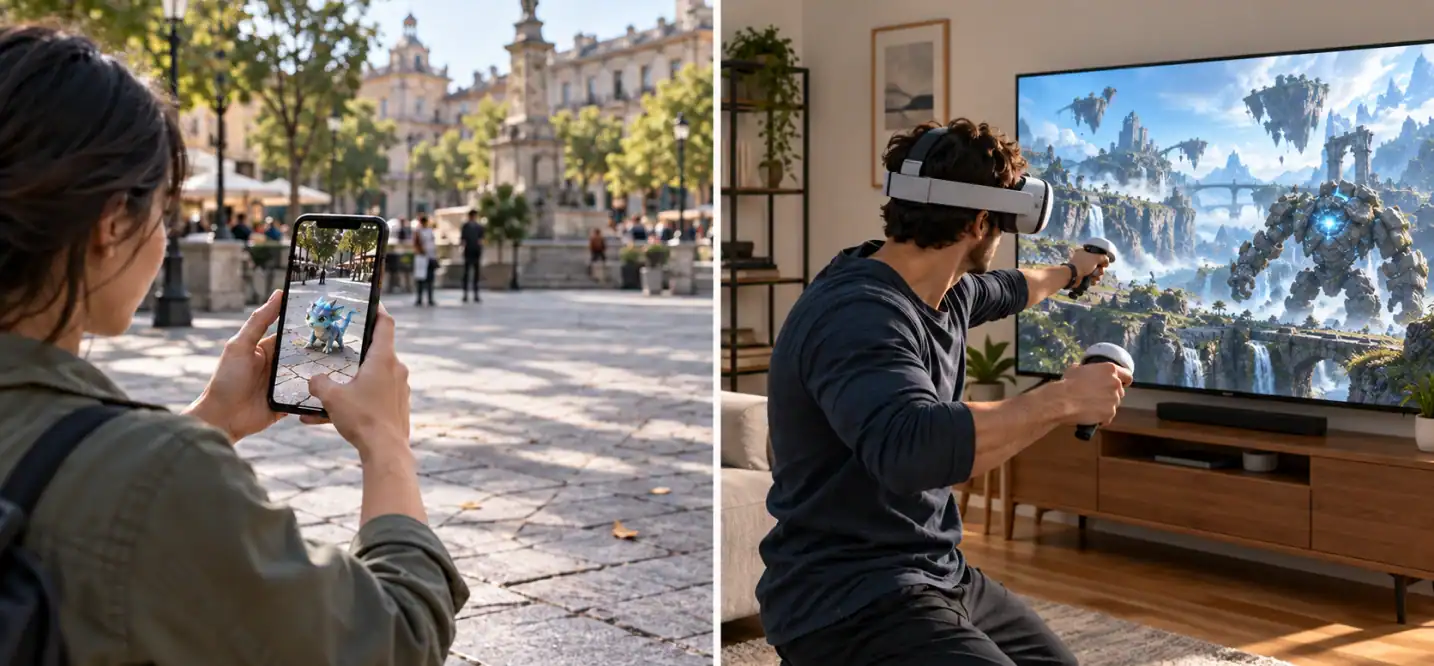
AR games use your phone’s camera to read the real world. The software maps your floor, your walls, your coffee table, then drops virtual objects into that space. Games like Pokémon GO made this mainstream, but the underlying tech has gotten a lot sharper since then. Newer AR development leans on LiDAR sensors and 5G to place objects more accurately and keep them locked in place as you move.
How VR Games Work
VR games block out the real world completely. Players wear a headset and step into a fully rendered 3D environment. Every wall, prop, and character is generated by the engine, not the camera. This is why VR game development spends so much time on physics, spatial audio, and movement, since none of that comes from the real world anymore.
- AR blends virtual content with your real surroundings
- VR replaces your surroundings with a simulated world
- AR usually needs just a smartphone
- VR needs a dedicated headset and often a play space
- AR is easier to pick up and play in short bursts
- VR aims for longer, deeper immersion
AR vs VR — Quick Comparison
| Factor | AR Games | VR Games |
| Hardware | Smartphone, tablet, AR glasses | VR headset (Quest, PSVR, Vive) |
| Tracking Method | Camera + sensors (ARKit/ARCore) | Inside-out or outside-in tracking |
| Input | Touchscreen, gestures | Motion controllers, hand tracking |
| Environment | Real world + virtual overlay | Fully simulated 3D environment |
| Hardware Cost | Low (uses existing phone) | Medium to high (separate headset) |
| Example Titles | Pokémon GO, Jurassic World Alive | Beat Saber, Half-Life: Alyx |
The Step-by-Step AR/VR Game Development Process
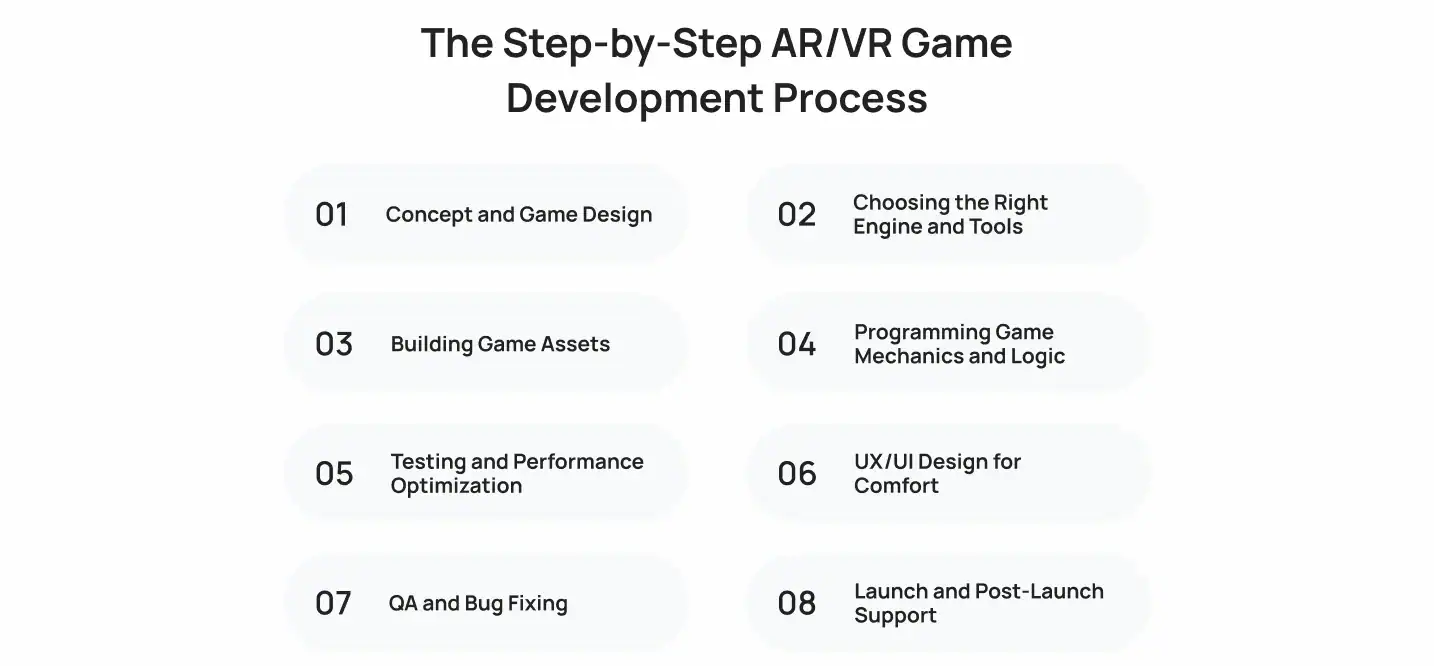
Every AR or VR title, big or small, moves through roughly the same pipeline. The order rarely changes, even if the scale does.
Step 1: Concept and Game Design
Every project starts with a simple question: what’s the experience actually about? Teams sketch out the game design, pick a target platform, and decide what makes the experience worth putting on someone’s face or phone. This stage produces a design document, rough storyboards, and early concept art.
Step 2: Choosing the Right Engine and Tools
Next comes the technical foundation. For AR, that usually means ARKit for iOS or ARCore for Android. For VR, it’s almost always Unity or Unreal Engine, paired with an SDK for the target headset. This choice shapes everything that follows, so studios don’t take it lightly.
Step 3: Building Game Assets
This is where the world starts to look like something. Artists build 3D models, textures, animations, and sound. Every asset also has to be optimized, since AR and VR hardware has far less headroom than a gaming PC or console.
Step 4: Programming Game Mechanics and Logic
With assets ready, developers write the game mechanics and game logic that make everything interactive. This includes object recognition and marker tracking for AR, or physics, hand tracking, and controller input for VR. This step is where “game” actually becomes a game.
Step 5: Testing and Performance Optimization
XR hardware is unforgiving. A frame rate drop that’s annoying on a phone can cause real nausea in a headset. Teams test across multiple devices and tune graphics, physics, and load times until performance holds steady.
Step 6: UX/UI Design for Comfort
Menus, HUDs, and controls all need rework for XR. Flat-screen UI patterns don’t translate well into 3D space. Comfort is a real design constraint here, not an afterthought, especially for VR where the wrong camera movement can make players sick.
Step 7: QA and Bug Fixing
Before launch, the game goes through rounds of quality assurance. Testers hunt for crashes, tracking glitches, and anything that breaks immersion. Most studios repeat this cycle several times before they’re happy.
Step 8: Launch and Post-Launch Support
The game ships, but the work doesn’t stop. Updates, patches, and new content keep players around. Most successful AR/VR games treat launch as day one, not the finish line.
Most AR/VR titles take anywhere from four months to over a year to build, depending on scope and platform count.
Technology Behind AR Game Development
AR development leans heavily on a handful of core technologies, and picking the right combination matters a lot.
ARKit vs ARCore
ARKit powers AR development on iOS, while ARCore does the same job on Android. Both handle motion tracking, environmental understanding, and light estimation, but each ties closely to its own platform’s hardware.
Marker-Based vs Markerless Tracking
Older AR apps used printed markers or QR-style images to anchor virtual content. Most modern augmented reality games development now uses markerless tracking instead, reading the environment directly through the camera without needing a printed cue.
The Role of LiDAR and Spatial Mapping
Newer phones pack LiDAR sensors that measure depth in real time. This lets games understand room shape almost instantly, which means faster, more stable placement of virtual objects and better object occlusion, where a virtual character can correctly hide behind your real couch.
- ARKit and ARCore for native mobile AR
- Vuforia and Wikitude for cross-platform AR
- 8th Wall for browser-based AR experiences
- OpenXR for cross-device compatibility
The global AR gaming market sits at roughly $13.8 billion in 2026 and is projected to grow at over 22% a year through 2031, largely on the back of 5G rollout and better LiDAR sensors.
Technology Behind VR Game Development
VR development works with a different toolkit, built around headsets rather than cameras.
VR Headsets and SDKs
Meta Quest, PlayStation VR, and HTC Vive each ship their own SDK. Developers build against these SDKs to handle tracking, rendering, and input for that specific headset.
Motion Controllers and Hand Tracking
Players interact through handheld controllers or, increasingly, tracked hand movement with no controller at all. Both need precise, low-latency input handling to feel natural instead of laggy.
Physics and Spatial Interaction
Since the whole environment is virtual, physics has to carry a lot of weight. Grabbing an object, throwing it, or leaning against a wall all need to feel physically real, or the immersion breaks fast.
Popular VR Headsets and Their Development Ecosystems
| Headset | Primary SDK | Tracking Type | Common Engine |
| Meta Quest 3 | Meta XR SDK | Inside-out (cameras) | Unity, Unreal |
| PlayStation VR2 | PS VR2 SDK | Inside-out + eye tracking | Unreal, proprietary |
| HTC Vive | SteamVR / OpenXR | Outside-in (base stations) | Unity, Unreal |
| Valve Index | SteamVR / OpenXR | Outside-in (base stations) | Unity, Unreal |
The consumer segment, which includes gaming and virtual concerts, now makes up over 50% of the entire AR/VR market. Gaming is genuinely driving this industry forward, not riding along behind it.
Game Engines Used for AR/VR Development
Almost every AR or VR game you’ve played was built on one of two engines.
Unity for AR/VR
Unity is the default choice for most XR studios. It’s lighter, easier to learn, and has deep native support for ARKit, ARCore, and every major VR headset SDK.
Unreal Engine for AR/VR
Unreal Engine shows up more often in visually heavy, high-budget VR titles. Its rendering quality is hard to beat, though the learning curve is steeper and it demands more from the hardware.
Unity vs Unreal Engine for AR/VR Development

| Factor | Unity | Unreal Engine |
| Learning Curve | Easier for beginners | Steeper, more complex |
| Graphics Quality | Strong, highly customizable | Best-in-class out of the box |
| Platform Support | Broadest AR/VR device support | Strong, slightly narrower |
| Scripting Language | C# | C++ and Blueprints |
| Best For | Mobile AR, indie VR, fast iteration | High-fidelity VR, cinematic titles |
| Pricing Model | Free tier, revenue-based fees | Free tier, royalty on revenue |
- Pick Unity if you need broad device support and faster development cycles
- Pick Unreal if visual fidelity is the top priority and your team has the technical depth
Industry estimates have long put Unity’s share of AR/VR content development well above its share of traditional gaming, with multiple reports placing it anywhere from 70% to over 90% of XR titles built.
Cost and Timeline to Develop an AR/VR Game
Budget questions come up early in almost every conversation with a new client. The honest answer: it depends a lot on scope.
Factors That Affect Development Cost
- Platform count (mobile-only AR vs multi-headset VR)
- Asset complexity (stylized vs photorealistic)
- Multiplayer and backend requirements
- Custom hardware features like haptics or eye tracking
- Post-launch support and content updates
Typical Timeline by Complexity
Simple AR games with basic mechanics can ship in a few months. Complex, multiplayer VR titles with custom assets can take well over a year.
Cost and Timeline Breakdown by Game Complexity
| Complexity | AR Cost Range | VR Cost Range | Typical Timeline |
| Simple | $15K – $40K | $25K – $60K | 2 – 4 months |
| Mid-Complexity | $40K – $90K | $60K – $150K | 4 – 8 months |
| Complex | $90K – $180K+ | $150K – $300K+ | 8 – 14 months |
The broader AR/VR gaming market was valued at $23.9 billion in 2024 and is projected to reach $462.8 billion by 2034, growing at a CAGR of over 34%. That kind of growth is exactly why more studios are willing to invest in bigger XR projects now.
Common Challenges in AR/VR Game Development
XR development brings problems flat-screen games simply don’t have.
- Motion sickness caused by movement mismatches between the eyes and inner ear
- Hardware fragmentation across dozens of phone models and headset types
- Battery drain from constant camera and sensor use in AR
- Strict frame rate requirements to avoid discomfort
- Limited field of view compared to natural human vision
- Real-world lighting conditions that throw off AR tracking
How Studios Like Cubix Solve These Challenges
Experienced teams get ahead of these problems early instead of patching them later. At Cubix, that means device-specific optimization from day one, comfort-focused camera design for VR, and rigorous cross-device QA before anything ships. Studios that skip this step usually pay for it in bad reviews.
Discomfort remains one of the top reasons players stop using a VR app within the first few sessions, which is exactly why comfort testing gets so much attention during development.
Multiplayer and Social Features in AR/VR Games
Playing alone is fine, but playing together is where a lot of AR/VR games find their real audience.
Networking Challenges in XR
Syncing player positions, object states, and interactions across multiple headsets or phones in real time is genuinely hard. Latency that’s invisible in a normal online game can cause real disorientation in VR.
Popular Multiplayer AR/VR Titles
Games like Pokémon GO, Rec Room, and VRChat built entire communities around shared, social AR/VR spaces. Location-based, social AR experiences are becoming a category of their own.
The location-based entertainment market, which includes a lot of shared AR/VR experiences, is projected to hit $15.33 billion by 2029, growing at nearly 23% a year. Social and shared experiences aren’t a side feature anymore. They’re a growth driver.
Where AR/VR Game Development Is Headed
The technology is still moving fast, and a few trends stand out.
AI in AR/VR Game Design
AI is starting to handle procedural environments, smarter NPC behavior, and faster asset generation. This is speeding up production timelines across immersive gaming projects.
Cloud Rendering and 5G’s Role
5G is becoming the backbone of cloud XR, where heavy graphics processing happens on remote servers instead of the headset itself. This cuts hardware weight and heat, while keeping latency low enough to avoid motion sickness in fast-paced multiplayer VR.
- Spatial computing becoming a mainstream platform, not a buzzword
- Lightweight AR glasses built for all-day wear
- Cross-platform XR titles that work across phones and headsets
- Deeper integration between AI and real-time 3D environment generation
The metaverse gaming market alone is projected to hit $119.2 billion by 2028, growing at a CAGR of 39.3%. Spatial computing isn’t a future concept anymore. It’s already being built.
Why Work With a Dedicated AR/VR Game Development Company
Building an AR or VR game in-house sounds doable until you encounter device fragmentation, comfort testing, and platform-specific certification requirements. A specialized game development service provides the engine expertise, cross-platform build pipelines, and QA processes that many in-house teams may not have developed yet.
- Deep, hands-on experience with Unity and Unreal for XR
- Established QA pipelines built specifically for AR/VR comfort and performance
- Faster time to market through reusable tools and frameworks
- Post-launch support that keeps a game alive well past release day
Cubix works as a VR game development partner for studios that want an experienced team handling the technical heavy lifting, from prototype through launch.
How Cubix Builds AR/VR Games
Cubix runs AR and VR projects through the same disciplined process covered in this guide, just with the tools and experience to move faster and avoid the common pitfalls.
- Full-cycle development, from concept and game design through launch
- Deep expertise across Unity and Unreal Engine for both AR and VR
- Support for multiplayer, networking, and social features
- Rigorous QA across devices, headsets, and platforms
- Ongoing post-launch updates and support
If your team is planning an AR or VR title and wants a partner who’s done this before, Cubix is worth a conversation.
Final Thoughts
AR and VR game development isn’t as mysterious as it looks from the outside. It’s concept, tools, assets, mechanics, testing, and launch, repeated with discipline and a lot of attention to comfort and performance. The market is only getting bigger, and the studios that treat this process seriously are the ones building games people actually stick with.
If you’re exploring your own AR or VR project, it’s worth checking out some of the best augmented reality games already on the market, comparing top gaming platforms, or looking at how top game development companies approach these builds. And if you want a broader primer first, this game development overview is a solid place to start.
Cubix has built AR and VR games across genres and platforms, and can help take your idea from a design document to something players can actually pick up and play.
Ready to build your next AR/VR game? Hop on board now
Contact UsFrequently Asked Questions
1. How are AR and VR games made?
They’re built through a structured process: concept and design, engine and tool selection, asset creation, programming game mechanics, testing, UX design, QA, and launch. AR games add camera-based tracking, while VR games add headset-specific rendering and physics work.
2. What technology is used to make AR games?
AR games typically use ARKit for iOS, ARCore for Android, and frameworks like Vuforia or 8th Wall for cross-platform builds. Many also rely on LiDAR sensors for more accurate spatial mapping.
3. What technology is used to make VR games?
VR games are built using Unity or Unreal Engine, paired with a headset-specific SDK such as the Meta XR SDK, SteamVR, or the PS VR2 SDK, along with motion controller or hand-tracking input systems.
4. Is Unity or Unreal better for AR/VR game development?
Unity is generally easier to learn and has broader device support, making it a common choice for AR and indie VR titles. Unreal Engine offers stronger visual fidelity, which makes it popular for high-budget, cinematic VR experiences.
5. How long does it take to develop an AR/VR game?
Simple AR/VR games can take 2 to 4 months. Mid-complexity projects usually run 4 to 8 months, while complex, multiplayer VR titles can take 8 to 14 months or longer.
6. How much does it cost to develop an AR/VR game?
Costs range from around $15,000 for a simple AR game to $300,000 or more for a complex, multiplayer VR title, depending on platform count, asset complexity, and backend requirements.
7. What programming languages are used for AR/VR games?
C# is the primary language for Unity-based AR/VR projects, while C++ (along with Blueprints) is used for Unreal Engine development. Swift and Kotlin also come into play for native mobile AR features.
8. Can AR and VR games be built for mobile devices?
Yes. AR games are largely built for mobile devices using ARKit and ARCore. VR mobile options exist too, though most dedicated VR experiences still run on standalone or tethered headsets rather than phones alone.
9. Can AR/VR games support multiplayer?
Yes, and many of the most popular titles do. Multiplayer AR/VR games require real-time syncing of player positions and interactions, which adds networking complexity compared to single-player builds.
10. What devices can run AR and VR games?
AR games run on most modern smartphones and tablets with ARKit or ARCore support, plus emerging AR glasses. VR games run on headsets like Meta Quest, PlayStation VR2, HTC Vive, and Valve Index.