Key Takeaways
- Hospitality app development covers guest apps, staff apps, and booking apps built for hotels.
- Mobile check-in, digital room keys, and in-app room service cut down guest friction.
- AI chatbots and IoT room controls are becoming standard, not extra.
- Personalization and loyalty features inside apps keep guests coming back.
- Costs vary a lot depending on features and integrations.
- Cubix builds hospitality apps that connect guest experience with real hotel operations.
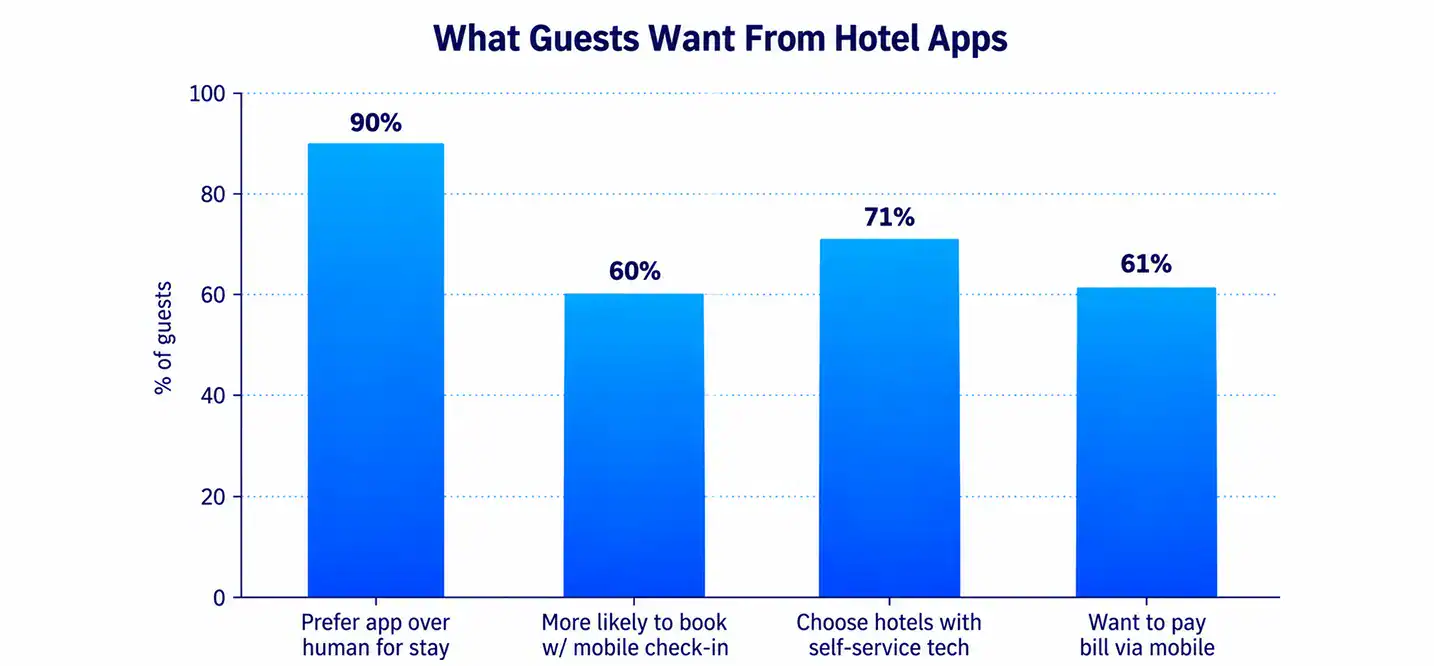
9 out of 10 travelers would rather use an app than talk to a person during their hotel stay. That’s not a small preference. That’s a shift in how guests want to be treated.
Hotels used to compete on thread count and lobby chandeliers. Now guests judge a stay by how smooth their phone experience is. Can they check in without waiting? Can they order towels without calling the front desk? Can they skip the key card altogether?
This is where hospitality app development comes in. In this guide, we’ll walk through what hotel apps actually do, which features matter most, what they cost, and how hotels use them to win guests back, again and again.
Got hotel app idea worth building? Let’s make it happen
Contact UsWhat Is Hospitality App Development?
Hospitality app development is the process of building software for hotels, resorts, and short-term rentals. It covers apps guests use during their stay, plus apps staff use behind the scenes.
Most hospitality apps fall into a few buckets:
- Guest-facing apps – check-in, room service, requests, messaging
- Staff and operations apps – housekeeping, maintenance, task management
- Booking and loyalty apps – reservations, rewards, personalized offers
- IoT-connected apps – smart locks, in-room controls, sensors
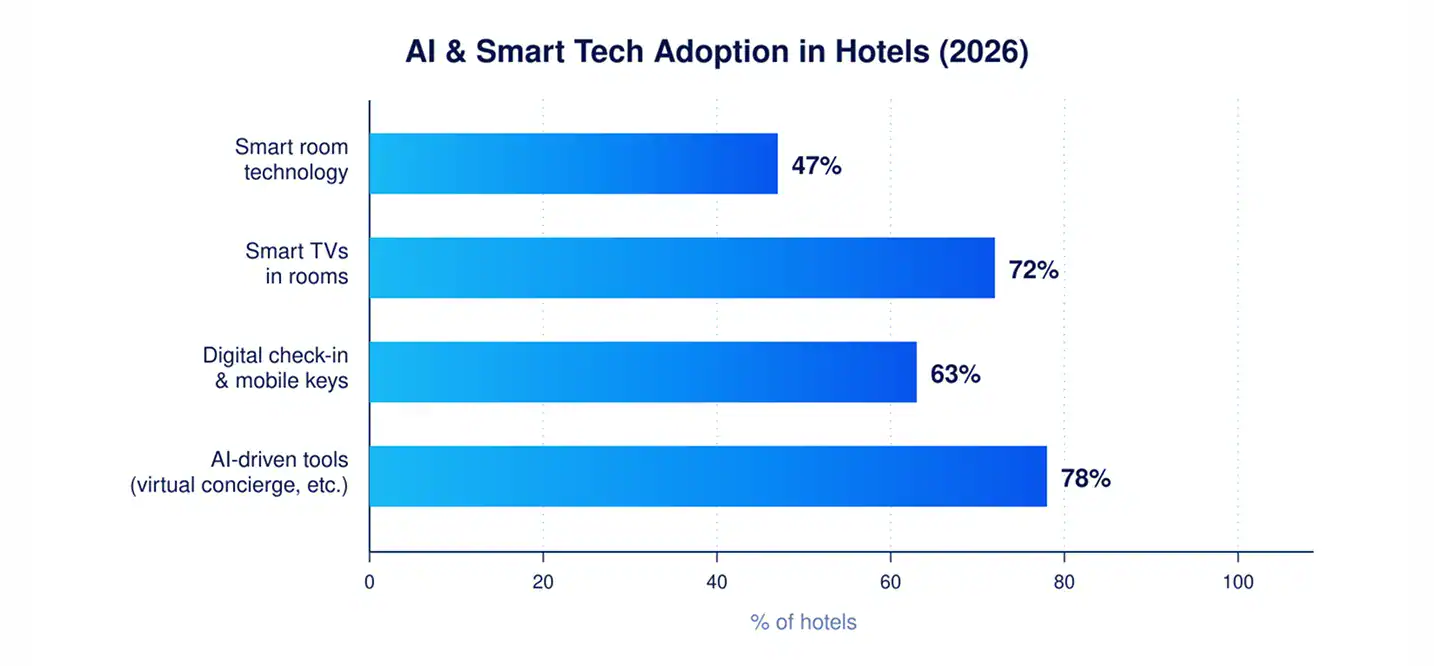
Roughly 7 in 10 hotels already use some form of AI-powered app or plan to within two years. That number alone shows this isn’t a niche investment anymore. It’s becoming the baseline.
Why Hotels Need Apps Today
Guests Expect Digital-First Stays
Guests already book flights, order food, and manage their bank accounts from their phone. They expect their hotel to work the same way. A property without an app now feels behind, even if the rooms are great.
Hotels Are Losing Bookings Without One
This isn’t just about convenience. It affects revenue directly. Guests are more likely to book, and rebook, hotels that offer digital-first tools.
- 60% of guests are more likely to choose a hotel offering mobile check-in
- 71% say they’re more likely to book a hotel with self-service technology
- Nearly 9 in 10 want an app that lets them manage their entire stay without talking to staff
Traditional Hotel Experience vs. App-Enabled Experience
| Guest Task | Traditional Way | App-Enabled Way |
| Check-in | Wait in line at the front desk | Check in from your phone before arrival |
| Room access | Physical key card | Mobile room key, tap to unlock |
| Room service | Call the front desk | Order in-app, track delivery |
| Requests (towels, etc.) | Call or walk to desk | Tap a button, get notified when done |
| Payments | Pay at checkout counter | Pay in-app, split or itemize easily |
| Communication | Phone calls, in-person | Chat, push notifications, virtual concierge |
If you want to see how this compares across the broader travel industry, our guide on travel app development breaks down similar shifts happening in flights and bookings.
Must-Have Features in a Hospitality App
Not every app needs every feature. But a handful of them show up in nearly every successful hotel app, because they solve real friction points.
Mobile Check-in & Checkout
Guests skip the line entirely. They fill out forms, verify ID, and get room assignments before they even arrive.
Mobile Room Keys
No plastic card to lose. The phone becomes the key, using Bluetooth or NFC to unlock doors.
Room Service & In-App Ordering
Guests order food, drinks, or amenities right from the app. Orders go straight to kitchen or housekeeping systems.
- 18% increase in room service orders when ordering happens through mobile, compared to phone calls
Virtual Concierge
A chat-based assistant answers questions about hotel hours, local recommendations, or amenities, day or night.
Push Notifications
Timely alerts about check-in windows, local events, or personalized offers keep guests engaged without being intrusive. Done right, push notifications drive real engagement instead of getting ignored.
Payment Processing
Guests pay bills, tips, or extras directly in-app, without a trip to the front desk.
- 61% of travelers say they want to pay their hotel bill through a mobile app
Building all of this well takes more than a basic app shell. It requires real mobile application development expertise, especially when payments and room systems are involved.
How AI Is Changing Hotel Apps
AI in hospitality isn’t science fiction anymore. It’s quietly running behind the scenes in a growing number of properties.
AI Chatbots for Guest Support
AI chatbots handle repetitive questions instantly. What time is checkout? Where’s the pool? Can I get a late checkout? A good chatbot resolves most of these without a human ever getting involved.
Personalization at Scale
AI looks at booking history, preferences, and behavior to suggest things guests actually want, a room upgrade, a dinner reservation, a spa slot, at the right moment.
- 78% of hotels now use AI-driven tools like virtual concierges and voice assistants
AI Use Cases in Hospitality Apps
| AI Use Case | What It Does | Guest Benefit |
| Chatbot support | Answers FAQs, handles simple requests | Instant answers, 24/7 |
| Predictive personalization | Suggests offers based on guest history | Feels tailored, not generic |
| Dynamic pricing | Adjusts room rates based on demand | Fairer, more accurate pricing |
| Voice assistants | Controls room features by voice command | Hands-free convenience |
| Sentiment analysis | Flags unhappy guests from messages/reviews | Faster service recovery |
If you’re exploring this beyond hospitality, our breakdown of AI in mobile apps covers how these same features apply across industries.
IoT and In-Room Control
IoT integration connects physical hotel rooms to the app on a guest’s phone. It’s what makes “smart rooms” actually smart.
Guests can control lighting, temperature, curtains, and TV, all from one screen. Some properties go further, letting rooms learn guest preferences and adjust automatically before they even walk in.
- Mobile key adoption is projected to climb above 70% in hotels worldwide
Hotels using this kind of automation also see a practical upside beyond guest comfort. Properties running smart room systems report energy savings of up to 25%, just from automated lighting and climate control.
Guest Engagement and Loyalty Through Apps
Personalization Drives Repeat Bookings
Guests remember hotels that remember them. A returning guest who gets their preferred room type, without asking, is far more likely to book direct next time instead of going through an OTA.
Loyalty Programs Built Into the App
Points, tier status, and rewards work better when they live inside the app guests already use daily. No separate login, no forgotten passwords.
- 86% of guests would choose one hotel over another if it offered a fully contactless, app-based experience
Loyalty only works if the data behind it is organized well. That’s where a solid CRM for travel companies matters just as much as the app itself. Strong user engagement strategies, borrowed from other industries, apply here too.
How Apps Improve Guest Analytics
Every tap inside a hotel app is a data point. Check-in times, most-ordered room service items, common complaints, all of it tells hotels what’s working and what isn’t.
- 93% of guests who used digital check-in said they were satisfied or extremely satisfied
- 76% say mobile check-in minimizes frustration compared to standing in line
Data Hotels Can Track Through Apps
| Data Type | How It’s Collected | What It’s Used For |
| Check-in/checkout times | App timestamps | Staffing and front-desk planning |
| Service requests | In-app request logs | Spotting recurring pain points |
| Order history | Room service, in-app purchases | Menu and upsell planning |
| Guest feedback | In-app surveys, chat sentiment | Service recovery, reviews |
| App usage patterns | Feature click data | Improving the app itself |
Cost to Develop a Hospitality App
There’s no single price tag here. Cost depends on features, integrations, and how custom the build needs to be.
Estimated Cost Ranges by App Complexity
| Tier | Core Features | Estimated Cost Range |
| Basic | Check-in, hotel info, simple requests | $30,000 – $60,000 |
| Mid-tier | + Payments, room service, push notifications | $60,000 – $120,000 |
| Advanced | + AI chatbot, IoT controls, loyalty, full PMS integration | $120,000 – $250,000+ |
These are rough industry ranges, not fixed quotes. The real number depends on your property size, existing systems, and how deep the AI and IoT integration goes. Working with a custom mobile app development company like Cubix helps you scope this accurately before writing a single line of code.
Common Challenges in Hospitality App Development
Building a hotel app isn’t just design and code. A few things trip up teams that skip planning.
- System integrations – connecting to your PMS, POS, and CRM without breaking existing workflows
- Data security – protecting guest payment and personal data across every touchpoint
- Offline functionality – making sure core features still work with weak hotel wifi
- Staff adoption – getting your team to actually use the operations side of the app
Staffing shortages make this even more pressing. 87% of hotels report ongoing staffing shortages, which is exactly why automation through apps matters so much right now. It’s a similar complexity curve to what we’ve seen in real estate app development, where integrations with third-party systems make or break the project.
Hotel Systems Your App Needs to Connect With
A hotel app doesn’t work in isolation. It needs to talk to the systems already running your property.
- PMS (Property Management System) – syncs bookings, room status, guest profiles
- POS (Point of Sale) – handles restaurant, bar, and spa charges
- CRM – stores guest preferences and loyalty data
- Payment gateways – processes secure transactions
- IoT hardware – smart locks, thermostats, lighting systems
Getting these integrations right is the difference between an app guests love and one that constantly breaks. This is a core part of what hospitality software development solutions should cover from day one.
Why Choose Cubix for Hospitality App Development
Building a hotel app that actually works, end to end, takes more than a design team. It takes engineers who understand hotel operations, not just app screens.
Cubix has spent years building apps across travel, real estate, and hospitality, industries where integrations and reliability matter as much as design. That experience shows up in how a hospitality app gets built.
- End-to-end development – from strategy and design through launch and support
- AI integration experience – chatbots, personalization engines, predictive tools built in-house
- IoT expertise – smart lock, in-room control, and sensor integrations done right
- Post-launch support – apps that get maintained, not abandoned after launch
If your hotel is ready to move past outdated systems, Cubix builds hospitality software solutions designed around how guests actually behave, not just how hotels wish they behaved.
Get Started With Cubix
Here’s what working with Cubix on a hospitality app typically looks like:
- Consult – we look at your current systems, guest pain points, and goals
- Build – design and development happen in parallel, with regular check-ins
- Launch – your app goes live, tested across devices and integrations
- Support – we stick around for updates, fixes, and new features
Whether you need a full hospitality app built from scratch or want to upgrade an existing one, Cubix’s hospitality software development solutions are built to fit your property, not a generic template. Reach out to a custom mobile app development company that’s already done this work, and skip the trial and error.
Ready to build a smarter hotel app? Let’s make it happen
Contact UsFrequently Asked Questions
1. What features should a hotel app have?
At minimum, mobile check-in, digital room keys, in-app room service, push notifications, and payment processing. Advanced apps add AI chatbots, loyalty programs, and IoT room controls.
2. How does mobile check-in improve guest experience?
It cuts wait times, reduces front-desk congestion, and gives guests control over their arrival. Studies show over 90% of guests using digital check-in report being satisfied or extremely satisfied.
3. What is the cost to develop a hospitality app?
Costs typically range from $30,000 for a basic app to $250,000+ for an advanced app with AI and IoT integration. The exact number depends on features and system integrations.
4. How can apps increase guest loyalty?
By making loyalty programs easy to access, personalizing offers based on guest history, and removing friction points that used to push guests toward third-party booking sites.
5. What role does AI play in hotel apps?
AI powers chatbots, personalized recommendations, dynamic pricing, and sentiment analysis. It handles repetitive tasks so staff can focus on guests who need real human attention.
6. How do push notifications benefit hotels?
They keep guests informed in real time, check-in reminders, local event alerts, personalized offers, without needing a phone call or email that might get missed.
7. Can hotel apps work offline?
Core features like room info and digital keys can be built to work with limited connectivity. Features requiring live data, like room service ordering, usually need a connection.
8. How do virtual concierge services work?
A virtual concierge uses chat or voice AI to answer guest questions instantly, covering everything from hotel amenities to local recommendations, without waiting on hold.
9. What integrations are needed with hotel systems?
At minimum, your PMS, POS, and payment gateway. Advanced apps also integrate CRM systems and IoT hardware like smart locks and in-room sensors.
10. How do apps track guest satisfaction?
Through in-app surveys, chat sentiment analysis, service request patterns, and review prompts sent right after checkout, while the experience is still fresh.