Key Takeaways
- Enterprise adoption, not consumer sales, is where Apple Vision Pro delivers measurable value today.
- Training, design visualization, remote collaboration, and field service show the clearest return on investment.
- More than half of Fortune 100 companies had purchased Apple Vision Pro units by 2024, according to Apple.
- PwC research shows VR-based training can run up to 4 times faster than classroom instruction, with 275% higher learner confidence.
- Apple Vision Pro competes with Meta Quest on different terms: fidelity and precision versus cost and scale.
- A pilot-first approach, built around one high-value problem, is the fastest path to enterprise ROI.
Apple Vision Pro has moved past its early “gaming and media” narrative. Enterprises now drive the device’s real growth story. According to a Wall Street Journal report covered by AppleInsider, businesses using the headset for sales enablement and technical training have become its most consistent customer segment, even as consumer demand stays soft because of weight and price.
This shift matters because it changes how you should evaluate the device. You’re not buying a consumer gadget. You’re evaluating a spatial computing platform that can cut training time, speed up design reviews, and support field technicians who need both hands free.
What Is Apple Vision Pro and Why Does It Matter for Businesses?
Apple Vision Pro is a mixed reality headset that blends digital content with the physical world. Unlike headsets that fully block out your surroundings, it uses passthrough cameras so you can see and work in your real environment while 3D models, dashboards, or instructions sit right in front of you.
For businesses, this matters for one simple reason: a lot of enterprise work is genuinely three-dimensional. Engineers review physical parts. Technicians repair machines they can’t see through a screen. Surgeons plan procedures on anatomy that has depth and structure. A flat monitor forces that work into two dimensions. Spatial computing puts it back into three.
That’s also why enterprise interest has held up even as consumer sales lagged. Apple’s own developer relations team has said there’s real opportunity for companies to rethink workflows using the headset, and IDC’s 2024 commercial AR/VR survey found meaningful IT-buyer interest in evaluating the device for business use, not just entertainment.
If you’re weighing where spatial computing fits into your broader technology roadmap, it helps to first understand the spatial computing business transformation already underway across manufacturing, healthcare, and retail. Vision Pro is one entry point into that shift, not the whole story.
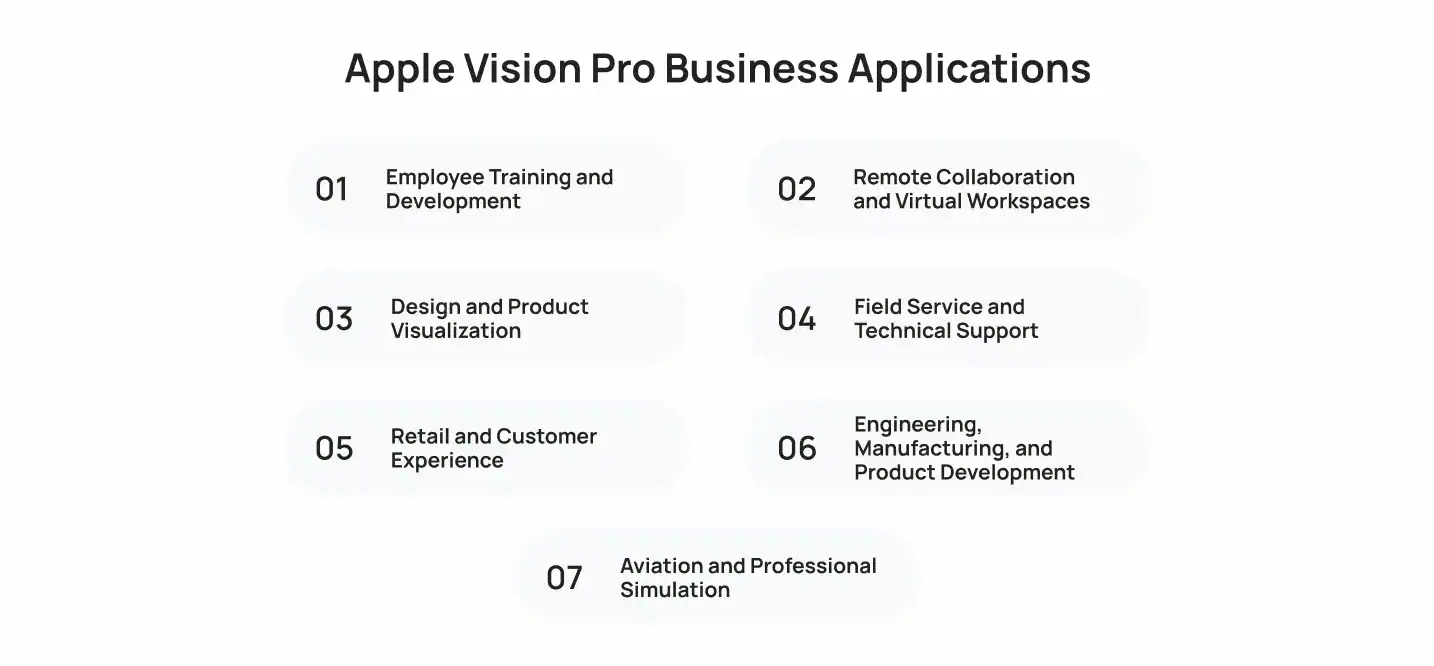
Apple Vision Pro Business Applications
Four traits make a workflow a good fit for Vision Pro: it’s spatial, it’s hands-busy, it’s high-stakes, or it benefits from remote presence. Here’s where those traits show up most clearly across current deployments.
1. Employee Training and Development
Vision Pro creates immersive training environments where employees can practice procedures using life-size 3D equipment before working with the real thing. This makes Vision Pro training and employee development especially useful for onboarding, technical training, and repeated practice without physical equipment or added session costs.
It’s also where immersive employee training simulation content converts fastest into measurable skill gains, since learners repeat scenarios as many times as needed without added cost per session.
2. Remote Collaboration and Virtual Workspaces
Vision Pro enables teams to work together in a spatial collaboration workspace, where 3D models, datasets, and virtual whiteboards can be viewed from different angles. This is particularly useful for design reviews, architecture, and engineering teams working across locations, alongside existing remote team collaboration tools. .
If your teams are spread across locations, it’s worth pairing this with a broader look at remote team collaboration tools, since spatial computing works best as one layer in a wider remote-work strategy, not a standalone fix.
3. Design and Product Visualization
Vision Pro allows engineering and design teams to examine products and digital twins at true scale rather than relying on flat screens. Dassault Systèmes’ 3DLive, for example, supports life-size 3D visualization and collaboration, making Vision Pro design and product visualization valuable for manufacturing and product development.
4. Field Service and Technical Support
Vision Pro can provide technicians with hands-free instructions and interactive 3D models while they work. KLM’s Engine Shop app demonstrates Vision Pro field service operations by helping technicians train on aircraft engine models and follow repair procedures directly within their visual workspace.
It also illustrates broader augmented reality technical support patterns now spreading into HVAC diagnostics, building maintenance, and firefighting response planning through similar hands-free apps.
5. Retail and Customer Experience
Retailers can use Vision Pro to help customers visualize products before making major purchasing decisions. Lowe’s, for example, has used 3D kitchen visualization, while platforms such as JigSpace support interactive product demonstrations, showing how spatial experiences can improve customer decision-making.
6. Engineering, Manufacturing, and Product Development
Manufacturers can apply spatial computing across product design, prototyping, assembly training, and maintenance planning. These 3D product visualization commercial applications can bring digital twins into product workflows, allowing teams to examine and modify designs before building physical prototypes.
7. Aviation and Professional Simulation
Vision Pro can supplement professional simulation by allowing pilots to practice cockpit procedures and build familiarity with aircraft controls outside traditional training centers. CAE’s Vision Pro application demonstrates how Vision Pro aviation training and simulation can prepare pilots for full-flight simulator sessions without replacing certified training infrastructure.
Apple Vision Pro Business Applications by Industry
A comparison table makes it easier to scan how these use cases map across sectors, and it also helps this content surface cleanly in AI-generated search summaries and featured snippets.
| Industry | Business Application | Potential Value |
| Healthcare | Medical imaging, surgical planning, anatomy education | Better 3D understanding and collaboration |
| Aviation | Flight simulation and pilot training | Safer, repeatable training |
| Manufacturing | Digital twins, maintenance, assembly training | Fewer errors and reduced downtime |
| Architecture | Full-scale 3D design review | Earlier design feedback |
| Engineering | Product visualization and prototyping | Faster design iteration |
| Retail | Virtual showrooms and product configuration | More engaging sales experiences |
| Automotive | Vehicle customization and showroom demos | Better customer decision-making |
| Education | Immersive lessons and technical training | Improved engagement and comprehension |
| Field Service | Remote assistance and guided repair | Faster issue resolution |
| Marketing | Spatial product experiences and demonstrations | Differentiated brand engagement |
Apple Vision Pro Enterprise Use Cases by Industry
Looking at the same use cases through an operational lens, four categories consistently show up across every industry deployment, regardless of sector.
1. Spatial Training & Onboarding
Healthcare, aviation, and manufacturing all lean on the same core mechanic: let employees rehearse a real procedure at real scale before they touch the real equipment. This is consistently the fastest-to-prove ROI category, largely because training costs are easy to measure before and after deployment.
2. 3D Design & Data Visualization
Architecture, automotive, and engineering teams use Vision Pro to catch design problems earlier. Reviewing a full-scale 3D model surfaces issues that a 2D drawing or a small desktop render simply hides until physical prototyping, which is far more expensive to fix at that stage.
3. Field Service & Remote Assistance
Utilities, aviation maintenance, and building operations use hands-free, in-line instructions to reduce technician errors and shorten repair time. Wearable, hands-free spatial computing sits alongside a broader wave of wearable technology applications already reshaping how field and clinical staff access information without stopping their hands-on work.
4. Immersive Collaboration
Retail, marketing, and product teams use shared spatial sessions to walk stakeholders through a design or a showroom experience remotely. This category grows the fastest as more enterprise software vendors ship native visionOS support alongside their existing desktop products.
Apple Vision Pro vs Meta Quest Enterprise
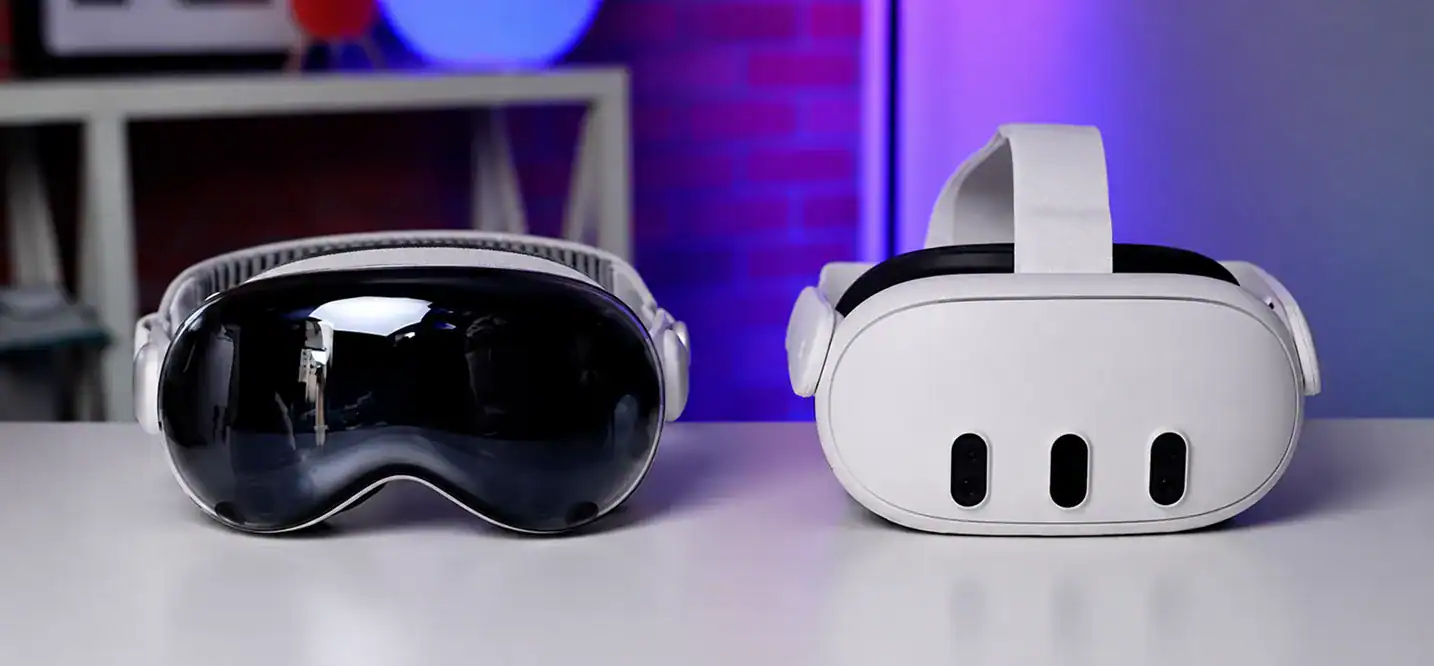
Choosing between Vision Pro and Meta Quest for an enterprise deployment usually comes down to fidelity versus scale.
| Factor | Apple Vision Pro | Meta Quest 3 / 3S |
| Starting price | $3,499 | $299–$499 |
| Display fidelity | Micro-OLED, highest passthrough quality available | Good, lower pixel density than Vision Pro |
| Best fit | Premium design review, executive tools, precision visualization | Large-scale training rollouts, cost-sensitive fleets |
| Device management | Apple Business Manager, mature MDM | Meta Horizon managed services |
| App ecosystem | Smaller catalog, strong enterprise and productivity focus | Larger catalog, mature enterprise SDK, strong training content library |
| Typical deployment | Small teams, high-value use cases | Fleet deployments across many employees |
Key Benefits of Apple Vision Pro for Businesses
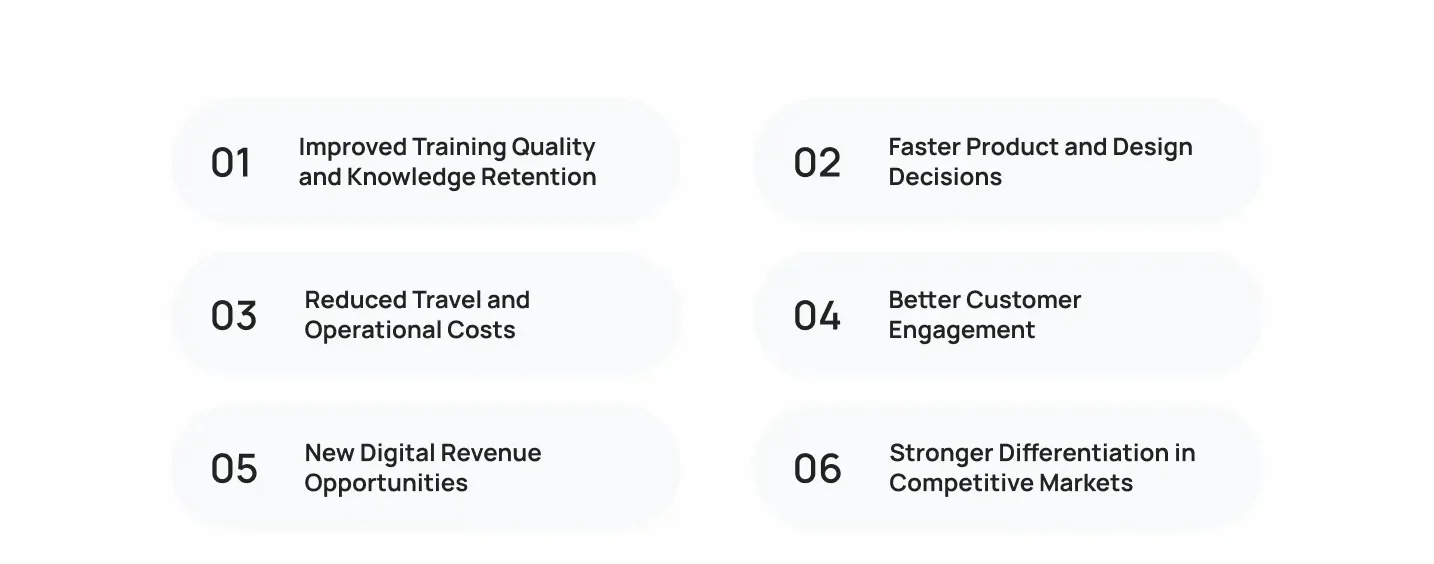
Beyond individual use cases, a few benefits show up repeatedly across almost every deployment.
1. Improved Training Quality and Knowledge Retention
PwC’s large-scale VR training study found that learners completed training up to 4 times faster than classroom equivalents, felt 275% more confident applying what they’d learned, and retained roughly 75% of training content compared to about 10% in a traditional classroom setting. Those numbers come from VR broadly, and Vision Pro’s higher display fidelity tends to strengthen this effect further for detail-heavy procedures.
2. Faster Product and Design Decisions
Reviewing a full-scale 3D model with your whole team in the room, even a virtual one, shortens the back-and-forth that normally happens over email threads and shared screens. Teams using Apple Vision Pro for design review report catching issues earlier, when they’re still cheap to fix.
3. Reduced Travel and Operational Costs
Remote design reviews, remote pilot training modules, and remote field assistance all reduce the need to fly people to a central location. For distributed manufacturing or aviation training operations, that adds up quickly across a year.
4. Better Customer Engagement
Retail and automotive brands using spatial product configuration report stronger buyer confidence at the point of sale, since customers can see and manipulate a realistic version of the product before committing.
5. New Digital Revenue Opportunities
The visionOS ecosystem has grown fast. The VisionOS ecosystem has expanded, with Apple continuing to add enterprise APIs, device-management capabilities, and business-focused spatial experiences. Sensor Tower data reported in early 2026 also found the average VisionOS app generated roughly $14,800 in net revenue in a single month, nearly three times the average for a comparable Meta Quest 3S title, suggesting real commercial demand behind enterprise and productivity apps specifically.
6. Stronger Differentiation in Competitive Markets
Being an early, credible adopter of spatial computing signals technical maturity to customers and partners. That’s a soft benefit, but it’s a real one in industries like aviation, healthcare, and premium retail, where buyers actively look for suppliers who invest in better tools.
How to Build an Apple Vision Pro Business Application
If you’ve decided spatial computing fits a real problem in your business, the build process follows a fairly consistent pattern.
1. Identify a High-Value Business Problem
Start with a task that’s genuinely three-dimensional, hands-busy, or remote-dependent. Flat dashboards, simple forms, and basic reporting don’t justify the hardware cost. Training, design review, and field service almost always do.
2. Choose the Right Experience Type
Decide whether the app needs full immersion, a passthrough overlay, or a shared collaborative session. This choice shapes your entire technical approach, from RealityKit usage to how you handle spatial audio and hand tracking.
3. Create a Spatial UX Strategy
Spatial interfaces don’t behave like phone or desktop apps. You need a plan for how users navigate 3D space, where information sits relative to their hands and eyes, and how they exit or pause an immersive session safely.
4. Integrate With Existing Enterprise Systems
An enterprise visionOS app development project rarely stands alone. It usually needs to pull data from PLM systems, ERP platforms, or existing 3D asset libraries like the ones built on Dassault’s 3DEXPERIENCE platform. Planning that integration early avoids costly rework later.
This is also the stage where cost planning matters most. If you’re benchmarking, it helps to review a full iOS app development cost breakdown, since visionOS projects share much of the same estimation logic around complexity, integrations, and platform-specific testing.
5. Start With a Pilot Project
Deploy to a small group first: one training module, one design review workflow, or one field service team. Measure the result against a clear baseline, then decide whether to scale. This approach also fits naturally alongside broader enterprise mobile app development programs, since a Vision Pro pilot often runs as one workstream inside a larger mobile and spatial strategy rather than a standalone initiative.
The Future of Apple Vision Pro Business Applications
The future of Apple Vision Pro business applications is being shaped by market growth, enterprise adoption, and device accessibility.
- Spatial computing market growth: The global spatial computing market is projected to grow from approximately $128 billion in 2023 to $469.8 billion by 2030, at a CAGR of about 20.4%. Manufacturing, healthcare, automotive, and retail are key areas driving adoption.
- More enterprise capabilities: Apple continues to expand Vision Pro’s business potential through hardware improvements and enterprise-focused visionOS features, giving companies more options for custom spatial experiences.
- Lower-cost devices: The current $3,499 price point limits large-scale workforce adoption. A lighter, more affordable Vision device could make Apple Vision Pro enterprise use cases more accessible for training, field service, and technical operations.
- Practical business value: Vision Pro is most useful when applied to specific workflows involving 3D visualization, hands-free interaction, simulation, or remote presence rather than as a replacement for conventional computers.
Your Apple Vision Pro App Development Partner
Building a spatial computing application well requires more than porting an existing app to a new screen. It means rethinking how users move through information in three dimensions, how they interact with real enterprise data, and how the whole experience holds up outside a demo environment in daily operational use.
Cubix, an iOS app development company, works with enterprises across manufacturing, aviation, healthcare, and retail to design and build VisionOS applications tied to specific, measurable business outcomes rather than generic proof of concepts. That includes system integration, spatial UX design, and ongoing support as a pilot moves toward wider rollout.
If your team already builds on Apple’s platforms, this work usually connects directly to your existing mobile strategy. You can review our broader iOS app development capabilities to talk through a specific Vision Pro use case with our team.
Frequently Asked Questions
1. What are the main business use cases for Apple Vision Pro?
Training, design and product visualization, remote collaboration, and field service and technical support lead current enterprise deployments. Retail product configuration is close behind.
2. What is the ROI for Vision Pro deployment in enterprises?
Most enterprise deployments show measurable ROI within 3 to 6 months when targeting training, design review, or field service, according to developer guidance based on shipped visionOS projects.
3. How does Apple Vision Pro differ from Meta Quest for business?
Vision Pro leads on display fidelity and precision at a $3,499 starting price. Meta Quest leads on cost and fleet-scale deployment, starting around $299 to $499 per unit.
4. Can Vision Pro truly reduce training costs for large organizations?
Yes, for the right use case. PwC found VR training can run up to 4 times faster than classroom instruction, though Vision Pro’s higher per-unit cost usually favors smaller, high-precision training groups over mass rollouts.
5. How do you develop apps for Apple Vision Pro and visionOS?
Development uses Apple’s visionOS SDK, RealityKit, and ARKit, typically alongside spatial UX planning and integration with existing enterprise data systems like PLM or ERP platforms.
6. What is the typical cost to build a Vision Pro business application?
Costs vary with complexity, but published developer estimates for visionOS projects generally range from $30,000 to $150,000 depending on integrations and the level of 3D fidelity required.
7. How secure is Apple Vision Pro for sensitive enterprise data?
Vision Pro integrates with Apple Business Manager for device management, the same enterprise-grade MDM framework Apple uses across iPhone, iPad, and Mac deployments.
8. Which industries benefit most from Vision Pro investments?
Aviation, manufacturing, healthcare, architecture, and retail show the clearest current ROI, largely because their core work is genuinely three-dimensional or hands-busy.
9. What percentage of Fortune 100 companies use Vision Pro today?
Apple reported that over half of the Fortune 100 had incorporated Vision Pro into their operations by its Q1 2024 earnings call, and enterprise deployment has continued growing since.
10. Is Vision Pro investment future-proof for our organization?
The broader spatial computing market is projected to grow at roughly 20% annually through 2030, per Grand View Research, so the underlying technology direction looks durable even as specific hardware evolves.