Key Takeaways
- To build NFT play-to-earn games with Unity, start with MVP and add blockchain later. Keep gameplay off-chain and use blockchain for ownership, tokens, and transactions.
- A P2E game connects five core parts: gameplay, NFTs, tokens, a wallet, and smart contracts that automate rewards and marketplace trades.
- Unity is the safer default for most NFT games. Its mature Web3 SDK ecosystem and mobile/WebGL reach beat Unreal for most projects.
- Budget $7,000 to $150,000+ and plan 8 to 12 weeks for an MVP or 6 to 12 months for a full launch, depending on scale and blockchain complexity.
- Success needs more than NFTs. Engaging gameplay, useful assets, a sustainable token economy, secure contracts, and a smooth player experience all matter.
To build an NFT play-to-earn game with Unity, you need to develop the core gameplay in Unity, integrate a blockchain network and crypto wallet, create NFT and token smart contracts, and connect the game to a secure backend and marketplace.
The market continues to attract significant investment and adoption. The global blockchain gaming market is projected to reach $279.1 billion in 2026, with a forecast CAGR of 21.8% through 2034.
Unity remains a popular choice for game development, supporting interactive 2D and 3D experiences across multiple platforms. Its 2025 Gaming Report draws on data from nearly 5 million Unity developers, while 90% of surveyed developers reported launching a recent game on mobile.
In this guide, you’ll learn how to build NFT play-to-earn games with Unity, including project setup, wallet integration, NFT creation, smart contracts, tokenomics, marketplace development, testing, and deployment.
What Are NFT Play-to-Earn Games?
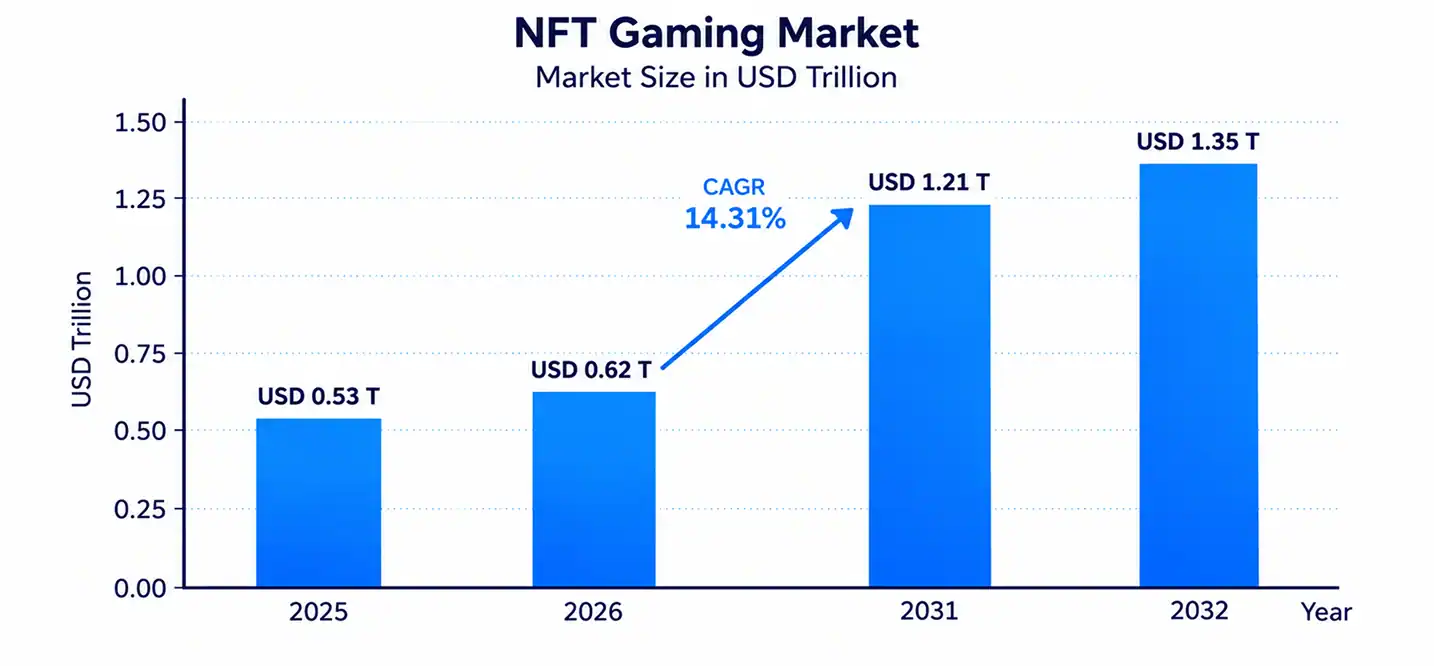
NFT play-to-earn games combine traditional gameplay with blockchain-based ownership and reward systems. Players can earn tokens or NFT assets by completing quests, winning battles, reaching milestones, or contributing to the game ecosystem. The NFT gaming market is estimated at $620 billion in 2026, growing at a projected 14.31% CAGR from 2026 to 2031.
Unlike conventional games, where digital items usually remain controlled by the game publisher, NFT-based games can give players verifiable ownership of assets. These assets can include characters, weapons, skins, land, cards, or other collectibles that players may be able to trade through supported marketplaces.
That is why newer play-and-earn models put more emphasis on fun gameplay while keeping ownership and rewards as supporting features.
How Does a Play-to-Earn Game Model Work?
A typical P2E game connects four major components: gameplay, NFTs, blockchain infrastructure, and an in-game economy.
Players first interact with the game through normal gameplay. Depending on the design, they may complete missions, defeat opponents, participate in tournaments, craft items, or reach specific achievements.
Rewards are then distributed through smart contracts or backend systems. These rewards may include NFTs or fungible tokens that players can hold in their wallets, use within the game, or trade where the ecosystem supports it.
| Component | How it works in a P2E game |
| Gameplay | Players complete missions, battles, quests, or other activities. |
| NFTs | Unique digital assets represent characters, items, land, cards, or collectibles. |
| Tokens | Fungible tokens can be used for rewards, purchases, crafting, or governance. |
| Wallet | Stores players’ blockchain-based assets and enables ownership. |
| Smart Contracts | Automate asset transfers, rewards, minting, and marketplace transactions. |
| Marketplace | Allows supported NFTs or assets to be bought, sold, or traded. |
| Game Economy | Controls how rewards enter and leave the ecosystem to maintain sustainability. |
What Are the Top NFT Play-to-Earn Games Built with Unity?
Several successful NFT and play-to-earn games use Unity as their primary game engine, combining its game development capabilities with blockchain technology for digital ownership, token rewards, and asset trading. The growing demand for these experiences is also reflected in the market, with the global Play-to-Earn (P2E) games market projected to reach $18,593.5 million by 2033, growing at a CAGR of 24.6% from 2025 to 2033.
A blockchain game development company can use a similar approach by keeping core gameplay within the game engine while using blockchain for NFTs, tokens, marketplaces, and player rewards. Below are some notable NFT games that demonstrate how Unity and blockchain technology can work together:
| Game | Unity Integration | NFT / P2E Features | Key Gameplay |
| Axie Infinity | Unity-based game development has been part of Axie Infinity’s strategy, particularly for its desktop/mobile gameplay. | NFT-based Axies, player-owned assets, token-based economy, marketplace trading | Digital pet collection, breeding, and battles |
| Heroes of Mavia | Uses a game-engine-based client to deliver its multiplayer strategy experience alongside blockchain systems. | NFT land/assets, crypto rewards, player-owned resources | Base building and multiplayer strategy |
| Voxie Tactics | The game launched a rebuilt client on the Unity Engine in 2024, bringing improved graphics and stability while retaining NFT compatibility. | Voxies NFTs, in-game NFT items, VOXEL rewards, trading and crafting | Turn-based tactical RPG |
| The Sandbox | Uses Unity technology and provides a Unity SDK for integrating avatars, NFTs, assets, collections, and user data. | LAND NFTs, avatars, digital assets, SAND rewards, creator monetization | User-generated metaverse experiences |
How to Build an NFT Play-to-Earn Game in Unity: Step-by-Step Guide
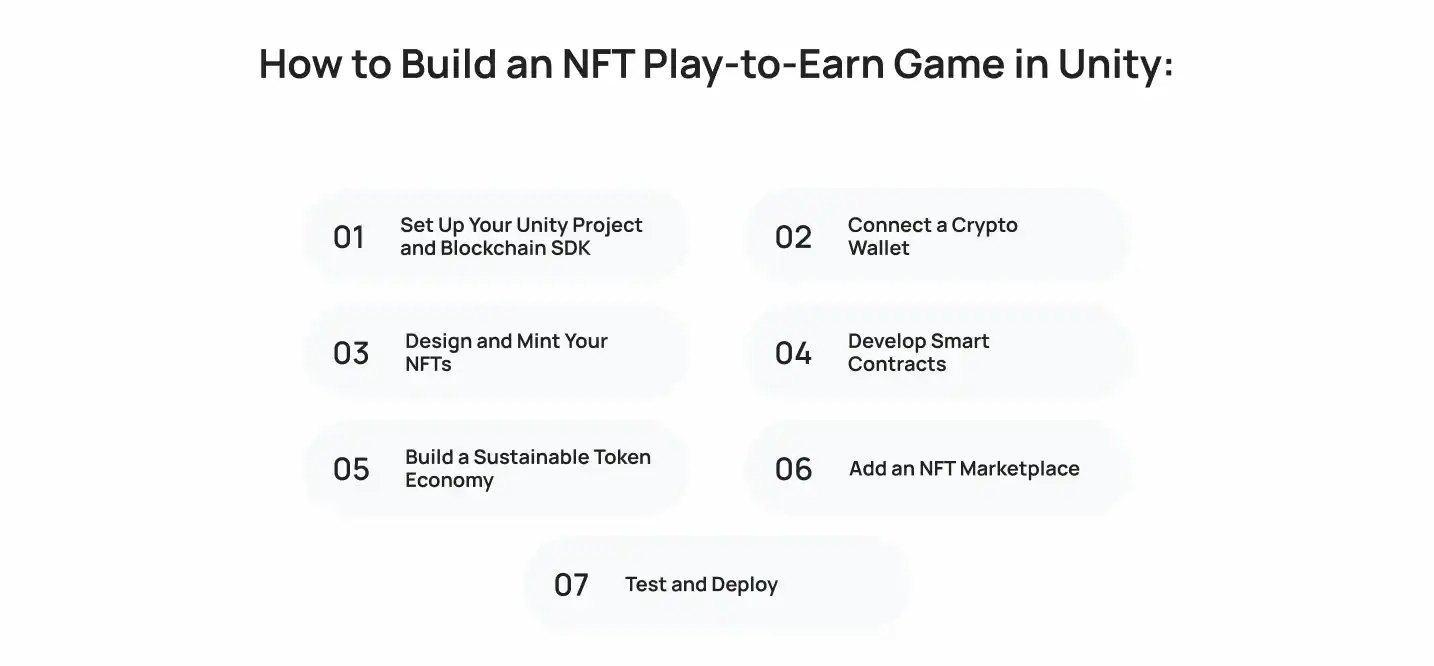
Building an NFT game in Unity combines traditional game development with blockchain infrastructure. An experienced online game development company can use Unity to build the gameplay, graphics, physics, UI, and platform deployment, while blockchain technology manages NFT ownership, tokens, wallets, and transactions. You can also learn more about the dApp development process to understand how blockchain-based applications are planned and developed.
The important part is to avoid putting every game action on-chain. Fast gameplay should generally remain within the Unity client and game backend, while blockchain is used for functions that benefit from verifiable ownership or decentralized transactions.
Unity supports major platforms including iOS, Android, and WebGL, making it possible to plan a multi-platform NFT game from the beginning.
Step 1: Set Up Your Unity Project and Blockchain SDK
Create your Unity project and build the core gameplay first. Choose your genre, target platforms, blockchain network, and integration tools.
Define:
- Game genre: RPG, strategy, card game, racing, etc.
- NFT utility: Decide which assets genuinely need ownership.
- Blockchain: Consider fees, speed, and developer support.
- Platforms: WebGL, Android, iOS, or multiple platforms.
- Backend: Keep matchmaking, progression, and player data off-chain.
Explore DApp development frameworks to identify suitable tools for your blockchain integration.
Step 2: Connect a Crypto Wallet
A wallet connects the player’s blockchain identity to your game. Players can use it to prove NFT ownership and approve transactions.
A simple flow is:
- Player selects Connect Wallet.
- Wallet authorization is requested.
- The game receives the public wallet address.
- The backend links it to the player’s account.
- Eligible NFTs and token balances are retrieved.
Avoid requiring wallet signatures for routine gameplay actions.
Step 3: Design and Mint Your NFTs
Choose which game assets should become NFTs, such as characters, weapons, cards, skins, or land.
ERC-721 works well for unique assets, while ERC-1155 is useful for games with multiple item types and batch operations.
NFT metadata can include:
- Name and rarity
- Attributes and abilities
- Visual assets
- In-game utility
Make sure each NFT has a meaningful purpose rather than adding blockchain ownership simply for the sake of it.
Step 4: Develop Smart Contracts
Smart contracts control NFT and token functions such as minting, ownership, transfers, approvals, and rewards.
You can use reusable implementations from OpenZeppelin for standards such as ERC-20, ERC-721, and ERC-1155.
Test contracts thoroughly before mainnet deployment, particularly for unauthorized minting, ownership errors, access control, and transaction failures.
Step 5: Build a Sustainable Token Economy
Define how players earn, spend, and use your in-game tokens.
| Element | Examples |
| Earning | Quests, achievements, tournaments |
| Spending | Upgrades, crafting, repairs |
| NFT Rewards | Characters, items, collectibles |
| Token Sinks | Fees, crafting, upgrades |
| Supply Controls | Emission limits, burning |
A sustainable economy needs enough spending mechanisms to balance the rewards entering the system.
Step 6: Add an NFT Marketplace
Give players a way to view, buy, sell, and trade eligible assets.
Core marketplace features can include:
- NFT inventory
- Asset details and rarity
- Search and filters
- Listing and purchasing
- Ownership verification
- Transaction history
- Marketplace fees
Keep browsing and filtering off-chain where possible, while using blockchain transactions for ownership and settlement.
Step 7: Test and Deploy
Test the complete game across WebGL, Android, and iOS, including gameplay, wallet connections, NFT ownership, transactions, marketplace functions, and backend performance.
| Platform | Key Tests |
| WebGL | Browser compatibility and wallet integration |
| Android | Performance, controls, wallet experience |
| iOS | Performance and platform requirements |
| All Platforms | Authentication, transactions, NFT ownership |
Unity supports these platforms, although its current WebGL documentation notes that WebGL builds target desktop browsers rather than mobile devices.
Ultimately, a successful NFT game needs more than blockchain features. Engaging gameplay, useful NFTs, a sustainable economy, secure contracts, and a smooth player experience should work together.
How Much Does It Cost to Build a P2E NFT Game With Unity?
The cost to build a P2E NFT game with Unity depends heavily on the game’s genre, graphics, multiplayer requirements, blockchain architecture, NFT functionality, and number of platforms. A practical planning range is $30,000–$150,000 for a mid-tier project, while a basic MVP can start around $7,000–$30,000, and a large-scale multiplayer or metaverse game can exceed $500,000.
| Game Scale & Type | Estimated Cost | Typical Scope |
| Basic MVP / Casual Game | $7,000–$30,000 | Simple gameplay, 2D/low-complexity graphics, wallet connection, basic NFT minting |
| Mid-Tier P2E Game | $30,000–$150,000 | 3D gameplay, multiplayer, NFT assets, smart contracts, token economy, marketplace |
| Advanced Web3 Game | $150,000–$300,000 | High-quality 3D assets, advanced multiplayer, custom economy, multiple blockchain integrations |
| Enterprise / Metaverse Game | $300,000–$500,000+ | Large multiplayer worlds, high-end graphics, extensive blockchain infrastructure, cross-platform support |
The biggest cost drivers are usually gameplay development, art and animation, backend infrastructure, blockchain engineering, smart contracts, and security testing.
Technical Cost Breakdown
Instead of treating the entire budget as one figure, divide it across the major development components:
| Development Component | Estimated Cost | What It Covers |
| Game Design & UI/UX | $5,000–$20,000 | Game mechanics, wireframes, interfaces, player journeys |
| 3D/2D Art & Animation | $10,000–$40,000+ | Characters, environments, weapons, effects, NFT assets |
| Unity Development | $10,000–$40,000+ | Gameplay, physics, controls, UI, animations, platform builds |
| Backend Development | $15,000–$45,000+ | Accounts, game servers, matchmaking, databases, leaderboards |
| Blockchain Development | $5,000–$25,000+ | Wallet integration, NFT contracts, token functionality |
| Marketplace | $5,000–$20,000+ | Listings, purchases, trading, NFT inventory and transaction history |
| Security Testing & Audit | $5,000–$50,000+ | Smart-contract review, vulnerability testing, remediation |
| QA & Deployment | $5,000–$15,000+ | Functional, device, performance, blockchain and launch testing |
How Long Does It Take to Build a P2E NFT Game?
A playable Web3-ready MVP can be built in 812 weeks, but a full P2E NFT game with a marketplace, token economy, and live multiplayer typically takes 6–12 months, and large-scale or metaverse titles can run 18–24 months or more. The timeline depends mainly on game complexity, blockchain architecture, and how many platforms you target.
| Game Scale & Type | Estimated Timeline | Typical Scope |
| Basic MVP / Casual Game | 8–12 weeks to 4 months | Simple 2D gameplay, wallet connection, basic NFT minting |
| Mid-Tier P2E Game | 6–9 months | 3D gameplay, multiplayer, NFT assets, token economy, marketplace |
| Advanced Web3 Game | 10–14 months | High-quality 3D, live multiplayer, custom economy, multiple chains |
| Enterprise / Metaverse Game | 18–24+ months | Large multiplayer worlds, cross-chain assets, custom L2 deployment |
MVP timelines cluster around 3–4 months, mid-scale games around 6–9 months, and enterprise builds at 14+ months. Full mainnet launches with marketplace and staking can extend to 12–24 months, while AAA or metaverse titles may take 24–48 months.sdlccorp+1
Phase-by-Phase Breakdown
| Development Phase | Estimated Time | What It Covers |
| Game Design & Tokenomics Planning | 2–4 weeks | Core mechanics, economy model, NFT utility, token sinks |
| Front-End & Smart Contract Development | 6–12 weeks | Gameplay, wallet integration, NFT and token contracts |
| Multiplayer & Backend Services | 4–6 weeks | Servers, matchmaking, player accounts, progression |
| Marketplace & NFT Features | 2–4 weeks | Listings, purchases, trading, NFT inventory |
| QA, Security Audits & Launch | 2–3 weeks | Testing, smart-contract audit, deployment |
A smart-contract security audit alone typically adds 4–8 weeks before mainnet launch, so factor it into your schedule
How Does Unity Compare to Unreal Engine for Blockchain Games?
Unity and Unreal are the two primary engines behind the top 1,000 Web3 games, so either is a credible choice. Unity holds roughly 48% of the mobile market, while Unreal powers about 31% of Steam revenue, a good signal of where each engine’s strengths lie. Read our blog to understand Unity vs. Unreal game engines.
Unity vs. Unreal for Blockchain Games
| Criteria | Unity | Unreal Engine |
| Best for | WebGL/browser, mobile, 2D and mid-fidelity 3D | AAA, photorealistic, PC and console |
| Programming language | C# | C++ |
| Learning curve | Easier, seamless UI | Steeper, more complex |
| Web3 SDK ecosystem | Mature—Moralis, Thirdweb, ChainSafe web3.unity, Enjin, Immutable | Growing but smaller plugin ecosystem |
| Blockchain support | Ethereum, Polygon, BSC, Solana via SDKs | Ethereum and others, fewer ready-made plugins |
| Graphics quality | Good overall, stylized to mid-fidelity | Photorealistic, AAA quality |
| Cost model | Free tier + subscription (Unity Pro) | Free + 5% royalty on revenue |
| Source code | Restricted | Open source |
| Talent pool | Larger and cheaper | Smaller, needs C++/technical-art expertise |
| Prototyping speed | Faster, leaner for MVPs | Heavier, slower iteration |
Which Engine Should You Choose?
Pick Unity if:
- You need a browser (WebGL) or strong mobile support.
- Your visuals are stylized, 2D, or mid-fidelity 3D.
- You want a larger, cheaper talent pool and faster prototyping.
- Fast iteration and broad distribution matter more than maximum graphical polish.
Pick Unreal if:
- Photorealistic or cinematic visuals are central to your pitch.
- You’re targeting PC and console, not the browser.
- You have (or can afford) experienced C++ and technical-art talent.
- A royalty-based license fits your revenue model better than subscriptions.
If you’re also considering a lightweight alternative to Unity and Unreal, compare Unity vs. Godot to understand how their features, workflows, and development use cases differ.
To build an NFT game with Unreal Engine, read our comprehensive blog at Cubix.
What Are the Biggest Challenges in P2E NFT Game Development?
- Hyperinflation: Excessive token rewards can increase supply, reduce token value, and destabilize the in-game economy.
- Death Spirals: Falling token prices can reduce player participation, causing demand and asset values to decline further.
- High Barrier to Entry: Expensive NFTs or upfront investments can discourage new players from joining.
- Smart Contract Exploits: Vulnerabilities in smart contracts can lead to unauthorized minting, stolen assets, or financial losses.
- Cross-Chain Complexity: Supporting multiple blockchains increases development, testing, wallet, and transaction-management requirements.
- Scalability Limits: High transaction volumes can create network congestion, delays, and increased gas fees.
- Legal Uncertainty: NFT games must navigate changing regulations around digital assets, tokens, and virtual economies.
- Securities Classification: Some tokens may face securities-related regulations depending on their design and jurisdiction.
- KYC/AML Mandates: Games involving token trading or financial transactions may need identity verification and anti-money-laundering controls.
Why Partner with Cubix for NFT Game Development
Cubix builds NFT play-to-earn games on Unity with end-to-end gameplay, wallets, smart contracts, token economies, and marketplaces. You get a single partner who handles the whole Web3 stack, so you don’t have to juggle multiple vendors. Our Play to Earn Game Development Services cover everything from sustainable reward models to NFT collections and player economies.
Unity is the heart of most NFT games, and we’ve made it our specialty. Our developers keep fast gameplay off-chain in the client while blockchain handles ownership and tokens — the approach that avoids the sluggish feel that hurts many P2E titles. This is how we approach every Unity Game Development Services project, from stylized 2D collectibles to browser-based WebGL builds.
And since many NFT games live or die on multiplayer, we pair our Web3 work with solid server and matchmaking infrastructure that scales with your players. Combined with our Multiplayer Game Development Services, the result is a P2E game people keep coming back to.
Want to discuss your project? Our experts are just a click away.
Contact UsFrequently Asked Questions
You can find tutorials in Unity documentation and Web3 platforms such as Immutable, Thirdweb, and ChainSafe.
Popular options vary by player activity and token value, but games such as Axie Infinity, Gods Unchained, and The Sandbox remain well-known.
Thirdweb, Immutable, ChainSafe, and Enjin offer tools or SDKs that can support NFT and blockchain integration with Unity.
Yes, but earnings are not guaranteed and depend on the game’s economy, NFT demand, token prices, and marketplace activity.
Build the gameplay in Unity, integrate a blockchain SDK, create smart contracts, connect wallets, and add NFTs or tokens where they provide real utility.
Create NFTs through smart contracts, connect them to your Unity game through a blockchain SDK, and link their ownership to in-game assets.
Ethereum, Polygon, Immutable, Solana, and other gaming-focused networks can be considered based on fees, speed, scalability, and developer tools.
Platforms such as Immutable, Thirdweb, ChainSafe, and Enjin provide tools for connecting Unity games with NFT and blockchain functionality.
You typically need Unity, a blockchain SDK, smart contracts, a wallet integration, NFT marketplace support, and a secure backend.