Most software projects don’t fail because teams can’t build. They fail because decisions were made too early, requirements weren’t validated, and teams started execution without enough clarity.
That’s where the software development discovery phase changes the outcome.
Discovery is the stage where ideas are challenged, priorities are aligned, and technical decisions are validated before development begins. Instead of moving directly into design and engineering, teams define user needs, assess feasibility, prioritize scope, and create a roadmap that supports execution.
Industry research reflects this pattern. A McKinsey study, carried out alongside the University of Oxford, found that roughly half of all large-scale IT projects, those starting with budgets above $15 million, end up significantly overshooting their original costs. The average overrun? 45% over budget, 7% past deadline, and only delivering about half the value stakeholders were originally promised. And within that landscape, software projects consistently top the charts for cost and schedule risk.
This article walks through what the software development discovery phase actually looks like, how it fits into the development lifecycle, and what deliverables businesses should expect from a software development company before writing a single line of production code.
[cta text="Contact Us" link="https://www.cubix.co/contact/"]
What Is the Software Development Discovery Phase?
The software development discovery phase is the structured upfront research period before actual development begins. Think of it as the blueprint stage; you wouldn’t build a skyscraper without architectural drawings. The same logic applies to every digital product.
During this phase, teams identify real user needs, define project scope, assess technical feasibility, and create a product roadmap that guides the entire development life cycle. It transforms vague business ideas into concrete, actionable specifications.
| Discovery Phase Activity | Purpose |
| Stakeholder interviews | Align on business goals |
| User research & personas | Understand end-user needs |
| Competitor analysis | Identify market gaps |
| Technical feasibility audit | Assess risks early |
| Scope definition | Prevent feature creep |
| Roadmap creation | Guide development sprints |
Why Skipping the Discovery Phase Costs You More
Skipping the software development discovery phase can feel like a shortcut, but in practice, it often creates delays, rework, and unexpected costs later in the project. When teams move directly into design or development without validating requirements, small assumptions quickly turn into expensive problems.

Without discovery, business goals may remain unclear, stakeholders may have different expectations, and technical limitations often surface after development has already started. That usually leads to changing requirements, rebuilding features, extending timelines, and increasing budgets.
Discovery helps prevent this by creating alignment before resources are committed. Teams validate user needs, define realistic scope, assess technical feasibility, and prioritize what actually needs to be built.
The earlier a problem is identified, the cheaper and easier it is to solve.
A proper project discovery process reduces uncertainty before development begins, helping teams avoid scope creep, improve delivery accuracy, and launch products with greater confidence. Rather than adding time to a project, discovery often saves time by reducing unnecessary work later in the software development life cycle.
Read More: 10 Tips for Choosing the Right Software Development Company
What Cubix Does Differently in Discovery from Other Companies
Many software companies treat discovery as a short kickoff session followed by a requirements document. Cubix approaches it differently. Instead of collecting feature requests and moving straight into development, discovery is treated as a structured validation process designed to reduce uncertainty before investment begins.

With more than 18 years of experience and hundreds of successful engagements, our discovery process has evolved into a repeatable framework that helps teams make informed product decisions earlier.
What makes Cubix’s approach different:
- Business-first thinking, not feature-first execution: Every discovery engagement starts with understanding business objectives, success metrics, and operational goals before discussing product features.
- Cross-functional collaboration from day one: Product strategists, UX specialists, architects, developers, and project stakeholders work together early to prevent disconnected decision-making later.
- Validation before development: User research, market analysis, and feasibility reviews are used to challenge assumptions and confirm priorities before engineering begins.
- Technical planning that reflects real-world delivery conditions: Architecture decisions, integrations, scalability considerations, timelines, and risks are evaluated up front to set realistic expectations.
- Actionable outputs, not generic documentation: Clients leave discovery with tangible deliverables including a product roadmap, wireframes, technical recommendations, prioritized scope, timeline estimates, and budget guidance.
Rather than treating discovery as a pre-sales step, Cubix uses it as the foundation that helps teams move into design and development with greater clarity, fewer surprises, and a more predictable path to launch.
How the Discovery Phase Fits Into the Development Life Cycle
The discovery phase in software development sits at the very start of the development life cycle, before design, before engineering, before QA. It’s the foundation layer. Get this wrong, and everything built on top of it wobbles.

Typical development life cycle stages:
- Discovery: Research, scope, feasibility
- Design: UX/UI prototyping, user flows
- Development: Frontend, backend, integrations
- Testing: QA, user acceptance testing
- Launch: Deployment, monitoring
- Maintenance: Updates, iterations
Discovery feeds every stage that follows. The personas built here inform design. The architecture decisions made here shape engineering choices. The risks flagged here prevent late-stage surprises.
Inside Cubix’s Discovery Phase: Step by Step
Our team of 350+ designers and software developers follows the discovery phase, which is more than an introductory workshop or a collection of requirements. It is a structured process designed to reduce uncertainty, validate ideas, and create a clear execution plan before development begins.
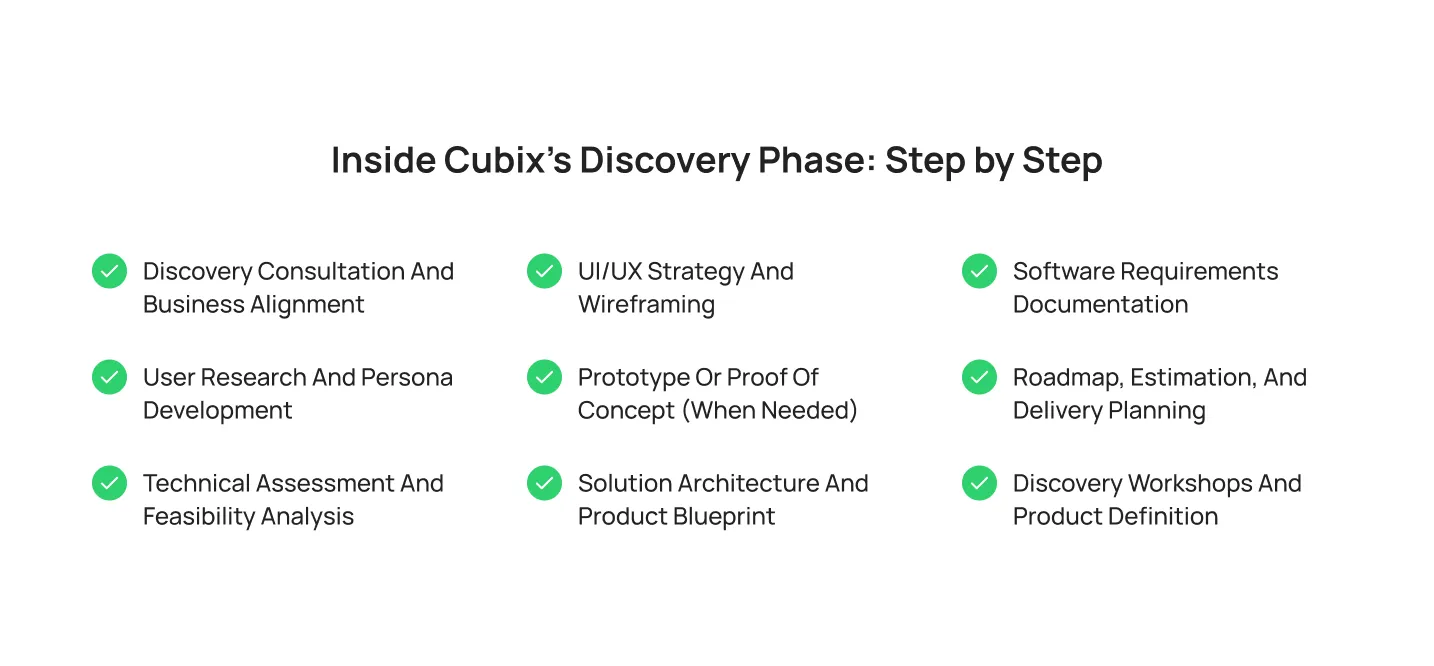
Each activity builds toward one goal: transforming business objectives into a product strategy that teams can confidently execute.
Step 1: Discovery Consultation and Business Alignment
Every discovery engagement begins with understanding the bigger business picture before discussing features, screens, or technology decisions.
The goal of this stage is to align stakeholders around a shared product vision and establish clear expectations for what success should look like. Rather than immediately jumping into requirements, the team focuses on understanding business objectives, market positioning, and long-term goals.
Activities during this stage typically include:
- Identifying business goals and success metrics
- Defining product vision and growth objectives
- Evaluating market opportunities and positioning
- Understanding user expectations and operational constraints
- Establishing initial scope and delivery priorities
This early alignment helps reduce conflicting expectations and creates stronger decision-making throughout the project lifecycle.
Deliverables:
- Business objectives documentation
- Stakeholder alignment notes
- Success metrics framework
- Initial project scope
- Preliminary product direction
By the end of this phase, stakeholders have a clearer understanding of the product’s goals and a validated foundation for discovery.
Step 2: User Research and Persona Development
Once business objectives are defined, we shift focus toward understanding the people who will ultimately use the product.
This stage ensures product decisions are based on user needs and real-world behavior rather than assumptions. The team gathers insights to understand how users interact, what challenges they face, and what outcomes they expect.
Activities during this stage include:
- Conducting user and market research
- Defining target user groups
- Building user personas and behavioral profiles
- Mapping user journeys and pain points
- Identifying product opportunities and expectations
The objective is to connect business goals with actual user needs and create experiences that solve meaningful problems.
Deliverables:
- User personas
- Customer journey maps
- User behavior insights
- Opportunity and pain-point analysis
- Experience recommendations
By completing this phase, the team gains a clearer understanding of who the product serves and how value should be delivered.
Step 3: Technical Assessment and Feasibility Analysis
Before moving into implementation, the team evaluates whether the proposed product can realistically be delivered within technical, operational, and business constraints.
This stage focuses on validating the solution from an engineering perspective while identifying risks and opportunities early.
Activities during this phase include:
- Reviewing architecture requirements
- Evaluating integrations and dependencies
- Planning infrastructure and deployment approaches
- Recommending suitable technologies and frameworks
- Assessing performance and future growth requirements
- Identifying technical risks and limitations
The objective is to eliminate uncertainty and establish realistic expectations before development begins.
Deliverables:
- Technical feasibility report
- Architecture recommendations
- Technology stack proposal
- Infrastructure guidance
- Risk and dependency assessment
By the end of this stage, stakeholders have greater confidence that the proposed solution aligns with technical and business realities.
Step 4: Discovery Workshops and Product Definition
Discovery workshops bring together business stakeholders, product experts, designers, and technical teams to transform ideas into a clear execution strategy.
These sessions help align priorities, refine requirements, and create actionable plans that guide future development.
Activities during this stage include:
- Defining user journeys and product use cases
- Mapping functional and business requirements
- Prioritizing features and release scope
- Aligning business and technical expectations
- Establishing delivery goals and milestones
This collaborative process creates transparency across teams and reduces ambiguity before execution begins.
Deliverables:
- Workshop documentation and decisions
- Product requirements summary
- User stories and use cases
- Feature prioritization framework
- Release planning recommendations
By the end of this phase, the product vision becomes more structured, measurable, and ready for the next stages of design and planning.
Step 5: UI/UX Strategy and Wireframing
Once product requirements and user expectations are validated, we move into defining the product experience. This stage focuses on translating ideas into visual and interactive flows that users can understand and navigate naturally.
Rather than designing screens in isolation, the team maps how users move through the product, identifies critical interactions, and prioritizes usability before development begins.
Key activities during this stage include:
- Creating user flows and journey maps
- Developing low- and mid-fidelity wireframes
- Structuring navigation and screen hierarchy
- Identifying usability improvements
- Validating interactions with stakeholders
The objective is to create a shared visual understanding of the product before engineering starts.
Deliverables:
- User flow diagrams
- Wireframes for core screens
- Navigation structure
- Early UX recommendations
- Initial UI direction
By the end of this phase, stakeholders can see how the product will function and provide feedback before development investment increases.
Step 6: Prototype or Proof of Concept (When Needed)
For products involving technical complexity, new business models, or uncertain requirements, we may recommend building a Prototype or Proof of Concept (POC) before full-scale development.
A Proof of Concept validates whether the proposed solution can realistically work using the selected technologies and infrastructure.
A Prototype focuses on user experience by demonstrating how users will interact with the product.
This stage may include:
- Interactive clickable prototypes
- Core functionality validation
- Technical experimentation
- User interaction testing
- Early stakeholder demonstrations
The goal is to reduce uncertainty before committing to development.
Deliverables:
- Interactive prototype or POC
- Feasibility findings
- Technical recommendations
- Validation outcomes
- Adjusted product direction (if needed)
This approach helps stakeholders make decisions based on evidence rather than assumptions.
Step 7: Solution Architecture and Product Blueprint
Once the product direction is validated, our expert team establishes the technical foundation that will support development and future growth.
This phase defines how the product will be structured behind the scenes and ensures architecture decisions align with business objectives, performance expectations, and scalability requirements.
Activities typically include:
- Designing system architecture
- Mapping integrations and dependencies
- Selecting technologies and frameworks
- Planning infrastructure requirements
- Defining security and performance standards
- Identifying technical constraints and risks
The architecture phase creates a clear blueprint for implementation and helps prevent costly redesign later.
Deliverables:
- Solution architecture document
- Infrastructure recommendations
- Integration map
- Technology stack guidance
- Security and scalability considerations
By completing architectural planning early, development teams enter execution with clearer technical direction.
Step 8: Software Requirements Documentation
After discovery findings are validated, Cubix consolidates them into structured documentation that becomes the reference point throughout development.
This documentation ensures business stakeholders, designers, and engineers remain aligned as the project moves to the next step.
The Software Requirements Specification (SRS) typically captures:
- Project objectives and scope
- Functional requirements
- Non-functional requirements
- User stories and acceptance criteria
- Feature definitions
- Business rules and constraints
Rather than creating static documentation, Cubix structures requirements to support execution and reduce ambiguity.
Deliverables:
- Software Requirements Specification (SRS)
- User stories and acceptance criteria
- Scope documentation
- Feature prioritization list
- Requirement traceability
This phase provides teams with a reliable source of truth before development begins.
Step 9: Roadmap, Estimation, and Delivery Planning
The final stage of discovery transforms validated ideas into an actionable execution plan.
At Cubix, this phase combines business priorities, technical recommendations, and delivery considerations to create realistic expectations around timelines, resources, and investment.
Activities during this stage include:
- Building the product roadmap
- Estimating timelines and effort
- Defining release milestones
- Planning resources and team structure
- Identifying delivery risks
- Establishing launch priorities
The objective is to create clarity around what will be delivered and how progress will be measured.
Deliverables:
- Product roadmap
- Delivery milestones
- Timeline estimates
- Budget projections
- Resource allocation plan
- Risk mitigation strategy
By the end of discovery, stakeholders have a practical roadmap that turns strategy into execution and provides a clearer path toward launch.
Read More: The Best Software Development Methodologies
Key Deliverables You Should Expect From Any Discovery Phase
Don’t walk away from a software project discovery phase without these documents. If an agency can’t produce them, that’s a red flag.
| Deliverable | What It Answers |
| Product Brief | What are we building and why? |
| User Personas | Who are we building it for? |
| Competitive Analysis | What’s the market landscape? |
| Technical Spec | How will we build it? |
| Risk Register | What could go wrong? |
| Roadmap | When will things get done? |
| Budget Estimate | What will it cost? |
So Why Is It Best to Begin With Discovery?
Starting with discovery creates clarity before significant time, budget, and development effort are committed. Instead of making assumptions and correcting courses later, teams move forward with validated requirements, aligned stakeholders, and a practical execution plan.
At Cubix, discovery helps uncover risks early, prioritize the right features, and connect business goals with technical decisions before development begins. That means fewer surprises during execution, more predictable timelines, and stronger confidence in product decisions.
By investing time upfront to understand users, validate ideas, and define technical direction, businesses create a smoother path from concept to launch and reduce the likelihood of costly rework later in the process.
How Long Does the Discovery Phase Take?
Discovery duration depends less on project size and more on decision complexity. Products with multiple user groups, legacy integrations, compliance requirements, or unclear business models usually require deeper validation before development begins. The value of discovery is rarely measured by the time it adds upfront, but by the time, budget, and rework it prevents later.
- Simple apps — 1 to 2 weeks
- Mid-complexity platforms — 3 to 4 weeks
- Enterprise or complex systems — 6 to 8 weeks
Cubix typically scopes discovery engagements based on the number of user types, integrations, and unknowns in the system. More unknowns = more discovery time needed.
Common Mistakes Teams Make During Project Discovery
Even experienced teams stumble here. Watch out for these pitfalls during project planning:
- Skipping user research: Building on assumptions is building on sand
- Inviting too few stakeholders: Hidden decision-makers surface late and derail projects
- Treating discovery as a formality: It’s not a checkbox; it’s your clearest thinking moment
- Ignoring technical constraints: Design and development must align from day one
- Underestimating scope: Wishful thinking in discovery creates nightmares in development
ROI of a Proper Discovery Phase
Here’s what the data says about teams that invest properly in the discovery phase in software development:
- 45% reduction in project overruns (McKinsey Digital)
- 30% faster time to market due to clearer requirements
- 60% fewer change requests during development
- Higher stakeholder satisfaction at every review milestone
These aren’t abstract numbers. They represent real money saved, real timelines met, and real products that actually launch.
Discovery in Practice with Real Projects
At Cubix, the discovery phase is used to establish a clear understanding of business needs, user behavior, and system requirements before any design or development work begins. It ensures that product direction is based on validated insights rather than assumptions.
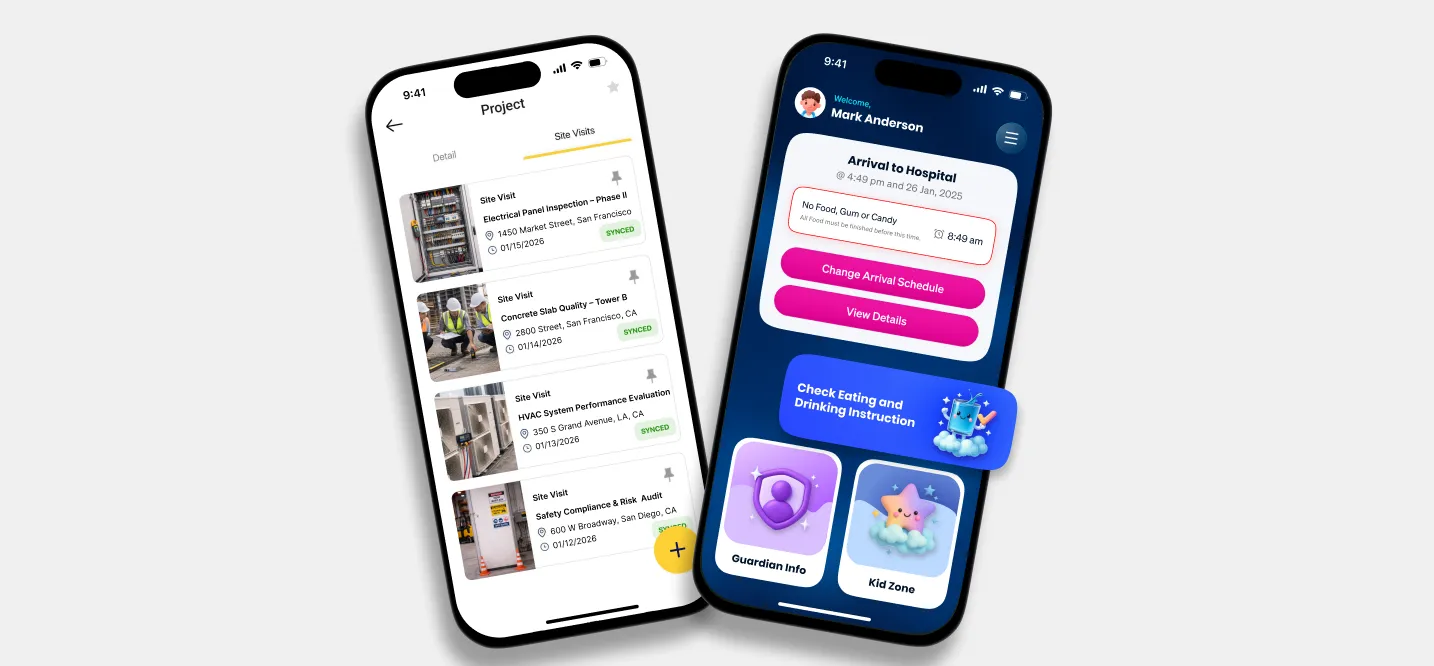
Two relevant projects of this approach are the LMCC Compliance Monitoring and Enforcement Platform, developed for the Labor Management Compliance Council (LMCC), and PreOpApp™ Kids, created in collaboration with Dr. Lauren Welsh, a pediatric anesthesiologist.
Both projects demonstrate how discovery is applied across very different domains, while following the same structured approach.
LMCC Compliance Monitoring & Enforcement Platform
The LMCC platform was developed for the Labor Management Compliance Council (LMCC), led by Executive Director Andres Posada, to support compliance monitoring and enforcement across construction projects in Southern California. The objective was to improve visibility into wage compliance and streamline reporting across multiple stakeholders, including field inspectors, contractors, and regulatory teams.
Understanding operational compliance workflows
During the discovery phase, the primary focus was to understand how compliance processes were executed in real-world environments. This involved analyzing how field inspectors collected data in the field, how contractors submitted required reports, and how regulatory teams reviewed and validated compliance information.
Aligning multiple stakeholder requirements
Given the involvement of several user groups, discovery workshops were conducted to align expectations and clarify responsibilities across different roles. This helped surface inconsistencies in manual reporting processes and highlighted communication gaps between field operations and administrative oversight.
Defining structured system behavior
The outcome of the discovery phase was a clearly defined system structure aligned with actual operational workflows. This ensured that the platform supported both mobile field operations and centralized monitoring while maintaining consistency in data reporting and enforcement processes.
PreOpApp™ Kids – Pediatric Surgery Experience Platform
PreOpApp™ Kids was developed in collaboration with Dr. Lauren Welsh, a pediatric anesthesiologist, to improve the pre-surgery experience for children and their caregivers. The platform was designed to address communication gaps and reduce anxiety associated with pediatric surgical procedures.
Understanding user behavior and emotional context
The discovery phase focused on understanding the emotional and behavioral challenges faced by children undergoing surgery, as well as the informational needs of caregivers. Children required reassurance and familiarity, while caregivers needed structured guidance and clear procedural information.
Structuring dual user journeys
Rather than designing a single unified flow, the discovery process separated the experience into two distinct user journeys. This allowed the product structure to address both emotional engagement for children and instructional clarity for caregivers.
Establishing experience-led design direction
The outcome of the discovery phase was a dual-layered experience model that balanced emotional support with functional guidance. This ensured that the platform addressed both psychological comfort and procedural preparedness before surgery.
Conclusion
The software development discovery phase isn’t a delay. It’s an accelerator. Done right, the way Cubix approaches it, discovery compresses the entire development life cycle by eliminating the guesswork that slows teams down later.
Every great product started with someone asking the right questions before writing the first line of code. Discovery is where those questions get asked, answered, and documented.
Frequently Asked Questions
1. What is the purpose of the software development discovery phase?
The software development discovery phase defines project scope, validates feasibility, aligns stakeholders, and creates a clear product roadmap before development begins. It prevents costly rework by surfacing problems early, when they’re cheap to fix.
2. How much does a discovery phase typically cost?
Discovery phase costs vary by agency and project complexity. Simple projects may run $5,000–$15,000. Enterprise-level discovery can reach $30,000–$80,000. The cost is almost always recovered through avoided rework and faster development.
3. Is the discovery phase necessary for small projects?
Yes, even small projects benefit from a lightweight project discovery process. A one-week discovery sprint for a small app can save weeks of development time by catching scope and technical issues upfront.
4. What’s the difference between discovery and planning?
Discovery is about learning and validating. Project planning takes those validated insights and translates them into timelines, resource allocation, and sprint structures. Discovery comes first; planning flows from it.
5. Who should be involved in the software project discovery phase?
Key stakeholders include the product owner, business sponsor, UX researcher, lead developer, and a project manager. Customer input, through interviews or surveys, is critical for grounding the product discovery process in real-world needs.
6. What happens if we skip the discovery phase?
Projects that skip the discovery phase in software development typically experience scope creep, missed deadlines, budget overruns, and high post-launch change request rates. Many fail to gain user traction because the product wasn’t properly validated before build.
7. What types of software has Cubix built through its discovery and development process?
Over the past 18 years, Cubix has worked with 600+ clients as a mobile app development company to design and build software solutions across multiple industries and business models. Our portfolio includes mobile applications, enterprise software platforms, SaaS products, on-demand marketplaces, healthcare solutions, fintech applications, logistics platforms, e-commerce systems, gaming products, and custom business software.
Each engagement starts with discovery to validate requirements, define technical direction, and create a roadmap before development begins, helping clients move from concept to launch with greater clarity and fewer execution risks.