Key Takeaways
- Mobile game development moves through clear stages: concept, design, prototyping, art, coding, QA, and launch.
- Most simple mobile games take 3 to 6 months to build. Complex ones take a year or more.
- Unity and Unreal Engine are the two most-used engines for cross-platform mobile games.
- Budgets range from $15,000 for a basic 2D game to $500,000 or more for a complex multiplayer title.
- QA testing and post-launch support decide whether a game survives past its first week.
- A clear Game Design Document is the single biggest predictor of a smooth build.
- Working with an experienced mobile game development company cuts risk and shortens timelines.
Mobile games now pull in about $92 billion a year. That’s roughly 49% of the entire $187 billion global games market. Almost half of all gaming money flows through phones and tablets.
Most people think making a game just means writing code. It doesn’t. A finished mobile game passes through designers, artists, programmers, testers, and marketers before it ever reaches an app store. Skip one of these people, and it usually shows.
This guide walks through the full process. You’ll see the steps, the timelines, the real costs, and the tools studios actually use for mobile games development. By the end, you’ll know exactly what goes into building one, from a rough idea to a live game with real players.
Want to discuss your project? Our experts are just a click away.
Contact UsWhat Is Mobile Game Development, Really?
The Short Definition
Mobile game development is the process of designing, building, testing, and launching a game for phones and tablets. It covers everything from the first sketch of an idea to the updates you push out months after launch.
It’s not one job. It’s a chain of jobs, each one handing off work to the next.
Who’s Involved in Building One
A single game usually needs input from several roles working together:
- Game designer – shapes the rules, mechanics, and level flow
- Programmer – writes the code that makes it all run
- Artist – builds characters, environments, and UI elements
- Sound designer – handles music and effects
- QA tester – hunts for bugs before players find them
- Producer – keeps the whole thing on schedule and on budget
Worldwide, there are now over 3.3 billion gamers, and about 80% of them play on mobile. That’s a massive audience, and it’s exactly why teams put this much structure behind every launch, whether it’s a small indie project or a full custom game development company build.
Why Mobile Games Are Booming Right Now
The Market Numbers
The numbers behind mobile gaming keep climbing. The global games market is on track to approach $205 billion by 2026, and mobile keeps grabbing the biggest slice of it.
Here’s how the platforms stack up against each other.
Global Games Market by Platform
| Platform | Revenue Share | Estimated Revenue |
| Mobile | ~49% | ~$92 billion |
| Console | ~28% | ~$51 billion |
| PC | ~23% | ~$43 billion |
Mobile isn’t just the biggest platform. It’s growing faster than the other two combined in most emerging regions.
Where the Growth Is Coming From
A few things are fueling the surge:
- Cheaper smartphones reaching first-time gamers in India, Southeast Asia, and Latin America
- Better mobile internet cutting load times and improving multiplayer play
- Hybrid-casual games blending simple mechanics with deeper monetization
- Live service updates keeping older games relevant for years, not months
Asia Pacific alone generates more than $88 billion in game revenue a year, making it the single largest gaming region on the planet.
How to Make a Mobile Game: Step by Step Guide
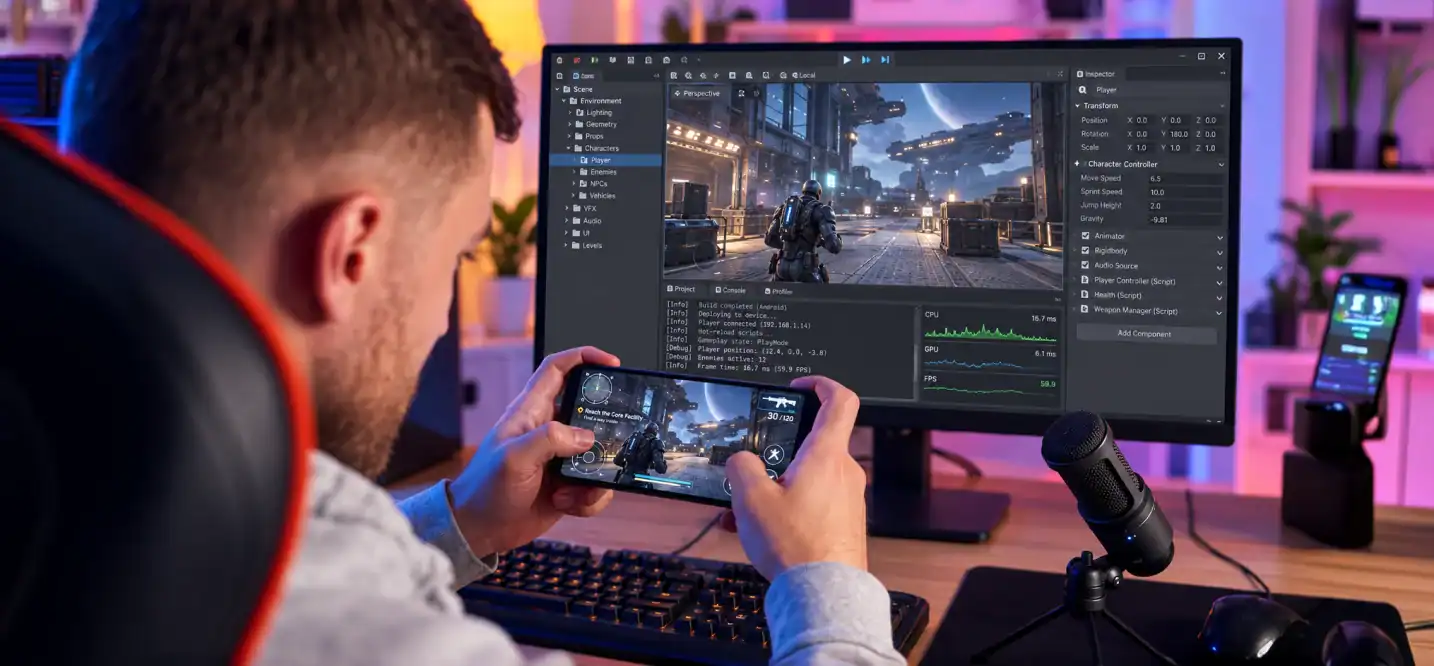
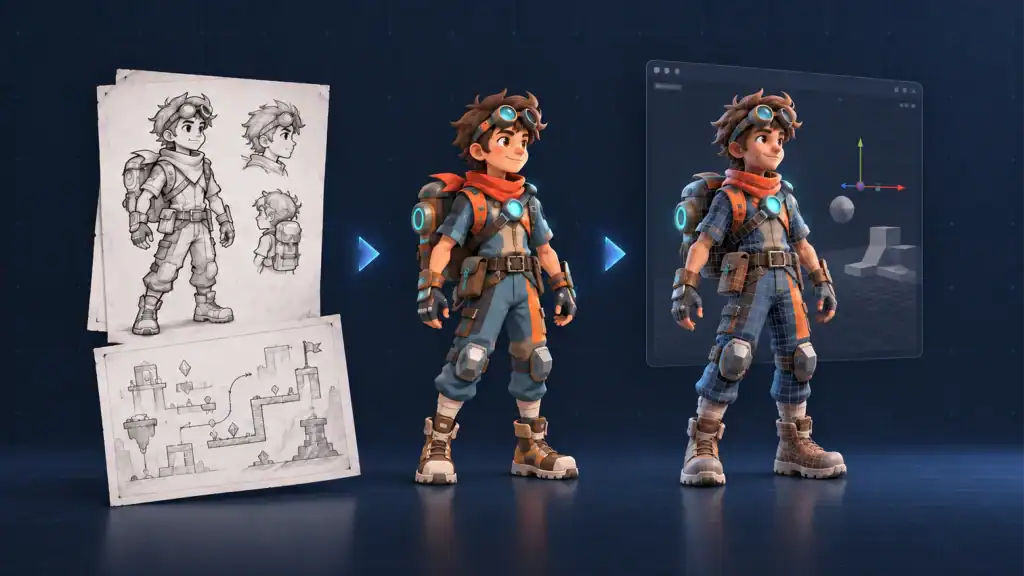
Mobile game making involves planning an idea, building it inside a game engine, and testing it, then finally launching it on app stores.
How to Make a Mobile Game #1: Concept & Idea Validation
Every game starts as a rough idea. Before anyone touches code, that idea needs a gut check.
- Is the core idea fun in one sentence?
- Does it fit a genre players already search for?
- Can a small team actually build it?
This stage is cheap. Mistakes here cost almost nothing. Mistakes caught later cost a lot more.
How to Make a Mobile Game #2: Market & Competitor Research
Next comes the homework. Teams study similar games, read App Store and Google Play reviews, and figure out who the target player actually is.
Global mobile game downloads hit roughly 50 billion in a single year. That’s a lot of competition fighting for the same thumbs. Skipping this step is one of the fastest ways to build something nobody wants.
How to Make a Mobile Game #3: Writing the GDD
The GDD is the blueprint. It spells out the core mechanics, the art direction, the level structure, and how the game plans to make money.
A good GDD answers questions before they become arguments mid-development. Teams that understand game theory in mobile game development tend to build tighter, more addictive core loops right from this stage.
How to Make a Mobile Game #4: Prototyping
Now the idea becomes something you can actually touch. A prototype is a rough, ugly, playable version of the core loop. No polish, no final art. Just proof the fun idea is actually fun.
Teams test it internally, tweak it, and sometimes throw the whole thing out and start again. That’s normal. Better to find out now than after months of art and code.
How to Make a Mobile Game #5: Choosing the Right Engine & Platform
This decision shapes everything downstream. Most teams pick between Unity and Unreal Engine, then decide whether to launch on iOS, Android, or both at once.
Unity vs. Unreal Engine for Mobile
| Factor | Unity | Unreal Engine |
| Best for | 2D, mobile, indie projects | High-end 3D, cinematic visuals |
| Mobile market share | ~48% | Smaller footprint on mobile |
| Learning curve | Gentler, built on C# | Steeper, built on C++ |
| Pricing | Free tier, paid plans from ~$185/yr | Free, 5% royalty over $1M revenue |
| Asset marketplace | Largest and most varied | Smaller, higher quality |
Unity powers roughly 70% of top-grossing mobile games today. For most mobile projects, it’s the safer starting point, especially for teams that want to ship on both iOS and Android without doubling their work. That’s exactly the kind of decision an experienced custom game development company helps clients make early, before a single line of code gets written.
How to Make a Mobile Game #6: Art & Asset Production
Once the engine is locked, art production ramps up. This covers 2D or 3D character models, environments, UI screens, animations, and sound design.
Good art doesn’t just look nice. It communicates rules. Color, shape, and motion tell players what’s safe, what’s dangerous, and what’s tappable, often before they read a single word.
How to Make a Mobile Game #7: Programming & Core Development
This is where the game actually gets built. Programmers wire up gameplay logic, backend systems, multiplayer networking, and monetization hooks.
Programming usually eats the largest share of the development timeline, often 40% or more of total build time on mid-to-complex titles. Studios that know how to build for scale behind top-grossing mobile games design their backend to handle millions of players without falling over on launch day.
How to Make a Mobile Game #8: QA Testing
Before launch, the game goes through heavy testing. QA checks functionality, device compatibility, performance under load, and edge-case bugs.
Testing happens across dozens of device models, screen sizes, and OS versions. A bug that never shows up on your test phone can crash the game for thousands of real users.
How to Make a Mobile Game #9: Launch Prep & Optimization
Launch isn’t just flipping a switch. Teams build store listings, write keyword-optimized descriptions, design screenshots, and often run a soft launch in one or two smaller markets first.
Soft launches let teams fix problems quietly, before the global audience ever sees them.
How to Make a Mobile Game #10: Post-Launch Support & LiveOps
The work doesn’t stop at launch. Successful games run ongoing updates, seasonal events, and analytics-driven tweaks for years after release. This stage, often called LiveOps, is what turns a one-week hit into a long-term earner.
Why Cubix for Your Mobile Game Development
Cubix has spent years building mobile games across genres, engines, and platforms, from hyper-casual hits to complex multiplayer titles. The team works across Unity and Unreal, ships on both iOS and Android, and has a track record building for scale, not just for launch day.
That combination matters. A studio that only knows how to launch a game isn’t the same as one that knows how to keep it alive, profitable, and growing a year later. That’s part of the case for custom game development, and why Cubix leads in that space.
Getting started is simple. Share your idea, even a rough one, and Cubix can help shape it into a real Game Design Document, a working prototype, and a realistic budget and timeline.
Want to discuss your project? Our experts are just a click away.
Contact UsFrequently Asked Questions
1. How do I create a mobile game from scratch step-by-step?
Start with a validated idea, then write a Game Design Document, build a prototype, choose your engine, produce art and code, run QA, and launch. Post-launch updates keep the game alive.
2. What are the initial steps for planning a mobile game?
Validate your idea, research competitors, and define your target audience. Then lock down the core mechanics in a written design document before any coding starts.
3. What are the best tools for developing a mobile game for beginners?
Unity is the most beginner-friendly engine, thanks to its gentler learning curve and huge asset marketplace. It also happens to power most mobile games already on the market.
4. Can you explain the process of designing levels for a mobile game?
Level design starts with the core mechanic, then builds difficulty gradually. Designers prototype levels quickly, test them internally, and adjust pacing based on player feedback.
5. How much does it cost to develop a simple mobile game?
A basic 2D or hyper-casual game typically costs between $15,000 and $50,000, depending on team location, art style, and platform count.
6. What are the popular game engines for cross-platform mobile development?
Unity leads by a wide margin for mobile, followed by Unreal Engine for higher-end 3D titles. Both support building for iOS and Android from a single codebase.
7. What programming languages are commonly used to make mobile games?
C# is the primary language for Unity, while C++ powers Unreal Engine. Some teams also use Swift or Kotlin for native platform-specific features.