Mathematics is one of the hardest places to hide weak reasoning. An AI system can produce a convincing explanation, but a mathematical argument has to survive logical scrutiny. That makes OpenAI’s latest mathematics release more significant than another benchmark score: the company has published 722 mathematical manuscripts organized into 372 result families, following an evaluation in which its internal model was presented with approximately 4,000 problems. OpenAI says many of the results also have Lean formalizations that allow mathematical proofs to be checked computationally.
The bigger story is not simply that AI can “do math.” It is that AI systems are being pushed toward research tasks that require exploration, multi-step reasoning, proof construction, and verification. For AI and software engineering, that raises a broader question: what could stronger mathematical reasoning mean for AI agents, software verification, optimization, algorithm design, and other systems that depend on reliable problem-solving?
Key Takeaways
- OpenAI has released 722 mathematical manuscripts across 372 result families produced by an internal frontier model.
- The evaluation involved approximately 4,000 mathematical problems, with the average result using compute equivalent to roughly three hours of ChatGPT Pro thinking.
- The collection spans areas including number theory, algebra, geometry, theoretical computer science, mathematical physics, and differential equations.
- Many results have been formalized in Lean, but not every manuscript has a Lean formalization, and OpenAI explicitly warns that some unformalized results could contain issues.
- The significance of the release lies in AI’s ability to tackle open-ended mathematical research, rather than simply answering problems with known solutions.
- Stronger reasoning could eventually benefit AI agents, software verification, algorithm development, optimization, scientific computing, and complex decision-support.
What Is OpenAI Mathematics?
OpenAI Mathematics is not the name of a public model or standalone product. It refers to OpenAI’s recently released collection of mathematical research produced by an internal frontier model.
The public repository contains manuscripts and supporting proof artifacts from OpenAI’s evaluation of its models on open mathematical research problems. OpenAI says it expanded these evaluations after performance on existing mathematical evaluations had saturated.
The scale of the resulting collection is what makes the release unusual.
| OpenAI Mathematics at a glance | Details |
| Mathematical manuscripts | 722 |
| Result families | 372 |
| Problems attempted | Approximately 4,000 |
| Reasoning summaries | 10 abridged summaries |
| Proof formalization | Many results formalized in Lean |
| Model | Internal and unreleased |
A result family can contain a principal result along with companion arguments, consequences, or alternative proofs. This means the 372 families should not be interpreted as 372 completely independent breakthroughs. They are groups of related research outputs.
OpenAI’s public mathematics repository also preserves manuscript versions, supporting materials, citation information, and the available Lean formalizations.
What Did OpenAI’s AI Model Achieve in Mathematics?
The most important distinction is between solving established mathematical problems and contributing to open mathematical research. A conventional math benchmark normally has a known answer. The model receives a problem, works through it, and is evaluated against an expected solution.
Research mathematics is different. A researcher may encounter a question where the path to a solution is unknown. Solving it can require developing intermediate claims, testing conjectures, finding counterexamples, combining existing results, and constructing a proof that other mathematicians can scrutinize.
OpenAI’s release is aimed at this harder setting.
1. From Math Benchmarks to Mathematical Research
The collection covers a broad range of disciplines, including:
- Number theory
- Algebra
- Geometry
- Combinatorics
- Theoretical computer science
- Mathematical physics
- Analysis and differential equations
- Operator algebras
The repository’s ten published reasoning summaries provide examples of the research areas involved. They include work on the irrationality exponent of π, Mahler conjectures, arithmetic progressions, an NP-hardness result, Kaplansky’s direct-finiteness conjecture, spin glasses, quantum Heisenberg ferromagnets, free group factors, and the relativistic Vlasov-Maxwell system.
| Mathematical area | Example represented in the collection |
| Number theory | Irrationality exponent of π |
| Number theory | Mahler conjectures |
| Theoretical computer science | NP-hardness at the basic semidefinite threshold |
| Algebra | Kaplansky’s direct-finiteness conjecture |
| Mathematical physics | Quantum Heisenberg ferromagnet |
| Operator algebras | Isomorphism of free group factors |
| Differential equations / mathematical physics | Relativistic Vlasov-Maxwell system |
These examples matter because they show the intended scope of the project. This is not simply an AI system answering textbook equations. It is an attempt to apply frontier AI to research-level mathematical problems.
At the same time, the existence of a manuscript should not be treated as equivalent to independent acceptance of every mathematical claim. OpenAI explicitly says the collection contains results at different stages of verification.
How Did OpenAI’s Model Approach Mathematical Problems?
OpenAI has provided more information about the process than simply publishing the final manuscripts.
According to the repository, the vast majority of the results came from a common procedure using an unreleased internal model. The model was presented with approximately 4,000 problems, and the average result used compute equivalent to about three hours of ChatGPT Pro thinking. The resulting outputs were then aggregated into research families and manuscripts based on an appropriate level of significance.
OpenAI also notes that the procedure was not identical for every result. The repository identifies exceptions involving work on a zero-free region for the Riemann zeta function and the Hodge Conjecture for CM abelian varieties. One write-up concerning the Riemann zeta function was also human-edited for readability.
What Does the Reasoning Process Look Like?
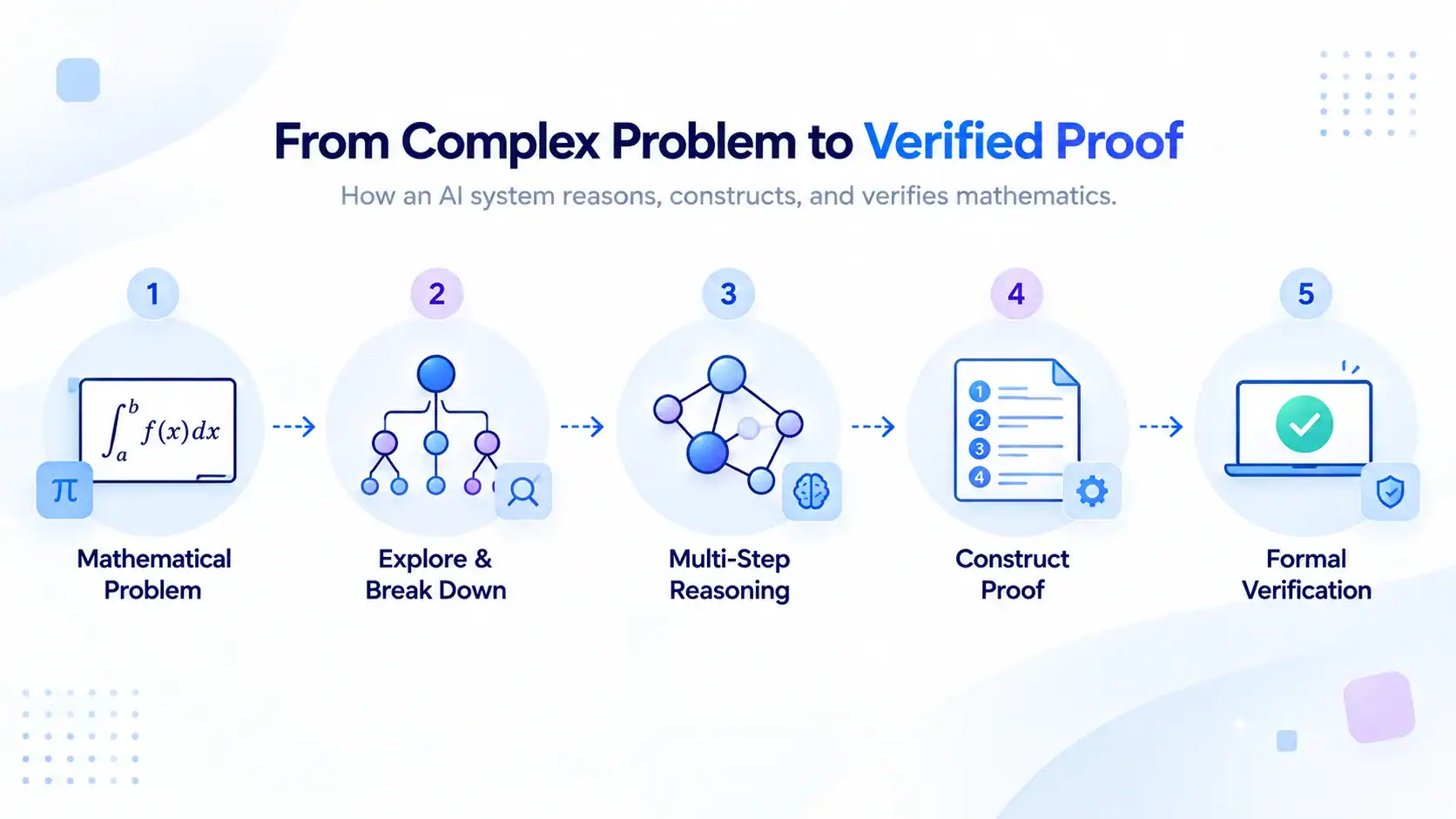
At a high level, research-oriented mathematical reasoning can involve a cycle like this:
Problem → exploration → candidate approach → intermediate results → proof construction → verification → revision
That is fundamentally different from asking a language model to produce an immediate answer.
A difficult problem may require the system to:
- Understand definitions and constraints.
- Identify useful mathematical structures.
- Explore possible approaches.
- Establish intermediate lemmas.
- Detect when an approach fails.
- Revise the strategy.
- Construct a coherent proof.
- Formalize the result where possible.
The exact internal reasoning process should not be inferred from the final papers alone. What OpenAI has publicly released are 10 abridged reasoning summaries, not unrestricted internal chain-of-thought transcripts. The summaries provide selected insight into how the model approached particular results.
This distinction matters because the goal is not simply to show that an AI can generate a long mathematical explanation. The more meaningful question is whether it can produce correct, useful, and independently checkable mathematical work.
Why Does Lean Matter for OpenAI Mathematics?
One of the most technically important parts of the release is its use of Lean. Lean is a theorem prover and programming language that allows mathematical statements and proofs to be expressed formally so that a computer can check them.
OpenAI has published Lean formalizations for many, but not all, of the results in the collection. The company says it will continue adding formalizations as they become available. The distinction between a manuscript and a formalized proof is important.
What Lean Can Check
When a proof has been correctly formalized, Lean can check whether the formal proof satisfies the rules and definitions of the formal system.
That can help catch problems such as:
- Invalid logical steps
- Missing assumptions
- Incorrect transformations
- Unsupported conclusions
- Errors hidden by informal mathematical notation
This makes theorem proving particularly valuable for AI-generated mathematics because language models can produce arguments that appear convincing while containing subtle errors.
Formal Verification Is Not the Same as Peer Review
These are separate layers of validation.
| Validation layer | Main purpose |
| AI-generated argument | Produces a candidate solution or proof |
| Lean formalization | Checks the formal proof within the specified system |
| Expert mathematical review | Examines correctness, context, significance, and interpretation |
| Peer review | Provides independent scholarly evaluation |
A Lean-checked proof can establish that a formalized argument follows from its formal assumptions. It does not by itself determine whether the result is novel, important, well-framed, or correctly positioned within the existing mathematical literature.
That is why OpenAI’s own repository cautions that not all results have Lean formalizations, and some unformalized results could have issues.
Why Is Mathematics a Useful Test for AI Reasoning?
Mathematics provides an unusually demanding environment for studying AI reasoning because many mathematical problems have precise definitions, explicit assumptions, logical dependencies, and reproducible proofs.
That creates several properties that are valuable for evaluating AI systems.
1. Correctness Can Be Defined Precisely
A mathematical result is not correct simply because it sounds persuasive. The argument has to follow from its assumptions.
2. Problems Can Require Long Reasoning Chains
Some research problems require many intermediate steps before a useful conclusion can be reached. This makes them a stronger test of reasoning than tasks that can be solved through direct recall.
3. Results Can Be Formalized
A theorem prover can provide a machine-checkable representation of a proof when the relevant mathematics has been formalized.
4. Research Problems Test More Than Recall
An open problem does not necessarily come with a known path to the answer. The system therefore has to explore possible approaches rather than simply reproduce a familiar solution.
This is part of the broader shift from AI systems that primarily generate answers toward systems that can plan, reason, use tools, evaluate intermediate results, and verify outcomes.
What Does OpenAI Mathematics Mean for the Future of AI?
The broader significance of OpenAI Mathematics extends beyond mathematics itself.
If AI systems become better at structured reasoning, they could become more capable components inside applications where the correct sequence of actions matters as much as the final response.
AI Could Move Beyond Answer Generation
Consider the difference between two systems.
A conventional assistant might receive a request and generate a response.
A reasoning-oriented system may need to determine:
- What the user is actually asking.
- What information is required.
- Which constraints apply.
- Which tools or data sources are needed.
- Which actions should happen first.
- Whether the result satisfies the original objective.
- What to do if the first approach fails.
That is much closer to problem-solving than simple text generation.
This is particularly relevant to large language models, which increasingly serve as reasoning and orchestration components within broader AI architectures.
Reasoning Could Make AI Agents More Capable
AI agents combine models with tools, APIs, data, memory, workflows, and action-taking capabilities.
Better reasoning could help an agent decide not only what to say, but what to do next.
For example, an enterprise agent might need to interpret a request, retrieve information from several systems, evaluate possible actions, execute one, check the outcome, and recover from an error.
Cubix’s work on AI agent development covers the engineering considerations involved in building systems that combine AI reasoning with task execution, integrations, and business workflows.
The important caveat is that stronger reasoning does not automatically make an agent reliable. Production agents still require controlled permissions, evaluation, observability, security, deterministic safeguards where appropriate, and human oversight.
How Could AI Mathematical Reasoning Affect Software Development?
Software engineering is a natural area for the application of stronger reasoning because software systems already provide multiple forms of machine-readable feedback.
Code can be compiled, tested, type-checked, analyzed, executed, and monitored.
That creates opportunities for AI systems to use feedback throughout the development process rather than treating code generation as a one-shot task.
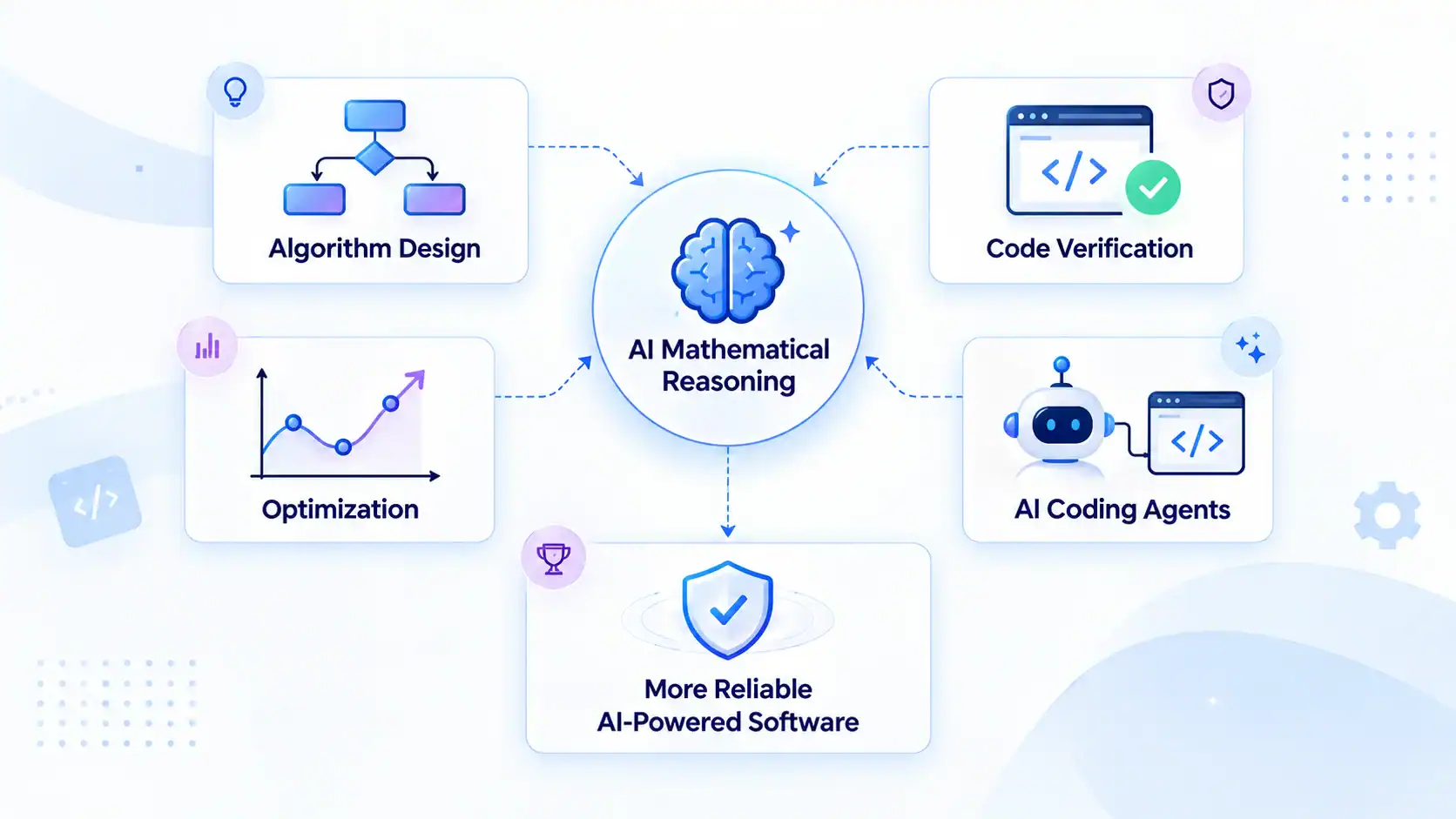
1. More Reliable Algorithm Design
Reasoning systems could assist engineers with problems involving:
- Algorithm selection
- Computational complexity
- Graph algorithms
- Constraint solving
- Scheduling
- Resource allocation
- Query optimization
- Performance analysis
The potential value is not simply generating code faster. It is helping reason about why an algorithm should satisfy a particular specification or constraint set.
2. Stronger Code Analysis and Verification
AI could also help analyze existing software.
A reasoning system might compare implementation logic against a specification, identify edge cases, generate targeted tests, or propose changes after a failure.
This creates a useful loop:
Analyze → propose → test → inspect failure → revise → verify
The same basic principle appears in mathematical research, although software has its own distinct engineering constraints.
3. More Capable Coding Agents
Coding agents need to handle chains of dependent tasks rather than isolated code-generation prompts.
A realistic workflow might involve:
- Understanding a feature request.
- Inspecting an existing codebase.
- Identifying affected components.
- Planning the implementation.
- Writing or modifying code.
- Running tests.
- Diagnosing failures.
- Revising the implementation.
- Checking for regressions.
- Preparing the final change.
That requires planning, tool use, feedback interpretation, and iterative reasoning.
Cubix’s analysis of AI-powered software development explores how AI is being applied across requirements, development, testing, deployment, and maintenance.
For organizations building custom AI-powered applications, AI software development provides the broader engineering context around incorporating AI capabilities into production software.
4. More Advanced Optimization
Optimization problems are another potential area of impact.
Businesses routinely deal with objectives subject to constraints, such as:
- Fleet routing
- Workforce scheduling
- Inventory allocation
- Supply chain planning
- Manufacturing schedules
- Network optimization
- Financial resource allocation
Better reasoning could help translate complex requirements into structured optimization problems and assist with evaluating candidate solutions.
It does not eliminate the need for domain-specific algorithms, accurate data, or validation. Instead, it could make AI systems more useful at the interface between natural-language requirements and formal computational methods.
What Could OpenAI Mathematics Mean for Businesses Building AI Systems?
The immediate lesson for businesses is not that they need a mathematics model.
The more useful takeaway is that reasoning and verification could become increasingly important layers in AI system architecture.
| Emerging capability | Potential application |
| Mathematical reasoning | Complex decision-support |
| Constraint reasoning | Scheduling and resource allocation |
| Optimization | Logistics and operations |
| Formal verification | Software and system validation |
| Multi-step reasoning | AI agents and workflow automation |
| Advanced problem-solving | Engineering and scientific applications |
| Structured analysis | Planning and forecasting |
These are potential application areas, not direct outcomes of OpenAI’s mathematics release.
A research result demonstrating stronger mathematical reasoning does not mean an enterprise AI system can immediately solve supply-chain optimization or verify production software autonomously.
Production systems still require:
- Reliable data
- Model evaluation
- Security controls
- Access management
- System integrations
- Observability
- Testing
- Human oversight
- Clear failure-handling procedures
As AI capabilities become more deeply integrated into business operations, organizations also need a consistent approach to governance, evaluation, security, and deployment. An AI Center of Excellence can provide an organizational framework for coordinating those efforts across teams.
What Comes Next for OpenAI Mathematics?
OpenAI’s own plans provide a better basis for discussing the next phase than speculation about what AI will supposedly accomplish next.
The company says it plans to continue adding Lean formalizations, improve the quality and presentation of future mathematical releases, and explore community-hosted alternatives for distributing research materials. It also says it will fund workshops, conferences, and special programs focused on understanding major results produced by AI.
OpenAI also says it is working toward responsibly releasing the model that produced these mathematical results and intends to continue evaluating its internal frontier models on mathematics and other sciences.
That creates several important areas to watch:
1. More Formalized Proofs
Additional Lean formalizations should make more of the collection independently machine-checkable.
2. Independent Mathematical Scrutiny
Researchers will need to assess the novelty, correctness, significance, and context of the results.
3. Better Transparency Around AI-Generated Research
Details about prompts, compute, methodology, revisions, and verification can make AI-generated research easier to evaluate.
4. Broader Scientific Applications
The same reasoning capabilities could eventually be tested in fields where problems require rigorous multi-step analysis.
The real measure of progress will therefore not be the number of manuscripts produced. It will be whether AI-generated mathematical work can withstand formal checking, expert scrutiny, independent reproduction, and meaningful use by researchers.
Conclusion
OpenAI Mathematics represents a meaningful shift in how frontier AI systems are being tested. The release moves beyond familiar math benchmarks toward open research problems that require exploration, multi-step reasoning, proof construction, and, where possible, formal verification. The 722-manuscript collection does not mean every result is independently established, but it does provide a substantial look at what an internal AI system can produce when given difficult mathematical research tasks.
For software and AI engineering, the broader lesson is even more relevant. Stronger reasoning could eventually support more capable AI agents, algorithmic problem-solving, code analysis, optimization, and verification workflows. But turning those capabilities into dependable products still requires sound architecture, evaluation, security, data, and human oversight. Organizations exploring these possibilities can learn more about AI software development and how reasoning capabilities can fit into production AI systems.
Ready to Build AI Systems With Advanced Reasoning?
Contact Us
Frequently Asked Questions
1. What is OpenAI Mathematics?
OpenAI Mathematics refers to OpenAI’s public collection of mathematical research results produced by an internal frontier AI model. The collection contains 722 manuscripts organized into 372 result families.
2. What did OpenAI’s mathematics model achieve?
The model produced mathematical research results across areas including number theory, algebra, geometry, theoretical computer science, mathematical physics, and differential equations. OpenAI describes the collection as the output of evaluations on open research problems.
3. How many mathematical problems did OpenAI’s model attempt?
OpenAI says the model was presented with approximately 4,000 problems during the evaluation that produced the collection. The resulting outputs were grouped into 372 research families and 722 manuscripts.
4. What is the OpenAI mathematics model?
The model behind the collection is an internal, unreleased OpenAI frontier model. OpenAI has not released the model itself but says it is working toward responsibly releasing it.
5. What is Lean in OpenAI’s mathematics research?
Lean is a programming language and theorem-proving system that allows mathematical statements and proofs to be expressed formally so that a computer can check them. OpenAI has released Lean formalizations for many, but not all, of the mathematical results in its collection.
6. Are OpenAI’s mathematical proofs verified?
Not all of them. Many results have Lean formalizations, but OpenAI explicitly states that the manuscripts are at different stages of verification and that some unformalized results could contain issues. Formal verification also differs from independent mathematical review.
7. How could AI mathematical reasoning affect software development?
Stronger mathematical reasoning could potentially improve areas such as algorithm design, code analysis, automated testing, optimization, formal verification, and AI coding agents. These applications still require engineering controls and validation before they can be trusted in production.