Key Takeaways
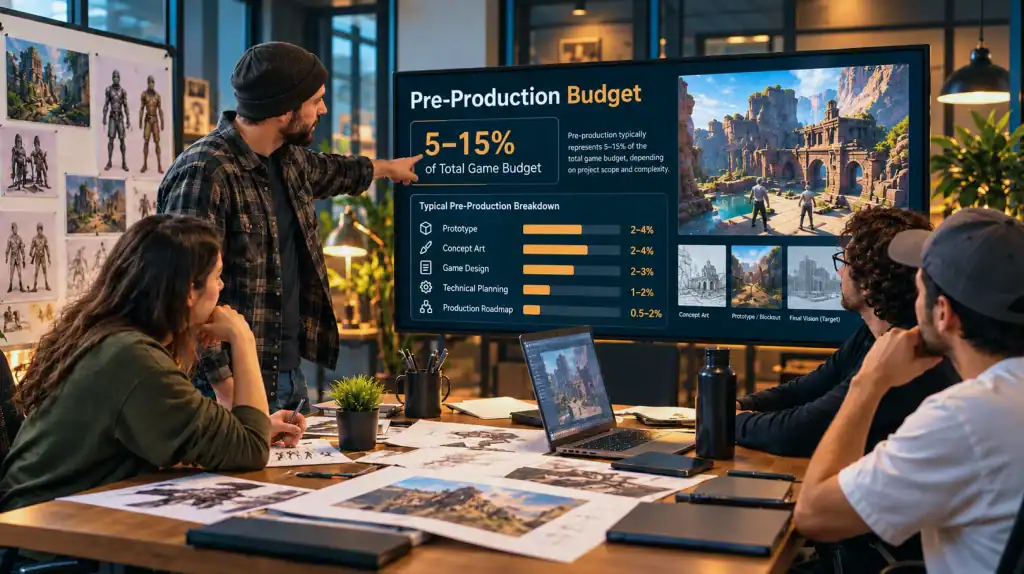
- Pre-production takes 5% to 15% of your total budget. For a small mobile game, that means $500 to $12,000. For a AAA title, it means $4 million or more.
- Prototyping and design carry the most weight. The prototype takes 25% to 35% of the phase, and game design takes 15% to 25%. Both catch expensive problems before full production starts.
- Team size and region set your rate. A solo or small indie team spends $500 to $25,000, while a large studio spends millions. Regional rates can also cut the same scope by 60% to 70%.
- Hidden costs add 10% to 25%. Stakeholder revisions, device testing, test servers, compliance reviews, and tool licenses rarely appear in the first quote.
- A contingency of 15% to 20% protects your budget. Add it after you price each deliverable, and validate the core loop with a proof of concept before you scale the team.
Game pre-production typically costs 5% to 15% of a project’s total development budget. This investment covers the planning, validation, and technical decisions needed before a studio commits to full-scale production.
For a small mobile game, pre-production may cost $500 to $12,000. For a large AAA title, it can cost millions of dollars. The final number depends on the game’s scope, genre, art style, target platforms, team size, prototype requirements, and technical complexity.
This guide explains what you pay for during game development pre-production, how costs vary by project type, and how to build a realistic estimate. For a broader look at full-project spending, see this guide to video game development costs.
If you need support with discovery, prototyping, and planning, Cubix provides game development services for mobile, PC, console, web, and multiplayer projects.
Have a Game Idea? Let’s Turn It Into a Playable Prototype
Contact UsWhat Is Pre-Production in Game Development?
Game pre-production is the planning and validation phase before full-scale development begins. It includes defining the game concept, testing the core gameplay loop, creating a prototype, selecting the technology, and preparing the production roadmap.
A 2025 Unity production-cycle guide places pre-production before production, post-production, and live operations in the game development lifecycle. The phase is used to plan the project, test ideas, document design decisions, and prepare the team for development.
The main outputs are a Game Design Document, playable prototype, technical plan, visual direction, and production roadmap. These deliverables help the team identify design and technical risks before committing to full-scale production.
What Percentage of a Game Budget Goes to Pre-Production?
Pre-production game development takes 5% to 15% of the total budget. Projects with new mechanics, multiplayer, or 3D art sit at the high end.
The Budget model shows one way to split the money:
- Discovery and planning: 10%
- Prototype or MVP: 20%
- Full production: 45%
- Testing and optimization: 15%
- Launch preparation: 10%
Production alone takes 60% to 70% of the game production budget on larger projects. Live-service games then spend another 20% to 40% of lifetime costs after launch.
Game Pre-Production Cost Breakdown
Every game development cost breakdown starts with the same seven line items. However, the weight of each item changes with genre and team size. The table shows the typical share of the pre-production budget.
| Line Item | Typical Share of Pre-Production Budget |
| Game design and documentation | 15% to 25% |
| Prototype development | 25% to 35% |
| Concept art and assets | 15% to 25% |
| Technical research and architecture | 10% to 15% |
| Market research | 3% to 5% |
| Project management and planning | 5% to 10% |
| Legal, licensing, and software | 3% to 8% |
1. Game Design and Documentation
Design turns an idea into a buildable plan. Your game design cost runs 8% to 12% of the total project budget, and much of that spend lands in pre-production.
Typical deliverables include:
- The core gameplay loop
- Progression and economy rules
- A monetization plan
- A first draft of the GDD
2. Prototype Development
A prototype tests whether your core mechanic is fun. A proof of concept comes first. It answers one question with rough assets, and the prototype then adds controls, UI, and feedback.
Expect a game prototype cost of $2,000 to $15,000 for mobile and indie projects. Mid-sized projects run $15,000 to $60,000. A vertical slice goes further because it shows one section at final quality. As a result, the vertical slice cost reaches $30,000 to $150,000 for most indie and AA games.
For many mobile games, prototyping and MVP development can represent a substantial early investment because the team must validate gameplay, controls, UI, and technical feasibility before full production.
3. Concept Art and 3D Assets
Art sets the visual target before you pay for volume. Art production takes 30% to 50% of a mobile project’s cost, so early style tests prevent expensive rework.
Dimension also matters. Full 2D projects run $20,000 to $100,000, while 3D projects start near $80,000. For a deeper comparison, read our guide to 2D versus 3D development costs.
Pre-production art usually covers mood boards, character concepts, environment paintings, and a UI style test. Together, these define your art direction.
4. Technical Research and Architecture
Technical planning confirms that your design runs on your target hardware. The team picks an engine, tests risky systems, and sketches the multiplayer architecture.
Engine choice changes the budget. Unity fits mobile and casual games at lower to medium cost, while Unreal Engine 5 fits high-end visuals at medium to high cost. Cubix explains the gap in its Unity game development costs guide.
In addition, backend systems take 8% to 15% of a mobile budget. A technical feasibility check therefore pays for itself early.
5. Market Research
Market research checks demand before you commit funds. It covers competitor analysis, audience data, and monetization models.
For example, mobile user acquisition costs $1.50 to $4.50 per install. A weak retention model breaks the business case fast. Research takes about 3% to 5% of the pre-production budget.
6. Project Management and Production Planning
Producers turn the design into a schedule. They build the production roadmap, set milestones, and log risks. Project management takes 5% to 10% of a typical budget, and pre-production follows the same range. Also, a clear plan gives you a baseline for tracking scope changes.
7. Legal, Licensing, and Software Costs
These items look small, but they add up. Budget for:
- Steam Direct fee: $100 per game
- Apple Developer Program and Google Play Console fees
- Engine licenses, such as Unreal’s 5% royalty after $1 million in lifetime revenue
- Asset packs and tool subscriptions
- Trademark searches and privacy compliance (GDPR, COPPA, CCPA)
Average Game Pre-Production Cost by Game Type
Game pre-production typically accounts for 5% to 15% of a game’s total development budget, depending on its scope, complexity, platform, and technical requirements.
| Game Type | Typical Total Budget | Estimated Pre-Production Cost |
| Hyper casual mobile | $10,000 to $40,000 | $500 to $6,000 |
| 2D mobile | $20,000 to $80,000 | $1,000 to $12,000 |
| 3D mobile | $80,000 to $300,000 | $4,000 to $45,000 |
| Indie PC | $50,000 to $500,000 | $2,500 to $75,000 |
| AA | $500,000 to $5 million | $25,000 to $750,000 |
| MMO | $2 million to $50 million+ | $100,000 to $7.5 million+ |
| AAA | $80 million to $300 million+ | $4 million to $45 million+ |
How Team Size Affects Game Pre-Production Costs
Sound game studio budgeting starts with headcount. People make up the largest expense in game development, so team size sets your cost more than any tool does.
| Team Type | Team Size | Estimated Pre-Production Cost |
| Solo or small indie | 1 to 5 | $500 to $25,000 |
| Small studio | 6 to 15 | $10,000 to $75,000 |
| Mid-sized team | 20 to 50 | $50,000 to $750,000 |
| Large or AAA studio | 100 to 500+ | $4 million to $45 million+ |
Solo or Small Indie Team
A team of one to five builds a proof of concept, writes a short GDD, and tests the core loop. Your indie game budget for this phase runs $500 to $25,000. Hyper casual teams of three to five people sit at the low end.
Small Studio Team
Studios of 6 to 15 people add a dedicated designer, concept artist, and technical lead. Card games and simulations fall in this range. Expect $10,000 to $75,000.
Mid-Sized Development Team
RPG and strategy projects use 20 to 50 people. Prototypes cover several systems, and the GDD grows into a set of documents. Expect $50,000 to $750,000.
Large or AAA Studio Team
AAA projects use 100 to 500+ developers. The market research and the GDD alone cost $50,000 to $150,000, plus $30,000 to $100,000 for UI/UX prototyping. Engine research and vertical slices push the full phase into the millions. Our guide to AAA game budgets shows the full cost structure.
What Is Included in a Game Pre-Production Budget?
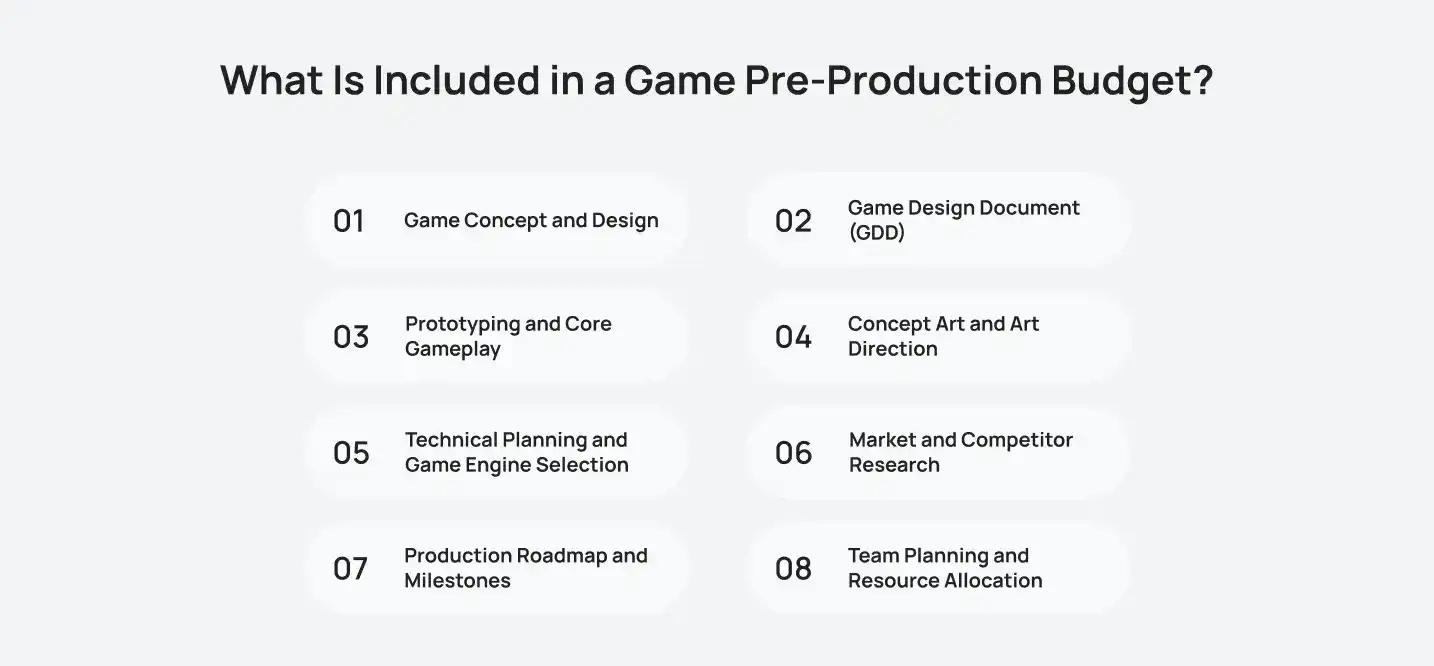
A complete budget covers eight deliverables. A game pre-production budget covers all costs for planning, prototyping, and scoping the project before full-scale asset creation begins.
1. Game Concept and Design
The output is a one-page pitch, a target audience profile, and genre positioning. This step costs little, but it guides every later decision.
2. Game Design Document (GDD)
The GDD records mechanics, systems, levels, and UI. Game design document cost ranges from $1,500 to $10,000 for indie projects and $10,000 to $40,000 for mid-sized ones. At the AAA level, market research and the GDD together run $50,000 to $150,000.
3, Prototyping and Core Gameplay
The output is a playable build of your core gameplay loop. Testers rate it for fun, and that rating decides whether the project moves forward.
4. Concept Art and Art Direction
The output is a style guide, character sheets, and environment paintings. Artists also test how the look performs on target devices.
5. Technical Planning and Game Engine Selection
The output is an engine decision, an architecture diagram, and a technical risk report. Engineers flag expensive systems before anyone builds them.
6. Market and Competitor Research
The output is a competitor matrix, pricing benchmarks, and monetization data. It tells you if your idea has room in the market.
7. Production Roadmap and Milestones
The output is a schedule with milestone gates. Solid game development planning ties each milestone to a deliverable and a payment.
9. Team Planning and Resource Allocation
The output is a role list and a hiring or outsourcing plan. Junior developers charge $25 to $50 per hour, while senior specialists charge $100 to $200+.
Game Pre-Production Costs by Region
Location changes your hourly rates more than any other variable. Rates below reflect junior to senior specialists in game design, engineering, and art.
| Region | Typical Hourly Rate | Cost vs. US Baseline |
| US and Canada | $80 to $200+ | 100% |
| UK and Western Europe | $60 to $150 | 80% to 90% |
| Eastern Europe | $35 to $90 | 50% to 60% |
| Latin America | $30 to $80 | 40% to 55% |
| South Asia | $25 to $60 | 30% to 40% |
Take the $20,000 example from the calculation section below. The same scope costs about $6,000 to $8,000 with a South Asian team.
Lower rates are not the only factor. Also compare:
- Time zone overlap for daily reviews
- Senior talent depth for prototyping and architecture
- Communication quality and documentation standards
- Legal and IP protection
Hidden Costs That Inflate Your Pre-Production Budget
Teams often plan for salaries and forget everything around them. These hidden costs add 10% to 25% to many pre-production budgets:
- Stakeholder revisions: Every design change resets estimates and art.
- Device testing: Android fragmentation and iOS optimization add 20% to 40% to mobile work.
- Cloud and test servers: Multiplayer prototypes need hosting from day one.
- Localization planning: Text length and cultural fixes affect UI design early.
- Compliance reviews: GDPR, COPPA, and CCPA checks cost legal time.
- Asset and tool licenses: Subscriptions renew monthly, so they keep running.
- Post-launch planning: Live operations take 20% to 40% of lifetime spending, and marketing takes 25% to 40% after launch.
How Long Does Game Pre-Production Take?
Duration drives cost because salaries run every week. The table pairs each project type with typical schedules of Cubix’s timelines.
| Project Type | Pre-Production Duration | Total Development Timeline |
| Small indie | 2 to 8 weeks | 2 to 8 months |
| Mobile and mid-sized | 1 to 4 months | 6 to 24 months |
| AAA and large-scale | 6 to 18 months | 3 to 7 years |
Small Indie Projects
Hyper casual and 2D mobile games take 2 to 8 months to build. Pre-production fits inside 2 to 8 weeks. Teams focus on one mechanic and one prototype.
Mobile and Mid-Sized Games
3D mobile games take 6 to 12 months, and mobile RPGs take 12 to 24 months. Pre-production runs 1 to 4 months because these games need backend and monetization planning. A realistic mobile game development budget reserves time for that work, and our mobile game development cost guide shows the full split.
AAA and Large-Scale Games
AAA schedules run 3 to 7 years. Pre-production takes 6 to 18 months because teams build engine tools, vertical slices, and story bibles first.
Factors That Affect Game Pre-Production Costs
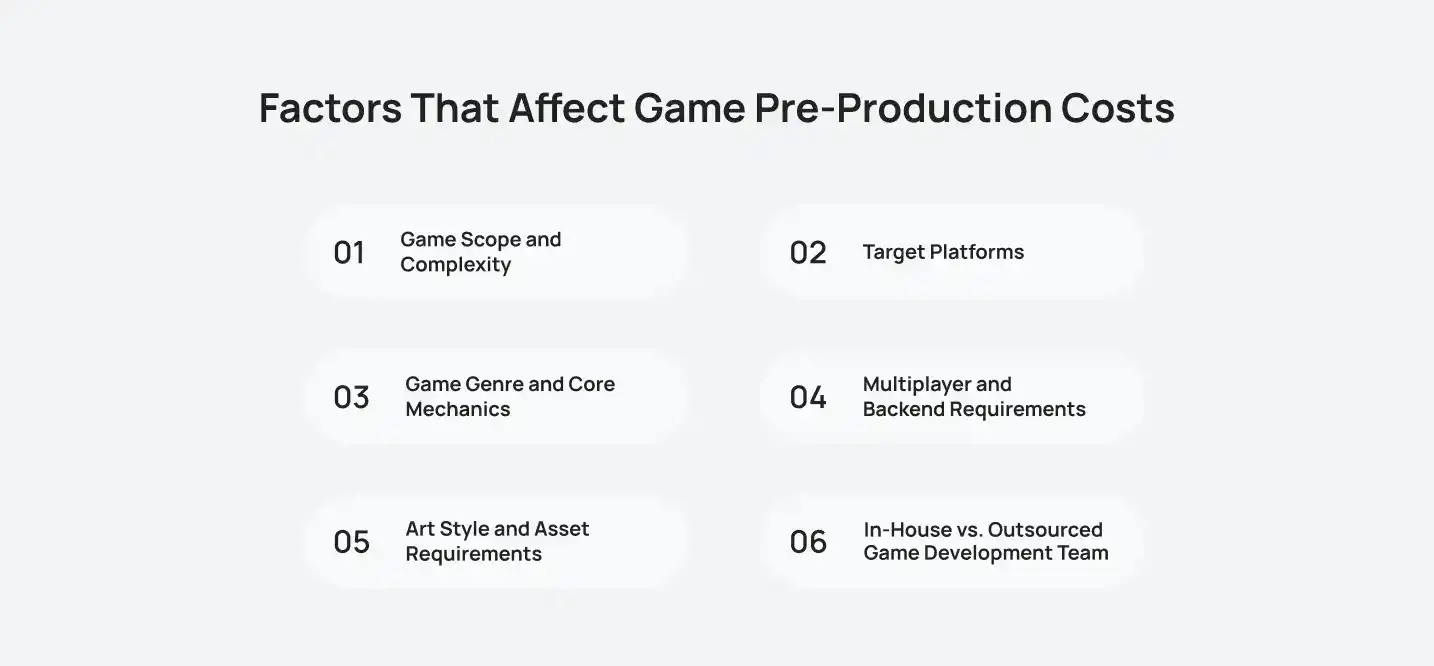
Game pre-production costs vary based on the project’s scope, platform, genre, technical requirements, art direction, and team structure. Understanding these factors early helps studios estimate resources, identify potential cost increases, and set a realistic pre-production budget.
1. Game Scope and Complexity
Scope sets the baseline. A hyper casual game costs $10,000 to $40,000 in total, while an MMO costs $2 million or more.
2. Target Platforms
Supporting both Android and iOS adds 20% to 40% to a mobile budget. Console releases add certification and dev kit costs.
3. Game Genre and Core Mechanics
Genre changes system count. A casual puzzle game costs $40,000 to $120,000, while an RPG costs $150,000 to $800,000+.
4. Multiplayer and Backend Requirements
Multiplayer needs servers, matchmaking, authentication, and anti-cheat. Each system adds hundreds of hours, so teams test the architecture during pre-production.
5. Art Style and Asset Requirements
Realistic 3D needs sculpting, rigging, and lighting. Unreal Engine 5 features such as Nanite and Lumen also demand larger teams, as our Unreal Engine development costs guide explains.
6. In-House vs. Outsourced Game Development Team
In-house hiring adds recruitment, hardware, benefits, and software licenses. Outsourced teams bring those resources under one rate, and you pay only for the phase you need.
How to Calculate a Game Pre-Production Budget
Accurate game development estimation follows six steps. Each step produces a number you can defend, so your game pre-production cost estimate holds up in review.
Define the Game Scope and Requirements
Write down genre, platforms, art style, multiplayer needs, and monetization. Then assign a total project budget from the table above.
Identify Essential Pre-Production Deliverables
List the outputs you need: GDD, prototype, art direction, technical report, and roadmap. Drop anything your project type does not require.
Estimate Team Roles, Hours, and Hourly Rates
Multiply hours by rate for each role. Use $25 to $50 for junior staff and $100 to $200+ for senior specialists.
Calculate Prototype, Design, Art, and Technical Planning Costs
Here is an example for a 3D mobile game with a $200,000 total budget. Pre-production at 10% gives $20,000.
| Role | Task | Hours | Rate | Cost |
| Game designer | GDD and mechanics | 50hr | $100 | $5,000 |
| Gameplay developer | Prototype | 80hr | $100 | $8,000 |
| Concept artist | Style tests | 30hr | $50 | $1,500 |
| Technical lead | Feasibility and architecture | 20hr | $150 | $3,000 |
| Producer | Roadmap and milestones | 20hr | $50 | $1,000 |
| Software and assets | Tools and licenses | Flat | Flat | $1,500 |
| Total | $20,000 |
Add Software, Licensing, and Third-Party Expenses
Include engine fees, asset packs, analytics tools, and store accounts. Flat costs like these rarely change with team size.
Include a Contingency Budget for Scope Changes
Cubix recommends a contingency of 15% to 20%. On the example above, 15% adds $3,000, which brings the phase to $23,000.
How to Reduce Game Pre-Production Costs
The most effective way to reduce game pre-production costs is to limit uncertainty before full development begins. A focused concept, early testing, prioritized features, reusable assets, and the right development team can help studios control spending without skipping essential planning.
Start With a Focused Game Concept
Pick one core mechanic and one audience. Cubix advises building the smallest version that still feels fun.
Build a Proof of Concept Before a Full Prototype
A proof of concept costs $1,000 to $5,000. This approach trims game prototyping cost because you build only the mechanic that passes the test.
Prioritize Core Features
Launch with one polished region and a few characters. Guilds, cosmetics, and extra modes wait for version two.
Use Reusable Tools and Game Assets
Buy asset packs, animation libraries, and Unity Asset Store tools. Artists then spend their hours on heroes, bosses, and key environments.
Partner With an Experienced Game Development Company
An experienced studio already has designers, engineers, and producers. As a result, you lower your game development budget by removing recruitment, hardware, and licensing overhead.
Common Game Pre-Production Budget Mistakes
Poor pre-production planning can lead to unexpected expenses, scope changes, and development delays. Identifying these budgeting mistakes early helps studios control costs and prepare for potential risks.
Starting Development Without Scope Validation
Features keep getting added when nobody validates scope. Each addition stretches the schedule and the invoice.
Underestimating Multiplayer Complexity
“Players should play together” sounds simple, but it adds servers, sync, and anti-cheat. Price it during pre-production.
Skipping a Technical Feasibility Review
Teams that skip this review start performance optimization too late. That delay creates the most expensive fixes.
Not Allocating a Budget Contingency
Software projects often exceed original estimates. Reserve 15% to 20% so scope changes do not stall the project.
Why Choose Cubix for Game Pre-Production and Development?
Cubix has 18+ years of experience and has delivered 1,300+ games and interactive experiences. Every project starts with a discovery phase that reviews genre, platform, art scope, multiplayer needs, monetization, and live operations.
For phone-first projects, our custom mobile game development team validates the core loop, prices the backend, and delivers a roadmap before production begins. The pre-production package includes:
- GDD and feature list
- Prototype or proof of concept
- Art direction samples
- Technical feasibility report
- Milestone schedule with costs
For high-end visuals, our unreal engine game development studio team tests Nanite and Lumen scenes on target hardware early. This step shows the real cost of your art style before you commit.
Ready to Plan Your Game? Let’s Build It the Right Way
Contact UsFrequently Asked Questions
1. How much does a game prototype cost?
A mobile or small indie game prototype often costs $2,000 to $15,000. Mid-sized projects may cost $15,000 to $60,000 because they require more systems, art, technical testing, and gameplay refinement. A proof of concept can cost less because it tests only one key mechanic or technical assumption.
2. How much does a vertical slice cost?
An indie or AA vertical slice can cost $30,000 to $150,000. It costs more than a prototype because it demonstrates a small part of the game at near-final quality, including gameplay, visuals, UI, audio, performance targets, and technical integrations.
3. What is the difference between a prototype and a vertical slice?
A prototype tests whether the core mechanic works and is enjoyable. It often uses rough or placeholder assets. A vertical slice demonstrates a small section of the game at near-final quality. It proves that the team can achieve the planned production standard.
4. What does a Game Design Document cost?
The cost depends on game scope and detail. A concise GDD for a small game may cost $1,500 to $10,000, while detailed documentation for a mid-sized project can cost $10,000 to $40,000 or more. Large projects may require multiple design, narrative, technical, and production documents.
5. Who works during game pre-production?
A typical pre-production team may include a game designer, gameplay programmer, concept artist, UI/UX designer, technical lead, producer, and QA tester. Larger projects can also involve narrative designers, systems designers, technical artists, backend engineers, data analysts, and legal specialists.
6. Is game pre-production necessary?
Yes. Pre-production validates the concept, identifies technical risks, defines scope, and produces the budget and schedule needed for production. Skipping this phase can lead to expensive rework, unclear priorities, and avoidable delays.
7. Can pre-production reduce total game development costs?
Yes. Spending 5% to 15% of the budget on planning, prototyping, technical testing, and scope validation can reduce costly changes later in production. The objective is to discover the highest-risk problems when they are still relatively inexpensive to solve.