Key Takeaways
- Self-healing test automation helps automated tests adapt to supported UI and locator changes.
- AI can compare DOM attributes, text, element relationships, visual signals, and historical data to identify replacement elements.
- Locator changes are generally easier to heal than changes to business logic or user workflows.
- Human review and validation remain important for low-confidence or high-risk repairs.
- The right success metric is reduced maintenance effort, not the number of failures an AI tool claims to fix.
Your regression suite has 500 tests. A front-end refactor changes a few IDs, restructures the DOM, and renames some buttons. The application still works, but dozens of tests turn red. Now your QA team has to spend the next few days fixing selectors instead of testing new functionality.
That is the test automation maintenance tax. Google has published internal data showing that flaky tests consume roughly 16% of engineering CI time at scale, and a large share of that flakiness traces back to brittle locators and UI drift, not actual product bugs.
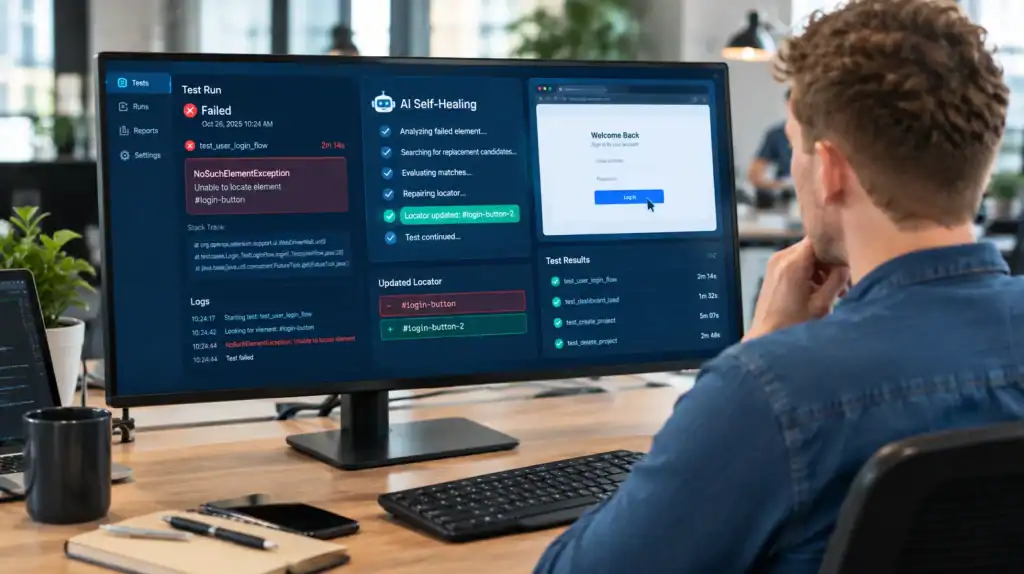
Self-healing test automation is designed to reduce that tax. Instead of treating every changed locator as a hard failure, a self-healing system can analyze the failed element, search for a likely replacement, validate the match, and continue the test when the change does not alter the intended behavior.
The important part is knowing where that approach works and where it does not. Self-healing can repair many locator and UI-related failures, but it should never be used to hide genuine application defects.
Want to discuss your project? Our experts are just a click away.
Contact UsWhat Is Self-Healing Test Automation?
Self-healing test automation allows automated tests to recover from certain application changes that would otherwise break the test.
Traditional UI tests often depend on locators such as IDs, CSS selectors, XPath, text, roles, or test IDs. When those identifiers change, the test can fail even though the feature itself still works. Selenium provides multiple locator strategies, while Playwright recommends user-facing locators and explicit test IDs to make tests less dependent on fragile DOM structures.
A self-healing layer adds another step between test failure and manual repair:
Traditional automation:
Locator breaks → test fails → engineer investigates → script is updated → test runs again.
Self-healing automation:
Locator breaks → system analyzes the change → alternative element is identified → repair is validated → test continues or requests review.
The goal is not to make every failed test pass. It is to automatically handle failures caused by application drift when the underlying test intent remains valid.
A published framework study on self-healing test automation reported a 38% reduction in manual test maintenance and a 45% improvement in test execution stability in its experimental implementation. That is a result from a specific framework study, not a universal industry benchmark, but it illustrates the maintenance problem self-healing approaches are designed to address.
Why Traditional Test Automation Requires So Much Maintenance
Automated regression testing becomes harder to maintain as applications and test suites grow.
Common causes include:
- Changed locators: IDs, classes, CSS selectors, or XPath expressions are modified.
- Dynamic elements: Generated IDs or attributes change between sessions.
- DOM restructuring: Elements move to different containers or change relationships.
- Changed labels: Button text, placeholders, or field names are updated.
- UI redesigns: The same function appears through a different interface.
- Timing changes: Elements render asynchronously or become available later.
- Growing regression suites: More tests mean more scripts to inspect after every release.
This is why locator strategy matters even without AI. Playwright recommends role-based, text-based, and test-ID locators instead of selectors that depend heavily on implementation details, while Selenium supports several locator mechanisms that teams can combine based on the application.
Self-healing does not eliminate the need for resilient test design. It adds a recovery mechanism for cases where the application changes after the test has already been created.
How Self-Healing Test Automation Works
A self-healing system generally works as a recovery layer around the existing test.
1. Capture the Element Fingerprint
During successful execution, the system can record multiple characteristics of the target element rather than relying on one locator.
These may include:
- ID and class
- CSS selector or XPath
- Visible text
- ARIA role and attributes
- Parent and child relationships
- Position and size
- DOM structure
- Visual characteristics
- Previous successful locations
This collection of attributes is often described as an element fingerprint. Functionize, for example, describes using attributes such as XPath, CSS selectors, parent-child relationships, visibility, size, and location to identify elements.
2. Detect the Failure
When the original locator no longer resolves, the system determines whether the failure resembles a recoverable element-identification problem.
A missing #checkout-btn is different from a server returning a 500 error. The first may be a candidate for healing; the second is an application or infrastructure problem that should remain visible.
3. Generate Replacement Candidates
The healing engine searches for elements that could represent the original target.
It can compare:
- Attributes
- Text
- Accessibility information
- DOM relationships
- Relative position
- Visual appearance
- Historical element data
4. Score the Candidates
The system then ranks potential matches.
A candidate that matches the expected role, text, surrounding structure, and historical characteristics is stronger than one that only happens to be located in the same area of the page.
Similarity calculations can use techniques such as string-distance measures for text or attribute comparison, vector similarity for encoded representations, or model-based scoring. More advanced systems can combine these signals rather than depending on a single matching rule.
5. Repair and Rerun
If the confidence level is high enough, the test uses the replacement element and continues.
Some platforms apply the repair temporarily during execution, while others can record the healed locator for review or future test runs. BrowserStack, for example, describes generating alternative locators when an original locator fails and providing the resulting healed locator through its reporting workflow.
6. Validate the Result
A successful click does not prove that the repair was correct.
The test should still verify its expected outcome. If a checkout test clicks something but never confirms that the correct payment step was reached, the test has not actually validated the repair.
7. Record the Decision
A useful AI-powered test maintenance system should record:
- What failed
- What changed
- Which candidate was selected
- Why it was selected
- Confidence level
- Whether the repair passed validation
- Whether a human approved or rejected it
That audit trail is critical when self-healing is used in production CI/CD pipelines.
What Technologies Power Self-Healing Testing?
Self-healing testing is not one AI technique. Different tools use different combinations of rules, machine learning, visual recognition, and semantic analysis.
| Approach | Signals used | Typical use |
| Locator fallback | IDs, CSS, XPath, text, roles | Simple locator changes |
| Heuristic matching | DOM structure, proximity, relationships | Structural changes |
| Similarity scoring | Text and attribute similarity | Finding the closest replacement |
| Computer vision | Screenshots and visual features | UI/layout changes |
| Machine learning | Historical executions and repair patterns | Repeated application changes |
| NLP/semantic matching | Labels, intent, context | Intent-based element identification |
Computer vision can help recognize elements based on appearance and location. NLP can help interpret labels and test intent. Machine learning can learn patterns from previous executions and repairs. An experimental self-healing framework published in the research literature, for example, combines dynamic locator identification, intelligent waits, anomaly detection, reinforcement learning, NLP, predictive analytics, and image recognition.
The distinction matters because self-healing is a capability, not a single technology. One tool may simply fall back to another locator, while another may combine DOM, visual, semantic, and historical signals.
What Types of Test Failures Can Self-Healing Fix?
Not every failure should be healed.
| Failure type | Healing potential | Why |
| ID or class changed | High | Other element attributes may still identify the target |
| Dynamic element ID | High | Stable attributes or surrounding context can replace generated IDs |
| CSS/XPath changed | High | Alternative selectors can locate the same element |
| DOM structure changed | Moderate–High | Relationships and contextual signals can identify the target |
| Button or label changed | Moderate | Text, role, and semantic matching may help |
| Minor UI redesign | Moderate | Depends on visual and contextual capabilities |
| Element timing issue | Tool-dependent | Adaptive waits may help, but not every timing issue is a locator issue |
| Workflow changed | Low–Moderate | The test logic itself may need modification |
| Backend/API failure | Low | The problem is outside element identification |
| Business logic defect | No | The application behavior needs investigation |
| Authentication/security failure | No | The test should expose the failure |
This boundary is one of the most important things to understand about self-healing testing.
A renamed checkout button may be safely recoverable. A changed payment calculation is not.
Three Realistic Self-Healing Scenarios
Scenario 1: E-Commerce Checkout
A checkout test expects:
#btn-checkout
A UI refactor changes the ID to:
#complete-order
The button still has the same role and performs the same action.
A self-healing system can compare the failed locator with the button’s text, role, surrounding elements, and historical attributes, then select the new element.
Result: the test can continue without manually rewriting the locator.
Scenario 2: Dynamic IDs in a Single-Page App
A React application generates a different element ID after each render:
div#ember-4821 → div#ember-7394
The generated ID is unstable, but the element still has a consistent role, label, parent form, and data-testid.
A resilient healing system can use those stable signals instead of treating the dynamic ID as the element’s identity.
Scenario 3: Responsive Mobile Interface
A login control moves because the layout changes between phone and tablet breakpoints.
A strict coordinate- or structure-dependent test may fail. A system that can use accessibility attributes, semantic information, and visual context may still identify the intended login control.
The key point in all three cases is the same: the intended user action has not fundamentally changed.
Can Self-Healing Tests Hide Real Bugs?
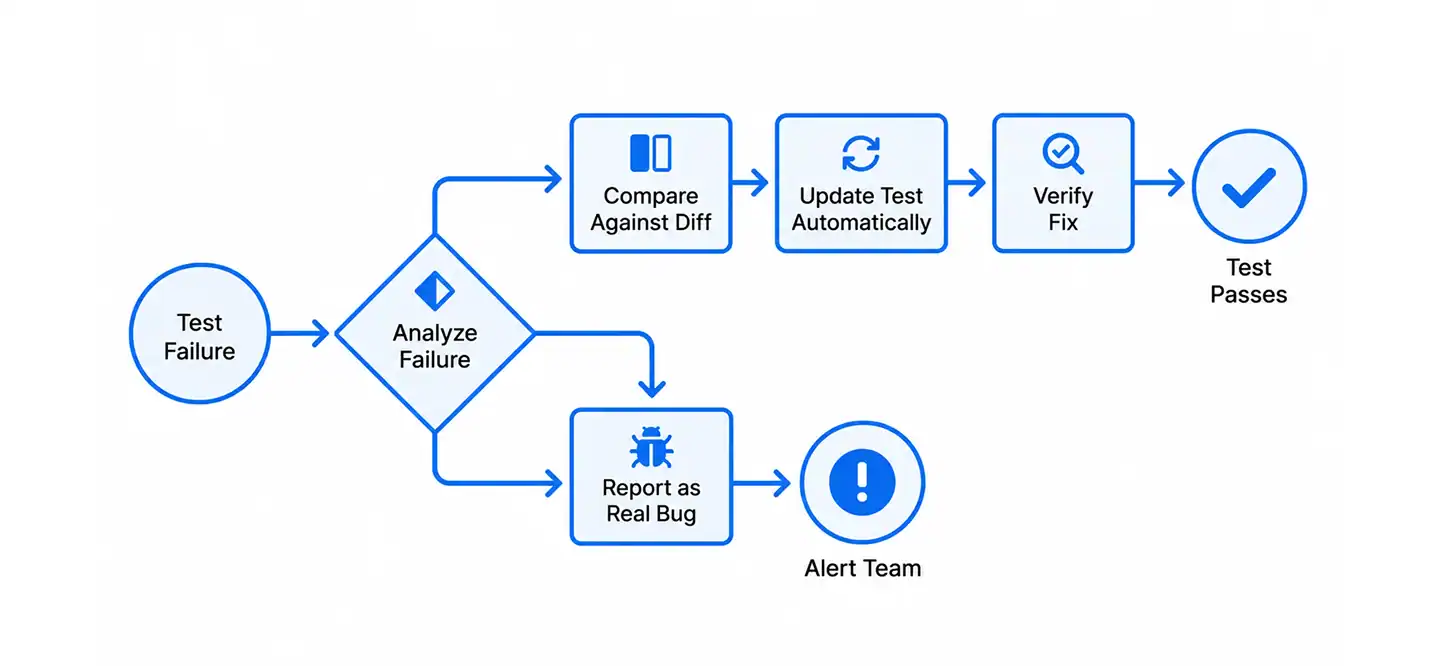
Yes. Poorly controlled healing can create false confidence.
Imagine a payment test expects a Pay Now button. A redesign changes its ID, but the payment function still works. Healing the locator is reasonable.
Now imagine the application has accidentally replaced the payment control with a different button. If an AI system simply chooses the visually closest element and continues, it could produce a false pass.
That’s why self-healing should use:
- Confidence thresholds
- Strong post-action assertions
- Human review for uncertain repairs
- Audit logs
- Stricter rules for critical workflows
- Failure classification before repair
Testsigma’s documentation similarly separates automated healing from analysis and human review, recognizing that an incorrect repair can hide a genuine application problem.
The rule should be simple: heal test maintenance problems, not product defects.
Self-Healing vs. Traditional Test Automation
| Area | Traditional automation | Self-healing automation |
| Broken locator | Test stops | Searches for alternatives |
| UI changes | Often requires manual updates | Can adapt to supported changes |
| Maintenance | Mostly reactive | Partially automated |
| Failure analysis | Engineer investigates | AI/rules can assist |
| Human review | Needed for repair | Still needed for uncertain repairs |
| Auditability | Framework-dependent | Healing decisions can be logged |
| CI/CD impact | Broken tests can interrupt pipelines | Recoverable UI failures can reduce interruptions |
| Business logic changes | Test must be updated | Still requires human/test redesign |
Self-healing is therefore not a replacement for test automation. It is a maintenance and recovery capability added to an existing automation strategy.
Which Self-Healing Test Automation Tools Are Worth Evaluating?
Tool selection should depend on your existing framework, application type, and how much autonomy you actually need.
| Tool | Category | Best fit | Approach |
| Healenium | Open-source library | Selenium-based suites | ML-based locator healing |
| Testsigma | AI testing platform | Low-code/no-code teams | AI locator detection and healing |
| BrowserStack | Cloud testing platform | Cross-browser/device testing | AI-assisted self-healing |
| Playwright | Test framework | Modern web applications | Resilient locator strategies rather than built-in AI healing |
| Functionize | AI testing platform | Enterprise-scale automation | ML, element recognition, and AI-assisted repair |
Healenium describes itself as an open-source Selenium-based self-healing library that uses machine learning to recover from UI changes such as modified IDs and class names. BrowserStack provides AI-powered self-healing within its low-code automation platform, while Testsigma positions automated healing as part of its AI testing platform.
Playwright belongs in the comparison for a different reason: its locator strategy can reduce brittleness before a self-healing layer is even considered.
The lesson is that the most advanced tool is not automatically the best tool. Compatibility with your existing test stack and the types of failures your team actually experiences matter more.
When Does Self-Healing Test Automation Make Sense?
Self-healing is usually a stronger candidate when:
- The application UI changes frequently.
- The regression suite is large.
- Locator failures are a recurring source of test maintenance.
- Releases happen frequently through CI/CD.
- QA engineers spend substantial time repairing existing scripts.
- The product runs across multiple browsers or devices.
- UI refactoring is common.
It may provide less value when:
- The application is relatively stable.
- The test suite is small.
- Most failures originate in APIs, infrastructure, or business logic.
- Tests lack meaningful assertions.
- The team has no process for reviewing automated repairs.
The technology works best when added to good test architecture, not used to compensate for poor test design.
How to Implement Self-Healing in an Existing QA Workflow?
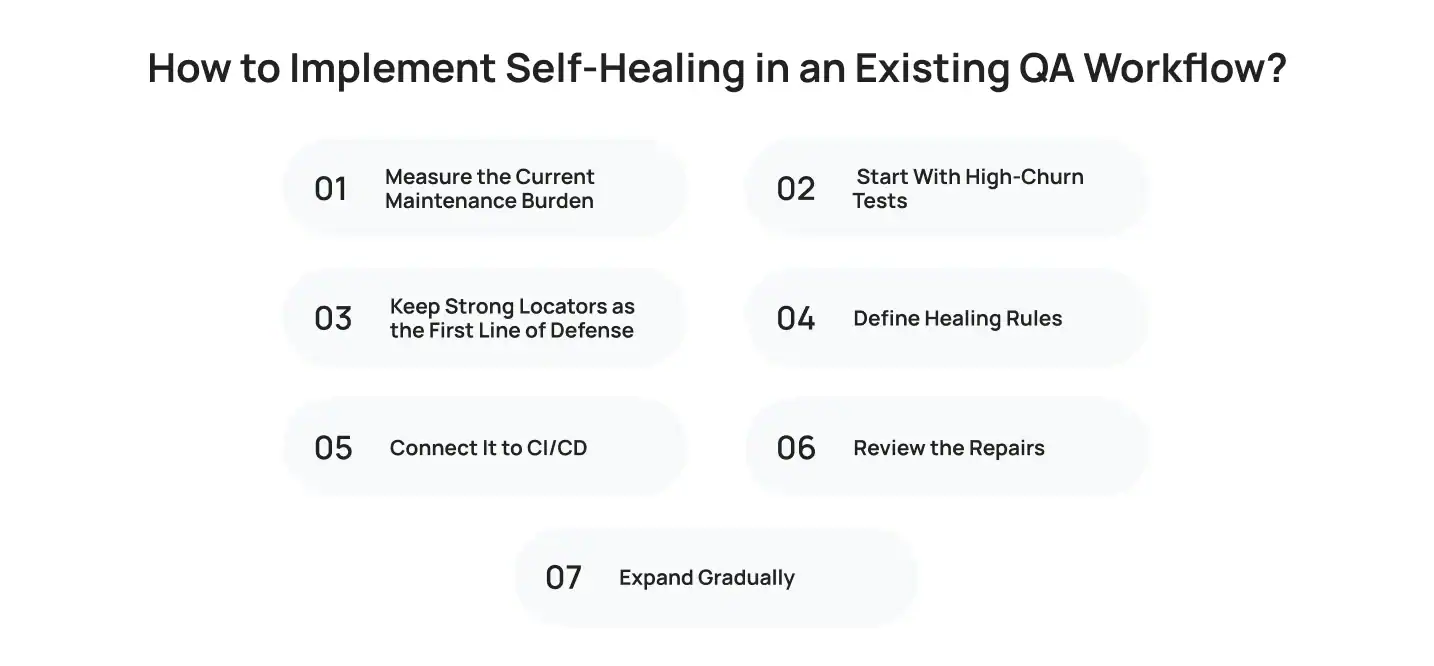
You do not necessarily need to replace your existing automation framework.
1. Measure the Current Maintenance Burden
Track maintenance hours, locator-related failures, repeat failures, and CI/CD interruptions before introducing self-healing.
2. Start With High-Churn Tests
Choose tests that frequently break because of UI changes. They provide a clear baseline for evaluating the technology.
3. Keep Strong Locators as the First Line of Defense
Self-healing should complement resilient selectors. Playwright, for example, recommends user-facing locators and explicit test IDs over fragile selectors tied closely to implementation details.
4. Define Healing Rules
Decide which changes can be automatically repaired and which require approval. Authentication, payment, authorization, and other high-risk flows should have stricter controls.
5. Connect It to CI/CD
Healing should happen within the existing regression workflow rather than becoming a separate manual process.
6. Review the Repairs
Monitor what the system healed, why it selected the replacement, and whether the test’s assertions still passed.
7. Expand Gradually
Once the approach proves reliable on a pilot suite, expand it across additional tests and environments.
Cubix’s broader QA approach already integrates continuous testing, automated regression testing, CI/CD quality gates, and tools such as Selenium, Cypress, Appium, and BrowserStack across software delivery.
How Should You Measure Test Maintenance Reduction?
Don’t measure success by how many tests an AI tool claims to heal. Measure the work it removes from your QA team’s workload.
| Metric | What it tells you |
| Maintenance hours | Time spent repairing automated tests |
| Automatic repair rate | Share of eligible failures healed automatically |
| Repair acceptance rate | How often suggested repairs are correct |
| False repair rate | How often the wrong element is selected |
| Mean time to repair | How quickly broken tests become usable again |
| Locator failure rate | Frequency of selector-related failures |
| Pipeline interruption rate | How often failures block delivery |
| Repeat failure rate | Whether repaired tests remain stable |
A useful real-world benchmark comes from a Tricentis case study involving a regression suite of more than 1,200 tests. The company reports that 15–25% of tests were failing from locator issues every two weeks, with the QA team spending about two days per sprint on repairs. After implementing self-healing, the case study reports a reduction of more than 60% in test maintenance time over three months. This is a vendor-reported case, so it should be treated as an example rather than a universal benchmark.
That is the kind of measurement that matters: how much maintenance work disappears from your actual QA process?
How Self-Healing Fits Into AI-Driven QA
Self-healing is one component of broader AI-driven QA.
AI can also support:
- Test case generation
- Test prioritization
- Failure analysis
- Regression selection
- Test data generation
- Anomaly detection
- Predictive maintenance
But these capabilities should work together rather than operate as disconnected AI features.
Cubix’s existing guidance on AI in software testing takes a similar position: AI can automate repetitive QA work and expand testing capabilities, but human testers remain important for contextual judgment, edge cases, validation, and critical decisions.
For organizations evaluating broader intelligent QA workflows, AI inspection software can complement automated testing by helping analyze systems and surface issues for investigation.
How Cubix Can Apply Self-Healing to QA Workflows
Self-healing should not be treated as a standalone feature added simply because a test suite contains AI.
A practical implementation starts with the existing QA environment:
Existing tests → Failure analysis → High-maintenance test identification → Healing strategy → Confidence rules → CI/CD integration → Monitoring
The focus is on identifying where automated maintenance is consuming engineering time, selecting the right healing mechanism for those failures, and keeping human review in the loop where a wrong repair could hide a genuine defect.
That approach aligns with Cubix’s broader software testing services, where automated regression testing, continuous QA, CI/CD integration, and measurable quality benchmarks are incorporated into the development lifecycle.
If your QA team is spending more time repairing automation than expanding coverage, the right question is not simply “Can AI heal our tests?” It is “Which failures can we safely automate away, and how will we prove that the repairs are correct?”
The Goal Is Less Test Maintenance, Not Fewer Test Failures
Self-healing test automation is valuable because it can absorb a specific class of change that otherwise creates repetitive maintenance work.
A renamed locator, changed DOM structure, or minor interface adjustment should not always require an engineer to stop what they are doing and rewrite a test. AI and machine learning can help identify the intended element, recover the interaction, and validate the result.
But the technology has a boundary. It should not make genuine application defects disappear behind an automated “fix.”
The strongest approach combines resilient test design, automated test repair, confidence-based healing, meaningful assertions, auditability, and human judgment.
For teams already investing in AI-powered QA testing, that combination can make automated regression testing more resilient while giving QA engineers more time to focus on the failures that actually matter.
Want to discuss your project? Our experts are just a click away.
Contact UsFrequently Ask Question
1. How much does self-healing test automation cost?
The cost depends on the platform, test volume, environments, framework compatibility, and implementation model. A useful comparison is between adoption costs and your current maintenance burden, including QA hours spent repairing tests and CI/CD delays caused by brittle automation.
2. Can self-healing automation fix all failed tests?
No. Self-healing is best suited to failures caused by supported UI, DOM, or locator changes. Backend failures, broken business logic, incorrect calculations, authentication issues, and major workflow changes still require investigation and potentially new test logic.
3. How does self-healing reduce test maintenance time?
It can automate repetitive work such as finding changed elements, selecting replacement locators, updating supported test steps, and rerunning affected tests. The actual reduction depends on how many of your existing failures are caused by changes the healing system can reliably handle.
4. Is human review required for AI-generated test repairs?
Human review should remain available, especially for low-confidence repairs and critical workflows. A reliable implementation should show what changed, why a replacement was selected, and whether the repaired action passed its expected assertions.
5. Which applications benefit most from self-healing test automation?
Applications with large regression suites, frequently changing interfaces, dynamic elements, and rapid release cycles tend to benefit most. Enterprise SaaS, e-commerce, financial applications, healthcare platforms, and other UI-heavy products can be strong candidates.
6. Can self-healing test automation integrate with an existing CI/CD pipeline?
Yes. Self-healing can operate during automated regression runs and return the results to an existing CI/CD workflow. The implementation should preserve failure reporting, approval rules, test artifacts, and visibility into every automated repair.