Key Takeaways
- Travel app development spans seven build types, from booking platforms to AI trip planners and super apps. Pick the type before choosing features.
- Mobile now drives the majority of online travel bookings, with over 20 billion hours spent in travel apps globally in 2024.
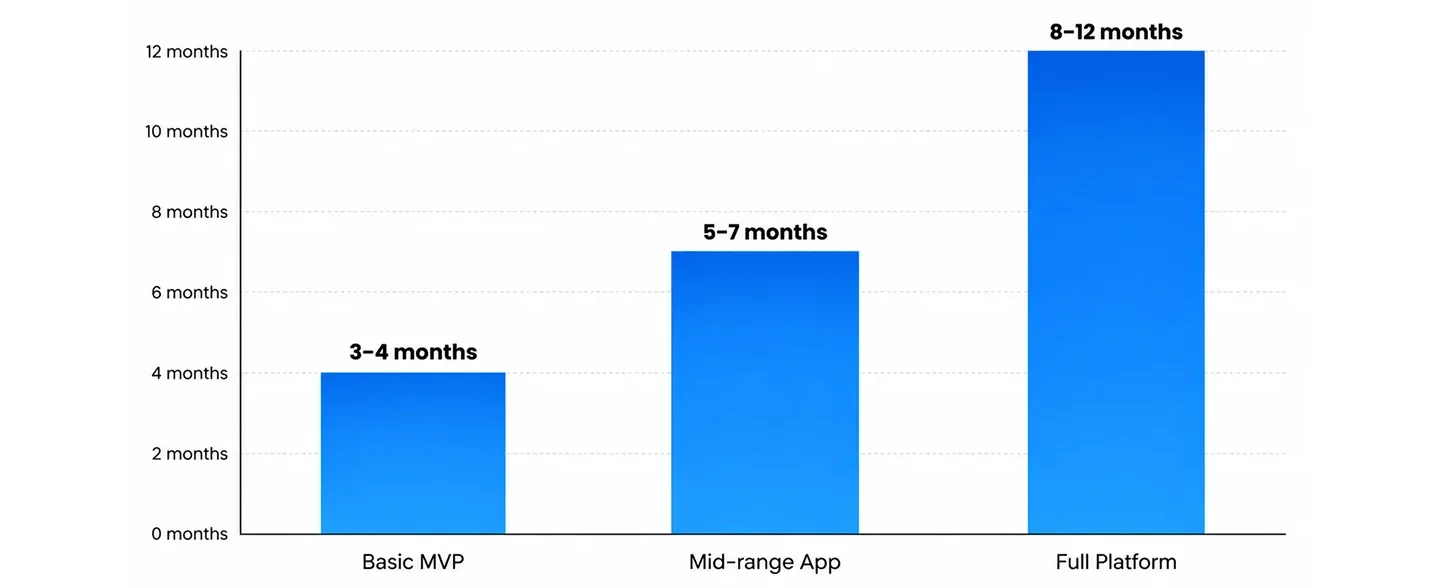
- A basic MVP takes 3-4 months, while a full-featured platform can take 8-12 months. Timelines often affect travel app development cost more than feature count does.
- India: $20-$45/hour | Eastern Europe: $40-$80/hour | Western Europe: $65-$100/hour | USA: $80-$150/hour.
- Over 60% of Gen Z and Millennial travelers already use AI tools for trip planning, and AI-driven personalization can lift bookings by around 28%.
- Validate the product with real users before scaling. Over-building before product-market fit is one of the costliest mistakes founders make.
Here’s a number worth sitting with. People spent over 20 billion hours inside travel apps in 2024 alone. That’s not a typo. It’s also up more than 7% from the year before.
Travel used to mean a browser tab. Then ten more tabs. Then a lot of copy-pasting. Now it means one app on your phone. Search, book, check in, get updates. All in your pocket. That shift didn’t happen by accident. Users got impatient with slow sites. Companies got smarter about what phones can do. And travel itself got more spontaneous. More “let me just book this now.” It’s part of why Cubix is regarded as a custom mobile app development company for travel and hospitality brands.
This guide walks through what matters in 2026. What features users expect. What it costs. What’s changing fast, especially around AI. And where a partner like Cubix fits in. No fluff, just what you need before you start.
Want to discuss your project? Our experts are just a click away.
Contact UsWhy Is 2026 a Good Time to Build a Travel App?
Short answer: the market is big, growing, and still has real gaps.
The travel app industry generated roughly $60 billion in 2024. It’s on track to hit $120 billion by 2030. That’s a growth rate most industries would kill for. And it’s not just big players eating the pie. Over 70% of travel decisions now get shaped by an app somewhere along the way, whether that’s search, comparison, or the final booking.
Mobile isn’t just part of the story anymore. It’s most of it. Mobile devices now account for the majority of online travel bookings worldwide. That share keeps climbing every year. If your app isn’t mobile-first, you’re already behind. That’s why mobile-first design isn’t optional for any serious travel booking app development project.
There’s also a gap worth noticing. Mobile traffic to travel sites is huge. But mobile web conversion still lags behind a well-built app. That gap is where the opportunity lives. Remove the friction on a small screen, and you’re not just competing. You’re winning the attention users already want to give you.
Why Do So Many Travel Apps Fail?
Here’s the part most guides skip. Online travel startups had the highest shutdown rate of any travel segment in 2024. Roughly 3% of them closed down. That’s nearly double the rate in hospitality, air travel, or ground transport.
The pattern behind most of these failures isn’t bad code. It’s a missing answer to one question: what does this app do that Booking.com, Google, or an existing app doesn’t already do? Without a real answer, users have no reason to switch. Neither do investors.
Real example: Airalo solved exactly one problem, expensive roaming data, with a simple eSIM app. That focus took it to unicorn status in 2025, serving over 20 million travelers across 200-plus countries. One clear problem, solved well, beat a dozen half-built features.
The apps that survive usually share one thing. They solve one specific problem really well, instead of copying every feature a bigger competitor already has. That’s the gap between building a travel app and building a reason someone opens it twice.
What Types of Travel Apps Can You Build?
This decision matters more than people think. Pick the wrong category, and you’ll spend months building features nobody asked for.
Travel apps generally fall into seven core types. Most successful products go deep on one type first. They expand later.
| App Type | What It Does | Example Players | Typical Revenue Model |
| Trip planning | Organizes itineraries, suggests destinations | TripIt, Wanderlog | Freemium, subscriptions |
| Booking (flights/hotels) | Sells inventory, manages reservations | Booking.com, Expedia | Commission per booking |
| Transportation | Ride-hailing, car rental, transfers | Uber, BlaBlaCar | Service fees |
| Navigation & discovery | Maps, local tips, AR guides | Google Maps, Citymapper | Ads, premium tiers |
| Restaurant & food | Reservations, meal ordering | OpenTable, Yelp | Listing fees, commissions |
| Travel fintech | Currency exchange, insurance, BNPL | Wise, Revolut | Transaction fees |
| Super apps | Multiple travel services in one place | Uber, Trip.com | Multiple revenue streams |
Real example: Hopper hit $7.5 billion in gross bookings in 2024. Nearly 40% of that came from fintech add-ons like Price Freeze and Cancel for Any Reason, not booking commissions. The lesson: a booking app alone rarely wins on its own. A booking app with a financial safety net built in often does.
A quiet trend worth watching: these categories are blurring together. Booking apps are adding fintech features. Ride-hailing apps are adding flight search. The line between “a travel app” and “an app with travel in it” keeps getting thinner. Decide your core early. But build your backend so it can flex later. That’s a lesson Cubix applies on every travel booking app development project: structure for today’s scope, leave room for tomorrow’s features. If corporate travel is your focus, our roundup of the best business travel apps is worth a look too.
What Features Does a Travel App Need in 2026?
Some travel app features are simply non-negotiable now. Users won’t tolerate their absence. Others are how you actually stand out.
The Must-Have Features
Think of this as your baseline. Skip any of these, and users will notice fast.
- Search and filtering. Fast, accurate, and flexible by date, price, and location.
- Booking engine. The core transaction flow, from selection to confirmation.
- Geolocation. For nearby suggestions, maps, and check-in features.
- Payment gateway. Secure, fast, and supports multiple methods.
- API integration. Connects flight, hotel, and payment data in real time.
- Push notifications. Price alerts, booking updates, gate changes.
- Offline access. Boarding passes and itineraries shouldn’t need Wi-Fi.
| Feature | What It Does | Why Users Expect It |
| Search and filtering | Narrows results by date, price, location | Saves time, reduces frustration |
| Booking engine | Handles the full purchase flow | It’s the whole point of the app |
| Geolocation | Powers maps and nearby suggestions | Makes the app feel context-aware |
| Payment gateway | Processes transactions securely | Trust is the deciding factor here |
| API integration | Pulls live flight, hotel, and pricing data | Keeps availability and prices accurate |
| Push notifications | Sends timely, relevant alerts | Keeps users informed without opening the app |
| Offline access | Stores key info locally | Travel means unreliable connectivity |
Roughly 39% of users pick an app over a mobile site simply for speed. Another 30% cite better functionality. Speed and usability aren’t nice extras. They’re the actual product.
Features That Set Apps Apart
Once the basics are covered, this is where you actually compete.
- AI itinerary builder. Generates a day-by-day plan from a few preferences.
- AR previews. AR in travel lets users see a room or destination before booking.
- Real-time price alerts. Notifies users the moment a fare drops.
- Multi-currency and multi-language support. Removes friction for international users.
AI-driven recommendations alone can lift bookings by around 28%. Average order value climbs about 20% too. That’s not a marginal gain. That’s the difference between a good app and a profitable one.
What Do Users Expect From a Travel App?
Travel app user expectations shifted fast over the past two years. What felt like a bonus feature in 2023 is now the baseline.
Speed and Personalization Are the Baseline
Nobody wants generic results anymore. Around 85% of travelers say tailored recommendations shape what they book. Show every user the same homepage, and you lose bookings. Cubix’s work on travel services with AI shows how far this kind of personalization has come.
Speed matters just as much. A slow search screen kills conversion fast. So does a clunky checkout. Mobile users have even less patience than desktop ones.
Trust and Security Matter Just as Much
Personalization only works if users trust you with their data in the first place.
- Encryption for all payment and personal data.
- Secure, well-known payment providers, not custom-built processors.
- Transparent data practices, clearly stated, not buried in terms.
- Fraud protection built into the booking flow itself.
| User Expectation | What Delivers It |
| Fast, relevant results | Personalized search and recommendations |
| Feeling understood | AI-driven suggestions based on past behavior |
| Safe transactions | Encrypted, PCI-compliant payment processing |
| Peace of mind | Clear data policies and visible security cues |
Cubix builds personalization and security from day one. Not as a bolt-on after launch. That approach avoids the costly rework that comes from treating trust as an afterthought.
How Much Does Travel App Development Cost?
This is the question everyone actually wants answered. Let’s get specific about the cost of travel app development.
MVP vs. Full Platform
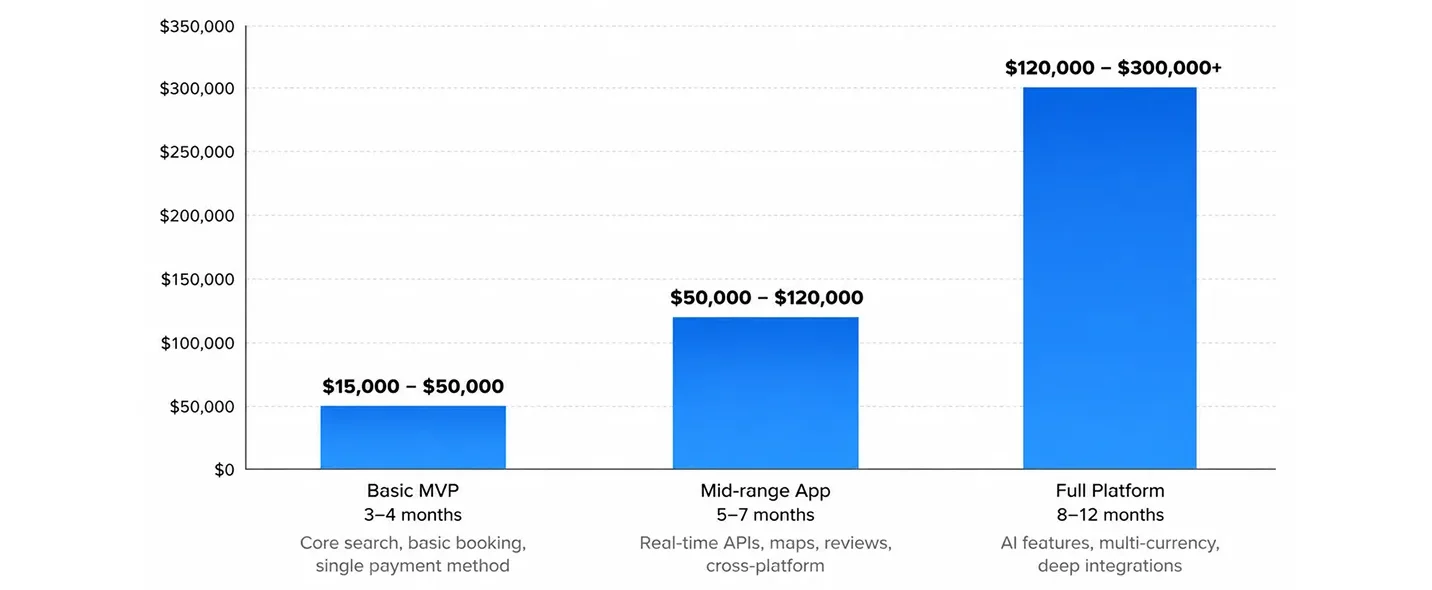
A basic MVP usually takes three to four months. Think core search, simple booking, one payment method. A full platform with AI and deep integrations can take eight to twelve months. Timeline drives cost more than any single feature does. For a broader comparison across categories, see our full mobile app development cost breakdown.
| Complexity Level | Cost Range | Timeline | What You Get |
| Basic MVP | $15,000 – $50,000 | 3–4 months | Core search, basic booking, single payment method |
| Mid-range app | $50,000 – $120,000 | 5–7 months | Real-time APIs, maps, reviews, cross-platform |
| Full platform | $120,000 – $300,000+ | 8–12 months | AI features, multi-currency, deep integrations |
How Regional Developer Rates Affect Your Budget
Here’s where budgets swing the most. The same app, same scope, can cost two to three times more. It all depends on where the team sits.
| Region | Hourly Rate Range |
| India / South Asia | $20 – $45/hr |
| Eastern Europe | $40 – $80/hr |
| Western Europe | $65 – $100/hr |
| United States | $80 – $150/hr |
Location isn’t the only factor worth weighing. Communication, time zone overlap, and real travel-industry experience matter just as much. A cheap team that doesn’t understand booking engines can cost you more in rework later. Cubix works across these budget tiers. The goal is always an MVP that fits your actual runway, not an inflated wish list.
How Is AI Changing Travel Apps?
AI in travel apps stopped being a buzzword a while ago. It’s now a baseline expectation. Especially for anyone under 40.
What AI Actually Does Well Right Now
- Smart search. Understands natural language, not just keyword filters.
- Personalized recommendations. Learn from past trips and behavior.
- Price prediction. Tells users when to book versus when to wait.
- AI-powered support. Handles common questions without a human agent.
Over 60% of Gen Z and Millennial travelers already use AI for trip planning. That number keeps rising every quarter. It’s not slowing down.
Other Travel App Trends 2026 Worth Watching
- Social-first discovery. Travelers find destinations on video platforms before they ever open a search bar.
- Sustainability filters. Carbon estimates and eco-friendly badges are moving from nice-to-have to expected.
- Contactless and biometric travel. Digital boarding passes and mobile room keys are now standard, not novel.
- AR destination previews. Letting users “see” a hotel room or landmark before committing.
None of these trends work in isolation. They stack. AI search, social discovery, contactless checkout, together they’re just modern travel now. This mirrors the broader digital innovation in aviation we’re seeing industry wide. Cubix builds these as connected systems. Not disconnected add-ons bolted onto old architecture.
What Does the Development Process Look Like?
Skipping steps here is how budgets balloon. And timelines slip. Here’s the mobile app development process that actually works for travel apps.
- Validate before you build. Talk to real users. Confirm the problem is real before writing code.
- Pick your revenue model early. Commission, subscription, or fintech features each demand different backend architecture.
- Scope a lean MVP. Core booking flow, payments, and search. Nothing more, at least at first.
- Build, test, and ship. Iterative sprints with real testing on the booking flow, since bugs here cost real money.
- Launch, then keep iterating. Track conversion, retention, and repeat bookings. Adjust based on what users actually do.
How Long Does It Actually Take?
| Build Type | Realistic Timeline |
| Basic MVP | 3–4 months |
| Mid-range app | 5–7 months |
| Full platform | 8–12 months |
Retention is the metric most founders underestimate. Travel apps typically see around 18% retention on day one. That drops to under 3% by day thirty. That’s normal for this category. People don’t open a travel app daily. The real win is their next trip, not their next login.
How Do You Choose the Right Travel App Development Partner?
Four things separate a good partner from a risky one.
- Real travel industry experience. GDS quirks and supplier APIs aren’t things your team should learn on your dime.
- Cross-platform expertise. Building once for iOS and Android saves real budget. No quality lost either.
- Genuine AI capability. Not a slide in a pitch deck. Actual hands-on booking flow experience.
- Transparent pricing and process. You should know what you’re paying for, and why, at every stage.
Cubix checks each of these boxes. The team has shipped apps across travel, fintech, and on-demand categories. Booking engines and payment layers aren’t unfamiliar territory here. That experience means fewer surprises during development. And a smoother path from MVP to full platform.
Are You Ready to Build Your Travel App?
You don’t need every feature on day one. You need the right ones, built well, with room to grow. That’s the gap between an app that launches and one that keeps users coming back.
Cubix has spent years building apps that handle real-time data, secure payments, and AI features that actually work. Are you ready to scope your travel app the right way? Get in touch with Cubix for a straightforward conversation about your idea, your budget, and a realistic roadmap.
Want to discuss your project? Our experts are just a click away.
Contact UsFrequently Asked Questions
1. What are the must-have features for a travel app in 2026?
Search and filtering, a reliable booking engine, geolocation, a secure payment gateway, push notifications, and offline access. These aren’t optional anymore, they’re the baseline users expect from any travel app.
2. How much does it cost to develop a travel app?
A basic MVP typically runs $15,000 to $50,000, while a full-featured platform can reach $120,000 to $300,000 or more. Cost depends heavily on feature scope, timeline, and where your development team is based.
3. How is AI changing travel app development?
AI now powers smart search, personalized recommendations, price prediction, and automated customer support. It’s shifted from a nice-to-have into a baseline expectation, especially among younger travelers.
4. What are the latest trends in the travel industry?
AI personalization, social-first discovery, sustainability filters, contactless and biometric travel, and AR destination previews are the trends shaping travel apps right now.
5. How do you integrate flight and hotel APIs?
Most apps connect to Global Distribution Systems like Amadeus or Sabre, or to modern aggregator APIs, to pull real-time flight and hotel inventory. This usually requires backend architecture built specifically to handle live pricing and availability.
6. What do users expect from a modern travel app?
Speed, personalization, and security, in that order of visibility. Users want fast, relevant results and they want to trust the app with their payment details and personal data.
7. Is AR useful in travel apps?
Yes, particularly for previewing hotel rooms, landmarks, or destinations before booking. It’s not essential for every app, but it’s a strong differentiator for booking and discovery apps.
8. How do you ensure data security in travel apps?
Encryption for all sensitive data, PCI-compliant payment processing, transparent data policies, and built-in fraud protection are the standard requirements for any travel app handling payments.
9. How long does it take to build a travel app?
A basic MVP takes about three to four months. A mid-range app takes five to seven months. A full-featured platform with AI and deep integrations can take eight to twelve months.
10. Can a travel app work without an internet connection?
Yes, if it’s built with offline access in mind. Boarding passes, itineraries, and saved trip details should be stored locally so users can access them without Wi-Fi or cell service.