Key Takeaways
- The best mobile game development companies in the USA for 2026 include Cubix, Electronic Arts (EA), SDLC Corp, Activision Blizzard, Zynga, Scopely, Jam City, Gameloft, Supercell, and Tencent America.
- Mobile game development costs in the US typically range from $25,000-$80,000 for simple 2D games, $100,000 to $300,000 for multiplayer titles, and $500,000+ for high-fidelity AAA experiences.
- Unity and Unreal Engine 5 remain the industry’s leading game development technologies for iOS and Android projects.
- California, Texas, Florida, Washington, and New York continue to be major hubs for game development talent.
- The biggest trends shaping mobile game success in 2026 include AI-powered asset creation, hybrid-casual gameplay, LiveOps, and cross-platform experiences connecting mobile, PC, and consoles.
The US mobile gaming market generates over $15 billion in App Store revenue alone, the largest of any country in the world, yet most studios still burn through their budgets before finding a working game loop. With user acquisition costs climbing and organic discovery getting harder by the month, the margin for error on a new mobile title has never been thinner.
That’s why the choice of development partner matters more than ever. From billion-dollar publishers and AAA studios to specialized teams helping startups ship their first viral hit, the US is home to some of the most capable mobile game development companies on the planet, but finding the right one means understanding not just who’s good, but who’s good for your project.
This guide breaks down the best mobile game development companies in the USA, the trends shaping the market in 2026. Read down below!
Want to discuss your project? Our experts are just a click away.
Contact UsWhat is the Mobile Game Development Landscape in the USA Like?
Mobile gaming has evolved far beyond simple puzzle games and endless runners. Today, mobile devices are capable of delivering console-quality graphics, real-time multiplayer experiences, cloud connectivity, and advanced monetization systems.
According to recent industry reports, mobile gaming remains the most popular gaming platform in the United States, with approximately 80% of gamers playing on mobile devices. Additionally, more than 212 million Americans play video games weekly, highlighting the enormous scale of the market.
This sustained growth has created significant opportunities for businesses, startups, entertainment brands, and publishers seeking to enter the gaming market. Whether developing a casual game, an RPG, a strategy title, or an AR-powered experience, choosing the right development partner has become one of the most important business decisions in the project lifecycle.
Several factors continue to drive mobile gaming growth in the United States:
- Widespread smartphone adoption
- Improved mobile hardware performance
- Faster 5G connectivity
- Increased consumer spending on digital entertainment
- Cross-platform gaming ecosystems
- More sophisticated monetization models
The market is also becoming increasingly competitive. Players now expect polished user experiences, high-quality graphics, seamless multiplayer functionality, and regular content updates. As a result, businesses are turning to experienced mobile game development companies that can manage everything from concept validation and game design to development, testing, launch, and LiveOps support.
Current State of Mobile Game Development in the USA (2026)
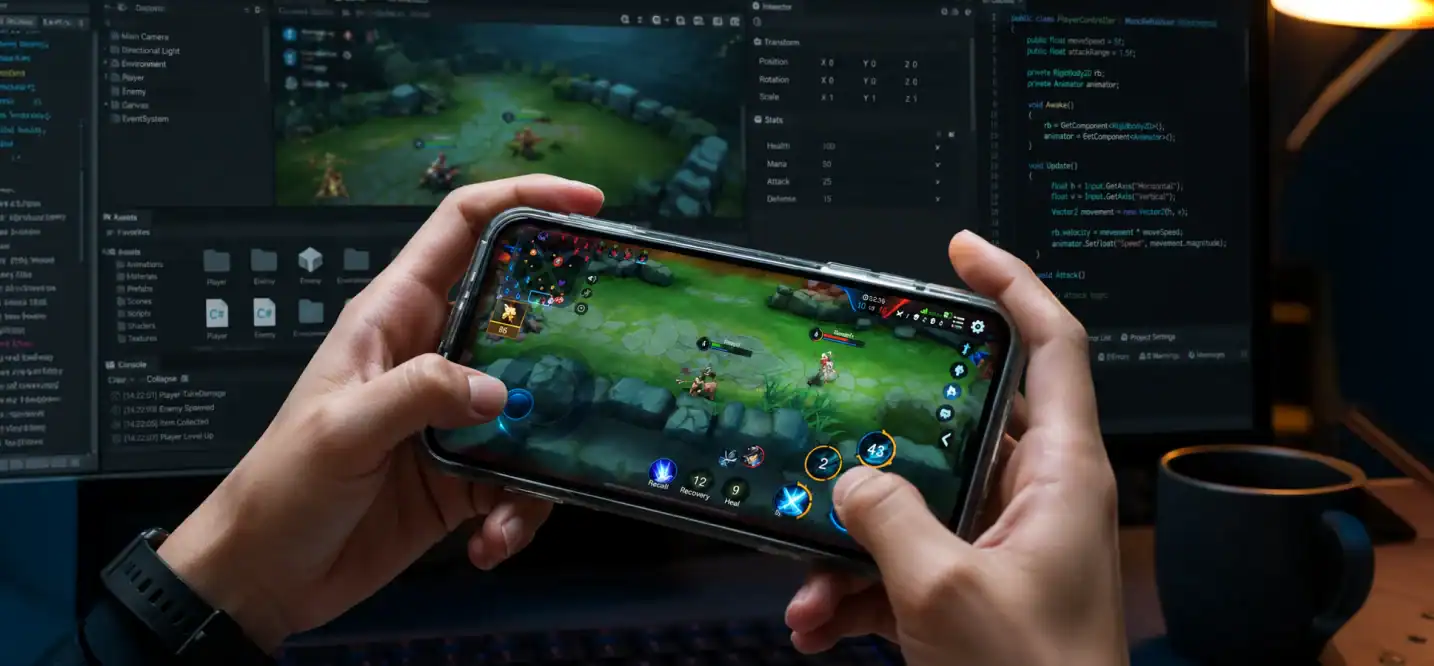
The mobile gaming industry in 2026 looks very different from just a few years ago. While downloads have stabilized, revenue growth continues to be driven by stronger engagement, improved retention, and smarter monetization strategies. Industry analysts note that the market is increasingly rewarding studios capable of building long-term player communities rather than chasing short-lived viral success.
AI Is Transforming Game Development
Artificial intelligence is rapidly becoming part of the game production pipeline.
Modern studios are leveraging AI tools to accelerate:
- Concept art generation
- Character prototyping
- Environment design
- Automated testing
- Localization workflows
- NPC dialogue generation
While AI is not replacing game developers, it is significantly reducing production time and helping teams create content more efficiently. This allows studios to spend more resources on gameplay refinement, player retention, and innovation.
Cross-Platform Gaming Is Becoming the Standard
The traditional divide between mobile, PC, and console gaming continues to fade.
Players increasingly expect their progress, purchases, and social connections to move seamlessly across devices. Games that support cross-platform functionality often enjoy higher retention and stronger engagement because users can continue playing wherever they are.
Major publishers are investing heavily in cross-platform ecosystems, and even mobile-first titles are increasingly launching with PC support. Recent releases continue to demonstrate the growing importance of shared progression and cross-play functionality across gaming platforms.
The Rise of Hybrid-Casual Games
One of the biggest trends shaping the industry is the continued growth of hybrid-casual games.
Unlike traditional hyper-casual titles that rely almost entirely on advertising revenue, hybrid-casual games combine simple gameplay with deeper progression systems, in-app purchases, seasonal events, and LiveOps features.
This model has proven highly effective because it balances accessibility with long-term monetization. Industry analysts increasingly view hybrid-casual as the dominant growth category for mobile gaming in 2026.
Monetization Is Becoming More Sophisticated
The most successful mobile games no longer depend on a single revenue stream.
Instead, developers are combining:
- In-app purchases
- Rewarded video advertising
- Battle passes
- Seasonal content
- Subscription models
- Cosmetic purchases
This hybrid monetization approach allows studios to maximize lifetime player value while maintaining strong user engagement. For businesses entering the market, selecting a development partner with proven monetization expertise is now just as important as choosing one with strong technical capabilities.
Top Mobile Game Development Companies in the USA
| Company | US Headquarters | Team Size | Core Tech Stack | Minimum Project Size |
| Cubix | West Palm Beach, FL | 350+ | Unity, Unreal Engine 5, AR/VR | $25,000+ |
| Electronic Arts (EA) | Redwood City, CA | 13,000+ | Frostbite, C++, Proprietary Tech | Enterprise |
| SDLC Corp | San Francisco, CA | 400+ | Unity, Unreal Engine, IOS and Android | $40,000 + |
| Activision Blizzard | Santa Monica, CA | 13,000+ | Unreal Engine, Proprietary Tools | Enterprise |
| Zynga | San Mateo, CA | 2,000+ | Unity, Backend LiveOps Systems | $100,000+ |
| Scopely | Culver City, CA | 2,500+ | Unity, AWS, Proprietary Backend | $100,000+ |
| Jam City | Los Angeles, CA | 1,000+ | Unity | $75,000+ |
| Gameloft USA | New York, NY | 3,500+ | Unity, Unreal Engine | $50,000+ |
| Supercell | San Francisco Operations | 500+ | Unity | Enterprise |
| Tencent America | Palo Alto, CA | 5,000+ | Unity, Unreal Engine | Enterprise |
Our Selection Criteria
Hundreds of companies offer mobile game development services in the United States. However, only a small percentage have demonstrated the technical expertise, commercial success, and industry reputation needed to deliver successful gaming products at scale.
For this list, we evaluated studios using four key criteria:
Portfolio Complexity
We prioritized companies that have successfully developed:
- 2D mobile games
- 3D mobile games
- Multiplayer experiences
- AR and VR applications
- Cross-platform titles
Studios capable of delivering multiple game genres generally offer more flexibility and lower project risk.
Technical Expertise
Technology remains one of the biggest factors influencing game quality.
We evaluated each company’s experience with:
- Unity
- Unreal Engine 5
- Multiplayer architecture
- LiveOps systems
- Backend infrastructure
- Cross-platform deployment
Unity continues to be the most widely used mobile game engine globally, while Unreal Engine 5 remains a leading choice for high-fidelity 3D experiences. Recent industry data shows Unity is used by nearly half of active mobile game developers, while Unreal Engine continues gaining adoption for premium mobile experiences.
Industry Recognition
We also reviewed:
- Client reviews
- Clutch ratings
- GoodFirms rankings
- Industry awards
- Market reputation
Consistent positive feedback often indicates stronger project management and client communication practices.
US Market Presence
Finally, we considered each company’s impact within the American gaming market.
Studios with established operations in major gaming hubs such as California, Florida, Texas, New York, and Washington typically have greater access to experienced development talent and industry partnerships.
Top Mobile Game Development Companies
1. Cubix
Company Overview
Founded in 2008 and headquartered in West Palm Beach, Florida, Cubix has become one of the most recognized game development companies serving startups, enterprises, and established brands.
The company specializes in building mobile games, blockchain games, metaverse applications, AR/VR experiences, and multiplayer platforms.
Gaming Specialization
- Strategy games
- Simulation games
- AR-powered experiences
- Multiplayer mobile games
- Enterprise gamification
Tech Stack
- Unity
- Unreal Engine 5
- C#
- C++
- Photon Multiplayer
- AWS
Art & Animation Capabilities
- 2D character design
- 3D modeling
- Environment creation
- Animation pipelines
- UI/UX design
Monetization Expertise
- In-app purchases
- Rewarded advertising
- Subscription models
- Virtual economies
Ideal For
Businesses seeking an end-to-end development partner capable of handling concept design, development, launch, and post-release support.

2. Electronic Arts (EA Mobile)
Company Overview
Electronic Arts remains one of the largest gaming companies in the world. Through EA Mobile, the company has built some of the highest-grossing sports and simulation games available on mobile platforms.
Gaming Specialization
- Sports games
- Simulation games
- Live-service experiences
Tech Stack
- Frostbite Engine
- Proprietary EA technologies
- C++
Notable Games
- EA Sports FC Mobile
- Madden NFL Mobile
- The Sims Mobile
Why They Stand Out
EA’s strength lies in its ability to transform globally recognized franchises into long-term mobile gaming ecosystems supported by frequent updates and seasonal content.
Ideal For
Large enterprises and publishers seeking AAA production quality.
3. SDLC Corp
Company Overview
Founded in 2015, SDLC CORP is a full-spectrum software development company offering end-to-end game development services for businesses, startups, and gaming studios.
Gaming Specialization
Mobile games
Android and iOS games
2D and 3D games
Tech Stack
Unity
Unreal Engine
iOS & Android
Monetization Expertise
In-app purchases
Rewarded ads
Interstitial and banner ads
Why They Stand Out
SDLC CORP stands out for combining game development, backend engineering, QA, multiplayer systems, blockchain integration, AR/VR development, and post-launch support.
Ideal For
Startups, studios, and enterprises looking for a full-cycle game development partner.

4. Activision Blizzard
Company Overview
Activision Blizzard has successfully extended major console franchises into mobile gaming, proving that AAA gameplay can thrive on smartphones.
Gaming Specialization
- Action games
- FPS games
- Competitive multiplayer
Tech Stack
- Unreal Engine
- Proprietary networking systems
Notable Games
- Call of Duty: Mobile
- Hearthstone
Why They Stand Out
Call of Duty: Mobile remains one of the most successful mobile shooters ever released, demonstrating the company’s expertise in adapting premium console experiences for mobile audiences.
Ideal For
Publishers developing large-scale multiplayer games.
5. Scopely
Company Overview
Scopely has become one of the fastest-growing mobile gaming companies in North America.
The company gained worldwide attention through the extraordinary success of MONOPOLY GO!, which surpassed $6 billion in lifetime revenue faster than any other mobile game in history.
Gaming Specialization
- Social games
- Casual games
- LiveOps-driven experiences
Tech Stack
- Unity
- AWS
- Proprietary backend systems
Notable Games
- MONOPOLY GO!
- Marvel Strike Force
- Star Trek Fleet Command
Why They Stand Out
Scopely’s expertise in live events, player retention, and monetization has become an industry benchmark.
Ideal For
Businesses interested in long-term engagement and live-service business models.
 6. Zynga
Company Overview
Zynga helped define social mobile gaming and continues to operate some of the industry’s most recognizable franchises.
Gaming Specialization
- Social games
- Casual games
- Racing games
Tech Stack
- Unity
- Proprietary analytics systems
Notable Games
- Words With Friends
- CSR Racing
- FarmVille
Why They Stand Out
Zynga excels at building highly engaging player communities and long-term retention systems.
Ideal For
Projects focused on social interaction and broad audience appeal.
7. Jam City
Company Overview
Jam City is a major mobile game publisher known for combining entertainment brands with engaging mobile gameplay.
Gaming Specialization
- Narrative games
- Casual games
- Puzzle games
Notable Games
- Harry Potter: Hogwarts Mystery
- Disney Emoji Blitz
Why They Stand Out
The company has extensive experience working with major entertainment IPs.
Ideal For
Brands looking to create story-driven mobile experiences.
8. Gameloft USA
Company Overview
Founded in 1999, Gameloft remains one of the most experienced mobile game studios operating today.
Gaming Specialization
- Racing games
- Action games
- Strategy games
Tech Stack
- Unity
- Unreal Engine
Notable Games
- Asphalt Legends
- Modern Combat
- March of Empires
Why They Stand Out
Gameloft consistently delivers console-quality graphics and gameplay on mobile devices.
Ideal For
Organizations requiring premium production values without AAA publisher budgets.
9. Supercell (US Operations)
Company Overview
Although headquartered in Finland, Supercell maintains a strong presence in the US market and remains one of the most influential mobile gaming companies worldwide.
Gaming Specialization
- Strategy games
- Competitive multiplayer
Notable Games
- Clash of Clans
- Clash Royale
- Brawl Stars
Why They Stand Out
Few companies can match Supercell’s expertise in player retention and long-term community growth.
Ideal For
Studios seeking inspiration for scalable live-service game models.

10. Tencent America
Company Overview
Tencent’s American operations support some of the largest mobile gaming ecosystems in the world.
Gaming Specialization
- Competitive multiplayer
- Battle royale games
- Online services
Notable Games
- PUBG Mobile
- Arena of Valor
Why They Stand Out
Tencent combines world-class infrastructure with massive publishing reach.
Ideal For
Large-scale global game deployments.
Why Businesses Are Investing in Mobile Games

Mobile games are no longer limited to entertainment companies. Today, retailers, sports organizations, healthcare providers, education platforms, and media brands are investing in gaming experiences to increase customer engagement and generate new revenue streams.
The reason is simple: people spend more time on mobile games than almost any other category of mobile application.
Recent industry reports show that mobile gaming continues to account for nearly half of global gaming revenue, making it one of the most profitable digital channels available to businesses.
Higher User Engagement
Most marketing channels fight for seconds of attention.
Games earn minutes or even hours.
A user may spend less than two minutes interacting with a traditional advertisement. By comparison, successful mobile games often achieve daily session times exceeding 30 minutes per user.
This is one reason why major brands are embracing gamification strategies.
For example, sports organizations use fantasy games and prediction apps to keep fans engaged between matches. Retail companies introduce reward-based mini-games to increase customer retention and purchase frequency.
New Revenue Opportunities
A well-designed mobile game can generate revenue from multiple sources.
These include:
- In-app purchases
- Rewarded video ads
- Subscription models
- Sponsorships
- Virtual goods
Games such as MONOPOLY GO! have demonstrated how powerful these monetization systems can be. The title surpassed $6 billion in lifetime revenue within two years of launch, making it one of the fastest-growing mobile games ever released.
Stronger Brand Loyalty
Mobile games create ongoing relationships with users.
Unlike websites or social media campaigns, games encourage repeat visits through:
- Daily rewards
- Progression systems
- Seasonal events
- Social competition
This creates more opportunities for brands to build long-term customer loyalty.
Mobile Game Development Costs in the US (2026)
One of the most common questions businesses ask is:
“How much does it cost to develop a mobile game?”
The answer depends on several factors, including game complexity, art style, multiplayer functionality, and platform requirements. A simple puzzle game may cost less than a new luxury car.
A multiplayer game with live events and custom 3D graphics can require the budget of a startup funding round.
Estimated Development Costs by Game Type
| Game Type | Estimated Cost Range |
| Simple 2D Game | $25,000 – $80,000 |
| Casual Mobile Game | $50,000 – $150,000 |
| Multiplayer Game | $100,000 – $300,000 |
| Mid-Core Mobile Game | $150,000 – $500,000 |
| AR/VR Mobile Game | $200,000 – $600,000 |
| AAA Mobile Game | $500,000 – $2M+ |
Example 1: Casual Puzzle Game
Features:
- Basic mechanics
- Single-player gameplay
- Simple UI
- Limited content
Estimated budget:
$25,000-$80,000
Example 2: Multiplayer Strategy Game
Features:
- Real-time matchmaking
- Player accounts
- Cloud infrastructure
- Live events
Estimated budget:
$100,000-$300,000
Example 3: High-End 3D Mobile Game
Features:
- Console-quality graphics
- Custom animations
- Cross-platform functionality
- LiveOps support
Estimated budget:
$500,000+
What Increases Development Costs?
Several factors can significantly impact the final budget.
Art Production
Creating custom characters, environments, visual effects, and animations requires specialized talent.
A stylized 2D game is generally less expensive than a realistic 3D title.
Multiplayer Infrastructure
Online gameplay introduces additional costs, including:
- Servers
- Databases
- Matchmaking systems
- Security features
LiveOps Support
Modern mobile games rarely stop evolving after launch.
Many successful titles release:
- Weekly updates
- Seasonal events
- New content packs
- Competitive tournaments
This ongoing support requires dedicated resources.
Cross-Platform Development
Many businesses now want players to switch seamlessly between mobile, PC, and console devices.
Cross-platform functionality increases development complexity but often improves player retention and lifetime value.
How to Choose the Right Mobile Game Development Company
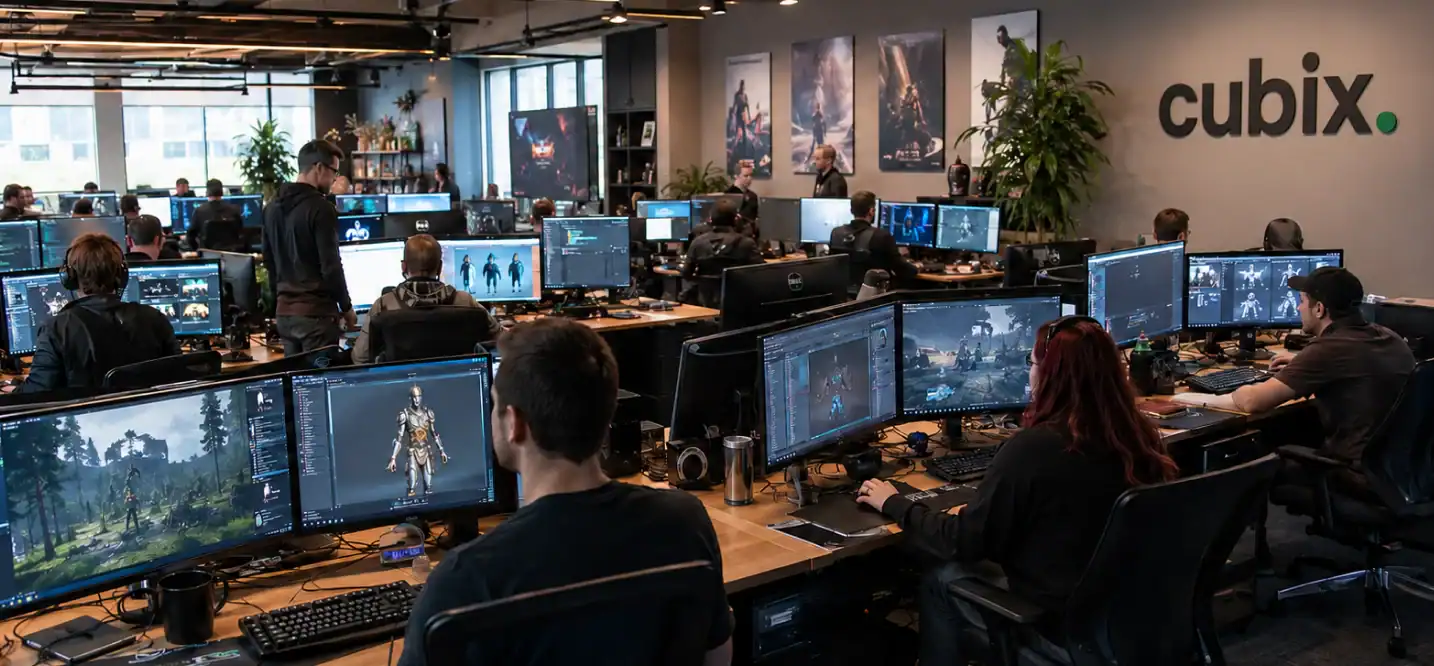
Selecting a game development partner should never be based on price alone.
A lower upfront cost may lead to higher expenses later if the game requires extensive revisions or fails to meet player expectations.
Here are the factors that matter most.
Review Their Portfolio Carefully
The fastest way to evaluate a studio is to examine previous projects.
Ask questions such as:
- Have they built games similar to yours?
- Do they have multiplayer experience?
- Have they worked with AR or VR technologies?
- Can they demonstrate successful launches?
A company that has already solved challenges similar to yours will typically deliver faster and more reliable results.
Evaluate Their Engine Expertise
The game engine affects everything from performance to scalability.
Unity
Unity remains the most popular engine for mobile game development because it supports:
- iOS
- Android
- Cross-platform deployment
- Rapid development cycles
It is commonly used for:
- Casual games
- Puzzle games
- Strategy games
- Hybrid-casual games
Unreal Engine 5
Unreal Engine 5 excels in:
- High-end graphics
- Realistic environments
- Advanced visual effects
It is often selected for premium 3D experiences and AAA-quality projects.
Assess Art and Animation Capabilities
Players notice visuals before they experience gameplay.
Strong studios invest heavily in:
- Character design
- Environment art
- UI design
- Visual effects
- Animation
Games with polished visuals generally achieve stronger first impressions and higher user retention rates.
Ask About Post-Launch Support
Launching a game is only the beginning.
Top studios provide:
- Performance monitoring
- Analytics reporting
- Bug fixes
- Content updates
- LiveOps support
Games that receive regular updates often outperform static products in terms of revenue and player retention.
Benefits of Hiring a US-Based Mobile Game Development Company
Businesses targeting American audiences often benefit from working with a US-based development team.
Better Communication
Time-zone alignment reduces delays and speeds up decision-making.
Teams can collaborate in real time rather than waiting an entire day for responses.
Strong Intellectual Property Protection
The United States maintains some of the world’s strongest legal protections for intellectual property.
For businesses developing original gaming concepts, this can provide additional peace of mind.
Access to Specialized Talent
Many of the world’s most experienced game developers work in major US gaming hubs such as:
- San Francisco
- Los Angeles
- Austin
- Orlando
- New York
- Seattle
These cities continue to attract talent from leading gaming companies and technology firms.
Better Understanding of Local Audiences
Studios operating within the United States often have deeper insight into:
- Consumer behavior
- Monetization preferences
- Cultural trends
- Platform usage patterns
This knowledge can help improve player acquisition and retention.
Mobile Game Development Lifecycle
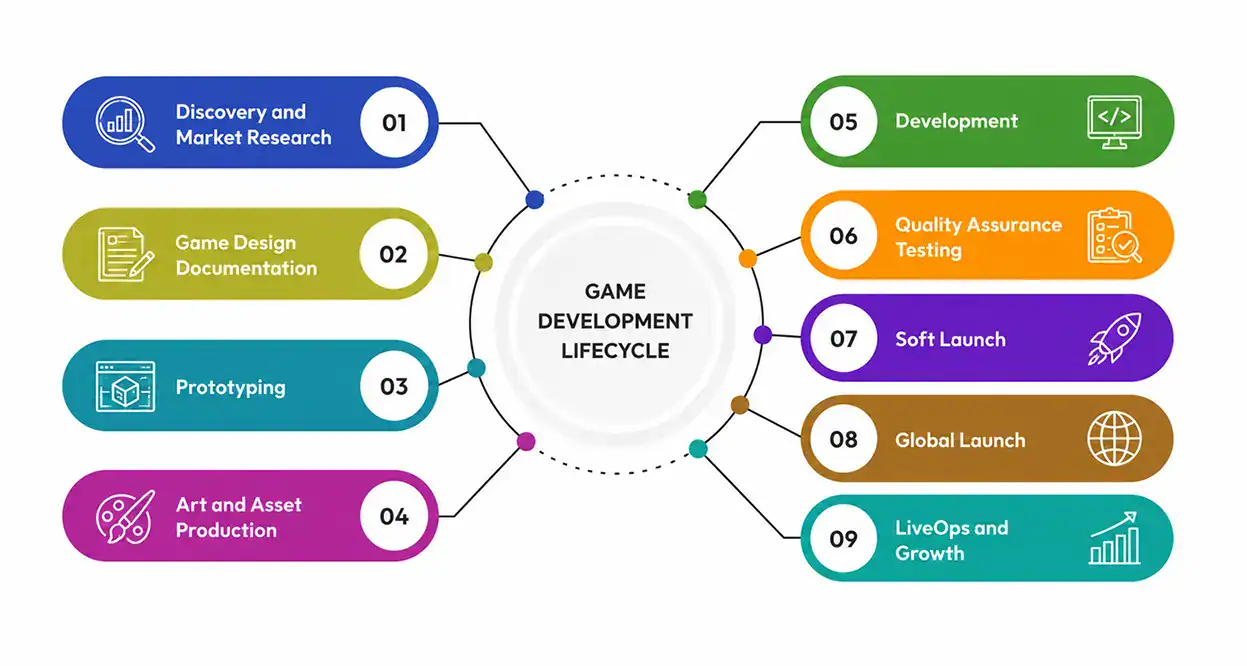
Building a successful game requires more than writing code.
The process typically follows nine stages:
1. Discovery and Market Research
The team validates the concept, target audience, and monetization strategy.
2. Game Design Documentation
Core gameplay systems, progression loops, and technical requirements are defined.
3. Prototyping
A playable prototype is developed to test the concept.
4. Art and Asset Production
Characters, environments, animations, and visual effects are created.
5. Development
Programmers build the game’s systems and functionality.
6. Quality Assurance Testing
The game undergoes extensive testing to identify bugs and performance issues.
7. Soft Launch
A limited release gathers player feedback and performance data.
8. Global Launch
The game becomes available to the wider market.
9. LiveOps and Growth
Updates, events, and new content help maintain engagement and revenue.
Final Thoughts
The mobile gaming industry continues to evolve at a remarkable pace. AI-powered production tools, cross-platform experiences, and hybrid-casual monetization models are changing how successful games are built and maintained.
The companies featured in this guide represent some of the most experienced and influential mobile game development studios operating in the United States today. Each brings unique strengths, technologies, and industry expertise to the table.
If your goal is to build a game that players return to again and again, invest time in selecting a partner with the technical capabilities, creative vision, and long-term support needed to turn your idea into a lasting success.
Consult with our Game Design Experts today and discover how Cubix can help transform your vision into a successful mobile gaming experience.
Want to discuss your project? Our experts are just a click away.
Contact UsFrequently Asked Questions
1. What is the average cost of hiring a mobile game developer in the US?
Most mobile game projects range from $25,000 to $500,000+, depending on complexity, art requirements, multiplayer functionality, and post-launch support.
2. How long does it take to develop a professional mobile game?
Simple games can take three to six months. More advanced multiplayer or 3D projects often require nine to eighteen months.
3. Which is the best engine for mobile game development in 2026?
Unity remains the most widely used engine for mobile games due to its flexibility and platform support. Unreal Engine 5 is often preferred for projects requiring high-end graphics and advanced visual effects.
4. Why should I choose a US-based game development company?
US studios offer stronger intellectual property protection, improved communication, access to experienced talent, and a deeper understanding of American gaming audiences.
5. What are the most profitable mobile game genres?
Strategy games, RPGs, casino games, simulation titles, and hybrid-casual games continue to generate strong revenue across the mobile gaming market.
6. How do mobile games make money?
Most successful games combine in-app purchases, advertising, subscriptions, battle passes, and virtual item sales.
7. Can a mobile game also launch on PC and consoles?
Yes. Many modern games are developed with cross-platform functionality, allowing players to continue their progress across multiple devices.
8. What should I look for when hiring a mobile game development company?
Review the company’s portfolio, technical expertise, client reviews, communication practices, monetization experience, and post-launch support capabilities.