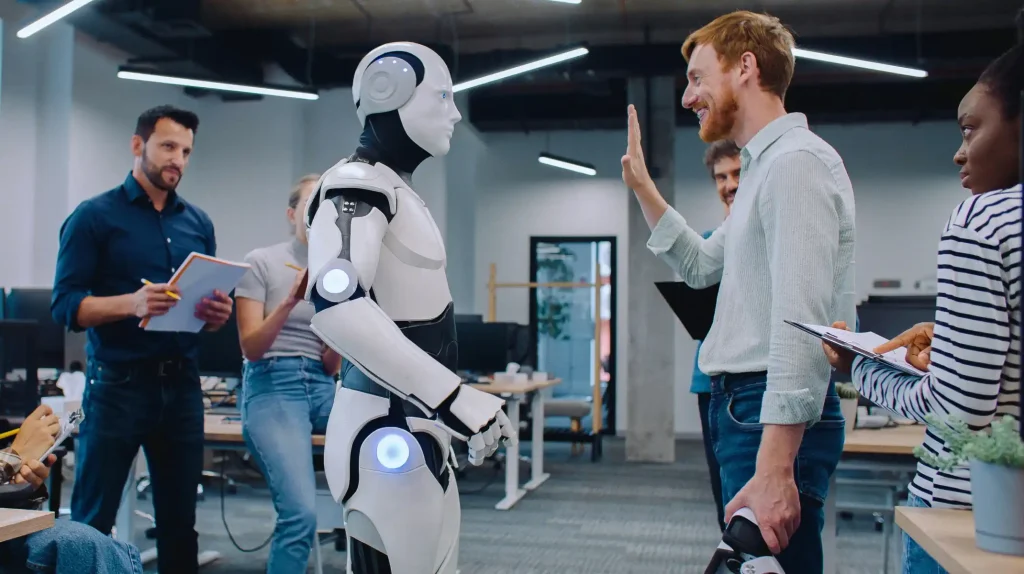
The AI technology is changing quickly, and one of the fields in which this is most striking is that of robotics. According to PwC, AI robots could automate 30% of jobs worldwide by the mid-2030s.
AI development races at breakneck speed, and the intervention of robots and AI-powered systems is becoming more pronounced in daily life. Ranging from industrial robots to personal assistants, this steady penetration of AI in robotics raises a vital question: Will smart machines ultimately replace human beings?
Though it is commonly said that machines cannot learn, this is no longer true today. From the early incorporation of machinery to modern sophisticated robots, all possible components have been incorporated into, forming machines that accept most of the functions done by human beings. Such an AI brings about changes in different industries like healthcare, logistics, manufacturing, and many others towards more excellent automation, innovation, and improvement in productivity at various levels.
Read More: Will Robots Shape Work’s Future? Decoding the Future of Automation
In this blog, we will explore the role of AI in robotics, the effects on working humans in the future, and how AI-powered robotics may shape human life and work in ways unimaginable just a few decades ago.
AI in Robotics: A Glimpse of the Future

We have passed the days when AI in robotics was a futuristic thought; it is here and present. AI robots are indeed performing complex tasks in many fields. These are a few examples of industries that adopt robots: manufacturing, logistics, healthcare, and even customer service.
AI robotics are capable of learning from the environment, and make decisions based on available data. These smart machines use AI algorithms to assess the situation and react in real-time to changes. While the entire notion of autonomous robots replacing human beings might take a while to set in, AI in robotics is making headway toward this goal in the present.
- Markets and Markets data predicts that the global AI robotics market will reach around $35.3 billion by 2026, with the manufacturing and logistics industries driving much of the growth.
- As per the World Economic Forum, AI-powered robots are expected to grow in the healthcare sector by 2030, revolutionizing patient care and hospital operations.
Read More: Why AI Will Transform Inventory Management in Future
The Role of AI Development in Robotics

Robotics-integrated AI transformed today’s robots quite far beyond simple intelligence, in their increased versatility. However, AI is important in this transformation. Machine learning, deep learning, and computer vision have endowed robots with the ability to perform tasks that previously were regarded as beyond the possible tasks for a machine or even dangerous to perform.
For example, within the manufacturing area, robots equipped with AI could either work independently, on different kinds of tasks, checking their quality, or by themselves apply what they have learned to a new task. In healthcare, AI-enabled robots are now performing surgical procedures, accurately reducing the chance of human error. They can learn from failures and become more capable as they are continually updated and retrained.
Read More: How AI-Driven Healthcare Will Transform Patient Care and Diagnostics
AI and robotics are both capable of augmenting human ability. Robots can undertake hazardous actions that humans are incapable of undertaking. This will help bring down injuries and deaths from industrial accidents. For instance, AI can assist a farm robot in optimizing plant growth, establishing plant health monitoring systems, and assisting in the plant’s harvesting process. All this work would normally require human labor to improve efficiency, reduce the workforce, and ultimately lower costs.
- According to the World Economic Forum, an expected outcome of these AI robots would be that they would cut down human error in medical procedures by 40% by 2030. The AI surgical robot will be one such standard instrument in an operating room.
Read More: Transforming Healthcare with AI Integration
Will AI and Smart Machines Replace Humans?

With the rapid advancement of AI and robotics, many people worry that intelligent machines might completely replace humans in the workforce. While robots are increasingly capable of performing repetitive, labor-intensive, and even hazardous tasks, full automation across all sectors is unlikely. Instead of replacing humans, AI-powered machines are evolving as collaborators, enhancing efficiency, precision, and safety while freeing humans to focus on higher-level, creative, and strategic work.
Pros and Cons of AI in Robotics:
Pros:
- Efficiency: AI robots can handle large volumes of tasks with speed and accuracy, reducing human error and improving productivity.
- Safety: By taking over dangerous or physically demanding jobs, robots significantly reduce the risk of workplace accidents.
- Job Creation: While some repetitive roles may diminish, new opportunities emerge in designing, programming, maintaining, and supervising AI systems.
- Enhanced Human Support: In healthcare, education, and customer service, AI robotics assist humans, making tasks easier and outcomes more reliable.
Cons:
- Job Displacement: Certain repetitive, routine, or hazardous roles may become fully automated.
- High Costs: Developing, implementing, and maintaining AI-powered robotics requires investment, making it harder for small businesses to adopt.
- Ethical Considerations: Using AI in decision-making raises questions about accountability, bias, and whether machines should ever override human judgment.
- Human Touch: Despite their intelligence, robots cannot replicate intuition, empathy, or emotional decision-making, which are critical in many fields.
The Future Outlook:
AI and smart machines are likely to take over tasks that are dangerous, highly repetitive, or extremely physically demanding. Humans, however, will remain essential in roles that require creativity, problem-solving, emotional intelligence, and strategic thinking. This collaboration creates an environment where machines handle what they do best, while humans focus on higher value work.
For example, in manufacturing, AI robots can assemble products with unmatched precision, while humans manage quality control, innovation, and workflow optimization. In healthcare, surgical robots assist doctors during complex procedures, allowing surgeons to focus on decision-making and patient care rather than manual precision tasks. Similarly, in agriculture, AI-enabled machinery performs planting and harvesting efficiently, while farmers monitor crop health and make strategic decisions.
Shoaib Abdul Ghaffar, Vice President at Cubix, said:
“AI in robotics isn’t about replacing humans; it’s about redefining how we work, think, and create in a world of limitless possibilities.”
AI-powered robots will transform industries, but their purpose is to augment human capabilities, not replace them. By working together, humans and machines can achieve more than either could alone, leading to safer workplaces, greater productivity, and new avenues for creativity and innovation.
How AI in Robotics is Transforming Work and Innovation
The future of AI in robotics is not about machines taking over human jobs but about creating a collaborative environment where humans and robots work side by side. AI-powered robots are increasingly capable of handling physically demanding, repetitive, or dangerous tasks, while humans focus on creativity, problem-solving, and decision-making. This balance between human intelligence and machine precision is driving a new era of productivity and innovation across industries.
When robots take on the heavy lifting literally and figuratively, humans gain more freedom to think, design, and create. This partnership transforms workplaces into hubs of creativity, safety, and efficiency, unlocking potential that was once limited by human fatigue or physical constraints.
Key Ways AI in Robotics Is Transforming Work and Innovation
- Enhanced Workplace Safety: Robots are now used to perform dangerous operations such as deep sea exploration, chemical handling, and construction work in unsafe environments, reducing risks to human workers.
- Boosted Efficiency and Speed: Intelligent robots can operate around the clock without breaks, ensuring consistency, accuracy, and faster production cycles in industries like logistics, manufacturing, and warehousing.
- Empowered Creativity: With repetitive tasks automated, workers can channel their energy toward strategy, product design, and creative problem-solving, areas where human ingenuity thrives.
- Smarter Decision-Making: AI-driven robots can analyze data in real-time, identify patterns, and assist teams in making informed decisions faster than ever before.
- Improved Healthcare Support: In hospitals, surgical robots assist doctors in performing precise procedures, while service robots help nurses with medication delivery and patient support.
- Advanced Learning and Skill Development: AI-powered systems are enabling professionals to upskill through simulation-based learning, robotics assisted training, and interactive learning environments.
- Personalized Customer Experiences: Service robots in retail and hospitality are now capable of assisting customers with personalized recommendations, improving satisfaction and engagement.
- Sustainability and Green Innovation: AI robotics are playing a major role in renewable energy maintenance, waste management, and precision agriculture, helping reduce waste
and optimize resources.
Read More: AI Outsourcing – How to Choose the Right Technology Partner
Transform Your Business with AI-Powered Robotics

With a wave of revolution, Cubix comes armed with various AI development solutions for today’s automated processes, growing efficiency, and overturning established industry practices: all ways in which our expertise in AI in robotics will assist you in being ahead of the game. Let us create intelligent options to enhance the magic of human capabilities.
Contact Cubix today!