The answer to “how much does blockchain app development cost?” depends on what you’re building. A simple NFT marketplace has very different technical requirements than a DeFi lending platform or an enterprise supply chain solution. Smart contracts, security audits, blockchain networks, integrations, and compliance all influence the final budget.
The global blockchain technology market is projected to reach $47.96 billion in 2026, up from $31.18 billion in 2025, and is expected to grow at a 36.5% CAGR through 2034. This expansion reflects increasing investment in decentralized finance, digital assets, blockchain-based payments, smart contracts, and supply chain applications.
If you’re planning a blockchain project, working with an experienced development partner also makes a difference. As a blockchain protocol development company, Cubix helps businesses define the right feature set, choose the best blockchain technology, and build secure, scalable applications that align with both business goals and budget.
What Affects Blockchain App Development Cost?
Blockchain app development costs typically range from $30,000 to over $300,000 in 2026. The final price depends on your project’s scope, the blockchain ecosystem you choose, and the level of security and functionality your application requires.
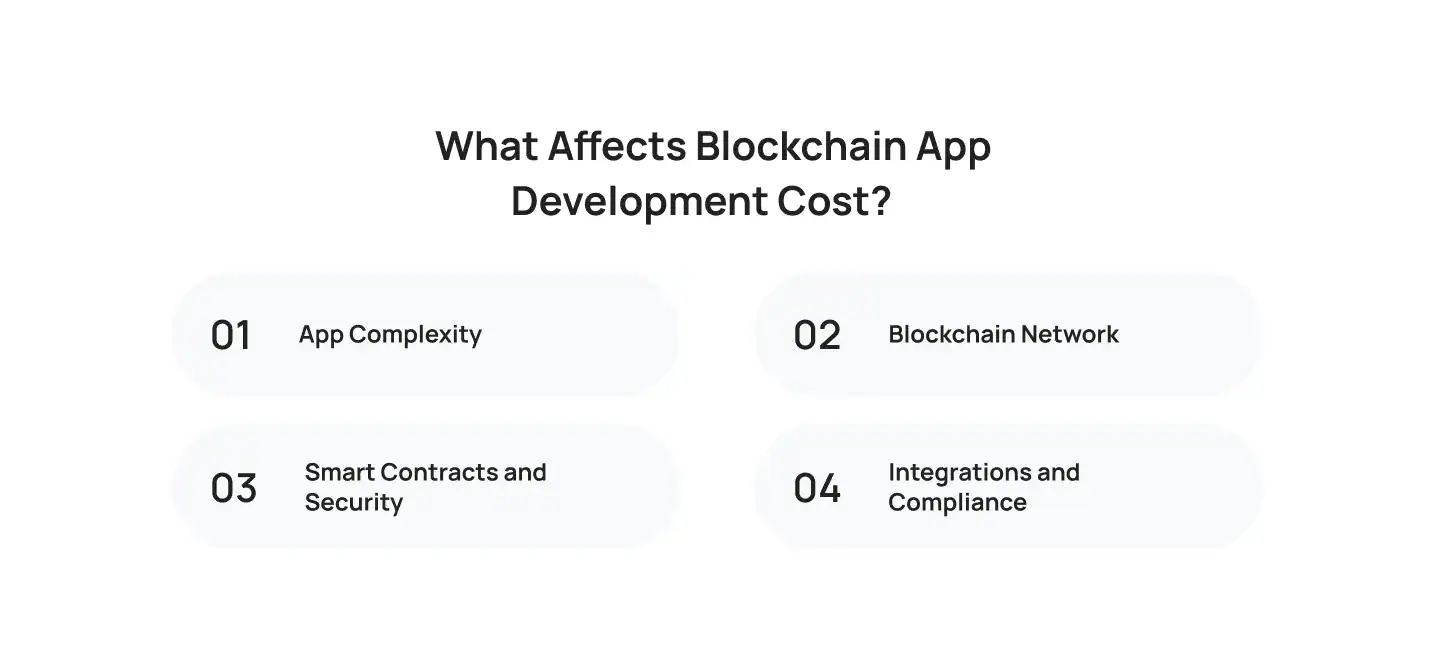
Before estimating your budget, it’s important to understand the main factors that influence development costs.
App Complexity
The more features your application includes, the higher the development cost.
A basic blockchain MVP with user authentication, wallet integration, and a few smart contracts costs much less than an enterprise platform with advanced automation, analytics, and multi-chain support.
Here’s a general cost breakdown:
| App Complexity | Cost Estimate |
| Basic MVP | $30,000–$60,000 |
| Mid-Level Application | $60,000–$150,000 |
| Enterprise Solution | $150,000–$300,000+ |
Starting with an MVP helps you validate your idea before investing in advanced features. You can then expand the application based on user feedback and business needs.
Blockchain Network
The blockchain you choose affects both development effort and long-term operating costs.
Public blockchains like Ethereum provide a mature ecosystem and strong security, but transaction fees are often higher. Networks such as Polygon and Solana offer faster transactions and lower fees, making them popular for cost-conscious projects.
For enterprise applications, businesses often choose permissioned networks like Hyperledger Fabric, which provide greater privacy, access control, and customization. These solutions usually require more planning and integration work, increasing development costs.
Your blockchain network should support your business goals, expected transaction volume, and scalability requirements instead of simply being the cheapest option.
Smart Contracts and Security
Smart contracts are the backbone of most blockchain applications. The smart contracts market is growing rapidly, increasing from $3.2 billion in 2025 to $3.94 billion in 2026, with an annual growth rate of 23.1%.
They automate transactions, enforce business rules, and eliminate manual processes.
Developing secure smart contracts requires experienced blockchain developers and extensive testing. For applications that manage digital assets or financial transactions, independent security audits are essential.
Security costs typically include:
- Smart contract development
- Code testing and optimization
- Third-party security audits
- Vulnerability assessments
- Ongoing security updates
Skipping these steps often leads to much higher costs later if vulnerabilities are discovered after launch.
Integrations and Compliance
Most blockchain applications rely on more than blockchain technology alone. They also connect with external systems and third-party services.
Common integrations include:
- Cryptocurrency wallets
- Payment gateways
- Identity verification (KYC)
- AML compliance tools
- Oracle services
- ERP and CRM platforms
- Cloud infrastructure
Each integration adds development time, testing, and maintenance requirements.
Blockchain App Development Cost by Use Case
No two blockchain applications have the same development cost. A DeFi platform handles financial transactions and requires advanced security, while an NFT marketplace focuses on digital asset management. A supply chain solution, on the other hand, prioritizes transparency and enterprise integrations.
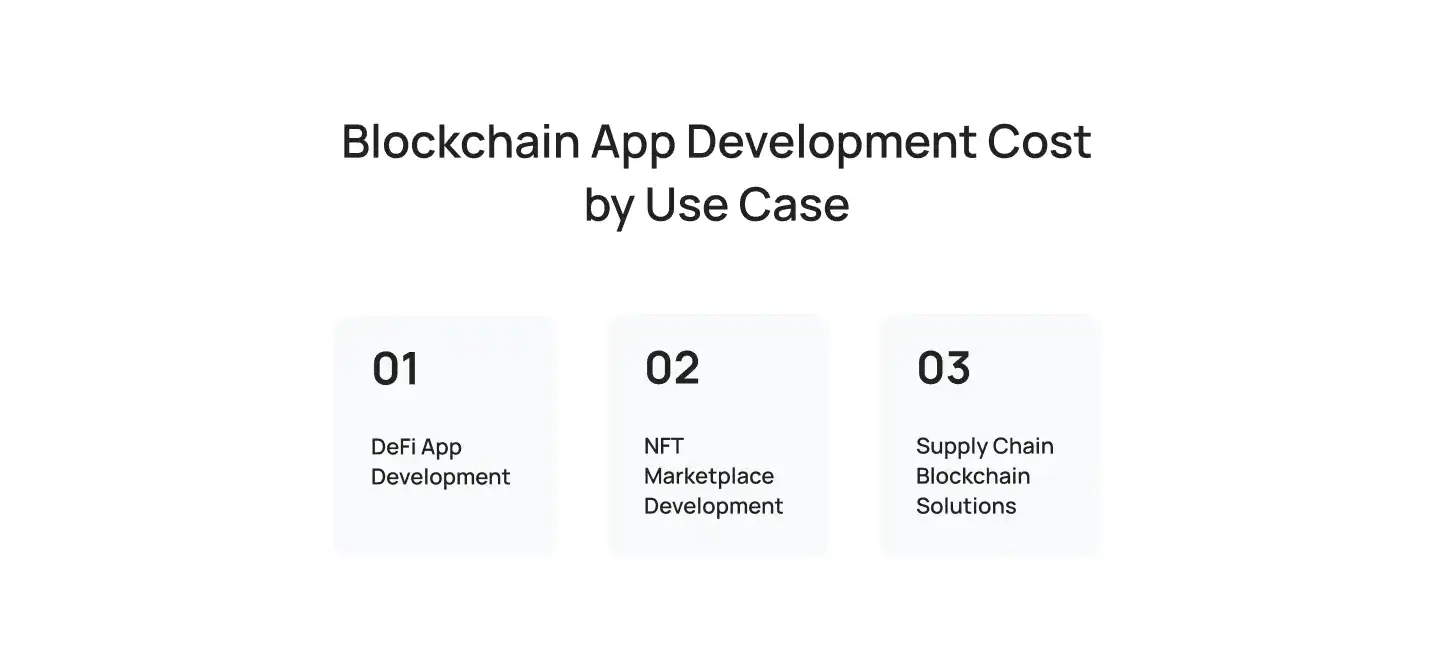
The table below provides a general estimate for the most common blockchain applications in 2026.
| Use Case | Estimated Cost | Timeline |
| DeFi Application | $30,000–$60,000 | 4-8 months |
| NFT Marketplace | $60,000–$150,000 | 3-6 months |
| Supply Chain Solution | $150,000–$300,000+ | 4-9 months |
Actual costs depend on the number of features, blockchain network, integrations, and security requirements.
DeFi App Development
DeFi applications are among the most expensive blockchain projects because they manage digital assets and financial transactions. Every smart contract must be secure, thoroughly tested, and audited before deployment.
A typical DeFi application costs between $80,000 and $300,000+, depending on its functionality and complexity.
Common features include:
- Wallet integration
- Token swapping
- Staking and yield farming
- Lending and borrowing
- Liquidity pools
- Governance voting
- Portfolio dashboards
- Multi-chain support
The biggest cost drivers are smart contract development, security audits, liquidity management, and integrations with key blockchain protocols. Since these applications often process high-value transactions, businesses invest heavily in security testing to reduce vulnerabilities.
Development usually takes 4 to 8 months, with more advanced platforms requiring additional time for testing and audits.
NFT Marketplace Development
NFT marketplaces are generally less complex than DeFi platforms, but pricing still varies based on the user experience and marketplace features.
The United States is leading the NFT market at US$56.3 million, highlighting continued demand for NFT platforms despite a more mature market.
Development costs typically range from $50,000 to $180,000.
Most NFT marketplaces include the following:
- User registration
- Crypto wallet integration
- NFT minting
- Buying and selling
- Auctions
- Royalties
- Search and filters
- Creator profiles
- Admin dashboard
- Projects that support multiple blockchain networks, advanced search capabilities, or large user communities require a higher investment.
Most NFT marketplaces take 3 to 6 months to develop.
Supply Chain Blockchain Solutions
Supply chain applications focus on improving product traceability, transparency, and operational efficiency. Unlike consumer-facing apps, these platforms often integrate with existing enterprise systems.
Development costs generally fall between $70,000 and $250,000, depending on the scale of the project.
Common features include:
- Product tracking
- QR code or barcode scanning
- Shipment monitoring
- Smart contract automation
- Inventory management
- Role-based access
- Analytics dashboards
- ERP and warehouse integrations
Enterprise integrations are usually the largest cost factor. Connecting blockchain platforms with existing ERP software, inventory systems, and logistics platforms requires additional development and testing.
Large organizations also choose permissioned blockchain networks such as Hyperledger to improve data privacy and control, which increases implementation complexity.
A typical supply chain blockchain solution takes 4 to 9 months to build, depending on the number of stakeholders and integrations involved.
Want to discuss your project? Our experts are just a click away.
Contact UsAdditional Costs to Consider
Your initial development budget is only part of the total investment. Once your blockchain application goes live, you’ll need to account for ongoing expenses that keep it secure, reliable, and scalable.
Planning for these costs early helps you avoid budget overruns later.
- Smart contract audits. Basic audits run $5,000 to $15,000. Comprehensive DeFi audits run $15,000 to $40,000, and enterprise-grade audits can exceed $100,000. Never treat this as optional.
- Ongoing maintenance. Expect to spend 15 to 25 percent of your initial build cost every year on bug fixes, security patches, and updates.
- Cloud and blockchain infrastructure. Node access through providers like Alchemy or Infura runs $100 to $800 a month. Add Oracle services, monitoring tools, and cloud hosting, and monthly infrastructure spend typically lands between $1,000 and $10,000 for a live app.
- Future updates and scaling. Adding a new chain, a new feature, or scaling to more users after launch is never free. Plan for it in your roadmap and budget instead of treating your MVP as a finished product.
How to Reduce Blockchain Development Costs

Reducing development costs doesn’t mean sacrificing quality. The goal is to invest in the features that deliver the most value while avoiding unnecessary complexity in the early stages.
Here are four practical ways to keep your blockchain project within budget.
Start with an MVP
Launching a minimum viable product (MVP) helps you validate your idea before committing to a full-scale platform.
Instead of building every feature at once, focus on the core functionality your users need. Once you gather feedback and understand user behavior, you can introduce advanced features through future updates.
This approach shortens development time and reduces upfront costs.
Prioritize Essential Features
Every additional feature increases development time, testing, and maintenance costs.
Start by identifying the features that directly support your business goals. Every feature added mid-build costs 30 to 50 percent more than the same feature scoped from day one. Lock your feature list before development starts.
Prioritizing essential features helps you control costs while delivering a functional product faster.
Choose the Right Blockchain Platform
Not every blockchain network is the right fit for every application.
When selecting a platform, consider factors such as transaction fees, scalability, security, ecosystem maturity, and developer support. Keeping up with the latest blockchain trends can also help you choose a network that supports your long-term business goals. Choosing the right blockchain from the start reduces the need for costly migrations or architectural changes later.
The best option is the one that aligns with your technical and business requirements, not simply the lowest-cost network.
Work with an Experienced Development Partner
Blockchain development requires expertise in smart contracts, security, infrastructure, and blockchain architecture.
An experienced development team helps you define realistic project requirements, recommend the right technology stack, and avoid common mistakes that lead to delays or rework.
Why Choose Cubix For Blockchain Applications
Every successful blockchain project starts with a business goal, not a technology choice. At Cubix, our blockchain development solutions are built around your business objectives, helping you develop secure, scalable, and future-ready applications while keeping development costs under control.
1. Discovery and Strategy
We begin by understanding your business objectives, target users, and technical requirements. This allows us to recommend the right blockchain platform, define the project scope, and create a realistic development roadmap.
2. Solution Architecture
Our team designs the application’s architecture, selects the most suitable blockchain network, and plans how it will integrate with your existing systems. Whether you’re building a DeFi platform, NFT marketplace, or supply chain solution, we focus on creating an architecture that supports long-term growth.
3. UI/UX Design
We design intuitive user experiences that simplify blockchain interactions. From wallet connections to transaction flows, every screen is built to make complex processes feel familiar and easy to use.
4. Development and Smart Contracts
Our blockchain developers build secure smart contracts alongside the front end and back end of your application. We also integrate wallets, payment gateways, APIs, and other third-party services required for your product.
5. Testing and Security Audits
Before launch, every application goes through extensive quality assurance, smart contract testing, and security reviews. This helps identify vulnerabilities early and ensures your platform performs reliably under real-world conditions.
6. Deployment and Long-Term Support
Once the application is deployed, we continue supporting our clients with maintenance, performance monitoring, feature enhancements, and scalability improvements. As your business grows, your blockchain application evolves with it.
Whether you’re launching a decentralized finance platform, an NFT marketplace, or an enterprise blockchain solution, Cubix follows a proven development process that helps reduce technical risks, improve security, and deliver products built for long-term success.
Bottom Line
Blockchain app development costs vary because every project solves a different business problem. A DeFi platform requires advanced financial logic and rigorous security, while an NFT marketplace focuses on digital asset management, and a supply chain solution depends on enterprise integrations and real-time data visibility.
Instead of asking, “How much does a blockchain app cost?” ask, “What does my business need to achieve?” Your answer determines the features, technology stack, development timeline, and overall investment.’
If your blockchain solution includes a customer-facing application, it’s equally important to plan your mobile app development strategy alongside your blockchain infrastructure. A well-designed mobile experience helps users interact with your platform more easily, improves adoption, and supports long-term business growth.
Starting with the right strategy, prioritizing essential features, and partnering with an experienced development team helps you control costs without compromising quality.
“The success of a blockchain project isn’t determined by how much you spend. It’s determined by investing in the right architecture, security, and user experience from day one. When those foundations are in place, your application is built to scale with your business.”
FAQs
1. How much does it cost to build a blockchain app?
Most blockchain apps cost between $40,000 and $300,000, depending on complexity, the blockchain network you choose, and how many integrations you need. Simple MVPs can start closer to $10,000 to $30,000, while enterprise-grade platforms can exceed $500,000.
2. Why are DeFi apps more expensive?
DeFi apps handle real user funds in a live environment, which means they need extensive smart contract audits, often from multiple firms. They also require oracle integrations, complex financial logic, and constant security monitoring after launch, all of which add cost that content-based apps do not carry.
3. How much does an NFT marketplace cost?
An NFT marketplace typically costs $45,000 to $180,000. The price depends on your feature set, including minting, royalties, auctions, and how many wallets you support. Advanced features like lazy minting and cross-chain support can add 20 to 50 percent to a base build.
4. What is the cheapest blockchain for app development?
Layer 2 networks like Polygon and Base are currently the cheapest active chains to build and deploy on. They are EVM compatible, so Solidity developers can use them without learning a new language, and gas costs sit well under a cent per transaction.
5. How long does blockchain app development take?
Timelines run from 3 to 9 months depending on the use case. NFT marketplaces typically take 3 to 6 months. DeFi apps take 4 to 8 months due to audit cycles. Supply chain and enterprise builds take 4 to 9 months because of ERP integration work.
6. Do blockchain apps need ongoing maintenance after launch?
Yes. Budget 15 to 25 percent of your initial development cost annually for maintenance, security monitoring, and updates. Skipping this is one of the most common reasons blockchain projects run into trouble after launch.