Key Takeaways
- Blockchain app development cost depends on app type, blockchain platform, and feature complexity, not a fixed price tag.
- A basic MVP starts far lower than a full enterprise-grade platform.
- Security audits are a mandatory line item, not an optional extra.
- Developer location changes your total budget more than almost any other factor.
- Working with an experienced team helps you avoid the hidden costs that blow up budgets mid-project.
If you’re a founder or a business owner exploring blockchain, the first question you’re probably asking is simple: how much does it cost to build a blockchain app? It’s a fair question, and the honest answer is “it depends”, but not in a vague way. The final number is shaped by a handful of very specific decisions you’ll make early on: what kind of app you’re building, which blockchain you build it on, and how deep your security needs go.
As of 2026, the blockchain industry itself has grown into a market worth close to $40 billion, and that growth is exactly why more businesses are asking about the cost to develop a blockchain app before they’ve even picked a tech stack. Pricing swings widely because “blockchain app” covers a huge range of products, a simple token-tracking tool sits nowhere near the price of a full DeFi lending protocol.
That’s exactly what this guide breaks down. We’ll walk through real 2026 cost ranges by app type, the factors that push your budget up or down, developer rates around the world, and how to plan a budget that doesn’t fall apart halfway through the build. And if you’d rather skip the guesswork, Cubix, a custom mobile app development company with a dedicated blockchain team, can scope your project and hand you a real number instead of a range.
What Does Blockchain App Development Cost in 2026?
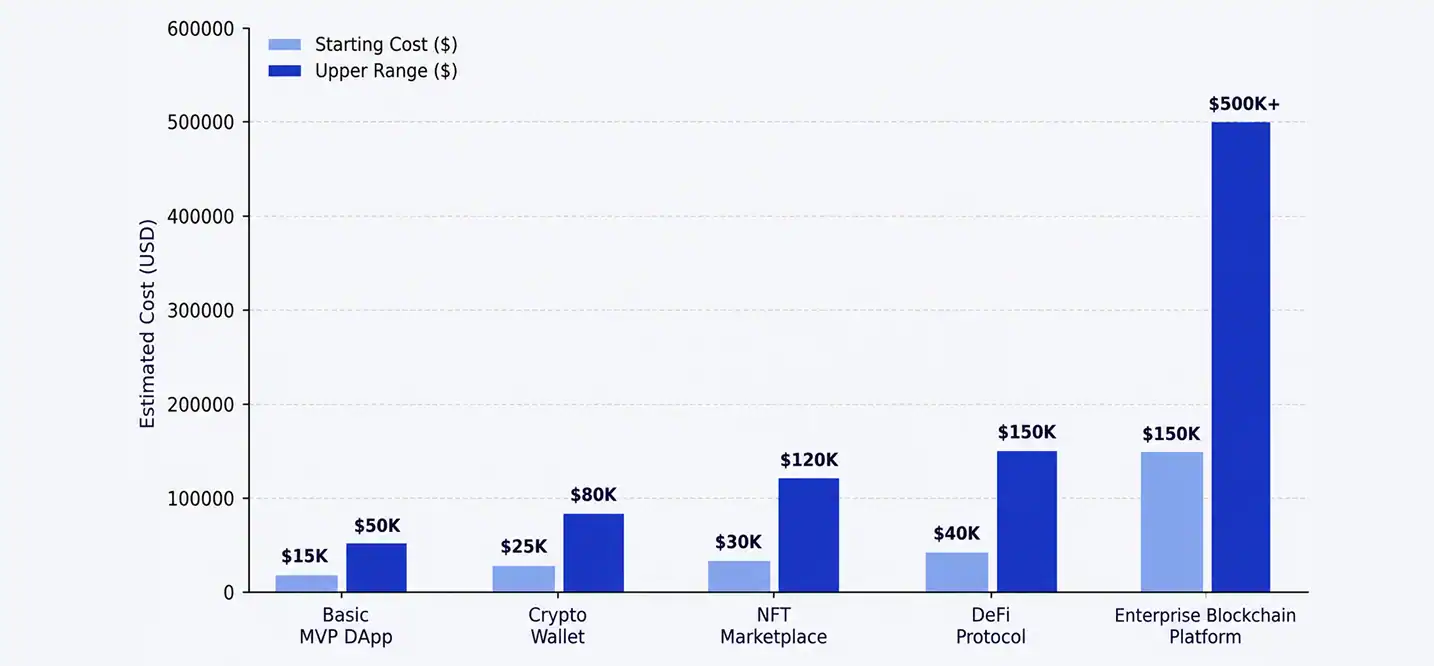
Most projects fall somewhere between $15,000 and $300,000+, with the biggest jumps in price coming from smart contract complexity and whether you need a security audit. Here’s the general breakdown:
| App Type | Starting Cost | Upper Range |
| Basic MVP DApp | $15,000 | $50,000 |
| Crypto Wallet | $25,000 | $80,000 |
| NFT Marketplace | $30,000 | $120,000 |
| DeFi Protocol | $40,000 | $150,000 |
| Enterprise Blockchain Platform | $150,000 | $500,000+ |
If you’re only building a smart contract integration into an existing product rather than a full platform, your number will sit toward the lower end of these ranges.
Blockchain App Development Cost by App Type
Crypto wallets are usually the cheapest full product to build, since the core job is secure key management and a clean transaction UI. NFT marketplaces cost more because they need minting logic, royalty splits, and marketplace listing features; we cover this in detail in our guide on how much it costs to build an NFT marketplace.
DeFi protocols (lending, staking, DEXs) are the most expensive of the “standard” builds because the financial logic has to be airtight, any bug here is a direct financial risk. If you’re building your own token as part of this, budget separately for that; our breakdown on the cost of creating a crypto coin covers token-specific pricing.
Key Factors That Influence Blockchain App Development Cost
Your final quote is really the sum of several independent decisions:
- Blockchain platform, Ethereum, Solana, Polygon, and private/permissioned chains all carry different development and gas-fee profiles.
- Smart contract complexity, a simple transfer contract costs a fraction of a multi-condition DeFi contract.
- Security audits, non-negotiable once real money moves through your contracts.
- Compliance needs, KYC/AML adds both features and legal review time.
- Team location, covered in detail below, and often the single biggest lever on total cost.
If you’re still deciding whether your product even needs to be decentralized, our blockchain development roadmap walks through that decision before you spend a dollar on development.
Blockchain App Development Cost by Project Stage
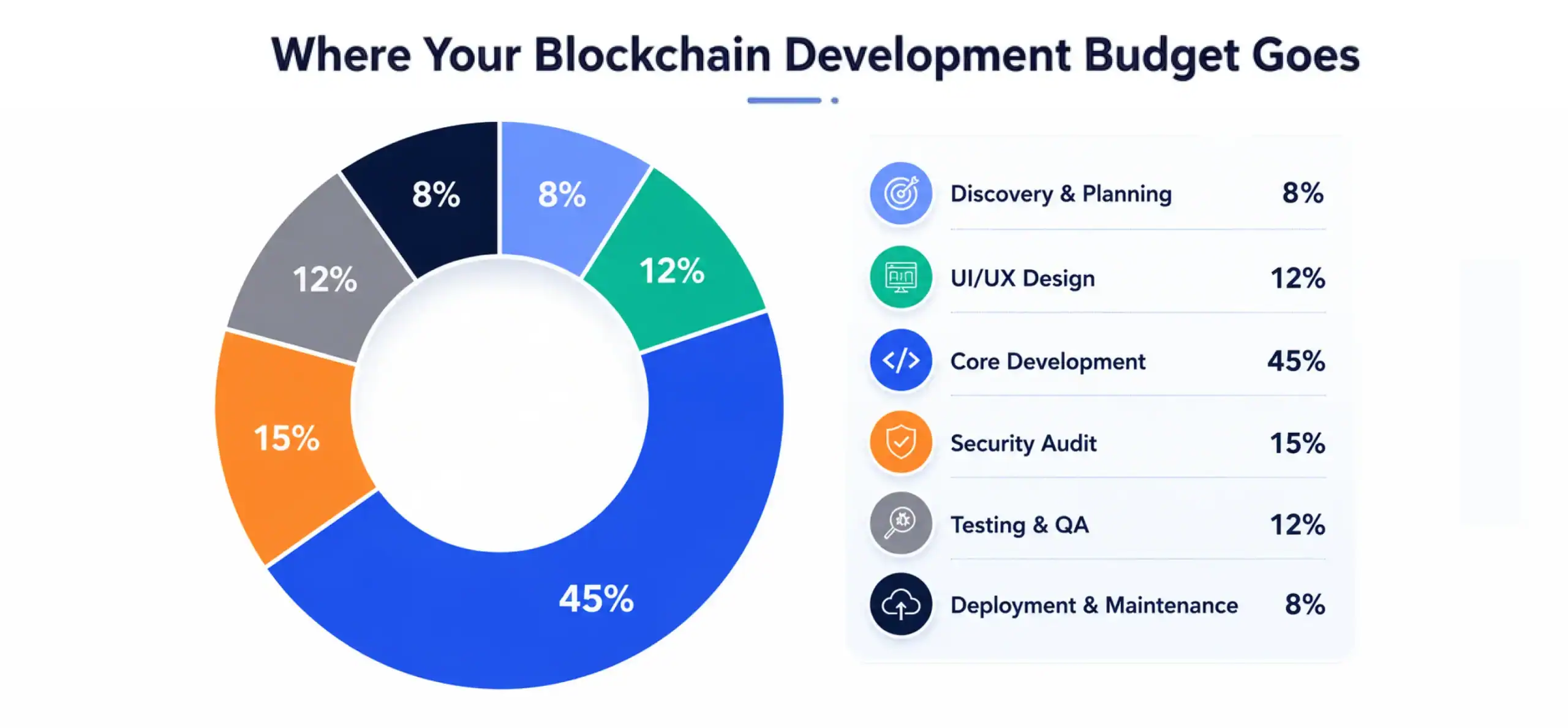
Development isn’t one line item, it’s spread across distinct phases, and skipping any of them is how projects end up over budget later.
| Stage | Share of Total Budget |
| Discovery & Planning | 8% |
| UI/UX Design | 12% |
| Core Development | 45% |
| Security Audit | 15% |
| Testing & QA | 12% |
| Deployment & Maintenance | 8% |
Notice that security audits alone claim roughly the same share as design, that’s usually the biggest surprise for first-time blockchain founders. For a general sense of how this compares to a standard build, see our breakdown of mobile app development cost.
Blockchain Developer Hourly Rates by Region (2026)
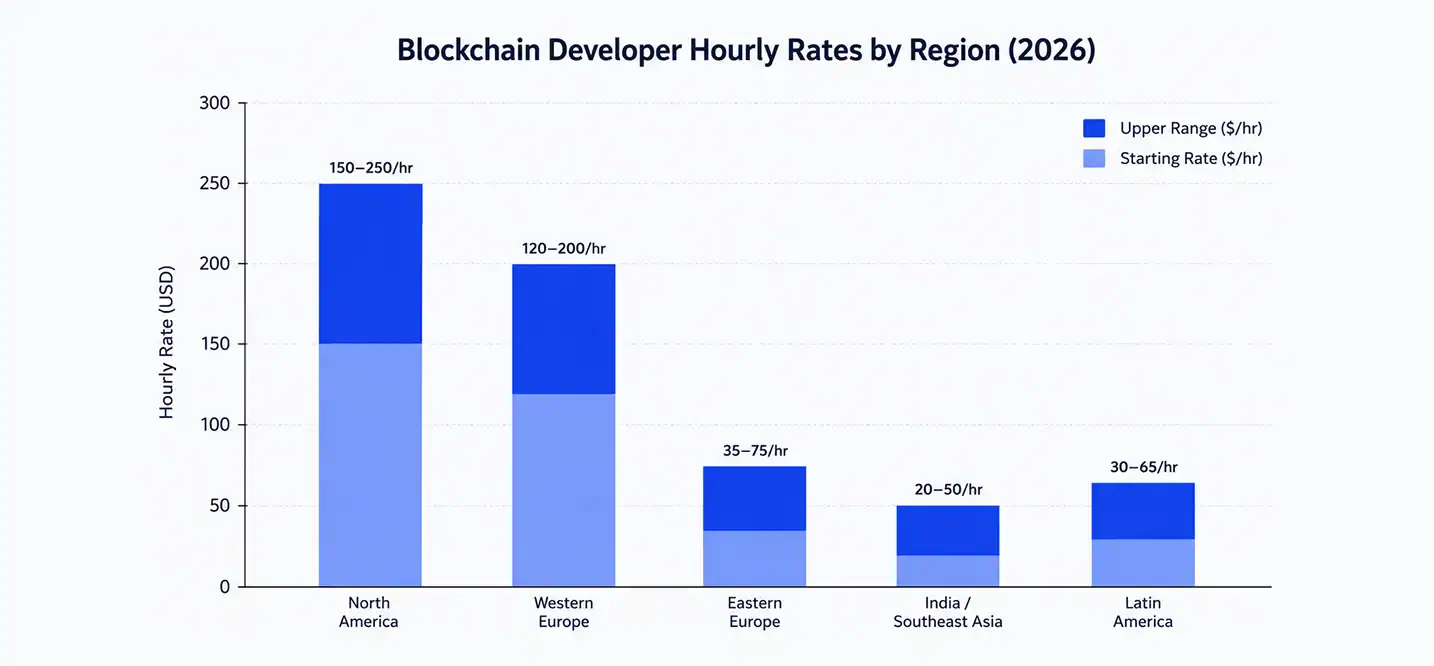
Where your development team is based changes your total cost more than almost any other single factor.
How Much Does a Blockchain Game App Cost to Develop?
Blockchain gaming (play-to-earn, NFT-based assets, in-game economies) sits on top of standard game development costs, then adds token economics, wallet integration, and marketplace logic on top. A simple blockchain game with basic NFT ownership can start around $40,000, while a full play-to-earn economy with its own token and marketplace can climb past $200,000.
“The hardest part of blockchain gaming isn’t the graphics, it’s designing an in-game economy that can’t be gamed the moment real money is on the line.”, Cubix Game Development Team
If a marketplace is part of your game’s economy, our guide on building a blockchain marketplace is worth a read before you scope the build.
Smart Contract Security Audit Costs Explained
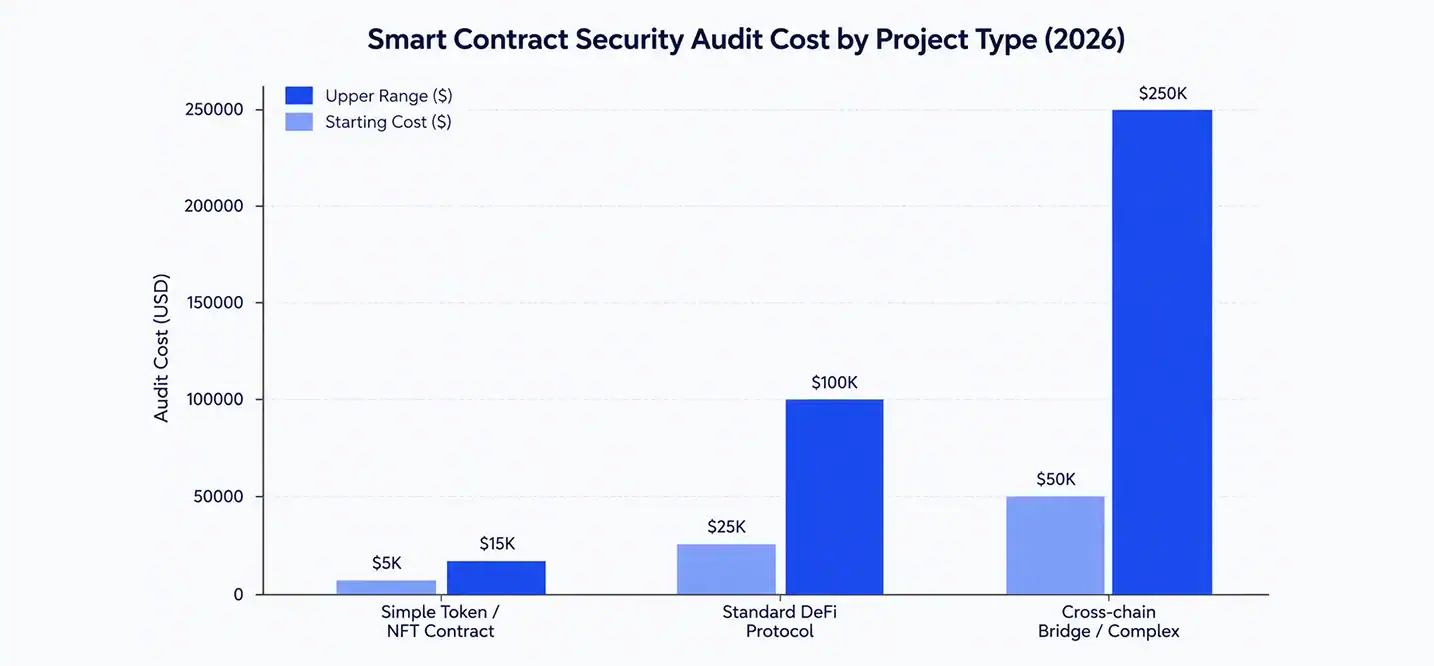
This is the line item that catches most first-time founders off guard. Audits aren’t priced by lines of code, they’re priced by how much financial risk the contract carries.
How AI and Blockchain Features Affect App Development Costs
Combining AI with blockchain, think fraud detection, predictive analytics on-chain, or AI-assisted smart contract auditing, adds engineering time upfront but often reduces long-term costs by catching issues before launch. Projects blending the two typically see a 15–30% increase in initial development cost, offset by lower audit and maintenance costs later. To see where blockchain fits more broadly into enterprise strategy, check out what blockchain means to enterprises.
How to Reduce Your Blockchain App Development Costs
- Start with an MVP instead of the full feature set.
- Choose your blockchain platform based on actual need, not hype.
- Bundle your security audit into the development contract rather than sourcing it separately.
- Work with a team like Cubix that scopes a fixed estimate upfront instead of open-ended hourly billing.
Why Work With Cubix on Your Blockchain App
Cubix has spent years building products where getting the architecture right the first time actually matters, because in blockchain, mistakes are expensive and often permanent. That mindset shapes every estimate Cubix gives.
“We don’t quote blockchain projects like regular apps, because they aren’t regular apps. One overlooked edge case in a smart contract can cost more than the entire audit would have.”, Salman Lakhani, CEO, Cubix
Whether you’re exploring blockchain-as-a-service for your enterprise or building a standalone DApp, Cubix’s team scopes the real cost before writing a single line of code. If a managed backend fits your use case better than a fully custom build, our guide on what Blockchain-as-a-Service actually is is a useful next read, as is our deep dive on developing an NFT marketplace if that’s the direction you’re headed.
Get a Real Blockchain Development Cost Estimate from Cubix
Every range in this guide is exactly that, a range. Your actual number depends on your specific features, your chosen chain, and your compliance needs. Cubix’s blockchain team can turn that range into a fixed estimate tied to your real scope, the same way we approach every blockchain app development project we take on. Reach out to Cubix and get a number you can actually plan around.
Want to discuss your project? Our experts are just a click away.
Contact Us
Frequently Asked Questions
1. What’s the average cost to develop a custom blockchain application?
Most custom builds land between $30,000 and $150,000, depending on features and blockchain choice.
2. Which companies offer blockchain app development services, and what do they charge?
Agencies range from small freelance teams charging under $50/hour to established firms like Cubix that price by fixed project scope rather than hourly rate.
3. How does the cost compare across different blockchain protocols?
Ethereum development tends to cost more due to gas fees and auditor availability, while chains like Polygon or Solana can lower both transaction and audit costs.
4. How much should I budget for a basic blockchain app build?
Plan for at least $15,000–$30,000 for a genuinely basic build, plus a security audit even at MVP stage.
5. How long does it take to develop a blockchain app?
The development timeline for a blockchain app can range from three to twelve months or longer, depending on the project’s complexity. A basic MVP may take three to five months, while a crypto wallet, NFT marketplace, or advanced DeFi application may require six to twelve months.
6. What is the most expensive part of blockchain app development?
Smart contract development and security auditing are often the most expensive parts of a blockchain project. Complex smart contracts require specialized developers, extensive testing, and independent audits to identify vulnerabilities before deployment.
7. Do blockchain apps require ongoing maintenance?
Yes, blockchain apps require ongoing maintenance even after the initial launch. Maintenance may include infrastructure monitoring, frontend and backend updates, security improvements, API maintenance, performance optimization, and support for blockchain network upgrades.
8. Can I reduce blockchain app development costs by starting with an MVP?
Yes. Building a minimum viable product (MVP) is one of the most effective ways to reduce initial blockchain development costs. An MVP focuses on the core user journey and essential blockchain functionality while leaving advanced features for future releases.