Key Takeaways
- There is no single “smartest” AI assistant. The best choice depends on your specific needs, whether that’s coding, research, writing, or business productivity.
- ChatGPT remains the strongest all-round AI, while Claude excels at long-form reasoning, Perplexity leads in research, Gemini integrates seamlessly with Google Workspace, and Copilot is ideal for Microsoft 365 users.
- AI coding tools are improving developer productivity, but they are not replacing software engineers.
- AI agents are moving beyond simple chatbots by automating workflows, handling repetitive tasks, and integrating with enterprise systems.
- Businesses should evaluate AI platforms based on real-world performance, integrations, scalability, security, and ROI rather than benchmark scores alone.
Artificial intelligence is moving so fast that comparing AI assistants today feels very different from how it did just a year ago. New models are launching every few months. Features change. Benchmarks improve. And yet, one question keeps coming up on Reddit, Quora, LinkedIn, and almost every tech forum:
Which AI is actually the smartest?
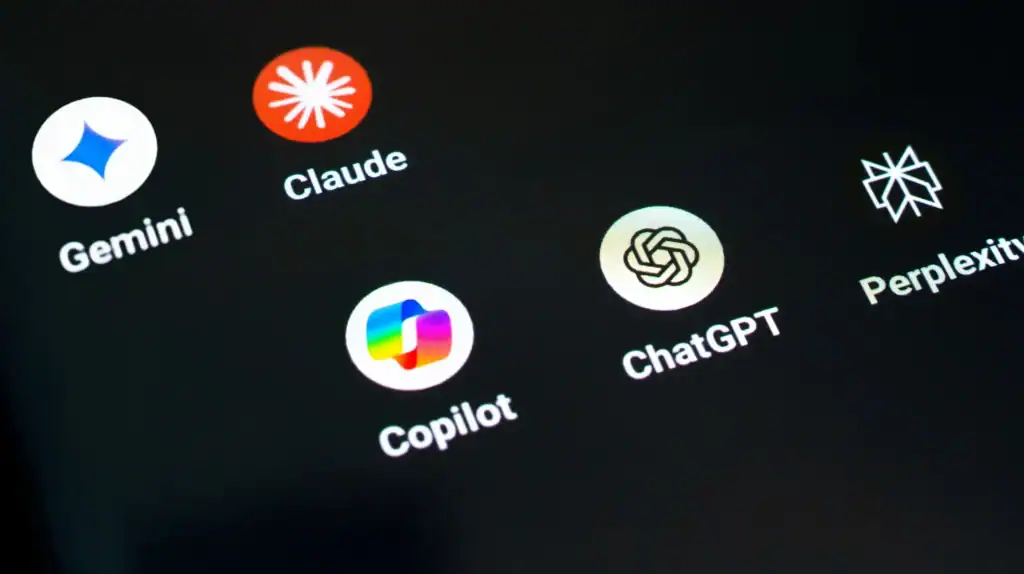
You might use ChatGPT every day for writing and coding. Someone else may swear by Perplexity because it cites its sources. A Microsoft heavy business probably gets the most value from Copilot, while companies already working inside Google Workspace often lean toward Gemini. Then there’s Claude, which many developers and writers appreciate for handling long documents and thoughtful responses.
And businesses have noticed this shift. According to McKinsey’s latest global AI research, 78% of organizations now use AI in at least one business function, up significantly from previous years. Instead of asking whether AI is useful, companies are asking which AI delivers the best return for specific tasks. That is a much more practical question.
Want to discuss your project? Our experts are just a click away.
Contact UsThis guide compares five of today’s most popular AI assistants:
- ChatGPT
- Gemini
- Claude
- Microsoft Copilot
- Perplexity
Let’s start with something many comparison articles overlook.
What Matters Now After the AI Race?

For the first couple of years, people judged AI almost entirely by benchmark scores. If one model scored a few percentage points higher on a reasoning test or solved more coding problems, it was automatically declared the winner.
But that’s not how most people use AI.
If you’re writing reports, researching competitors, debugging code, answering customer emails, or summarizing a 200 page document, benchmark numbers only tell part of the story. What matters is whether the AI gives you useful, reliable answers without making you double check every sentence.
What should you actually compare?
Before choosing an AI assistant, it’s worth looking beyond marketing claims. Here are the factors that make the biggest difference in everyday use.
| Evaluation Factor | Why It Matters |
| Accuracy | Reduces hallucinations and factual mistakes |
| Reasoning | Solves complex, multi-step problems more reliably |
| Coding Ability | Helps developers write, debug, and explain code |
| Research Quality | Provides trustworthy answers with citations when needed |
| Writing Quality | Produces natural, readable content across different styles |
| Context Window | Understands longer documents and conversations |
| Integrations | Fits into tools like Microsoft 365, Google Workspace, GitHub, and Slack |
| Speed | Delivers responses quickly without sacrificing quality |
| Pricing | Determines long-term value for individuals and businesses |
For example, if your company already relies on Microsoft 365 every day, Copilot can save hours by working directly inside Word, Excel, Outlook, and Teams. On the other hand, if research is your biggest priority, Perplexity’s built-in citations often make fact-checking much easier. And if you’re handling long reports or technical documentation, Claude’s large context window can feel like a real advantage.
ChatGPT vs. Gemini vs. Perplexity vs. Copilot vs. Claude: Side-by-Side Comparison
Now comes the question everyone wants answered. Which AI should you actually use?
The truth is, there isn’t a single winner. Over the past year, all five assistants have improved at an incredible pace. ChatGPT has become stronger at reasoning and coding, Gemini works naturally across Google’s ecosystem, Claude continues to impress with long-form writing and programming, Copilot fits perfectly into Microsoft’s productivity tools, and Perplexity has carved out a space as one of the best AI-powered research assistants.
Instead of asking which one is “better,” it’s more useful to compare them based on the work you need done.
A quick comparison of the top AI assistants
| Feature | ChatGPT | Gemini | Claude | Perplexity | Microsoft Copilot |
| Best For | General purpose AI, coding, writing | Google Workspace users | Long documents, coding, writing | Research and fact-checking | Microsoft 365 productivity |
| Reasoning | Excellent | Very Good | Excellent | Very Good | Very Good |
| Coding | Excellent | Very Good | Excellent | Good | Very Good |
| Creative Writing | Excellent | Good | Excellent | Good | Good |
| Research | Very Good | Very Good | Good | Excellent | Good |
| Citations | Limited (unless browsing) | Available with Search | Limited | Built-in | Limited |
| Context Window | Large | Large | Very Large | Moderate | Moderate |
| Ecosystem | OpenAI tools & APIs | Google Workspace | Anthropic API | Web-first platform | Microsoft 365 |
| Free Version | Yes | Yes | Yes | Yes | Yes |
| Best Choice For | Everyday users | Google users | Developers & writers | Researchers | Business teams |
No assistant dominates every category. That’s become much clearer in 2026.
For example, if you’re researching a medical topic or comparing financial reports, Perplexity’s source-backed answers often save time because you can verify information immediately. But if you’re brainstorming marketing ideas or debugging a Python application, ChatGPT or Claude usually produce more detailed and structured responses.
Which AI feels the smartest in everyday use?
For most people, “smart” doesn’t mean solving advanced math problems. It means giving useful answers consistently.
Here’s how each assistant generally performs in day-to-day work:
- ChatGPT remains the most balanced option. It handles writing, coding, brainstorming, data analysis, and problem-solving well, making it a reliable all-round assistant.
- Claude often shines when conversations become longer or more detailed. Many developers also prefer its explanations because they feel more thoughtful rather than simply producing code.
- Gemini stands out if you already use Gmail, Google Docs, Sheets, Drive, and other Google services. Its biggest strength is how naturally it fits into that ecosystem.
- Perplexity is often the first choice for researchers, analysts, journalists, and students who need recent information with cited sources instead of generated text alone.
- Microsoft Copilot works best for organizations that spend their day inside Word, Excel, Outlook, Teams, and PowerPoint. Instead of switching between apps, employees can complete many tasks without leaving Microsoft’s environment.
So, which AI is the smartest?
If you’re judging overall flexibility, ChatGPT still leads for many users because it performs consistently across a wide range of tasks. But if your work revolves around research, coding, or productivity inside a specific software ecosystem, another assistant may actually serve you better. That’s why choosing an AI based on your workflow almost always leads to better results than simply choosing the model with the highest benchmark score.
Which AI Should You Actually Use? It Depends on Your Job.

One reason people disagree about the “best” AI assistant is simple. They’re using it for completely different jobs.
A software engineer doesn’t need the same features as a content marketer. A university student researches differently than a customer support manager. Once you look at AI through that lens, the comparison becomes much clearer.
For developers: Coding is more than writing code
A common question this year has been, ChatGPT vs. Claude vs. Gemini: which AI tool is best for developers in 2026?
The answer depends on what you’re building.
ChatGPT is still one of the strongest all-round coding assistants. It explains concepts clearly, generates code in multiple languages, helps debug issues, and can even review architecture decisions. Claude has become a favorite among many experienced developers because it performs well with larger codebases and provides more detailed explanations. Gemini continues to improve, especially if you’re building applications within Google’s ecosystem, while Copilot remains a natural choice for teams already using GitHub and Microsoft products.
| Task | Best AI Choice | Why |
| Writing new code | ChatGPT | Strong across multiple programming languages |
| Understanding large codebases | Claude | Handles long context and explains logic well |
| GitHub workflows | Copilot | Built into the developer workflow |
| Google Cloud development | Gemini | Tight integration with Google’s tools |
| Technical research | Perplexity | Finds recent documentation with sources |
But here’s something that often gets overlooked.
AI coding tools don’t replace experienced developers. They amplify them.
Senior engineers know when AI is wrong. They catch security flaws, question inefficient solutions, and understand how one change affects an entire system. Beginners, on the other hand, are more likely to accept AI-generated code without fully understanding it. That’s why companies still value problem-solving, software architecture, testing, and debugging just as much as coding itself.
Another question developers keep asking is which framework they should learn first: CrewAI, LangChain, or LangGraph?
For most developers, LangChain is still the easiest place to start because of its large community and extensive documentation. Once you’re comfortable building LLM applications, LangGraph becomes valuable for creating complex workflows with multiple AI agents and state management. CrewAI, meanwhile, focuses on teams of autonomous AI agents working together, making it a good choice for automation-heavy projects rather than beginner learning.
If your business plans to build these kinds of intelligent applications, working with an AI Software Development Services provider can save months of experimentation and help you choose the right architecture from the start.
For writers, researchers, and business teams
If writing is your daily job, both ChatGPT and Claude are hard to beat. They produce natural-sounding content, help organize ideas, rewrite drafts, and adjust tone without much prompting. Claude often feels slightly stronger when editing long documents, while ChatGPT offers more flexibility for brainstorming, outlining, and refining different writing styles.
Research is a different story.
Perplexity has built its reputation around providing cited answers, making it especially useful for market research, competitor analysis, and general knowledge queries. Instead of simply generating text, it points you toward the sources behind its responses. Gemini also performs well here because it combines Google’s search capabilities with conversational AI, although the experience varies depending on the type of query.
For businesses, productivity often matters more than creativity. That’s where Copilot and Gemini stand out.
If your team spends most of the day in Microsoft 365, Copilot can summarize meetings, draft emails, analyze Excel spreadsheets, and generate presentations without leaving the Microsoft ecosystem. Google’s Gemini offers similar advantages for organizations using Gmail, Docs, Sheets, and Drive.
And if you’re thinking beyond chatbots, many companies are now investing in AI-powered workflows instead of standalone assistants. That’s where a custom ai agent development company can help design AI agents that don’t just answer questions, but also complete tasks like processing invoices, managing customer requests, updating CRM records, or coordinating internal workflows.
Beyond Chatbots: AI Agents Are Changing How Businesses Work

Most people still think of AI as a chatbot. You type a question, it gives an answer, and the conversation ends there.
But that’s changing fast.
Companies are now building AI agents that can complete tasks from start to finish. Instead of simply answering “How do I create an invoice?”, an AI agent can gather the required information, generate the invoice, send it for approval, and even update your accounting system. It feels less like chatting with AI and more like working with a digital teammate.
What can AI agents actually do?
Today’s AI agents are already handling work that used to require multiple software tools and manual effort. Depending on how they’re built, they can:
- Answer customer questions 24/7.
- Schedule meetings and send follow-up emails.
- Summarize long reports and meeting notes.
- Search internal company knowledge bases.
- Generate sales reports from CRM data.
- Monitor dashboards and notify teams about unusual activity.
- Review contracts or policy documents.
- Help developers write, test, and document code.
This is one reason Gartner predicts that AI agents will become a major part of enterprise software over the next few years. Businesses are no longer looking for an assistant that only responds to prompts. They want systems that can actually get work done.
Of course, these agents still need human oversight. They can automate repetitive tasks very well, but important decisions, approvals, and customer interactions often require someone to review the outcome before anything goes live.
Choosing the right AI development partner
As AI projects become more complex, choosing the right technology partner matters just as much as choosing the right model.
A good AI partner won’t recommend ChatGPT, Claude, or Gemini simply because they’re popular. They’ll start by understanding your business problem first. Sometimes an off-the-shelf chatbot is enough. Other times, a custom solution built around multiple models delivers better results.
Here are a few questions worth asking before starting an AI project:
- Have they built production AI applications before?
- Can they work with multiple LLM providers instead of only one?
- Do they understand data privacy and AI governance?
- Can they integrate AI into your existing software and workflows?
- Will they continue supporting the solution after deployment?
Many organizations also realize they don’t need just one AI model. They need an ecosystem. For example, one model may handle customer conversations while another processes documents or powers internal search. That’s why businesses increasingly look for an experienced LLM development company that can design scalable architectures rather than simply connect to a single API.
Similarly, if your goal is to build content generation tools, intelligent assistants, or enterprise automation, working with a generative ai development company helps ensure the solution is designed around your specific workflows instead of generic templates. And if you’re adding conversational AI into an existing product, a dedicated chatgpt api integration service can often accelerate development while reducing implementation risks.
So, Who’s Actually the Smartest?
After comparing all five assistants, one thing becomes pretty clear. There isn’t a universal winner.
Each platform has reached a point where it performs extremely well in certain situations. The real difference isn’t which model scores highest on a benchmark. It’s which one helps you finish your work faster, with fewer mistakes and less effort.
Here’s a quick summary.
| If You Need To… | Best Choice | Why |
| Write content, brainstorm ideas, or solve everyday problems | ChatGPT | Well-rounded, strong reasoning, and excellent writing quality |
| Work with long reports or large codebases | Claude | Handles long context and provides thoughtful explanations |
| Research current topics with sources | Perplexity | Built-in citations make fact-checking much easier |
| Stay inside Google Workspace | Gemini | Integrates naturally with Gmail, Docs, Sheets, and Drive |
| Work across Microsoft 365 | Copilot | Fits seamlessly into Word, Excel, Outlook, and Teams |
So, is ChatGPT better than Gemini?
For many everyday users, yes. It offers one of the best combinations of reasoning, creativity, coding support, and flexibility. But if your work revolves around Google Workspace, Gemini may actually save you more time. The same goes for Perplexity if research is your primary task, or Copilot if your team already lives inside Microsoft’s ecosystem.
The same principle applies to businesses.
Instead of asking, “Which AI should we buy?”, a better question is, “What problem are we trying to solve?” The answer often determines the right model, the right architecture, and the right implementation strategy.
Want to discuss your project? Our experts are just a click away.
Contact UsWhy Businesses Choose Cubix for Enterprise AI Solutions
Choosing the right AI model is only one part of the equation. The bigger challenge is turning that model into something that solves real business problems.
That’s where Cubix comes in.
As an experienced provider of AI Software Development Services, Cubix helps businesses move beyond off-the-shelf AI tools by building solutions tailored to their workflows and goals.
Our team also works with organizations looking to build custom LLM-powered applications. From model selection and fine-tuning strategies to API integrations and deployment, Cubix helps businesses create scalable AI products that fit seamlessly into their existing technology stack. Every project begins with understanding the business problem first, then selecting the right architecture to solve it.
Frequently Asked Questions
1. Which AI assistant is the best overall in 2026?
There isn’t a single AI assistant that’s best for everyone. ChatGPT remains one of the strongest all-round options for writing, coding, brainstorming, and problem-solving. However, Perplexity excels at research, Claude performs exceptionally well with long documents and programming tasks, Gemini integrates seamlessly with Google’s ecosystem, and Copilot is ideal for Microsoft 365 users.
2. Will AI coding assistants replace software developers?
No. AI coding assistants improve developer productivity, but they don’t replace software engineers. Developers are still responsible for system architecture, security, testing, debugging, and making technical decisions. AI works best as a collaborative tool rather than a replacement.
3. Are AI chatbot development services worth investing in for small businesses?
Yes, if they’re solving a real business need. AI chatbots can reduce customer support costs, answer common questions around the clock, qualify leads, and improve response times. The best results come from designing chatbots around specific business workflows instead of using generic templates.
4. Which AI tool is the most reliable for research and fact-checking?
Perplexity is widely recognized for research because it provides citations alongside its responses, making it easier to verify information. ChatGPT and Gemini also support research, especially when web browsing features are enabled, but Perplexity remains a preferred choice for source-backed answers.