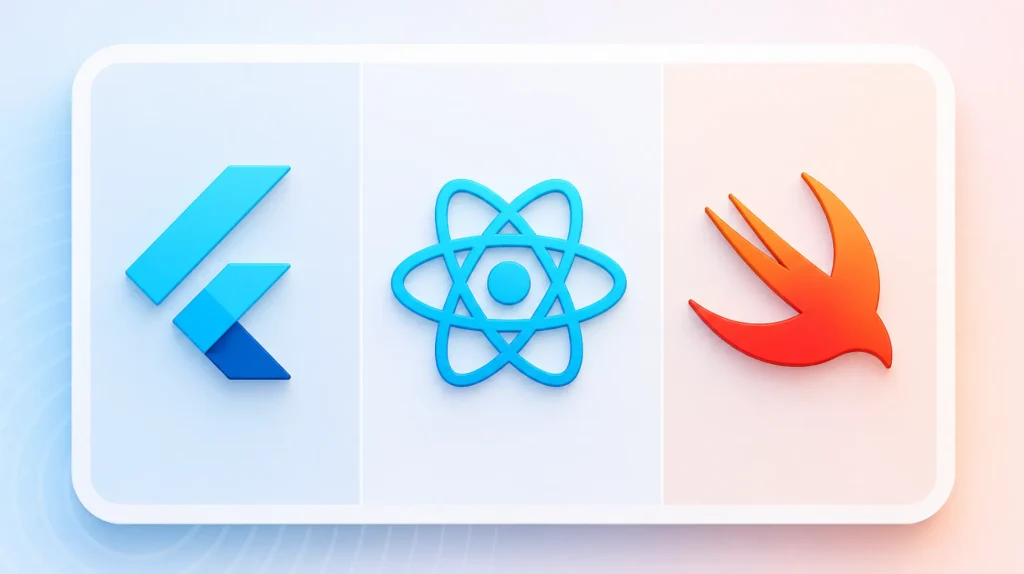
Blog Summary:
- The choice between Flutter, React Native, and Swift directly impacts app performance, development speed, and long-term scalability.
- Flutter offers the best overall balance for startups with fast development and strong cross-platform performance.
- React Native works best for JavaScript-based teams with faster hiring and strong ecosystem support.
- Swift delivers top-tier native performance but is ideal for iOS-only, high-end applications.
- The right choice depends on business goals, budget, and product roadmap rather than trends or popularity.
- Each framework solves a different problem, so selection should always start from product needs.
A single framework decision can determine whether your app scales smoothly, burns through your budget, or struggles to compete in an increasingly crowded market. Choose wisely, and you gain speed, flexibility, and room for growth. Choose poorly, and you’ll spend years paying for technical compromises.
That’s why the Flutter vs React Native vs Swift debate matters more than ever in 2026.
AI-powered experiences are becoming standard, development costs remain under pressure, and user expectations continue to rise. Businesses can no longer afford to Many businesses make the mistake of selecting a framework based solely on popularity or developer preference. The right choice depends on your goals, timeline, budget, performance requirements, and long-term product vision. Whether you’re building a startup MVP, a consumer-facing platform, or an enterprise application, understanding the strengths and limitations of each technology is essential.
Consulting an experienced react native app development company can also provide valuable insights into cross-platform feasibility, development efficiency, and future scalability. In this guide, we’ll compare Flutter, React Native, and Swift across performance, development speed, cost, scalability, and AI readiness to help you make the right investment for your next mobile app.
What’s Changed in 2026 and Why It Matters for Your Framework Decision
The competition between cross-platform mobile frameworks like Flutter and React Native has reshaped how teams build apps in 2026. According to the 2024 Stack Overflow Developer Survey, Flutter holds 46% market share among cross-platform frameworks, while React Native captures 35%, together accounting for more than 80% of the cross-platform development market. Swift, meanwhile, continues dominating premium iOS performance benchmarks, but at a steeper hiring and maintenance cost.
Three seismic shifts happened between 2024 and 2026 that changed this race entirely:
- Flutter’s Impeller rendering engine replaced Skia on iOS, delivering consistent 60–120 FPS performance with near-zero jank
- React Native’s New Architecture (Fabric + JSI + TurboModules) went fully production-ready, closing a long-standing performance gap
- Swift’s integration with Xcode 17 and Apple Intelligence APIs made it the undisputed choice for AI-native iOS apps — but only for teams that can afford it.
Understanding these shifts is table stakes before you compare frameworks. Let’s go deeper.
Flutter vs React Native vs Swift: Quick Overview
| Feature | Flutter | React Native | Swift |
| Created By | Meta (Facebook) | Apple | |
| Language | Dart | JavaScript / TypeScript | Swift |
| Development Type | Cross-platform | Cross-platform | Native iOS |
| Platform Support | iOS, Android, Web, Desktop, Embedded | iOS, Android, Web* | iOS, iPadOS, macOS, watchOS |
| Performance | Excellent (Near-Native) | Very Good | Best-in-Class |
| Development Speed | Fast | Fast | Moderate |
| Development Cost | Low | Low–Medium | High |
| AI Integration | Strong (Gemini, ML Kit, OpenAI APIs) | Strong (OpenAI APIs, AI SDKs) | Best (Apple Intelligence, Core ML) |
| Community | Large and Growing Rapidly | Very Large and Mature | Large iOS Developer Ecosystem |
| Maintenance Effort | Low | Medium | High |
| Hiring Availability | Growing Talent Pool | Highest Availability | Moderate Availability |
| Code Reusability | Up to 100% | Up to 90% | None |
| UI Approach | Custom Widget System | Native UI Components | Native UIKit / SwiftUI |
| Best For | Cross-Platform Business Apps | JavaScript-Based Teams | Premium iOS Applications |
| Time to Market | Fastest | Fast | Slower |
| Scalability | Excellent | Very Good | Excellent |
| Learning Curve | Moderate | Easy for JavaScript Teams | Moderate |
| Long-Term Flexibility | Excellent | Very Good | Limited to Apple Ecosystem |
Quick Recommendation
| If You Need | Recommended Framework |
| The Best Mobile App Framework in 2026 for Most Projects | Flutter |
| The Fastest Cross-Platform Development | Flutter |
| The Largest Hiring Pool | React Native |
| Best Framework Performance-Wise | Swift |
| Best Framework for Startups | Flutter |
| Deep Apple Ecosystem Integration | Swift |
| Lower Development and Maintenance Costs | Flutter |
| Native iOS Excellence | Swift |
What is Flutter?
Flutter is no longer the scrappy newcomer it was in 2018. Google’s open-source framework has grown into a serious production-grade tool, and the numbers back that up. It wins 7 out of 10 performance benchmarks against React Native and cuts development and maintenance costs by 35–60% compared to building native on both platforms separately.

What makes Flutter genuinely different is its rendering model. Unlike React Native, which bridges to native UI components, Flutter draws every pixel itself using its own Impeller rendering engine. That sounds like a technical nuance, but it’s actually the reason your Flutter app looks identical on a Samsung Galaxy and an iPhone 15 Pro. No platform-specific UI drift. No “this button looks weird on Android” bug reports.
Examples of Flutter Apps in Production
Don’t take Google’s word for it. Here are real-world deployments that carry billions of daily interactions:
| Company | App | Why Flutter |
| Google Pay | Consistent UI across 40+ countries | |
| BMW | Connected Car App | Performance + custom UI control |
| Alibaba | Xianyu (Flea Market) | Scale + single codebase |
| eBay | eBay Motors | Faster shipping across iOS & Android |
| Hamilton Musical | Official App | Pixel-perfect brand UI |
Advantages of Flutter
- Single Dart codebase deploys to iOS, Android, web, desktop, and embedded platforms.
- The Impeller engine delivers smooth performance and supports 120 FPS on compatible devices.
- Hot reload dramatically reduces development and testing cycles
- Access to 35,000+ packages through the pub.dev ecosystem
- Strong AI integration through Google’s ML Kit and Gemini APIs
- Consistent UI and user experience across platforms
- Lower development and maintenance costs compared to separate native applications
Disadvantages of Flutter
- Dart has a smaller talent pool compared to JavaScript and TypeScript
- Teams may require additional training before adopting Flutter
- Flutter applications include their own rendering engine, resulting in larger app sizes
- Platform-specific functionality may occasionally require native development expertise
- User interfaces may not feel as natively iOS as SwiftUI-based applications
Read More: What is Flutter? Overview, Features, and Working Process
What is React Native?
React Native is the framework people keep predicting will die, and it keeps refusing to. In 2026, it powers apps used by over 2 billion people daily, including Facebook, Instagram, and Microsoft Teams. That’s not a small footnote. That’s market proof.
The reason React Native persists is simpler than most think: JavaScript developers are everywhere. The JavaScript talent pool is 3–4x larger than Dart in North America. If your team already builds in React, React Native isn’t a new framework. Its familiar syntax pointed at a new target. That familiarity translates into faster onboarding, lower hiring costs, and reduced long-term learning overhead.
The New Architecture, fully production-stable as of 2025, was a genuine turning point. The old bridge model, where JavaScript and native code communicated asynchronously, created real performance challenges for heavy animations and complex gestures. JSI eliminates that bridge, while TurboModules reduce native module initialization overhead. Combined with Hermes V1, now the default engine in React Native 0.84, the framework delivers faster startup performance and improved runtime efficiency.
Unlike Flutter’s fully custom rendering approach, React Native now uses Fabric to modernize rendering and UI synchronization through native platform rendering layers, including UIKit on iOS and Jetpack Compose integration on Android.
The result? In 2026, React Native handles 80–90% of business app use cases without compromise.
React Native in 2026 is not the same framework as it was in 2018. But it remains not fully native. – StudioKrew iOS Development Analysis, March 2026
Examples of React Native Apps
Here are real-world products using React Native at scale:
| Company | App | Why React Native |
| Meta | Shared development across platforms | |
| Meta | Faster feature delivery | |
| Microsoft | Teams | Cross-platform collaboration |
| Shopify | Shop App | Rapid product iteration |
| Discord | Mobile App | Faster release cycles |
Advantages of React Native
- JavaScript and TypeScript reduce onboarding friction
- Large global developer ecosystem
- Faster hiring and team expansion
- Shared logic across iOS and Android
- Fabric renderer improves UI responsiveness
- Hermes V1 improves startup speed and runtime efficiency
- JSI + TurboModules reduce native communication overhead
- Access to more than 2 million npm packages, including 6,600+ React Native-specific packages
- Lower development cost than separate native applications
Disadvantages of React Native
- Performance still trails fully native development in demanding use cases
- Complex animations may require native optimization
- Dependency on third-party packages for some functionality
- Large applications may require additional architectural planning
- Platform-specific code is still necessary in some scenarios
- Long-term package maintenance quality can vary across community libraries
Read More: Flutter vs. React Native: Which One is the Best for Your Project?
What is Swift?
Let’s be direct. Swift is the best way to build an iOS app. Full stop. Nothing in this comparison delivers what native Swift development does when you need peak performance, deep system integration, or access to Apple’s latest capabilities the moment they ship.

Swift’s advantages aren’t abstract. They’re architectural. When your app runs in Swift, it compiles directly to native machine code. There’s no rendering engine, no JavaScript bridge, no translation layer between your code and the device’s silicon. You talk directly to the A18 chip. You get Apple Intelligence APIs on day one. You get SwiftUI’s latest components without waiting for third-party package maintainers to catch up.
The average annual salary for a Swift developer in the United States is $123,994 as of 2026, and senior iOS developer total compensation typically runs around $129,523 annually when bonuses and profit sharing are included. That’s not cheap. For startups with tight budgets, maintaining two separate native codebases (Swift for iOS, Kotlin for Android) can easily double your engineering costs compared to a single Flutter codebase.
When Does Swift Actually Make Sense?
| Use Case | Swift the Right Call? | Why |
| AR/VR apps (ARKit, RealityKit) | Yes | Direct hardware access needed |
| Apple Intelligence AI integrations | Yes | Day-one API access, deepest hooks |
| High-frequency trading/fintech | Yes | Zero-latency, no bridge overhead |
| Casual consumer app (both platforms) | No | Flutter/RN more cost-effective |
| Games with complex physics | Yes | Metal GPU access is unmatched |
| Enterprise cross-platform tool | No | Cost of maintaining two codebases |
| Premium iOS-only subscription app | Yes | iOS-first revenue optimization |
| MVP / early-stage startup | No | Time and cost overhead too high |
The stat that should shift your perspective: iPhone market share sits at 57% in the USA, 55% in Australia, and 51% in the UK according to Statcounter 2025 data. If your primary market is the US, and your app targets premium consumers willing to pay for quality. Swift’s higher development cost might pay for itself in conversion and retention.
Swift’s non-negotiables in 2026:
- Apple Intelligence integration: Siri Actions, Writing Tools, on-device summarization
- SwiftData and CloudKit: Apple’s native persistence and sync stack
- Metal API: Direct GPU access for graphics-intensive applications
- ARKit / RealityKit / visionOS: No cross-platform framework matches this
- HealthKit deep integration: Critical for medical and fitness apps
The Performance Numbers You Actually Need to See
Performance comparisons are meaningless without context. Benchmarks only matter if they reflect real application behavior. Here’s how Flutter, React Native, and Swift compare across scenarios that actually impact user experience in 2026.
| Performance Metric | Swift | Flutter | React Native |
| Startup Time (Cold Launch) | Fastest | Fast | Slightly Slower |
| Complex Animations | Excellent | Excellent | Very Good |
| List Rendering (Large Datasets) | Excellent | Very Good | Good |
| Average Memory Usage | Lowest | ~145 MB | ~120 MB |
| UI Blocking During Computation | None | None | Possible (Significantly Reduced with JSI) |
| On-Device AI / ML Inference | Excellent | Very Good | Good |
| 120Hz ProMotion Support | Native Support | Supported via Impeller | Supported with Additional Optimization |
| GPU Access | Direct Metal Access | Limited | Limited |
| Heavy Background Processing | Excellent | Very Good | Good |
| Native Hardware Integration | Full Access | Moderate | Moderate |
| Performance Consistency Across Devices | Excellent | Excellent | Very Good |
Mobile Development Stack Comparison: Cost Breakdown
This is the conversation most comparison articles avoid. Let’s have it.
| Cost Factor | Swift (iOS Only) | Flutter (Both Platforms) | React Native (Both) |
| Avg US developer hourly rate | $73–$96/hr | $55–$85/hr | $50–$80/hr |
| Codebase maintenance | High (2 repos for iOS+Android) | Low (1 repo) | Low-Medium (1 repo, some platform code) |
| Time to MVP (simple app) | 3–4 months | 2–3 months | 2–3 months |
| Cost reduction vs native (both platforms) | Baseline | 35–60% savings | 30–50% savings |
| Hiring availability (US market) | Moderate | Growing | High |
| Long-term maintenance cost | Highest | Lowest | Medium |
For most businesses in 2026, Flutter cuts development and maintenance costs by 35–60% compared to native builds. That’s not a rounding error; that’s the difference between a profitable product and a budget overrun.
The Decision Framework: Which One Should You Actually Choose?

Stop agonizing. Use this.
Choose Flutter if:
- You’re launching on both iOS and Android simultaneously
- Budget efficiency is a core constraint
- You need pixel-perfect, brand-consistent UI across platforms
- Your team can invest in Dart, or you’re working with a Flutter agency
- You’re building for markets beyond the US where Android dominates
Choose React Native if:
- Your team has strong JavaScript/React expertise already
- You need an authentic native iOS feel with real UIKit components
- You’re maintaining existing React Native codebases
- Your app integrates deeply with web systems your team already owns
- Hiring JS talent quickly in the US market matters
Choose Swift if:
- You’re building iOS-only, and performance is non-negotiable
- You need day-one Apple Intelligence API access
- Your app uses ARKit, RealityKit, Metal, or HealthKit deeply
- You’re operating at 10M+ users where platform optimization justifies the cost
- You’re targeting premium US/UK/Australian iOS users, and revenue-per-user is your primary metric
Real Talk: What Most Developers Get Wrong
Here’s something nobody writes about. Most developers choose a framework based on familiarity, not fit. A JavaScript developer reaches for React Native because Dart feels foreign. A Flutter advocate pushes Flutter into a fintech project that actually needed Swift’s precision. A startup founder chooses Swift for a cross-platform MVP because it “sounds more professional.”
All three are expensive mistakes.
The right question isn’t “Which framework is best?” The right question is “Which framework is best for this team, this product, and this budget?”
For new projects starting from scratch with a development agency, Flutter is the recommended choice for 90% of business apps. But choose React Native if your team already lives in JavaScript. And choose Swift only when platform depth genuinely earns back its premium cost.
How Cubix Helps Businesses Choose the Right Mobile Framework
Cubix, a mobile app development company with over 15+ years of experience, helps businesses choose the right framework that aligns with both immediate delivery goals and long-term product growth.
Choosing between Flutter, React Native, and Swift is more than a technical comparison. It’s a decision that shapes how fast your product ships, how well it performs under real usage, and how easily it can evolve as your business grows. The right choice depends on your goals, timeline, budget, user expectations, and long-term product roadmap.
At Cubix, framework selection begins with understanding the product vision before any code is written. Each project is evaluated based on:
- Business goals and growth direction
- Performance needs and scalability expectations
- Cross-platform vs native experience requirements
- AI readiness and future integration possibilities
- Development speed and release priorities
- Long-term maintenance and product evolution
Whether the goal is launching an MVP quickly, making the most of your development investment, or crafting a premium mobile experience, Cubix draws on industry experience to guide businesses toward a framework that delivers immediate results while staying aligned with future growth.
Great mobile products start with the right technology decisions. Choosing the right framework early creates speed, flexibility, and better outcomes later.
— Salman Lakhani, CEO at Cubix
Final Verdict
In 2026, the Flutter vs React Native vs Swift debate has a cleaner answer than ever before, but only if you’re honest about your constraints.
Flutter wins for most new cross-platform builds. React Native wins for JavaScript-native teams and apps needing authentic platform UI. Swift wins when you’re building something that demands everything Apple’s hardware can give.
Pick the framework that fits your team’s existing skills, your product’s platform requirements, and your budget’s reality. Not the one with the most impressive benchmark chart. That’s how you build apps that actually ship, and actually last.
Frequently Asked Questions
1: Which mobile app development framework offers the best performance and user experience for startups?
Flutter is best for most startups due to strong performance and fast development. React Native suits JavaScript teams, while Swift is ideal for high-performance, iOS-only apps requiring deep system integration.
2: Is Flutter faster than React Native?
Yes, in most cases Flutter delivers smoother UI performance because it uses its own rendering engine, while React Native depends on native UI components and a JavaScript bridge (though improved in newer architecture).
3: When should I choose Swift instead of cross-platform frameworks?
Choose Swift when you are building iOS-only apps that need deep Apple ecosystem integration, high-performance graphics, or access to features like ARKit, HealthKit, or Apple Intelligence APIs.
4: Is React Native still relevant in 2026?
Yes. React Native remains widely used due to its large JavaScript ecosystem, faster hiring pool, and strong improvements with its New Architecture (Fabric, JSI, TurboModules).
5: Which framework is cheapest for app development?
Flutter is often the most cost-effective option because it uses a single codebase for both iOS and Android, reducing development and maintenance costs. An experienced android app development company can help determine the most budget-friendly choice for your project.
6: How do app development costs compare across Flutter, React Native, and Swift platforms?
- Flutter: Usually the most cost-efficient for new cross-platform apps since one codebase works for both iOS and Android, reducing development time and maintenance effort.
- React Native: Also cost-effective, especially for JavaScript teams, but complex features may require native modules, which can add extra development effort.
- Swift: The most expensive option for full app development since it is iOS-only. Building for Android requires a separate Kotlin app, increasing total cost and timeline.
In short: Flutter is typically the most balanced for cost savings, React Native is efficient for existing JS teams, and Swift is best for premium iOS apps with higher investment.