This is a question that all the founders have to answer early on. Should you develop the product or test it first? MVP development for startups provides an answer to that question. It allows you to start a functional version of your product with as few features as possible, allowing you to gain experience and learn quicker, at lower cost.
The numbers illustrate why this is important. Based on CB Insights’ analysis of 431 startups that failed during the venture-backed life cycle, poor product-market fit (PMF) accounts for 43% of the failures.
If you’re looking for MVP development services, Cubix can be the right choice. MVP is developed through project structuring, design of the user-friendly interface and user experience, and development through the Agile process. We get our hands dirty in developing the product that will allow founders to validate their idea, attract investors, and scale.
This guide explains how you can create an MVP without breaking the bank. You’ll receive a detailed process, practical cost considerations and a checklist to have before the launch day.
What is MVP development? And why is it important for startups

A Minimum Viable Product (MVP) is a product with the minimum features to address a genuine problem. It is not a draft! It is not a demo. Rather, it’s a workable product that offers sufficient features to add value and receive feedback. This is a strategy that can be used by any startup, from any stage of funding and from any industry.
An MVP isn’t a prototype. A prototype is a model of a product that has not yet been mass-produced. An MVP is a thing that doesn’t work IF he/she doesn’t do one thing well, but it does work IF he/she does one thing well.
Here is what an MVP is not:
- A half finished app with bugs
- A feature list you plan to build later
- A polished product without real user testing
Why Startups Need MVP Development First

Startup MVP development exists to reduce risk. You test your idea with real users before you commit serious money. This approach protects your runway. It also gives you evidence, not guesses.
Numbers prove this point. Data from the Bureau of Labor Statistics reveal that 20.4% of new U.S. businesses fail within their first year The percentage increases to 49.4% after five years. Delving into the reasons gives more insight into this matter. In fact, the study by CB Insights of 431 venture-backed companies reveals that Product-Market Fit (PMF) is the reason for 43% of business failures.
MVP development gives you a way to avoid that outcome. You build the smallest version first. Then you test it with your target audience. Only after that do you decide whether to scale. Minimum viable product development, in other words, tests Product-Market Fit with a real, working product instead of a guess.
Common Reasons Startups Overspend on MVPs (and How to Avoid It)
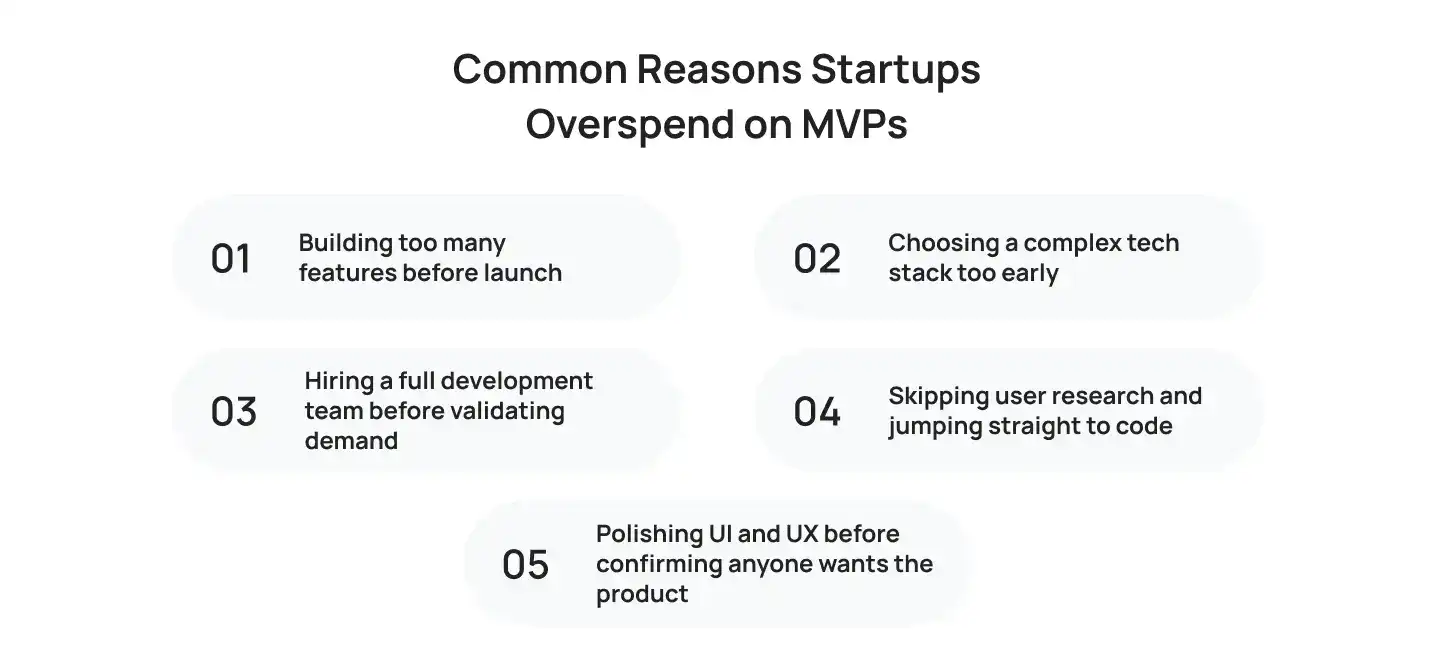
Most overspending happens before a single user sees the product. Founders fall into predictable traps. Each one adds cost without proving the idea works. These mistakes delay your launch. As a result, you spend more money before you get the one thing that actually matters: real user feedback.
- Building too many features before launch
- Choosing a complex tech stack too early
- Hiring a full development team before validating demand
- Skipping user research and jumping straight to code
- Polishing UI and UX before confirming anyone wants the product
Want to discuss your project? Our experts are just a click away.
Contact UsHow to Build MVP: A Step-by-Step Guide for Startups
MVP development for startups follows a repeatable process. Founders who skip steps usually pay for it later. Sometimes it costs wasted development time. Other times it costs a product nobody wants.
This process is reflective of lean startup thinking. Build, measure, learn, and repeat until the product fits the market. After you learn how to build an MVP this way, every product decision from here will be easier
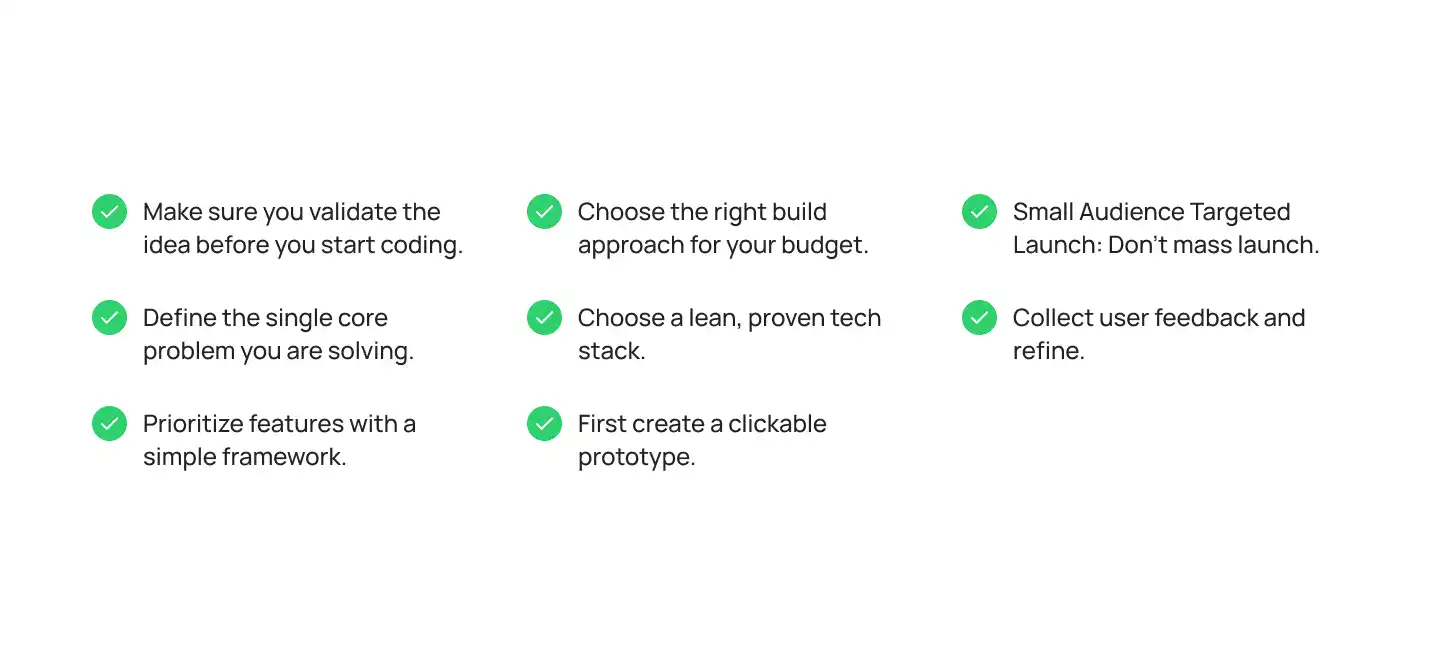
- Make sure you validate the idea before you start coding. Speak with potential users. Run a simple landing page test. Send a brief survey. You need proof of demand before you build anything.
- Define the single core problem you are solving. Choose one problem and solve it. All else can wait.
- Prioritize features with a simple framework. Use MoSCoW (Must have, Should have, Could have, Won’t have) or RICE (Reach, Impact, Confidence, Effort) to separate essential features from nice to haves.
- Choose the right build approach for your budget. No-code tools, freelancers, and agencies all offer different tradeoffs. Below we compare these.
- Choose a lean, proven tech stack. Boring, reliable technology beats trendy tools in MVP software development. Leave the experimenting till later.
- First create a clickable prototype. Test the flow with tools such as Figma before you write production code. This step provides a cheap early identification of usability problems.
- Small Audience Targeted Launch: Don’t mass launch. Release to a focused group that represents your ideal customer.
- Collect user feedback and refine. See what they use, what they avoid, and what confuses them. Then update the product roadmap based on actual behavior, not assumptions.
MVP Development Approaches: Which One Fits Your Budget?
Different build approaches suit different founders. Your choice depends on technical skill, timeline, and how much capital you have to spend.
| Approach | Best For | Typical Cost | Typical Timeline |
|---|---|---|---|
| No-code or low-code | Non-technical founders, simple apps | $2,000–$10,000 | 2 to 6 weeks |
| MVP development company | Startups needing speed and expertise | $15,000–$75,000+ | 6 to 12 weeks |
| In-house small team | Long-term product ownership | $80,000–$250,000+ per year | 3 to 6 months |
| Freelancers | Tight budgets, simple MVPs | $5,000–$25,000 | 4 to 8 weeks |
No-code platforms are a good alternative for early stage founders. Enterprise low-code spending increased 31% year over year in 2025, compared to only 8% growth for overall IT spending in the same period. It’s growth that proves how many teams now see no-code as a real way to get a working product, not just a shortcut.
Selecting the Right Tech Stack for a Lean MVP
Your MVP does not require cutting edge technology. It needs tech that is quick to build, easy to hire for, easy to maintain.
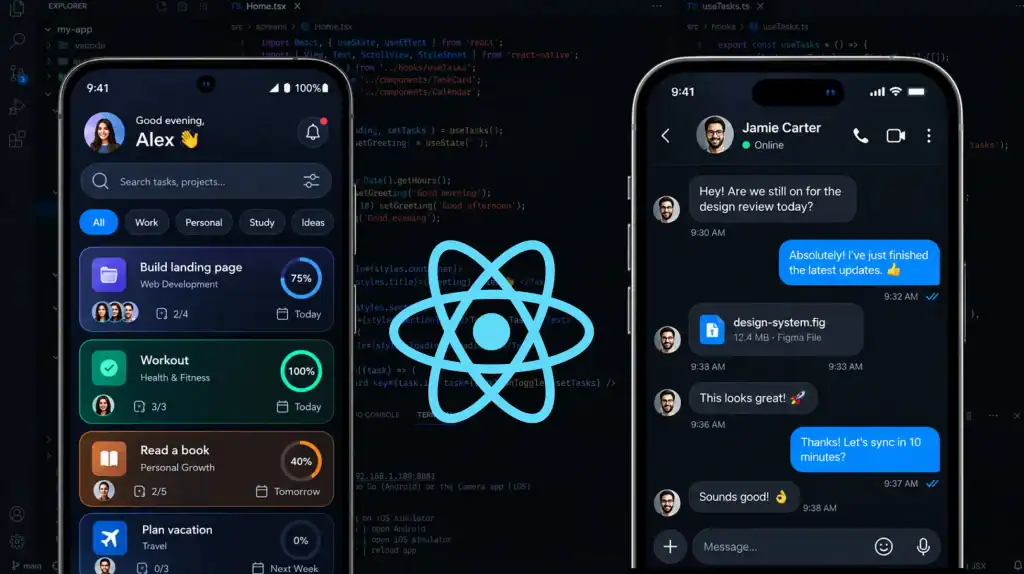
Many non-technical founders tend to choose no-code platforms like Bubble to build their MVP app. But if you are a team looking for more flexibility, a popular choice is React with a backend like Firebase or Node.js. Both options allow you to move fast without making a lot of investment in infrastructure that you don’t need now.
This is where the line between a prototype, and software development starts to blur. A good MVP tech stack means you can build fast today, and add complexity later on, without a complete rebuild.
Base your stack decision on these factors:
- Speed of development,
- We have developers familiar with the stack.
- Cost of hosting and maintenance
- Scalability in the future, without a full re-implementation
Read our blog to understand how to Develop an MVP in Less Than a Month.
How Much Does MVP Development For Startups Really Cost?
Cost depends heavily on scope, platform and who builds the product. However, a few factors consistently drive costs up.
An MVP with a narrow scope, built with no-code tools or a small freelance team, is often far less expensive than a fully custom build. Agencies and MVP development companies are in the middle, they offer more structure and expertise, but at a higher price than solo freelancers.
| MVP Type | Typical Cost Range | Best For |
|---|---|---|
| No-code MVP | $5,000 to $20,000 | Quick validation, non-technical founders |
| Simple custom MVP | $10,000 to $30,000 | Single core feature, one platform |
| Mid-complexity MVP | $30,000 to $80,000 | Multiple features, user accounts, integrations |
| Complex or AI-enabled MVP | $80,000 to $150,000+ | Compliance needs, AI features, multi-platform builds |
A tightly scoped MVP costs far less than a fully custom build. No-code tools and lean freelance teams keep that cost down. Agencies and MVP development companies sit in the middle. They offer more structure and expertise, at a higher price than solo freelancers.
MVP Budget Mistakes You Should Avoid From The Beginning
Even founders who understand the process still make costly errors. Watch for these patterns during startup product development. Avoiding these mistakes keeps your budget intact and your timeline realistic.
- Adding features because a competitor has them, not because users asked for them
- Skipping the prototype step and building directly into production
- Ignoring early user feedback because it contradicts the original plan
- Choosing a tech stack based on hype instead of team skill and project needs
- Treating the MVP as the finished product instead of a learning tool
Your Pre-Launch MVP Checklist: Are You Ready to Ship?
Before you launch, run through this checklist to confirm you are ready:
- Core problem clearly defined
- Single key feature identified and built
- Tech stack chosen for speed, not scale
- Prototype tested with real users
- Budget and timeline locked in
- Feedback collection process in place
- Product roadmap ready for post-launch updates
How Cubix Approaches Agile and Design for MVP Development for Startups
Cubix moves into agile development sprints after discovery. Instead of disappearing for months, the team ships working increments. It gathers feedback and adjusts direction as needed. This keeps founders involved. It also gives them room to pivot before spending on features nobody wants.
Cubix brings in-house UI/UX Design expertise too. Your MVP will not feel like a rough draft. Users get a clean, usable product, even in its earliest version. That matters, because a confusing MVP produces unreliable feedback.
How Cubix Handles MVP Development for Startups
The team builds MVPs for startups, for business, for organizations, for agencies, and for studios. It has shipped products across healthtech, fintech, and logistics. You might need a mobile app, a web platform, or a hybrid product. Either way, Cubix scopes the build to match your budget and timeline, not the other way around.
If you want an MVP development company with a track record of shipping fast, Cubix offers a structured path from idea to launch.
Want to discuss your project? Our experts are just a click away.
Contact UsFinal Thoughts
MVP development for startups is not about taking shortcuts. It’s about spending money on the right things, in the right order. First, validate. Build the smallest thing that validates your idea. Then let real user feedback tell you what to do next.
Founders who follow this process avoid the two biggest startup killers: running out of cash, and building something nobody wants. Build a little, ship a little, and let your users tell you what to do next.
Frequently Asked Questions
1. How does the 80/20 rule apply to startups?
The 80/20 rule or Pareto Principle suggests that 80 percent of the results you produce come from just 20 percent of your actions. Therefore, for startups it is important to focus on the core features of the product that bring the maximum value for users.
2. How to Make an MVP for Your Startup?
First, what is the big problem your product will solve? Second, who is your target audience? Build a prototype and define the necessary features. Create the MVP, deploy it to the first users and get their feedback to improve the product.
3. Do 90 percent of startups fail?
Various studies have proven that the majority of the startups (roughly 90 percent) fail due to various reasons including bad product-market fit, no funding, bad marketing, and product development which fails to meet customers’ needs.
4. How long does it take to create an MVP?
Most of the MVPs take anywhere from four to twelve weeks to be developed depending on the platform used, complexity of the product, and the team selected. No-code platforms would develop MVP faster compared to the custom development through an MVP development company.
5. What does an MVP development cost?
This depends on how big the project is and which build option you choose. An MVP done using a no-code platform will be much cheaper compared to the custom build. Factors that would determine cost here include design, scope of work, and mobile application development.
6. Do I need a tech team to create an MVP?
No. No-code and low-code platforms allow entrepreneurs to create their MVP without having a tech team at all. Yet some complex products will require the help of an MVP development company or experienced freelancers.
7. How do you distinguish a prototype from an MVP?
A prototype shows how a product should be, using a clickable model with zero functionality. An MVP, on the other hand, is a fully functional product for real users to use. First comes the creation of the prototype, which, after some testing will evolve into MVP.
8. What role does MVP play in Product-Market Fit?
Using MVP, you put a real product to the test of real users, thus proving if users need something that was built for them. In other words, MVP takes Product-Market Fit from the world of assumptions to a measurable reality.