Key Takeaways
- React Native mobile app development lets you build for iOS and Android from a single JavaScript and TypeScript codebase, cutting development time significantly.
- As of 2026, React Native powers apps at more than 18,800 companies worldwide, according to Landbase.
- The framework’s new architecture, built on Fabric, JSI, and TurboModules, has pushed performance much closer to fully native apps.
- React Native suits most consumer and business apps well, but performance-heavy apps like games or apps needing deep hardware access may still need native code.
- Before you commit, weigh your app’s complexity, performance needs, security requirements, and your team’s existing skills.
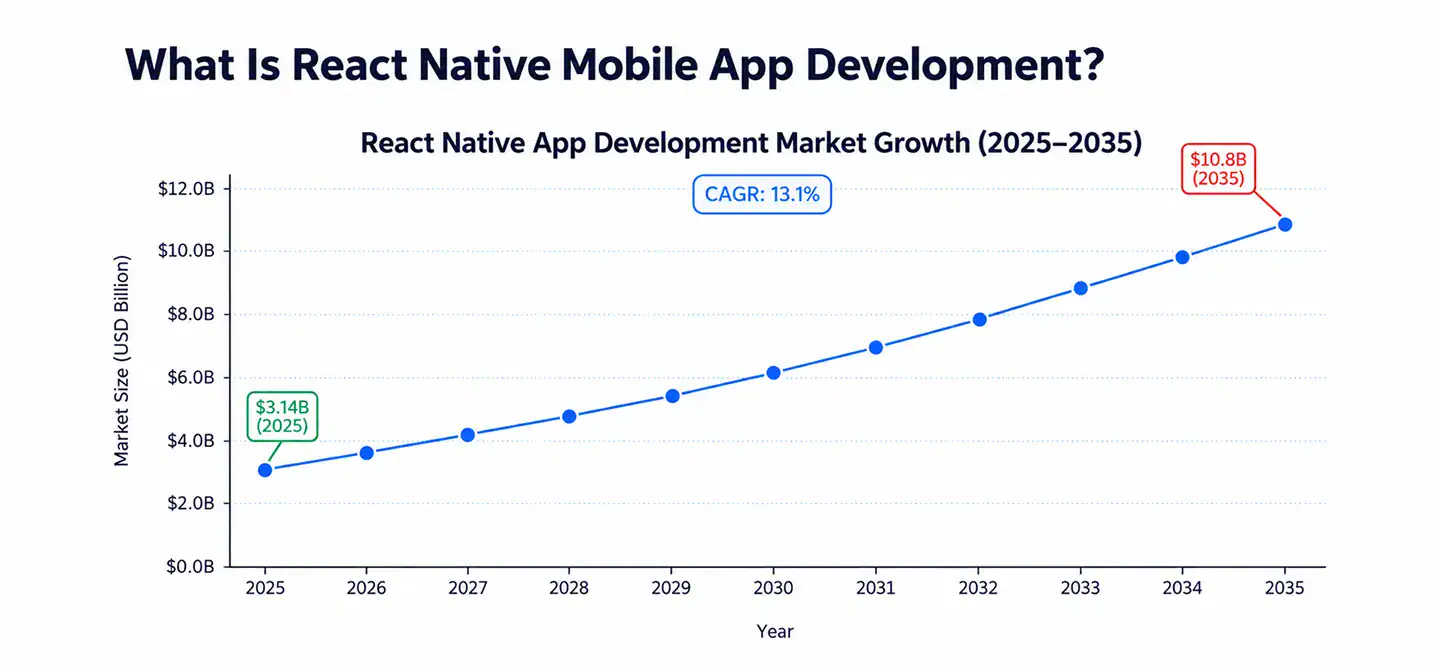
Choosing the right framework can make or break your app’s timeline and budget. That’s why so many businesses turn to React Native mobile app development when they need to launch on iOS and Android without doubling their engineering costs.The growing market reflects this demand. The React Native app development market was valued at USD 3.14 billion in 2025 and is projected to reach USD 10.8 billion by 2035, growing at a CAGR of 13.1%.
React Native lets you write one codebase and ship it across both major platforms. It combines the speed of JavaScript with near-native performance, which is why companies like Meta, Shopify, and Discord rely on it for production apps used by millions of people every day.
In this guide, you’ll learn exactly why React Native mobile app development has become the go-to option for startups and enterprises alike. We’ll cover the 11 biggest reasons to choose it, compare it against native development, and walk through the factors you should evaluate before committing to it.
Want to discuss your project? Our experts are just a click away.
Contact UsWhat Is React Native Mobile App Development?
React Native mobile app development is the process of building mobile apps using React Native, an open-source framework created by Meta. It lets developers write app logic once in JavaScript or TypeScript and deploy it to both iOS and Android.
Unlike hybrid frameworks that wrap a website inside a native shell, React Native renders real native UI components. Your buttons, lists, and navigation elements are actual native controls, not web elements dressed up to look native.
Here’s how it works under the hood:
- JavaScript thread: Runs your app’s business logic and React component tree.
- Native thread: Handles rendering, gestures, and platform APIs.
- Bridge or JSI: Connects the two so your JavaScript code can talk to native modules.
If you’re weighing this approach against other options, our cross-platform app development guide breaks down how React Native stacks up against Flutter, Xamarin, and other frameworks in more detail.
Why Choose React Native for Mobile App Development?
Businesses do not choose a framework because it is trendy. They choose it because it solves real problems tied to budget, speed, talent, and long-term maintenance.
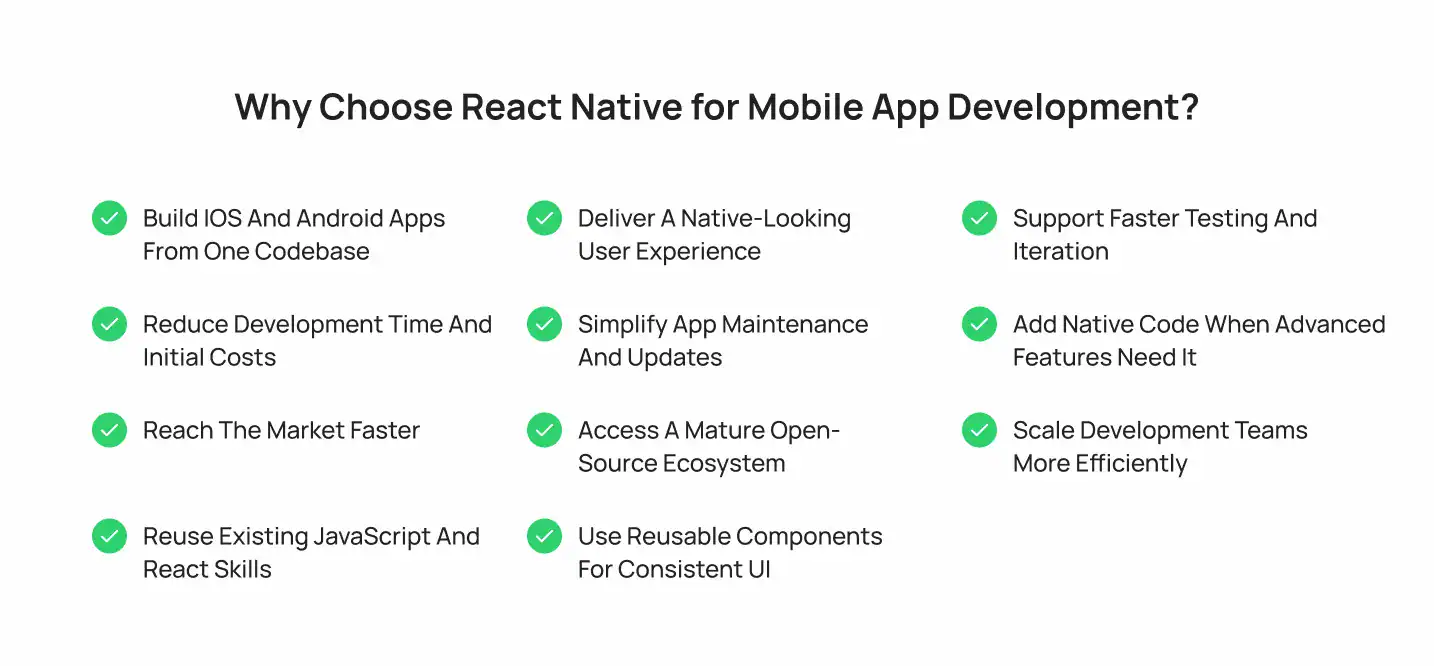
Below are 11 reasons why React Native mobile app development consistently wins over building two separate native apps, plus clear guidance on when another stack may fit better.
1. Build iOS and Android Apps From One Codebase
This is the main reason most teams choose React Native. Instead of maintaining a Swift codebase for iOS and a Kotlin codebase for Android, you write most of your app once.
- Shared business logic reduces duplicate bugs across platforms
- UI components can be reused with minor platform-specific tweaks
- Updates roll out to both platforms at the same time
Teams that need dedicated platform expertise for specific features can still pair React Native with specialists, such as an Android application development team or an iOS app development company, for the native pieces that need extra polish.
2. Reduce Development Time and Initial Costs
These React Native benefits make the framework especially attractive to businesses that need to control costs while launching on multiple platforms.
Industry analyses estimate that adopting React and React Native can cut development costs by up to 40 percent compared to building fully separate native apps, with typical time-to-market improvements of 30 to 50 percent for MVPs. Your actual React Native development cost will still depend on app complexity, features, integrations, design requirements, and the development team’s location.
3. Reach the Market Faster
Speed matters, especially when you are racing a competitor or trying to validate an idea before funding runs out. Because you are not building two apps in parallel, your team ships features to both platforms at once.
Faster releases also mean shorter React Native development time. You learn what users actually want sooner, and you can adjust course before you have sunk months into features nobody uses.
If you want a clearer picture of what a typical build timeline looks like, our breakdown of the mobile app development process walks through each phase from planning to launch.
4. Reuse Existing JavaScript and React Skills
If your team already knows JavaScript, TypeScript, or React for web development, the learning curve for React Native is short. Developers do not need to learn Swift and Kotlin from scratch just to ship a mobile app.
This matters more than it might seem. JavaScript remains one of the most widely known languages among developers, so hiring and onboarding stay simpler than they would for a native-only team. React Native also has more job listings than Flutter in the US and Canada, reflecting strong demand for RN-skilled engineers.
5. Deliver a Native-Looking User Experience
React Native does not render a webview dressed up as an app. It renders actual native UI components, so your app looks and feels like it belongs on the device it is running on.
- Animations run through the native rendering engine
- Navigation transitions match platform conventions
- Touch response feels immediate, not delayed by a web layer
With the New Architecture (JSI, Fabric, TurboModules), React Native now achieves near-native performance for standard UIs and complex interactions, closing most of the historical performance gap with fully native apps.For most business applications, React Native performance is strong enough to support responsive interfaces, animations, and complex user interactions without requiring a fully native build.
6. Simplify App Maintenance and Updates
React Native maintenance is generally simpler because you manage one shared codebase instead of two. When you fix a bug or ship a new feature, you typically do it once instead of twice.
- Bug fixes apply to both platforms simultaneously in most cases
- Dependency updates happen in one place
- QA teams test one core logic layer instead of duplicating effort
This lowers the long-term cost of ownership, which matters just as much as the upfront build cost, especially for apps you plan to support for years.
7. Access a Mature Open-Source Ecosystem
React Native has been in production use since 2015, and its ecosystem has matured significantly since then. As of 2026, more than 18,800 verified companies use React Native across industries including finance, retail, and software services.
That kind of adoption means:
- A large library of pre-built packages for common features like payments, maps, and push notifications
- Active community support on GitHub and Stack Overflow
- Frequent updates from Meta’s core React Native team and the broader ecosystem
8. Use Reusable Components for Consistent UI
React Native’s component-based architecture means you build UI pieces once and reuse them across screens. A button, card, or form input built for one screen works on the next without rewriting it.
This keeps your app’s design consistent and cuts down on the time your design and development teams spend rebuilding the same elements over and over.
9. Support Faster Testing and Iteration
React Native ships with Fast Refresh, which lets developers see code changes in the running app almost instantly, without a full rebuild. That single feature changes how quickly a team can iterate.
- Developers test UI changes in seconds instead of minutes
- QA can validate fixes faster during active sprints
- Product teams can prototype and demo features earlier in the cycle
Combined with Hermes, the JavaScript engine built specifically for React Native, apps also start up faster and use less memory on both iOS and Android.
10. Add Native Code When Advanced Features Need It
React Native does not lock you out of native development. When you need something React Native does not handle well out of the box, such as complex camera processing, heavy graphics, or specialized hardware access, you can write native modules in Swift, Kotlin, Java, or Objective-C and bridge them into your app.
This flexibility means you are not choosing between all React Native or all native. You get to use the right tool for each specific feature. Many teams building custom mobile app development projects take exactly this hybrid approach, using React Native for the bulk of the app and native modules for the parts that truly need them.
11. Scale Development Teams More Efficiently
Because React Native uses one shared codebase and a widely known language, it is easier to bring new developers onto a project without a long ramp-up period.
- A single team can support both platforms instead of hiring separate iOS and Android specialists
- New hires with React or JavaScript experience can contribute to mobile features almost immediately
- Contractors and agencies can staff projects faster since the talent pool is larger
A 2025 Statista survey of 500 enterprise mobile development teams found that 42 percent already used React Native in production, reflecting how comfortable large organizations have become staffing and scaling React Native teams.
React Native vs Native App Development : Comparison Table
Neither approach is universally better. The right choice depends on your app’s goals, budget, and long-term plans. Here’s how the two compare across the factors that matter most.
| Factor | React Native | Native Development |
|---|---|---|
| Codebase | One shared codebase for iOS and Android | Separate codebases for each platform |
| Development speed | Faster, since most code ships to both platforms at once | Slower, since each platform is built independently |
| Upfront cost | Lower, thanks to shared logic and smaller teams | Higher, due to two parallel development tracks |
| Platform-specific capabilities | Available through native modules when needed | Full, direct access to every platform API |
| Performance needs | Strong for most apps, near-native after New Architecture updates | Best for graphics-heavy apps, games, and AR/VR |
| Maintenance | Simpler, updates apply across both platforms | More complex, requires updates in two codebases |
| Best-fit app types | E-commerce, social, fintech, on-demand, MVPs | Games, AR/VR apps, apps needing deep hardware integration |
If you’re still deciding between the two approaches for your specific use case, our detailed comparison of hybrid vs. native app development covers additional trade-offs around performance and user experience.
It’s worth noting that React Native’s new architecture, built around Fabric, JSI, and TurboModules, has narrowed the performance gap considerably. Communication latency between the JavaScript and native layers dropped from roughly 16 milliseconds to under 2 milliseconds, and app startup times improved by close to 50 percent, according to a 2026 React Native guide. That shift means fewer apps actually need to go fully native just to hit acceptable performance.
Key Factors to Evaluate Before Choosing React Native
React Native fits most business apps well, but it’s not automatically the right call for every project. Run through these factors before you commit.
App Complexity and Feature Set
Simple to moderately complex apps, such as e-commerce, booking platforms, and social apps, run well on React Native. Apps with heavy 3D graphics, real-time video processing, or advanced AR features may need more native code or a fully native build.
Performance Requirements
Most business apps don’t need every millisecond of native performance. However, if your app depends on constant, complex animations or processes large datasets in real time, test performance early with a prototype before committing fully.
Third-Party Integrations
React Native’s ecosystem covers most common integrations, including payment gateways, analytics tools, and push notification services. Still, check that your specific vendors have maintained React Native SDKs before you build your architecture around them.
Security and Compliance
React Native app security can meet strict security and compliance requirements, including those required in fintech and healthcare, but this takes deliberate planning. You’ll need to handle secure storage, API authentication, and data encryption correctly, since React Native doesn’t manage these for you automatically. Teams building in regulated industries should also review common mobile app development challenges around compliance before locking in their architecture.
Long-Term Maintenance Strategy
Consider who will maintain your app after launch. React Native’s shared codebase generally means lower long-term maintenance costs, but you still need a plan for React Native version upgrades, since major version jumps sometimes require code changes.
Team Skills and Hiring Availability
If your existing team already knows JavaScript, TypeScript, or React, React Native is a natural fit. If you’re building a team from scratch, factor in that React Native developers are generally easier to find and hire than dedicated native specialists for both iOS and Kotlin.
Build Your Next Cross-Platform App With React Native
React Native cross-platform development gives you a practical way to launch on iOS and Android without doubling your budget or your team. It’s fast, backed by a mature ecosystem, and its new architecture has closed much of the performance gap with native apps.
That said, the framework works best when it’s applied to the right project, with the right architecture decisions made early. If you’re planning your next build and want an experienced partner, working with a mobile app development agency like Cubix can help you avoid costly missteps and get your app to market faster.
Whether you’re building an MVP or scaling an existing product, React Native remains one of the most efficient ways to reach both app stores without splitting your engineering resources in two.
Want to discuss your project? Our experts are just a click away.
Contact UsFrequently Asked Questions
1. What is React Native used for?
React Native is used to build mobile apps for iOS and Android from a single codebase. It’s commonly used for e-commerce apps, social platforms, on-demand services, fintech apps, and MVPs that need to launch quickly on both platforms.
2. Why should I choose React Native for mobile app development?
You should choose React Native mobile app development if you want to reduce development time and cost, reuse your existing JavaScript and React talent, and maintain one codebase instead of two. It’s a strong fit for most business apps that don’t require extremely graphics-heavy performance.
3. Is React Native really native?
React Native renders real native UI components instead of a webview, so the interface behaves like a true native app. However, some low-level logic still runs through a JavaScript layer, which is why it’s described as “near-native” rather than fully native.
4. Is React Native better than native app development?
Neither option is better in every scenario. React Native is generally faster and cheaper to build and maintain. Native development gives you the most direct access to platform APIs and the best performance for graphics-intensive apps like games.
5. Is React Native better than Flutter?
React Native vs Flutter comparisons usually come down to team skills and app requirements, not just popularity. React Native has a larger existing developer pool since it uses JavaScript and React, which many web developers already know. Flutter uses Dart and has gained ground quickly, with some 2026 estimates putting its developer market share at around 46 percent versus React Native’s 35 to 38 percent. The better choice depends on your team’s existing skills and your app’s specific requirements.
6. Does React Native reduce app development cost?
Yes, in most cases. Building one shared codebase instead of two separate native apps typically cuts total development costs, with some estimates showing savings of up to 40 percent compared to fully native development.
7. How much code can be reused in React Native?
Code reuse between iOS and Android typically ranges from 80 to 95 percent, depending on how much platform-specific logic your app needs. If you’re also building a web version with React Native Web, teams have reported sharing up to 70 percent of code between mobile and web products.
8. Can React Native handle complex or enterprise apps?
Yes. React Native powers production apps at large companies, including Shopify, Discord, and Microsoft. Its new architecture, including Fabric, JSI, and TurboModules, supports the performance and scalability that enterprise apps typically require.
9. What are the disadvantages of React Native?
React Native can require native code for advanced hardware features, graphics-heavy apps may still perform better fully native, and major version upgrades sometimes require code adjustments. It’s also worth budgeting extra QA time, since some bugs can behave differently across iOS and Android despite the shared codebase.
10. Should startups use React Native for an MVP?
Yes, React Native is a strong fit for most MVPs. It lets startups launch on both iOS and Android quickly, test their idea with real users, and iterate fast without maintaining two separate codebases.