Quick Answer: Enterprise mobile app development is the process of building custom software for internal business use, employee productivity, or customer-facing operations. It focuses on scale, security, and integration with existing enterprise systems. Unlike consumer apps, enterprise mobile applications prioritize data protection, automation, and long-term ROI over flashy design.
Key Takeaways
- Enterprise mobile app development is not the same as building a regular app. It solves business problems at scale.
- Success depends on clear planning, the right platform choice, and strong security from day one.
- API integration and cloud computing are the backbone of any modern enterprise mobile solution.
- Cost varies widely based on complexity, features, and the mobile app developers you choose to work with.
- Post-launch maintenance and ASO matter as much as the build itself.
- Choosing the right enterprise app development company can make or break your ROI.
Businesses run on mobile now. Employees expect apps that just work. Customers expect the same speed they get from consumer apps. This shift has a name: enterprise mobility. And it’s growing fast. The enterprise mobile application development market is projected to reach $303.56 billion by 2030>, growing at a 12.5% CAGR. That’s not a small trend. That’s a full-scale shift in how companies operate.
Think about your own workday. You check emails on your phone. You approve requests on the go. You track shipments from a tablet. None of this happens by accident. It happens because someone built the right enterprise mobile applications behind the scenes. Good enterprise apps remove friction. They turn slow, manual processes into fast, automated ones.
This guide breaks it all down. We’ll cover types of enterprise apps, must-have features, costs, security, and more.
Let’s get into it.
Want to discuss your project? Our experts are just a click away.
Contact UsWhat Is Enterprise Mobile App Development?
Enterprise mobile app development means building custom software for a business. Not for the public. For internal teams, partners, or specific customer groups. These apps solve specific problems. Think inventory tracking. Think sales dashboards. Think HR portals.
This is different from regular consumer app development. A consumer app chases downloads. An enterprise app chases efficiency. It needs to connect with your CRM, ERP, and other core systems. It needs to work offline in a warehouse with no signal. It needs to scale to thousands of employees at once.
Enterprise mobility management (EMM) spend hit $2.8 billion in 2023 alone. That number shows how seriously companies take mobile infrastructure now. It’s not a side project anymore. It’s core business strategy. If you want the basics of how the wider mobile app development process works before diving into enterprise-specific needs, that’s a good place to start.
Types of Enterprise Applications
Not all enterprise apps do the same job. Some manage people. Some manage inventory. Some manage money. Knowing the types of enterprise applications helps you plan the right build from day one.
| Type of Enterprise App | Primary Use | Example |
| CRM Apps | Manage customer relationships and sales pipelines | Field sales tracking apps |
| ERP Apps | Manage core business operations | Inventory and supply chain apps |
| HR & Workforce Apps | Manage employee data and scheduling | Leave management, payroll apps |
| Field Service Apps | Support on-site technicians and workers | Repair and maintenance apps |
| Business Intelligence Apps | Turn data into dashboards and reports | Executive reporting apps |
| Collaboration Apps | Support internal communication | Team messaging and project apps |
By platform type, business applications led with a 40.3% share of the enterprise mobile app development market in 2024. Field-service applications are catching up fast though. They’re growing at a 15.4% CAGR through 2030.
Deployment model matters too. Cloud-based solutions captured 68.3% of revenue share in 2024. That number keeps climbing. Enterprises want data they can access anywhere, not data locked inside a single office server. This is why cloud computing sits at the center of almost every modern enterprise mobile applications strategy today.
Why Do Enterprises Need Mobile Apps?
This is where enterprise mobility becomes real. Businesses don’t build apps for fun. They build them to fix broken processes. Manual approvals. Paper-based tracking. Disconnected teams. Mobile apps solve all of this through business process automation.
Here’s the bigger picture. The mobile enterprise application market itself is set to grow from $125.39 billion in 2025 to $141.83 billion in 2026. That’s a 13.1% jump in just one year. Enterprises are investing because the returns are real. Automation cuts errors. It saves time. It frees up staff for higher-value work.
This is also tied to enterprise digital transformation as a whole. Mobile apps are often the first visible piece of a larger transformation strategy. They give leadership real-time visibility. They give employees tools that actually help, instead of slowing them down. If you’re exploring where to start, our Enterprise App Development Services page breaks down how this typically works.
Must-Have Enterprise App Features
Good enterprise apps share common DNA. Certain enterprise application features aren’t optional. They’re the baseline. Skip them, and your app won’t hold up under real business use.
| Feature | Why It Matters |
| API Integration | Connects the app to CRM, ERP, and other core systems |
| Cloud Computing Support | Enables scalability and remote data access |
| Offline Functionality | Keeps the app usable in low or no connectivity |
| Role-Based Access Control | Restricts data access based on user roles |
| Push Notifications | Keeps teams updated in real time |
| Analytics Dashboard | Turns raw data into decisions |
| Multi-Device Support | Ensures consistency across phones and tablets |
API integration deserves extra attention here. It’s the glue that connects your custom enterprise software to everything else your business already runs on. Without solid enterprise application integration, your app becomes just another silo. And silos are exactly what enterprise apps are meant to eliminate.
Enterprise iOS vs Android App Development
This decision trips up a lot of teams. Should you build for iOS first? Android? Both? The answer depends on your workforce and your customers.
| Factor | iOS | Android |
| Global Enterprise Market Share | ~27.4% | ~72.6% |
| Best For | Executive-facing, premium UX apps | Field teams, cost-sensitive deployments |
| Device Fragmentation | Low | Higher, more device variety |
| Security Model | Tightly controlled | Flexible, needs stronger app-level security |
| Regional Strength | Strong in North America, Western Europe | Dominant in Asia-Pacific, Latin America |
Android currently holds a commanding lead, at roughly 72.6% of the global enterprise mobile OS market. That share climbs even higher in Asia-Pacific and Latin America, often past 85%. But iOS still wins where premium experience matters most. Many enterprises actually build for both. If you’re weighing platform strategy, our detailed piece on iOS App Development is worth a read before deciding on enterprise iOS app development specifically.
Mobile App Development Project Planning
A strong build starts long before a single line of code. Mobile app development project planning sets the direction for everything that follows. Skip this step, and costs balloon later.
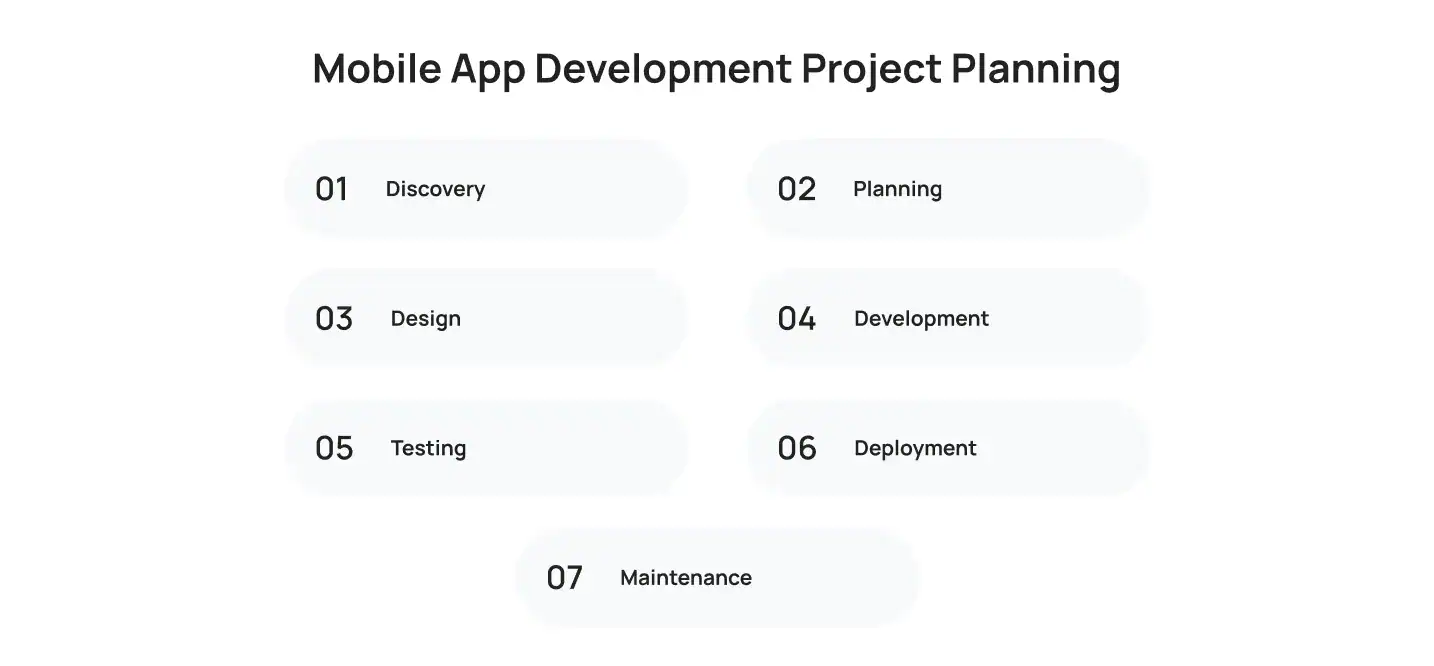
Here’s a simple breakdown of how enterprise projects usually move:
- Discovery — Define the business problem and target users.
- Planning — Set the mobile app product roadmap and timeline.
- Design — Build wireframes and user flows.
- Development — Build the app in sprints, not one giant push.
- Testing — Run security, performance, and usability checks.
- Deployment — Launch to app stores or internal channels.
- Maintenance — Support, update, and improve post-launch.
Cross-platform frameworks have changed this timeline a lot. Today, 74% of enterprise mobile apps are built using tools like React Native or Flutter. That single choice can cut development time significantly, without sacrificing much on performance.
App Development Risk Management
Every enterprise app project carries risk. Budget overruns. Missed deadlines. Security gaps. Good app development risk management catches these early, before they become expensive problems.
Common risks include unclear requirements, scope creep, and weak testing. The fix is simple in theory: build in checkpoints. Review progress every sprint. Don’t wait until launch to test security. Teams that follow this approach, including experienced partners like Cubix, tend to avoid the last-minute scramble that derails so many enterprise builds.
Security risk deserves its own spotlight too. Breaches involving compromised credentials account for 76% of mobile-related incidents. That’s a staggering number. It means most enterprise app risk isn’t exotic. It’s basic access control, done wrong.
Enterprise Mobile App Development Cost
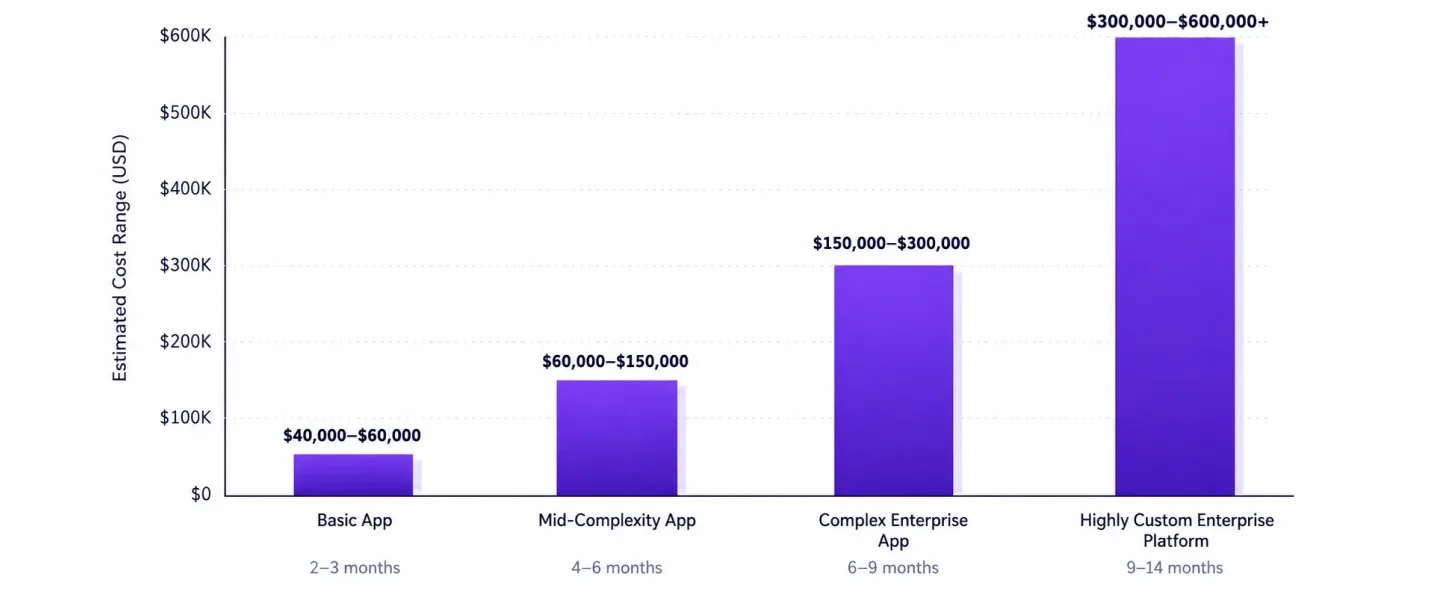
Let’s talk numbers. Everyone wants to know the enterprise mobile app development cost before they commit. The honest answer: it depends heavily on complexity.
| App Complexity | Estimated Cost Range | Typical Timeline |
| Basic App | $40,000 – $60,000 | 2–3 months |
| Mid-Complexity App | $60,000 – $150,000 | 4–6 months |
| Complex Enterprise App | $150,000 – $300,000 | 6–9 months |
| Highly Custom Enterprise Platform | $300,000 – $600,000+ | 9–14 months |
These ranges shift based on features, integrations, and platform choice. Custom enterprise app development with heavy API integration or AI features will land on the higher end. Working with experienced enterprise mobile app development companies helps you avoid rework, which is often the real budget killer.
Enterprise App Security Checklist
Security isn’t optional in enterprise mobile software development. One weak link can expose an entire company’s data. It takes an average of 207 days to identify a breach, and 73 more days to contain it. That’s nearly a full year of exposure.
A solid security approach includes encrypted data storage, multi-factor authentication, regular penetration testing, and strict access controls. It also means training staff, since human error causes many breaches. For a full breakdown of what to check before launch, see our enterprise app security checklist. Teams at Cubix build security review into every stage of development, not just at the end.
Post-Launch: App Store Optimization & Maintenance
Launch day isn’t the finish line. It’s the starting line. App store optimization and post-launch app maintenance decide whether your enterprise app actually gets used.
For consumer-facing enterprise apps, app store optimization improves visibility and trust. That means clear descriptions, the right keywords, and regular updates. For internal apps, “optimization” looks different. It means fast onboarding and clear in-app guidance instead.
Maintenance matters just as much. Nearly half of employees, 48%, say the apps their employer gives them are outdated or hard to use. That’s a real problem. Regular updates, bug fixes, and performance checks keep adoption high. Skipping this step is one of the fastest ways to waste your original investment.
Think of maintenance as ongoing insurance. Operating systems update constantly. Security threats evolve just as fast. An app that worked perfectly at launch can break within months if nobody maintains it. Budget for this from the start, not as an afterthought once problems appear.
Measuring Mobile App ROI
You built the app. Now, did it work? Measuring mobile app ROI keeps your investment honest. Without clear metrics, you’re just guessing.
| Metric | What It Tells You |
| Adoption Rate | How many target users actually use the app |
| Time Saved Per Task | Direct measure of process efficiency gains |
| Error Reduction Rate | Impact of automation on data accuracy |
| Support Ticket Volume | Signals usability and app stability |
| Cost Per Active User | Long-term efficiency of your investment |
Field service teams offer a strong example here. As many as 63% of field workers say they couldn’t do their jobs effectively without a mobile device. That single stat justifies the investment for many operations-heavy businesses on its own.
ROI isn’t always about direct revenue either. Sometimes it’s about avoided cost. Fewer errors mean fewer expensive fixes later. Faster approvals mean projects move quicker. Track both the hard numbers and the softer operational wins. Together, they tell the real story of your app’s value.
Choosing the Right Enterprise Mobile App Development Company
This decision matters more than most teams realize. The right partner shapes your entire outcome. Look for proven experience across enterprise Android app development and enterprise iOS app development both. Look for a real security track record, not just a promise.
Ask about their approach to business mobile app development specifically, not generic app-building. Ask how they handle enterprise application integration with legacy systems, since most large companies still run on older infrastructure. And ask for real case studies, not vague claims. This is exactly the kind of depth you’ll find explored further in our Enterprise App Development Services page.
Pricing matters too, but it shouldn’t be the only factor. A cheaper build that fails security review costs more in the long run. Weigh cost against experience, communication style, and post-launch support. The right fit often shows up in the small details, like how clearly a team explains its own process.
Get Started with Cubix
18 years in business means Cubix has already made the mistakes other firms are still making. That experience gets passed straight into your project.
Whether you need corporate mobile app development from scratch, or want to modernize an existing system, Cubix can guide the process end to end, the same way it has for over 1,300 clients before you.
The team’s focus on enterprise mobile solutions means your app won’t just launch. It will actually perform, scale, and last, backed by nearly two decades of enterprise delivery experience. Ready to talk through your project?
Reach out to Cubix and start building an enterprise app that actually moves your business forward.
Want to discuss your project? Our experts are just a click away.
Contact UsFrequently Asked Questions
1. How long does enterprise mobile app development usually take?
Most projects take between 4 and 9 months. Timeline depends on complexity, features, and integrations required.
2. What’s the difference between enterprise apps and consumer apps?
Enterprise apps focus on internal efficiency and security. Consumer apps focus on downloads and engagement.
3. How much does enterprise mobile app development cost?
Costs typically range from $40,000 to over $600,000. It depends heavily on complexity and custom features.
4. Should enterprises build for iOS or Android first?
It depends on your users. Android dominates global share, but iOS often fits executive-facing tools better.
5. Why is API integration so important for enterprise apps?
It connects your app to core systems like CRM and ERP. Without it, apps become isolated and less useful.
6. How do I choose the right enterprise app development company?
Look for proven security practices, real case studies, and experience with enterprise application integration.