Key Takeaways
- Mobile games can cost anywhere from $15,000 to more than $5 million, depending on genre, features, and production quality.
- The biggest drivers of game development cost are gameplay complexity, art style, multiplayer infrastructure, and live operations.
- RPGs, strategy games, and multiplayer titles usually require larger teams and longer development timelines.
- Marketing, server hosting, updates, and customer support often consume 30 – 50% of the total budget after launch.
- Choosing the right development model, whether freelancers, staff augmentation, or a full-service studio, can significantly reduce project risk.
- Unity remains the most popular engine for indie developers because of its lower learning curve and cross-platform support, while Unreal Engine becomes attractive for visually demanding projects.
- Planning an MVP before building a full game is one of the best ways to control your game development cost breakdown and validate your idea early.
The mobile gaming market has never been bigger. According to sources, mobile games generated over $92 billion in revenue in 2025, accounting for nearly half of the global games market. At the same time, Sensor Tower reported that players downloaded more than 49 billion mobile games across the App Store and Google Play during the year.
Those numbers are exciting. They also create one big question.
How much does it cost to make a game that can actually compete?
The answer isn’t as simple as putting a price tag on an idea. A simple puzzle game may cost less than a family sedan, while a multiplayer RPG can require millions of dollars before launch. Two games may even look similar but have completely different budgets because of multiplayer features, backend systems, live events, or the number of platforms they support.
If you’re building your first title, planning your next product, or trying to estimate your mobile game development cost, you need more than rough numbers. You need to understand where the money goes, which decisions increase your budget, and which ones can save you thousands without hurting quality.
What Determines Mobile Game Development Cost?
Many people search how much does it cost to make a game, expecting one number.
There isn’t one.
Think of game development like building a house. The number of rooms matters. The materials matter. The location matters. The same is true for games. Every feature you add affects your timeline, your team size, and your budget.
Let’s look at the biggest cost drivers.
Game Complexity Comes First
Game complexity has a bigger impact on cost than almost anything else.
| Game Type | Typical Budget | Development Timeline |
| Hyper Casual | $15,000–$50,000 | 2–4 months |
| Casual Puzzle | $40,000–$120,000 | 3–6 months |
| Racing or Simulation | $100,000–$350,000 | 6–10 months |
| RPG | $150,000–$800,000+ | 8–18 months |
| Multiplayer Shooter | $300,000–$1.5M+ | 12–24 months |
| AAA Mobile Game | $2M–$10M+ | 2–4 years |
These figures reflect industry averages based on projects completed by leading mobile gaming studios and public production estimates from publishers and market analysts.
So if you’re asking how much would it cost to make a video game, your genre is usually the first thing investors and development partners will ask.
Platform Choice Changes Your Budget
Android devices come in thousands of screen sizes and hardware combinations, increasing testing requirements. iOS devices are fewer but often require stricter optimization to meet Apple’s review guidelines.
Supporting both platforms adds work in several areas:
- UI optimization
- Performance testing
- Store compliance
- Controller compatibility
- Device-specific bug fixing
If you also plan to release on Steam or consoles later, your development cost grows because every platform has different certification rules and technical requirements.
Art Style Has a Bigger Impact Than Most People Think
In reality, art production often consumes 30 – 50% of the total project cost.
For example:
- Stylized 2D art is generally faster and less expensive.
- Low-poly 3D models reduce production time.
- Realistic characters require sculpting, texturing, rigging, animation, lighting, and optimization.
- Motion capture adds another production layer for premium games.
Multiplayer Is Much More Than Adding Online Play
Many clients say,
“We just want players to play together.”
That single sentence can add hundreds of development hours.
Multiplayer requires systems that single-player games don’t need:
- Dedicated servers
- Matchmaking
- Player authentication
- Cloud saves
- Anti-cheat protection
- Voice or text chat
- Leaderboards
- Real-time synchronization
According to Unity Gaming Services, backend infrastructure is now one of the fastest-growing portions of modern mobile game budgets as more titles shift toward live-service experiences.
This is why multiplayer games usually have a much higher game app development cost than offline games with similar graphics.
Live Operations Are Now Part of Every Successful Game
Years ago, a game launched once.
Today, launch day is just the beginning.
Players expect:
- Weekly events
- Seasonal updates
- Battle passes
- New characters
- New maps
- Community challenges
- Bug fixes
- Balance patches
Games like PUBG Mobile, Clash Royale, and Call of Duty: Mobile succeed because they continuously release fresh content.
That means your budget must include:
- Content designers
- LiveOps managers
- Community support
- Analytics
- Server scaling
- Ongoing QA
Many first-time developers overlook these costs. As a result, they underestimate their overall mobile game development cost before the project even begins.
Mobile Game Development Cost Breakdown by Genre
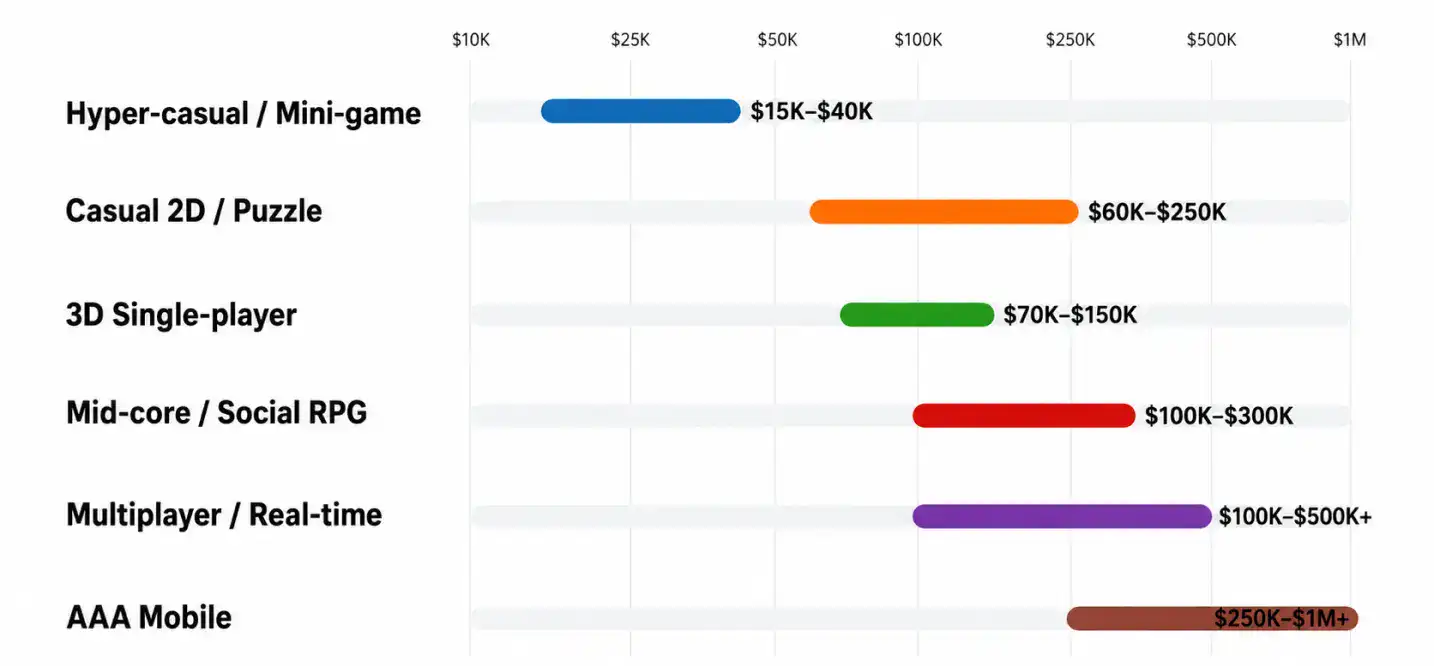
Not every genre is built the same.
Some require complex AI systems. Others need thousands of animations or massive multiplayer infrastructure. Understanding these differences gives you a much clearer picture of your expected game development cost breakdown.
| Genre | Typical Budget | Team Size | Average Timeline | Common Revenue Model |
| Hyper Casual | $15K–50K | 3–5 | 2–4 months | Ads |
| Puzzle | $40K–120K | 5–8 | 3–6 months | Ads + IAP |
| Card Games | $60K–180K | 6–10 | 4–8 months | IAP |
| Simulation | $100K–350K | 10–18 | 6–10 months | Premium + IAP |
| Racing | $150K–500K | 12–25 | 8–14 months | IAP |
| Strategy | $250K–800K | 20–40 | 12–18 months | Live Service |
| RPG | $200K–1M+ | 20–50 | 12–24 months | Battle Pass + IAP |
| MMO | $1M–5M+ | 50+ | 24–48 months | Subscription + IAP |
Why RPG Games Cost More
A typical RPG includes:
- Character progression
- Skill trees
- Inventory systems
- Crafting
- NPC behavior
- Dialogue
- Quests
- Save systems
- Combat balancing
- World-building
If you’re researching how to make an RPG game, you’ll quickly discover that writing code is only one part of the project. Story design, level balancing, character progression, and content creation often take just as much time as programming.
This is why businesses planning a large RPG usually choose an experienced rpg game development company instead of assembling freelancers from multiple platforms.
Where Does Your Budget Actually Go?
Many first-time founders focus on one number: the development quote. Experienced studios look at the full picture.
The initial quote is only part of your game app development cost. Marketing, infrastructure, compliance, testing, and post-launch support often account for nearly half of the total investment.
Here’s how a typical mobile game budget is distributed.
| Budget Category | Typical Share of Total Budget |
| Programming & Engineering | 25–35% |
| Art & Animation | 20–30% |
| Game Design | 8–12% |
| UI/UX Design | 5–10% |
| Audio & Music | 3–8% |
| Quality Assurance | 8–12% |
| Backend & Cloud Infrastructure | 8–15% |
| Project Management | 5–8% |
| Marketing & User Acquisition | 25–40% (post-launch) |
For many successful games, the launch budget is only the beginning. According to AppsFlyer, gaming companies now spend billions annually on user acquisition, with average cost-per-install (CPI) ranging from $1.50 to more than $4.50 depending on the region and game genre.
Hidden Costs That Catch Indie Developers Off Guard
Some of the most common hidden expenses include:
- Apple Developer Program and Google Play Console fees
- Localization into multiple languages
- Server hosting and cloud storage
- Push notification services
- Live chat and customer support
- Crash reporting tools
- Analytics platforms
- Privacy compliance (GDPR, COPPA, CCPA)
- App store optimization
- Marketing creatives
- Influencer campaigns
- Legal contracts and trademarks
Why Do Most Indie Games Go Over Budget?
A report from the Standish Group found that software projects frequently exceed original estimates because of changing requirements, underestimated complexity, and scope expansion. Games are no different.
The biggest reasons include:
- Features keep getting added.
- Teams underestimate testing time.
- Multiplayer introduces unexpected technical challenges.
- Performance optimization starts too late.
- Art production takes longer than expected.
- Developers begin polishing before core systems are finished.
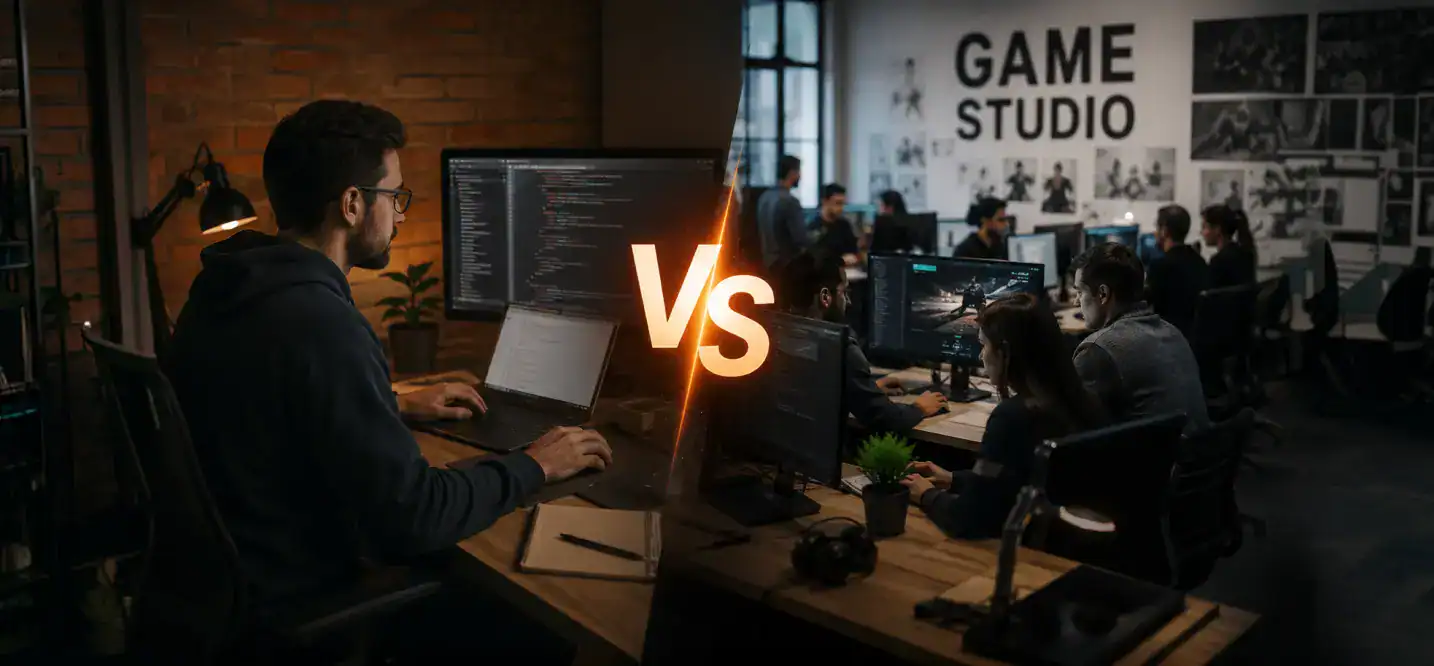
Hiring Developers vs. Studios: Which Option Saves More Money?
Freelancers on Upwork
Upwork gives you access to thousands of developers from around the world.
Advantages include:
- Lower hourly rates
- Large talent pool
- Flexible hiring
- Good for short-term work
Challenges include:
- Quality varies significantly.
- Managing multiple freelancers takes time.
- Communication gaps can slow development.
- Designers and programmers may follow different workflows.
Toptal vs. Upwork: Which Is Better?
Here’s the short answer.
| Upwork | Toptal |
| Open marketplace | Curated talent network |
| Lower hourly rates | Premium pricing |
| Large number of candidates | Smaller but highly vetted pool |
| Requires more screening | Faster hiring process |
| Better for smaller budgets | Better for senior specialists |
If you already have technical leadership, Upwork offers flexibility.
Boutique Studios vs. Large Enterprise Firms
Another common question is:
Should startups work with a boutique studio or a large company like ScienceSoft?
The answer depends on your project.
Boutique studios generally offer:
- Direct communication with senior developers
- Faster decision-making
- Greater flexibility
- Lower overhead
- Better fit for MVPs
Large enterprise firms usually provide:
- Large engineering teams
- Enterprise governance
- Extensive compliance processes
- Dedicated QA departments
- Strong documentation
Scaling Your Team Through Staff Augmentation
Sometimes you don’t need a full outsourcing partner.
You simply need more developers.
Staff augmentation allows you to add engineers, artists, QA specialists, or producers without building an internal hiring pipeline.
Many businesses choose this model during major launches because it offers flexibility without long-term hiring commitments.
Well-known providers include Cubix, depending on your project size and hiring needs.
If you’re planning to hire game app designers, look for teams with experience in mobile UX, monetization systems, and accessibility rather than general app design.
Those skills have a direct impact on player retention.
Engine, Platform, and Technology Costs You Shouldn’t Ignore
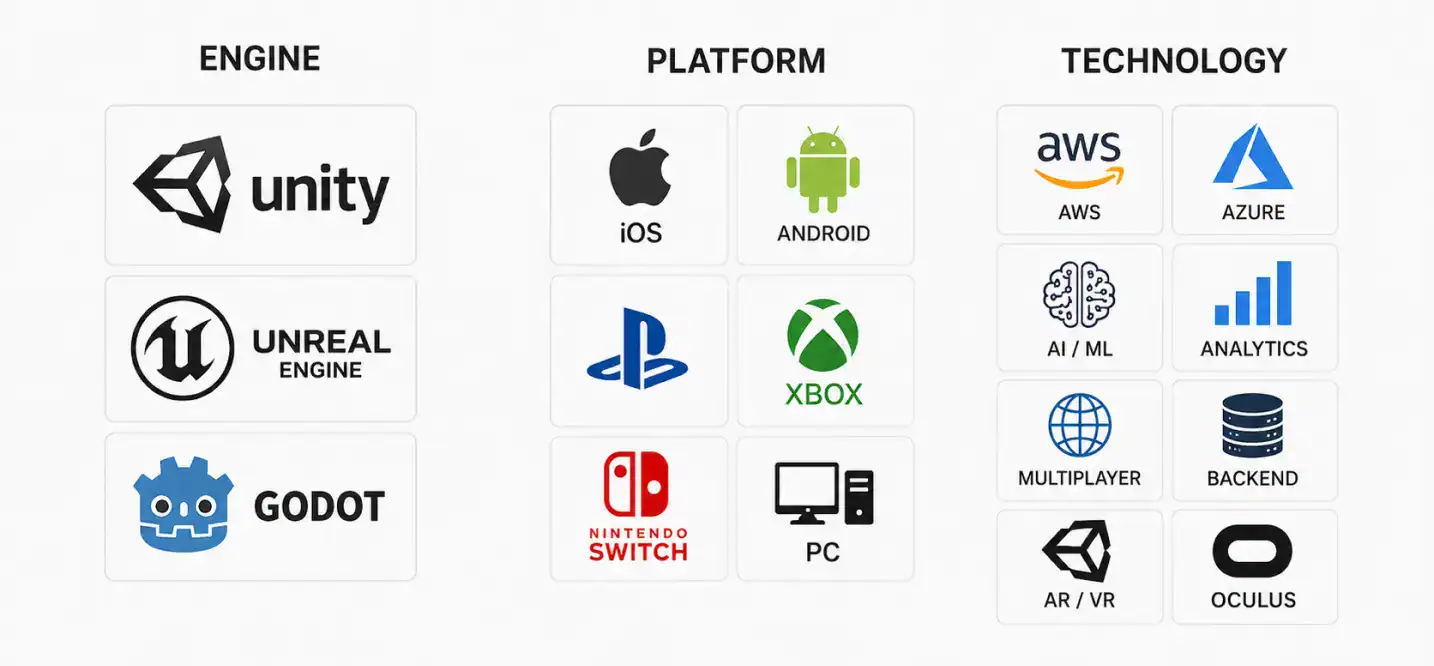
Choosing the right technology affects much more than graphics.
It influences hiring costs, deployment, licensing, maintenance, and long-term scalability.
Why So Many Indie Developers Choose Unity
Unity continues to power a large percentage of mobile games because it’s approachable, flexible, and supports Android, iOS, PC, and consoles from the same codebase.
Some of its biggest advantages include:
- Faster onboarding
- Huge Asset Store
- Strong documentation
- Excellent mobile optimization
- Large developer community
Cross-platform exporting also helps reduce long-term maintenance, although every platform still requires testing and certification.
For many indie developers wondering how much does it cost to make a computer game, Unity provides one of the lowest barriers to expanding from mobile to PC.
Understanding Unreal Engine Royalties
Unreal Engine offers outstanding visual quality.
But developers should also understand its licensing model.
Epic Games currently charges a 5% royalty after the first $1 million in lifetime gross revenue for games covered by its standard royalty license.
For many indie developers, this means there is no royalty payment until the game becomes commercially successful.
However, Unreal projects often require:
- More experienced developers
- Higher-end hardware
- Larger asset sizes
- More optimization work for mobile devices
Those factors can increase your game development cost before royalties even become relevant.
What About Web3 Games?
Blockchain games introduce another layer of development.
Besides traditional gameplay systems, teams may need:
- Smart contracts
- Wallet integration
- Marketplace development
- NFT management
- Token economies
- Security audits
- Blockchain infrastructure
Each of these adds development time and specialized engineering.
Companies exploring blockchain titles often work with experienced web3 game development services providers because blockchain security mistakes can become extremely expensive after launch.
How to Budget Your Mobile Game Without Overspending

If you’re asking how much does it cost to make a video game, don’t start with your dream feature list.
Start with your minimum viable product.
The most successful studios validate ideas before investing heavily. A practical budget often follows this structure:
| Development Stage | Recommended Budget Allocation |
| Discovery & Planning | 10% |
| Prototype / MVP | 20% |
| Full Production | 45% |
| Testing & Optimization | 15% |
| Launch Preparation | 10% |
Once the MVP proves player interest, you can safely expand your investment.
A Simple Budget Checklist
Before approving development, ask yourself:
- Do you have a contingency budget of at least 15%?
- Have you included post-launch support?
- Is marketing funded separately?
- Have you planned for live operations?
- Does your timeline include enough QA?
- Have you budgeted for analytics and user acquisition?
2026 Industry Benchmarks Worth Knowing
Here are a few numbers that help put today’s market into perspective:
| Statistic | 2025–2026 Estimate |
| Global mobile game revenue | $92B+ |
| Share of global gaming market | ~49% |
| Mobile game downloads | 49B+ |
| Average CPI | $1.50–$4.50 |
| Recommended contingency budget | 15–20% |
| Live-service budget after launch | 30–50% of Year 1 spending |
One final point.
People often search how much does it cost to hire a game developer expecting a single hourly rate. In reality, rates depend on experience, location, engine expertise, and specialization.
Why Businesses Choose Cubix for Mobile Game Development
Knowing how much does it cost to make a game is important. But getting an accurate estimate is even more important.
At Cubix, we have spent more than a decade helping startups, enterprises, and gaming brands turn ideas into successful digital products.
Our team develops everything from casual mobile games and multiplayer experiences to large-scale RPGs and emerging Web3 gaming platforms.
What sets Cubix apart is our focus on planning before production. Every project begins with a detailed discovery phase where we evaluate:
- Game genre and complexity
- Platform requirements
- Art and animation scope
- Multiplayer and backend needs
- Monetization strategy
- Live operations and post-launch support
This approach helps clients understand their true mobile game development cost before development starts, reducing surprises later in the project.
If you’re planning your next mobile game and want a realistic mobile game development service, Cubix can help you evaluate your idea, identify potential risks, and create a development roadmap tailored to your goals.
Frequently Asked Questions
1. How much does it cost to make a game in 2026?
Most mobile games cost between $15,000 and $500,000, while large multiplayer and AAA-quality projects can exceed $5 million depending on features, platforms, and production quality.
2. How much does it cost to make a mobile game for Android and iPhone?
Supporting both Android and iOS generally increases the budget by 20–40% because of additional testing, optimization, and platform-specific requirements.
3. How much does it cost to hire a game developer?
Hourly rates vary widely. Junior developers may charge $25–$50 per hour, while experienced Unity, Unreal, AI, or multiplayer specialists often charge $100–$200+ per hour depending on their expertise and location.
4. Is Unity cheaper than Unreal Engine?
For many indie projects, yes. Unity typically offers lower onboarding costs, a large asset ecosystem, and excellent cross-platform support. Unreal Engine can become more cost-effective for high-end visual projects but may require more experienced developers.