Key Takeaways
- Web3 mobile game development company blends blockchain, NFTs, and wallet integration for new player experiences
- Choosing the right blockchain and wallet solution is critical for scalability and compliance
- Smart contract security, tokenomics, and App Store policies can make or break your launch
- Leading frameworks include Unity, React Native, and blockchain SDKs like WalletConnect and MetaMask Mobile
The global blockchain gaming market is projected to reach $614.91 billion by 2030, and as of early 2026, Web3 games now attract 28 million monthly active players worldwide, generating $4.8 billion in 2025 revenue. If you want to step into this rapidly changing landscape, building a Web3 mobile game means combining blockchain integration, NFT mechanics, and wallet onboarding in ways unfamiliar to most traditional mobile developers. Unlike classic mobile games, these titles focus on player asset ownership, crypto transactions, and new revenue streams for studios and players alike.
Creating a successful Web3 mobile game calls for a thoughtful approach. You’ll need to pick the right blockchain, design smart tokenomics, secure your contracts, and meet the strict standards of Apple and Google app stores. This comprehensive guide will walk you through each stage, highlight must-know pitfalls, and explain the essential technology choices for 2026.
Want to discuss your project? Our experts are just a click away.
Contact UsWhat Makes a Web3 Mobile Game Different?
Web3 mobile games introduce features that set them far apart from traditional mobile gaming. The main shift is decentralized ownership, where players hold in-game assets as NFTs or tokens and trade them securely through blockchain. Wallet integration replaces the usual logins, letting users authenticate and transact with non-custodial or custodial wallets such as MetaMask Mobile and WAX Cloud Wallet.
Smart contracts form the core of the economy and asset flow, delivering transparent and automated trades, minting, and even battle results. The rise of play-to-own models and new tokenomics brings studios more revenue options, while players gain value just by playing.
Step-by-Step Process for Building a Web3 Mobile Game
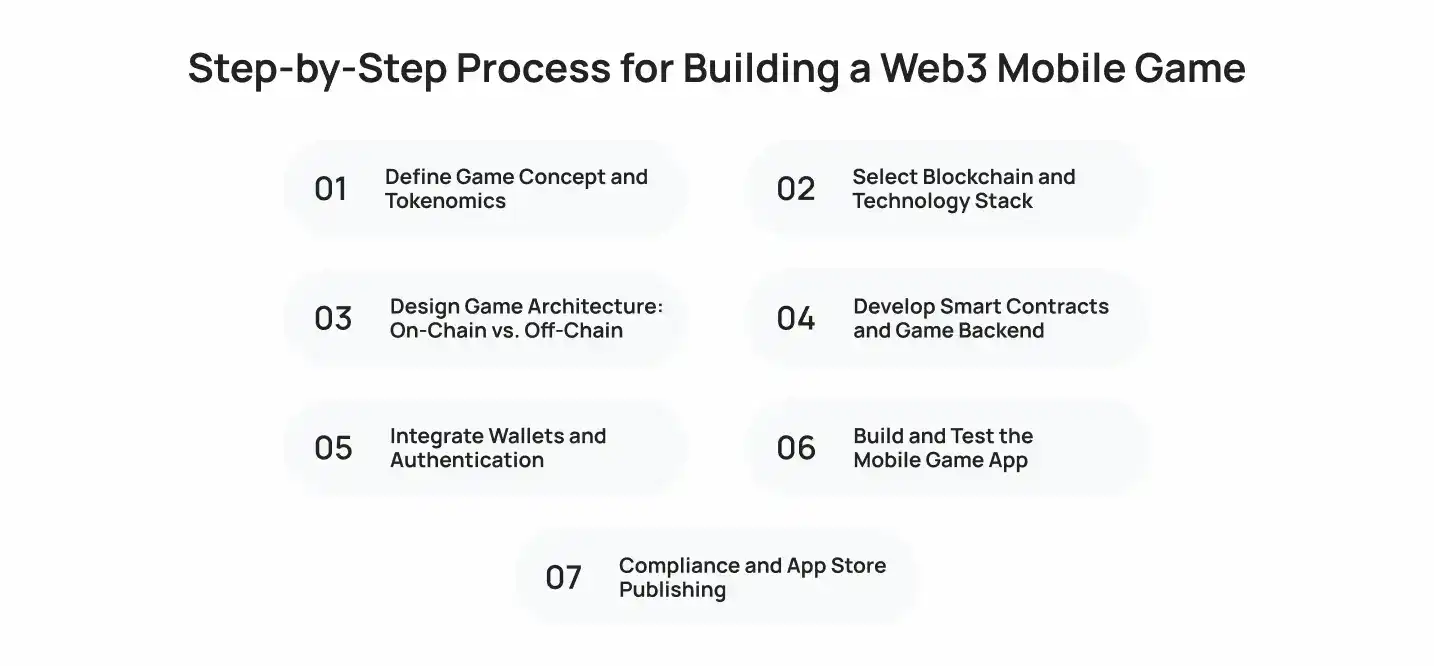
1. Define Game Concept and Tokenomics
Start with a solid game concept to anchor the player experience. In Web3, though, tokenomics shapes everything that follows. Decide if your model revolves around earning currency or NFTs (play-to-earn), asset ownership for resale (play-to-own), or a blend. Map out how tokens, NFTs, and coins circulate between players, the marketplace, and in-game rewards.
Think through supply, rarity, and incentives. An economy that rewards skill and engagement while protecting scarcity builds long-term retention. Too much speculation or rapid inflation can quickly drive away your community.
2. Select Blockchain and Technology Stack
Evaluate which blockchain best fits your vision based on gas fees, throughput, and developer support. Ethereum remains popular, but gas fees are high. Polygon and Immutable offer lower costs and dedicated NFT infrastructure. If you need cross-chain features, confirm your stack supports bridges or interoperability.
For development, best Unity game development services and React Native lead the way. Unity works best for visually rich or 3D-first games, while React Native suits lighter 2D and hybrid apps. Integrate blockchain SDKs like WalletConnect or MetaMask Mobile for wallet flows. Make sure your chosen blockchain and wallet are well-supported and updated.
Comparing Blockchains for Web3 Mobile Games
| Blockchain | Gas Fees | Speed | NFT Support | Notable Games | Mobile SDKs |
| Ethereum | High | Moderate | Strong | Axie Infinity | MetaMask Mobile, WalletConnect |
| Polygon | Low | Fast | Strong | Zed Run | MetaMask Mobile, WalletConnect |
| Immutable | Zero | Fast | Specialized | Gods Unchained | Immutable SDK, WalletConnect |
| Arbitrum | Low | Fast | Good | Treasure | MetaMask Mobile, WalletConnect |
| WAX | Zero | Fast | Strong | Alien Worlds | WAX Cloud Wallet |
Your choice directly affects scalability, performance, development cost, and compliance. Compare carefully against your needs. For more on picking a protocol, see this top blockchain protocols guide.
3. Design Game Architecture: On-Chain vs. Off-Chain
Balance on-chain transparency with off-chain performance. On-chain logic and data storage work best for NFT ownership and token transfers, where trust and proof matter. For frequent data updates, like player progress or leaderboards, keep them off-chain for speed and scalability.
Careful planning now prevents costly rework and avoids game-breaking fees. The right split sets a strong foundation for both gameplay and secure economic activity.
On-Chain vs. Off-Chain Game Components
| Component | On-Chain (Y/N) | Rationale |
| NFT ownership | Yes | Ensures player asset control |
| In-game currency | Yes | Needed for trading and interoperability |
| Player progress | No | High-frequency updates, not security-critical |
| Game logic (core) | Sometimes | Only if trustless execution is required |
| Analytics/leaderboards | No | Privacy and performance reasons |
For more details on planning and workflow, refer to this step-by-step DApp development process guide.
4. Develop Smart Contracts and Game Backend
This is the technical heart of your Web3 mobile game. Write smart contracts using Solidity (for Ethereum/Polygon) or Rust (for Solana), and rigorously test them to prevent exploits. Your code should enable NFT minting, token transfers, asset auctions, and any critical on-chain rules.
Connect these contracts to your backend, which manages users, tracks analytics, and runs off-chain logic. Plan for upgradability, as fixing deployed contracts is often difficult or impossible. A formal audit by experienced smart contract developers is essential before launch, especially when live assets and money are involved.
Smart Contract Audit Checklist
| Audit Area | Key Checks |
| Reentrancy | Prevents double-spending |
| Access control | Only authorized calls allowed |
| Gas optimization | Efficient code to reduce player costs |
| Upgradability | Proxy pattern or modular contract design |
| NFT standards | ERC-721, ERC-1155 compliance |
With about 93% of Web3 game projects between 2020 and 2026 having failed, leading to over $12 billion in losses, security cannot be an afterthought.
5. Integrate Wallets and Authentication
Players need an easy way to access your game, manage assets, and sign transactions. The right wallet can boost onboarding for both crypto veterans and newcomers. Support non-custodial options like MetaMask Mobile and WalletConnect for players wanting self-custody, while custodial solutions like WAX Cloud Wallet help ease adoption for the mainstream.
Design wallet flows to be intuitive. Guide users through connecting, signing, and recovery. Testing on both iOS and Android is important, as wallet behavior can differ by OS.
Wallet Integration Options for Mobile Games
| Wallet Type | User Control | Supported Blockchains | Best For | Example Games |
| MetaMask Mobile | Non-custodial | Ethereum, Polygon, Arbitrum | Crypto-native players | Axie Infinity |
| WalletConnect | Non-custodial | Multi-chain | Cross-wallet compatibility | Zed Run |
| WAX Cloud Wallet | Custodial | WAX | Mainstream onboarding | Alien Worlds |
Your wallet choice will impact user experience, security, and even compliance. Always check for updates or changes in support.
6. Build and Test the Mobile Game App
Now, develop the core game using Unity for feature-rich 3D titles or React Native for lighter, rapid updates. Integrate blockchain SDKs and handle wallet flows as part of your main authentication process. Test minting, asset transfers, and in-game payments extensively.
Testing must cover all real-world scenarios: wallet connection issues, transaction failures, gas fee spikes, and device fragmentation. Use a thorough game testing checklist to catch hidden bugs.
Key Testing Areas for Web3 Mobile Games
- Wallet connection and transaction reliability
- NFT minting and transfer flows
- Smart contract calls under real-world network conditions
- Gas fee handling and error states
- Compliance with App Store and Play Store policies
Remember, the average blockchain game lasts around four months, and 30-day retention sits at only 12%. Rigorous testing for both gameplay and blockchain flows helps you beat these odds.
7. Compliance and App Store Publishing
Before launch, review Apple and Google rules for apps using crypto, NFTs, or blockchain features. Both stores now allow NFT trading and wallet integration, but require clear user disclosures, explicit handling of gas fees, and strict in-app payment policies.
Prepare documentation showing compliance and be ready for reviews or rejections. If your game includes token sales or gambling, you might need KYC or AML processes.
App Store and Google Play Blockchain Policy Comparison
| Policy Area | Apple App Store | Google Play Store |
| NFT Trading | Allowed with restrictions | Allowed with restrictions |
| Crypto Payments | In-app purchase rules apply | In-app purchase rules apply |
| Wallet Integration | Permitted, but must use approved APIs | Permitted, must disclose clearly |
| Gas Fees | Must be disclosed to users | Must be disclosed to users |
For the latest compliance information, check both the Apple and Google developer guidelines as policies can change quickly.
Tokenomics and NFT Game Mechanics
A strong NFT economy will help your game stand out. Define clear rarity tiers, supply caps, and in-game uses for each NFT. NFT game development services could unlock special abilities, personalize avatars, or grant voting rights in governance. Distribute tokens thoughtfully, balance allocations for players, your studio, and ecosystem partners to avoid oversupply.
Put protections in place to block bots and stop exploitative trades. Use gradual unlock schedules, whitelisting, or CAPTCHAs to safeguard your in-game market and community trust. For details on how NFTs in the gaming world are evolving, review this overview.
Cross-Chain Interoperability and Marketplace Integration
Players now expect freedom to move their assets, so cross-chain support is essential. Enable trading of your game’s NFTs across supported blockchains using bridges or standards such as ERC-1155 or LayerZero. This expands both appeal and liquidity.
Integrate with established NFT marketplaces like OpenSea, Immutable, or WAX Marketplace to reach a broader audience. For decentralized asset hosting, use solutions such as IPFS. That approach keeps graphics and metadata available and secure, even when centralized servers are offline.
Analytics, Monetization, and Player Retention
Analytics in Web3 games must track both on-chain actions, such as NFT trades and token transfers, and classic app events for retention, virality, and monetization. Use advanced analytics to fine-tune your economy and spot where players drop out or try to exploit game mechanics.
Hybrid monetization models work best. Combine in-app purchases with NFT sales, curated loot boxes, or exclusive item drops. Boost retention with referral bonuses, NFT staking rewards, or seasonal tournaments. Because 30-day retention averages just 12% in blockchain games, you’ll need to keep innovating in both gameplay and monetization.
Common Pitfalls and Security Considerations
Risks are everywhere in Web3. The most common issues are smart contract vulnerabilities (like reentrancy and integer overflows) that can put your NFT supply or treasury at risk. Gas fee spikes disrupt gameplay and frustrate new users, while wallet phishing and social engineering threaten user security
Lack of clarity about crypto or monetization can get your app banned or delayed on Apple or Google stores. Regular audits, clear user communication, and education are essential. Almost all Web3 failures since 2020 have resulted from misjudged economics, weak code, or compliance mistakes.
Build Your Web3 Mobile Game with a Proven Partner
Cubix Games delivers a secure blockchain game development company made for mobile platforms. With expertise in Unity, React Native, and blockchain integration, Cubix ensures wallet onboarding works for every player type. The team leads game economy design and provides tight smart contract security through comprehensive audits.
Cubix connects games with leading NFT marketplaces and cross-chain protocols, giving your in-game assets the widest possible reach. Every project includes device-level QA and compliance checks, aligned with the latest Apple and Google mobile standards. For studios searching for a dependable Web3 development company, Cubix delivers both strong games and the tech foundation that players expect. For a full service tailored to your needs, consider Cubix as your Web3 game development company.
Want to discuss your project? Our experts are just a click away.
Contact UsFrequently Asked Questions
1. What is a Web3 mobile game?
A Web3 mobile game integrates blockchain technology, allowing players to own, trade, and earn NFTs or tokens directly within the app.
2. How much does it cost to build a Web3 mobile game?
Costs typically range from $150,000 to $500,000, depending on blockchain complexity, wallet integration, and NFT features.
3. Which blockchain is best for a mobile Web3 game?
Polygon, Immutable, and WAX are popular for their low fees and strong NFT support, but the best choice depends on your game’s needs.
4. Do I need NFTs in a Web3 mobile game?
NFTs are not strictly required, but they enable true asset ownership and secondary trading, which are core to most Web3 game models.
5. Should a Web3 game use play-to-earn or play-to-own?
Play-to-own is gaining favor for its focus on asset ownership and long-term value, while play-to-earn can attract speculators but may struggle with retention.
6. How do wallets work in a mobile blockchain game?
Wallets authenticate users and manage crypto assets. Games can support both non-custodial (MetaMask, WalletConnect) and custodial (WAX Cloud Wallet) options.
7. What should be on-chain versus off-chain?
Critical assets (NFTs, tokens) and trustless logic should be on-chain, while frequent updates and sensitive data (progress, analytics) are best kept off-chain.
8. How do I secure smart contracts and in-game assets?
Conduct thorough audits, implement access controls, and follow secure coding practices to protect against exploits and unauthorized access.
9. Can I publish a Web3 mobile game on the App Store and Google Play?
Yes, but you must comply with their crypto and NFT policies, disclose gas fees, and use approved APIs for wallet integration.
10. How do I onboard players who do not own crypto?
Offer custodial wallet options and fiat onboarding, and simplify the wallet setup process to lower the barrier for mainstream players.