Key Takeaways
- Define your game concept, target platforms, audience, features, and budget before contacting development teams.
- Look beyond screenshots when reviewing a portfolio. Play the games and evaluate gameplay, performance, art, animation, and polish.
- Choose a studio with experience in your genre and the technical stack your game actually needs.
- Ask direct questions about development milestones, communication, source-code ownership, QA, security, and post-launch support.
- Compare fixed-price, hourly, dedicated-team, and milestone-based engagement models before choosing a contract.
- A prototype can help you validate the team, gameplay, and development approach before committing to full production.
- Do not choose a developer simply because the quote is the lowest.
- Look for a partner that can support your game beyond launch, especially if you plan regular content updates or LiveOps.
The global games market generated $201.6 billion in 2025, crossing the $200 billion mark for the first time, according to Newzoo. Mobile alone is forecast to generate $121.1 billion in 2026, which shows just how much opportunity exists for games that can attract and retain players.
But here is the part that many game founders discover too late. A great game idea is only the beginning. You can have an exciting concept, memorable characters, and a clear monetization plan, yet still end up with a slow, buggy, expensive game if the development partner is not the right fit. The wrong team can create problems with art consistency, gameplay mechanics, performance, communication, deadlines, and even ownership of your final source code.
That is why knowing how to hire the best 2D Game Development Company is so important. Whether you are planning a mobile platformer, casual puzzle game, pixel-art RPG, arcade title, or an indie game, this guide will show you what to check, which questions to ask, how to compare portfolios, what development models cost, and how to choose a team that can take your idea from concept to launch.
Want to discuss your project? Our experts are just a click away.
Contact UsHere Are Some Tips to Choose the Right 2D Game Development Company
Before you start contacting developers, get clear about what you are actually building. A good development company can help shape your idea, but you should still have a basic understanding of the product you want.
Start with these questions:
- What type of 2D game are you creating?
- Who is the target player?
- Will it launch on iOS, Android, PC, web, or multiple platforms?
- Will it be single-player or multiplayer?
- What art style do you want?
- Will you use ads, in-app purchases, paid downloads, or another model?
- Do you need a backend?
- What is your target launch date?
- Do you need post-launch updates?
The more clearly you answer these questions, the easier it becomes to find the right development partner.
Decide What Type of Development Partner You Need
You do not always need the biggest studio. A small project may work well with a small team, while a multiplayer game with backend systems, analytics, LiveOps, and multiple platform releases may require a broader team.
| Partner Type | Best For | Cost Level | Control | Scalability |
| Freelancer | Small prototypes and simple games | Low | High | Low |
| Small 2D Game Studio | Indie and mid-size projects | Medium | Medium | Medium |
| Dedicated Team | Longer-term development | Medium to High | High | High |
| Full-Service Game Development Company | Complex games and LiveOps | High | High | High |
If you need design, art, programming, QA, backend development, and post-launch support under one roof, a full-service Game Development Company can reduce the number of separate vendors you need to manage.
What Are the Key Qualities of a Top-Tier 2D Game Development Studio?
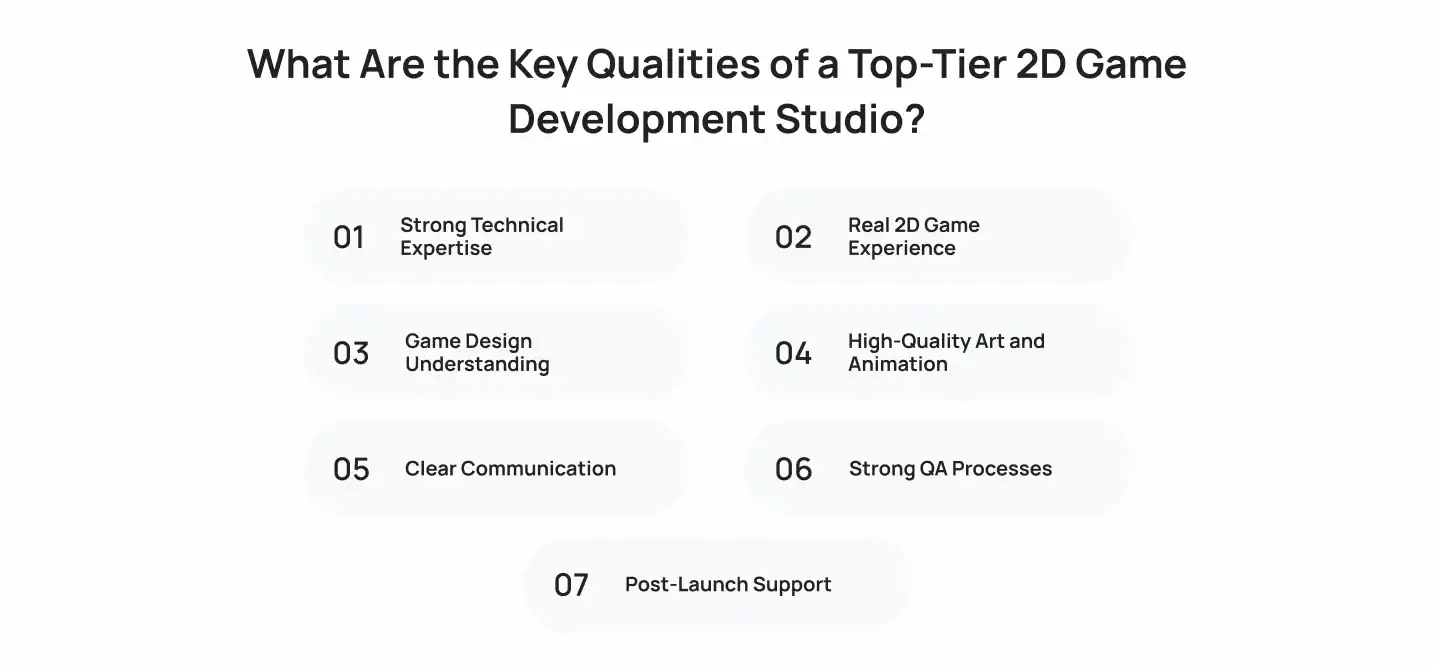
A strong 2D game studio is not simply a group of programmers who know a game engine. Successful 2D development combines programming, game design, art, animation, sound, UI, optimization, testing, and product thinking.
Here are the top qualities to look for.
1. Strong Technical Expertise
The team should understand the technology behind your game, including the chosen engine, programming language, physics, animation systems, APIs, analytics, multiplayer technology, and platform requirements.
2. Real 2D Game Experience
Ask whether the studio has actually shipped 2D games. Building a basic demo is very different from taking a game through production, testing, store submission, launch, and updates.
3. Game Design Understanding
Developers should understand gameplay loops, progression, difficulty, player feedback, level design, retention, and monetization.
4. High-Quality Art and Animation
For a 2D game, visual quality can make or break the player experience. Look for consistency in characters, environments, UI, effects, animation, and transitions.
5. Clear Communication
You should know who manages the project, how often you receive updates, where tasks are tracked, and how quickly questions are answered.
6. Strong QA Processes
Testing should happen throughout development, not during the final week. Mobile games especially need testing across different screen sizes, operating systems, hardware levels, and input conditions.
7. Post-Launch Support
A game is not necessarily finished when it reaches the app store. Updates, bug fixes, balance changes, new content, analytics, and LiveOps may continue for months or years.
Unity’s 2026 Game Development Report found that 52% of surveyed developers said their studios were prioritizing smaller, more manageable projects, while 67% said they spend three months or less in prototyping. This reflects a broader move toward testing ideas earlier and reducing production risk.
A Simple Hiring Scorecard
Use this scorecard when comparing potential 2D game studios:
| Factor | Suggested Weight |
| Technical Expertise | 20% |
| Portfolio and Past Projects | 18% |
| Game Design Understanding | 15% |
| 2D Art and Animation | 15% |
| Communication and Transparency | 12% |
| QA and Testing | 10% |
| Post-Launch Support | 6% |
| Pricing and Value | 4% |
| Total | 100% |
Do not treat these percentages as an industry rule. Use them as a practical way to compare your shortlist consistently.
How to Compare Portfolios of 2D Game Development Companies
This is where many hiring decisions go wrong.
A portfolio full of attractive screenshots does not automatically mean you have found the right company.
You need to look deeper.
Check for Relevant Game Genres
If you want to build a platformer, a studio that has only created casino games may not be your ideal choice. Genre experience can help the team understand your mechanics, player expectations, progression system, and art direction faster.
Play the Games
Whenever possible, download or play the company’s previous work.
Ask yourself:
- Does the game feel responsive?
- Are controls smooth?
- Are animations natural?
- Does the UI feel polished?
- Does the game load quickly?
- Are there obvious bugs?
- Is the difficulty balanced?
- Does the visual style remain consistent?
Look for Released Projects
A playable, publicly released project gives you much more information than a concept image.
Also check whether the studio explains its role. Did it handle programming only? Art? Full production? Backend? QA? LiveOps?
That distinction matters.
Portfolio Evaluation Scorecard
| Portfolio Factor | What to Check | Maximum Score |
| Gameplay | Mechanics and responsiveness | 20 |
| Art Style | Visual quality and consistency | 15 |
| Animation | Character movement and effects | 15 |
| Technical Complexity | Physics, APIs, multiplayer, systems | 15 |
| Platform Experience | iOS, Android, PC, web | 10 |
| Released Games | Evidence of shipped products | 10 |
| Genre Experience | Similar games and audiences | 10 |
| Case Studies | Process and results | 5 |
| Total | 100 |
Tip: Always play the game if possible. A playable portfolio is more useful than a gallery of screenshots.
Where Can I Find Reputable 2D Game Development Agencies?

Finding agencies is easier than ever. Finding the right agency is the difficult part.
Start with Google and search for specific phrases such as “2D game developers,” “2D game development studio,” or your exact genre plus “game development company.”
You can also use professional review platforms. Clutch, for example, lets buyers filter gaming development companies by location, pricing, reviews, and services. Its gaming directory was updated in August 2026.
Other places to research include:
- Game development communities
- Developer forums
- Industry directories
- Client referrals
- App Store and Google Play listings
- Company case studies
- Conference and industry networks
You can also compare established firms through resources covering the top game development companies and top mobile game development companies.
Where to Find Reviews for 2D Game Development Companies
Do not look only at star ratings.
A useful review should tell you something about the actual working relationship.
Look for comments about:
- Communication
- Technical skills
- Meeting deadlines
- Responsiveness
- Problem-solving
- Project management
- Quality of deliverables
- Long-term support
A company with fewer but detailed reviews can sometimes provide more useful information than one with hundreds of vague testimonials.
Best Questions to Ask When Hiring a 2D Game Development Company
The interview stage is where you can separate a real development partner from a company that simply wants the contract.
Questions About Experience
- How many 2D games have you developed?
- Have you built games in my genre?
- Can I play some of your previous games?
- Have you worked on similar platforms?
- Which parts of those projects did your team handle?
Questions About Development
- How do you handle game prototyping?
- What milestones will you use?
- How often will I receive playable builds?
- How do you manage scope changes?
- How do you estimate development time?
For more questions to add to your interview checklist, see 10 Questions Before Hiring a Game Dev Studio.
Questions About Technology
- Which 2D game development engine do you recommend?
- Why is that engine right for my game?
- How will you handle performance optimization?
- What tools will you use for analytics?
- How will you approach multiplayer if needed?
Questions About Ownership
- Who owns the source code?
- Who owns the artwork?
- Who owns the game design documents?
- Will I receive the complete project files?
- What happens if I move development to another team?
Questions About Support
- Do you provide post-launch maintenance?
- Can you handle updates and new features?
- How are bugs handled after launch?
- Do you provide LiveOps support?
- What happens when the original development team is no longer available?
These questions may feel detailed, but they can prevent expensive problems later.
How to Evaluate the Technology Stack for a 2D Game
Your development partner should recommend technology based on your project, not simply use whatever their developers prefer.
Unity
Unity remains a major choice for cross-platform game development. Unity says more than 70% of the top 1,000 mobile games were made with Unity, and its platform supports more than 20 end-user platforms.
Its 2D toolset includes sprites, Tilemaps, 2D physics, animation, lighting, and visual effects.
Godot
Godot is another strong option, particularly for teams that want an open-source engine. Its documentation describes it as a free, open-source 2D and 3D engine, with dedicated 2D rendering, physics, TileMaps, particles, animation, and lighting tools.
GameMaker and Construct
These tools can be useful for certain indie and rapid-development projects, especially when the game does not require highly customized technology.
Custom Technology
Custom engines can make sense for unusual technical requirements, but they usually introduce additional development and maintenance considerations.
2D Game Engine Comparison
| Engine | Best For | Learning Curve | Platform Support | 2D Capability |
| Unity | Cross-platform commercial games | Medium | Excellent | Excellent |
| Godot | Indie and open-source projects | Easy to Medium | Very Good | Excellent |
| GameMaker | 2D-focused indie games | Easy | Good | Excellent |
| Construct | Browser and lightweight games | Easy | Good | Very Good |
| Custom Engine | Specialized requirements | High | Custom | Custom |
The right engine depends on the game. Do not hire a company simply because it advertises one particular engine.
Steps to Hire a Reliable 2D Game Development Company
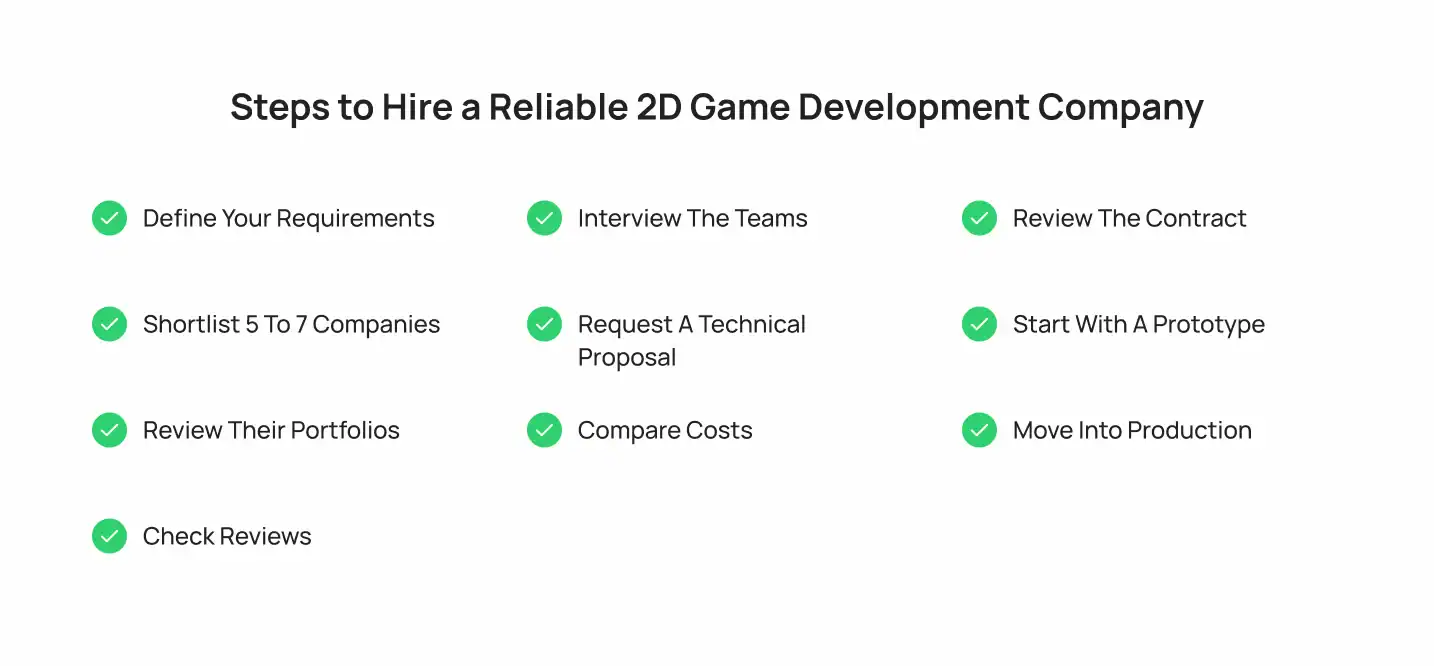
Here is a practical process you can follow.
Step 1: Define Your Requirements
Write down the core gameplay, platform, audience, art style, monetization, and essential features.
Step 2: Shortlist 5 to 7 Companies
Avoid contacting dozens of companies without a clear screening process.
Step 3: Review Their Portfolios
Focus on relevant projects rather than impressive but unrelated work.
Step 4: Check Reviews
Look for detailed client feedback and evidence of real projects.
Step 5: Interview the Teams
Ask about technology, milestones, communication, ownership, and support.
Step 6: Request a Technical Proposal
The proposal should explain the recommended technology, team structure, development phases, assumptions, and deliverables.
Step 7: Compare Costs
Do not compare only the final number. Compare what is actually included.
Step 8: Review the Contract
Pay attention to intellectual property, milestones, payment terms, change requests, confidentiality, and termination clauses.
Step 9: Start With a Prototype
A prototype lets you test gameplay and the working relationship before full production.
Step 10: Move Into Production
Once the prototype and scope are approved, the team can move into full development.
This approach also aligns with current development trends. Unity’s 2026 report found that 67% of surveyed developers spend three months or less in prototyping, reinforcing the value of testing ideas early.
What Are Typical Pricing Models for Outsourced 2D Game Development?
There is no universal price for a 2D game.
A simple arcade game and a multiplayer RPG can both be called “2D games,” but their development requirements are completely different.
Common Pricing Models
| Pricing Model | Best For | Main Advantage | Main Risk |
| Fixed Price | Clearly defined MVPs | Predictable budget | Less flexibility |
| Hourly | Evolving projects | Flexible scope | Final cost can vary |
| Dedicated Team | Long-term development | Greater control | Higher management responsibility |
| Milestone-Based | Larger projects | Payments follow progress | Requires clear milestones |
| Hybrid | Complex projects | Combines flexibility and control | Requires careful planning |
How Much Does 2D Game Development Cost?
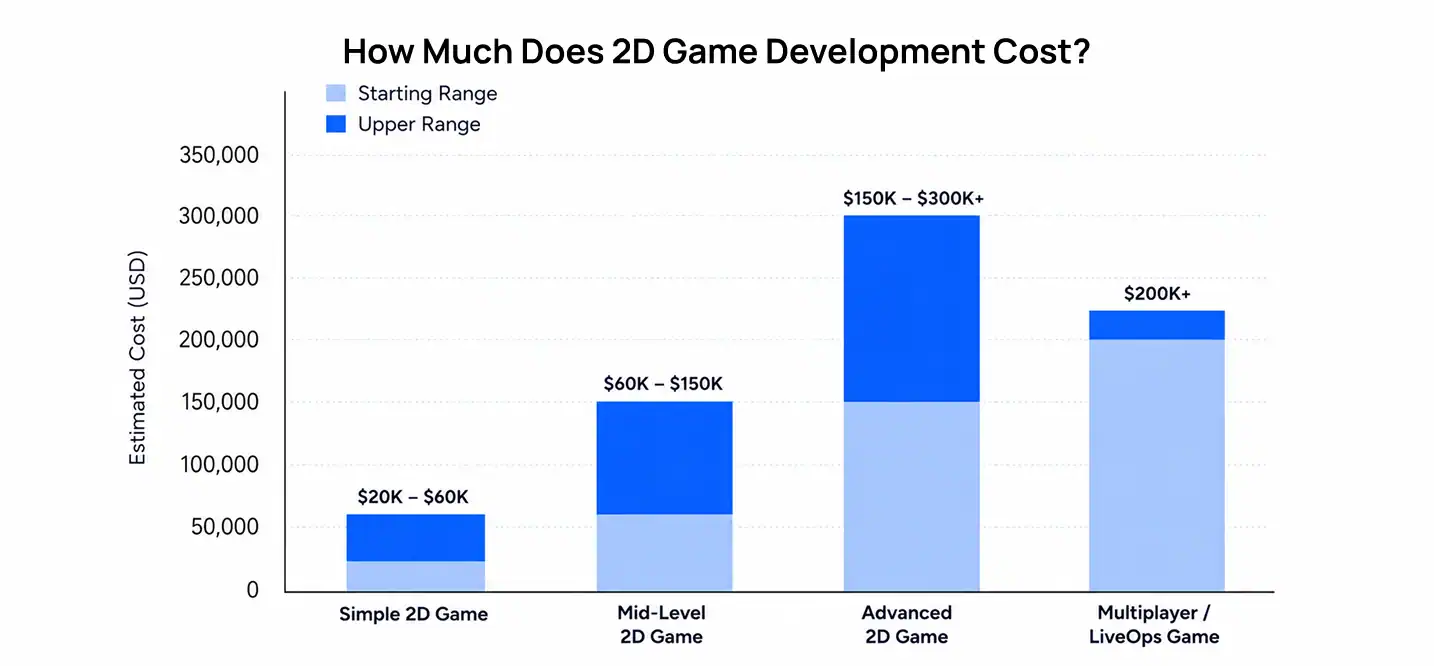
As a planning range, a simple 2D game may fall around $20,000 to $60,000, while a mid-level project can reach $60,000 to $150,000. More advanced games with complex mechanics, multiplayer, custom backend systems, extensive content, or LiveOps can move well beyond $150,000.
These are planning ranges, not fixed market prices. The final estimate depends on the game itself.
| Project Type | Estimated Cost | Typical Complexity |
| Simple 2D Game | $20,000 to $60,000 | Core mechanics, limited content |
| Mid-Level 2D Game | $60,000 to $150,000 | More levels, polished art, monetization |
| Advanced 2D Game | $150,000 to $300,000+ | Complex systems and extensive content |
| Multiplayer / LiveOps Game | $200,000+ | Backend, multiplayer, analytics, ongoing updates |
The important question is not “Who is cheapest?”
Ask instead:
What am I getting for the price?
A low quote that excludes QA, backend development, UI, optimization, or post-launch support may become much more expensive later.
How to Develop an Indie 2D Game Without Overspending
Indie developers usually have to make difficult decisions about where to spend money.
The best approach is to protect the core gameplay first.
Start with an MVP that answers one question:
Is this game actually fun?
Do not spend heavily on dozens of levels before proving that the central gameplay loop works.
Consider:
- Building a prototype first
- Limiting the number of characters
- Starting with fewer levels
- Reusing suitable systems
- Prioritizing core mechanics
- Testing with real players
- Adding advanced features later
- Outsourcing specialized work when necessary
Outsourcing can also give indie teams access to specialized programming, art, QA, and production skills without requiring a permanent in-house team. You can learn more about the advantages in Game Development Outsourcing Benefits and Outsource Game Development.
How to Develop 2D Games in Unity
If you decide that Unity is the right engine, the development process generally starts with the project foundation and then moves through gameplay, art, animation, UI, audio, testing, and publishing.
Unity’s current documentation covers sprites, Tilemaps, 2D physics, animation, lighting, profiling, optimization, and publishing as part of its 2D workflow.
A simplified process looks like this:
- Create the Unity project.
- Define the game’s perspective and art style.
- Import and organize sprites.
- Build the player controller.
- Add enemies and gameplay mechanics.
- Create levels with Tilemaps or other level tools.
- Add animation and effects.
- Build menus and UI.
- Add audio.
- Test and optimize.
- Prepare platform builds.
- Publish and monitor the game.
For a deeper walkthrough, read How to Build Your First 2D Game in Unity: A Step-by-Step Guide.
2D vs. 3D: Which Development Approach Is Right for Your Game?
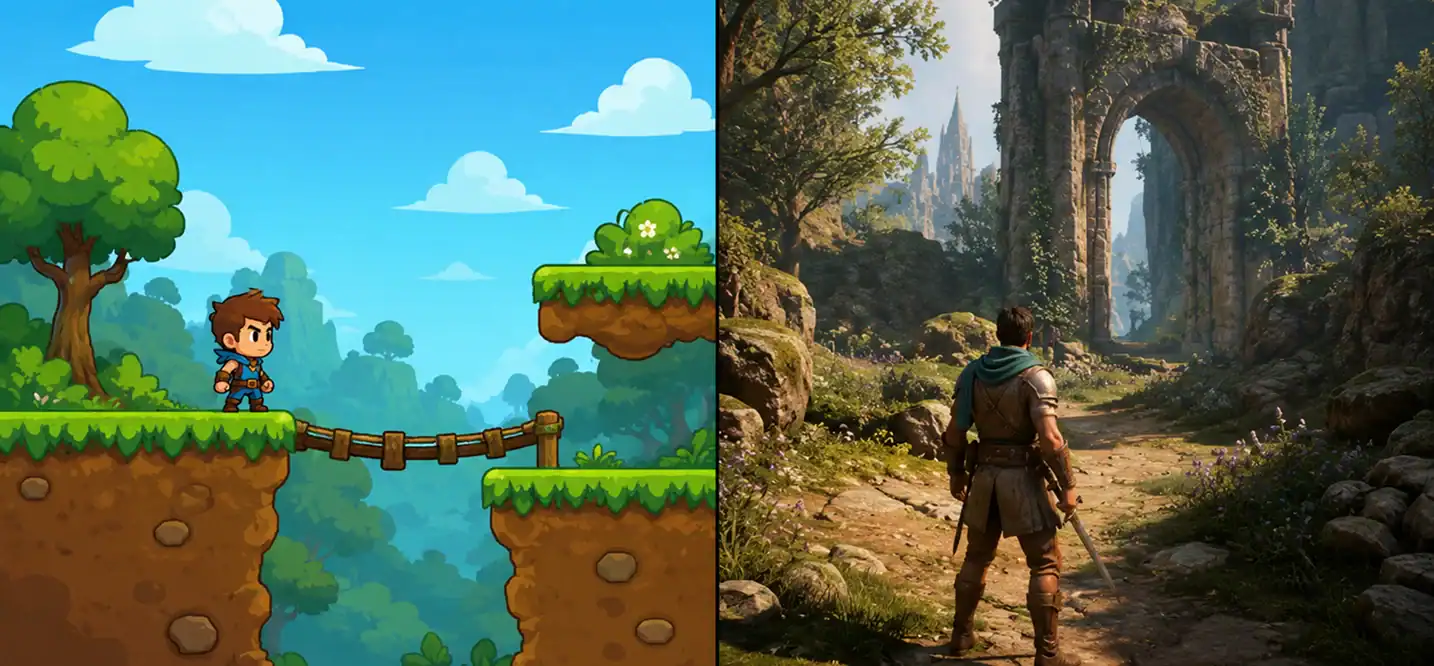
2D is not automatically the cheaper or easier choice. It depends on what you are trying to build.
| Factor | 2D Games | 3D Games |
| Development Complexity | Usually lower | Usually higher |
| Art Requirements | Sprites and 2D assets | Models, textures, rigs, environments |
| Animation | 2D animation systems | 3D rigging and animation |
| Performance | Often easier to optimize | More demanding in many projects |
| Camera | Usually simpler | More complex |
| Best Fit | Platformers, puzzles, arcade, RPGs | Simulations, immersive worlds, 3D action |
The key is to choose based on gameplay, not simply development cost.
If your concept depends on a side-scrolling platformer, pixel-art adventure, card game, or 2D strategy experience, forcing it into 3D may add complexity without adding player value.
For a deeper comparison, see 2D vs 3D Game Development.
Common Mistakes to Avoid When Hiring 2D Game Developers
Choosing Based Only on Price
The cheapest proposal may not include everything your project needs.
Ignoring the Portfolio
If a company cannot show relevant game work, ask why.
Not Playing Previous Games
Screenshots do not show responsiveness, bugs, performance, or gameplay quality.
Skipping the Prototype
A prototype can expose technical and gameplay problems before they become expensive.
Not Defining Ownership
Make source-code and intellectual-property ownership clear before development starts.
Ignoring Communication
A talented developer who is difficult to communicate with can still create a difficult project.
Forgetting Post-Launch Support
Your game may need updates, bug fixes, analytics, new content, and optimization after launch.
Not Defining Milestones
A project should have clear deliverables and approval points.
What Is the Best Company in Game Programming?
There is no single company that is best for every game.
The right choice depends on your project requirements.
For example, a small indie platformer may need a compact team with strong 2D art and gameplay experience. A multiplayer mobile game may need programmers, backend engineers, QA specialists, analytics expertise, and LiveOps support.
When comparing companies, look at:
- Relevant portfolio experience
- Technical expertise
- Game design capabilities
- Art and animation quality
- Communication
- Pricing
- Development methodology
- QA
- Post-launch support
The strongest partner is the one that fits your game, not necessarily the company with the biggest website or the lowest quote.
What Are the Best Game Development Companies Based in the US?
If you specifically want a US-based partner, use the same evaluation process.
Look at:
- Location and time-zone compatibility
- Portfolio
- Client reviews
- Technical skills
- Communication
- Pricing
- Team size
- Support model
- Relevant genre experience
Do not assume that location automatically determines quality. A strong remote or offshore development partner can sometimes provide broader talent access and more flexible engagement options.
The better question is:
Which team has the skills, process, communication, and experience your game needs?
Why Choose Cubix for 2D Game Development?
Choosing a Game Development Studio is ultimately about trust.
Cubix approaches game development as a full product process rather than treating programming as the only deliverable. The team can support different stages of development, from initial concept and game design through development, QA, launch, and ongoing improvements.
That matters because a successful 2D game needs more than functional code. It needs responsive gameplay, consistent visuals, thoughtful UX, stable performance, and a development process that keeps the project moving.
For teams looking for a partner that can handle multiple parts of the development lifecycle, Cubix can provide a more integrated approach to game production.
Build Your Next 2D Game With Cubix
Your idea does not need to start as a finished game.
It can start with a mechanic, a sketch, a character, or even a simple question:
“Would players actually enjoy this?”
The right development team can help turn that starting point into a prototype, refine the gameplay, build the technology, create the art, test the experience, and prepare it for launch.
Cubix brings together game design, engineering, art, QA, and development expertise to help turn game concepts into playable experiences.
If Unity is the right technology for your project, Cubix can also support the development process through its Unity game development services.