Key Takeaways
- Mobile gaming is projected to exceed 60% of global gaming revenue by 2030.
- AI-assisted development will significantly reduce production time for many workflows.
- Cross-platform functionality will become the standard rather than a premium feature.
- Cloud gaming adoption will continue expanding as internet infrastructure improves globally.
- Subscription services will play an increasingly important role in player acquisition and retention.
- Handheld gaming PCs will continue blurring the line between consoles and traditional computers.
Not long ago, gaming was largely defined by hardware. You either owned a gaming PC, played on a console connected to your television, or occasionally passed time with simple mobile games.
Fast forward to 2026, and that distinction has blurred dramatically.
Today’s gamers move seamlessly between smartphones, gaming laptops, consoles, tablets, and even cloud gaming platforms. Someone might complete daily quests on their phone during lunch, continue the same game on a PC after work, and finish the evening on a console with friends. Gaming is no longer tied to a single device, it’s becoming an interconnected ecosystem.
The numbers tell an equally fascinating story.
The global gaming industry is now valued at well over $250 billion, making it significantly larger than both the global movie and music industries combined. Meanwhile, more than 3.5 billion people around the world play video games in some form. That means nearly one out of every two people on Earth is now a gamer.
But despite this incredible growth, one question continues to spark debate among developers, publishers, investors, and gamers alike:
Which platform actually dominates the gaming industry in 2026?
Is it mobile, with billions of users and unmatched accessibility? Does PC remain the preferred platform for competitive gaming and esports? Or do consoles continue to command the premium gaming experience through exclusive titles and high-spending audiences?
The answer isn’t as straightforward as looking at player numbers alone.
Each platform dominates a different part of the gaming ecosystem. Mobile leads in accessibility and revenue, PCs continue to power competitive gaming and creator communities, while consoles remain the benchmark for blockbuster entertainment and premium player engagement.
In this guide, we’ll break down the latest 2026 gaming market statistics, compare mobile vs. PC vs. console gaming, analyze player behavior, examine regional trends, and explore where the industry is heading over the next several years.
Gaming Industry Snapshot (2026)
The mobile game development services industry has entered a period of sustainable growth after the explosive expansion witnessed during the COVID-19 pandemic. While lockdowns accelerated digital entertainment adoption between 2020 and 2022, today’s growth is driven by entirely different factors, higher smartphone penetration, live-service games, cloud gaming, artificial intelligence, and expanding gaming populations across emerging markets.
According to multiple market research firms, including Newzoo, Statista, Grand View Research, and PwC, the global games market continues to demonstrate remarkable resilience despite broader economic uncertainty.
Several macro trends are fueling this expansion:
- Rising internet accessibility worldwide
- Affordable smartphones entering developing markets
- Live-service business models generating recurring revenue
- Increasing popularity of esports
- Subscription gaming services
- AI-assisted game development
- Cross-platform multiplayer ecosystems
Rather than competing against each other, gaming platforms increasingly complement one another. Players often own multiple devices and expect their progress, purchases, and friends lists to travel with them.
Want to discuss your project? Our experts are just a click away.
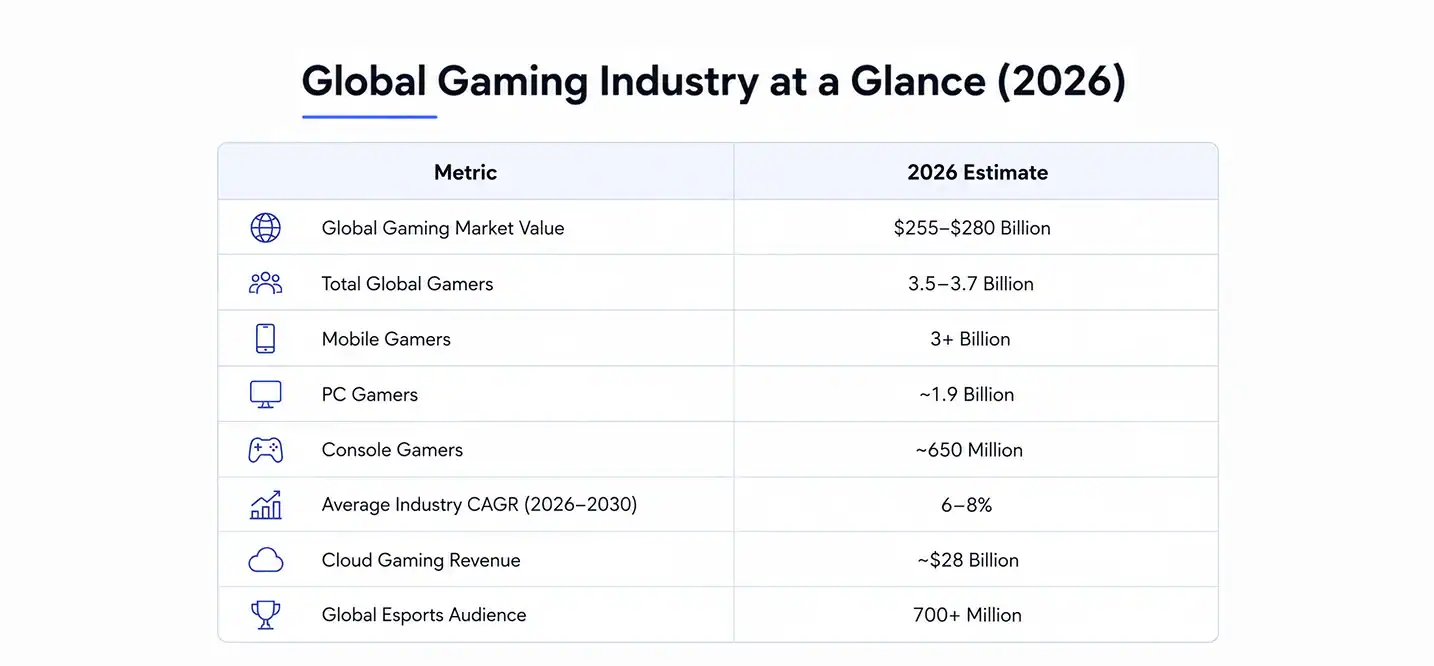
Contact UsGlobal Gaming Industry at a Glance (2026)
| Metric | 2026 Estimate |
| Global Gaming Market Value | $255–$280 Billion |
| Total Global Gamers | 3.5–3.7 Billion |
| Mobile Gamers | 3+ Billion |
| PC Gamers | ~1.9 Billion |
| Console Gamers | ~650 Million |
| Average Industry CAGR (2026–2030) | 6–8% |
| Cloud Gaming Revenue | ~$28 Billion |
| Global Esports Audience | 700+ Million |
One statistic stands out more than any other:
More people now play games on mobile devices than own a gaming PC or console combined.
Who Are Today’s Gamers?
The stereotypical image of gamers has changed dramatically.
Gaming audiences now span virtually every age group and demographic. Casual mobile gamers include office workers, parents, and retirees, while competitive PC and console communities continue attracting younger audiences alongside long-time enthusiasts.
Some interesting demographic trends include:
- Nearly half of all gamers are female.
- The average gamer is now in their early-to-mid 30s.
- Millennials remain one of the industry’s highest-spending demographics.
- Generation Z continues driving social gaming, creator content, and live-service engagement.
Gaming has evolved beyond entertainment, it’s become a social platform, a competitive sport, and for many, a professional career.
Mobile vs. PC vs. Console: Market Share Comparison
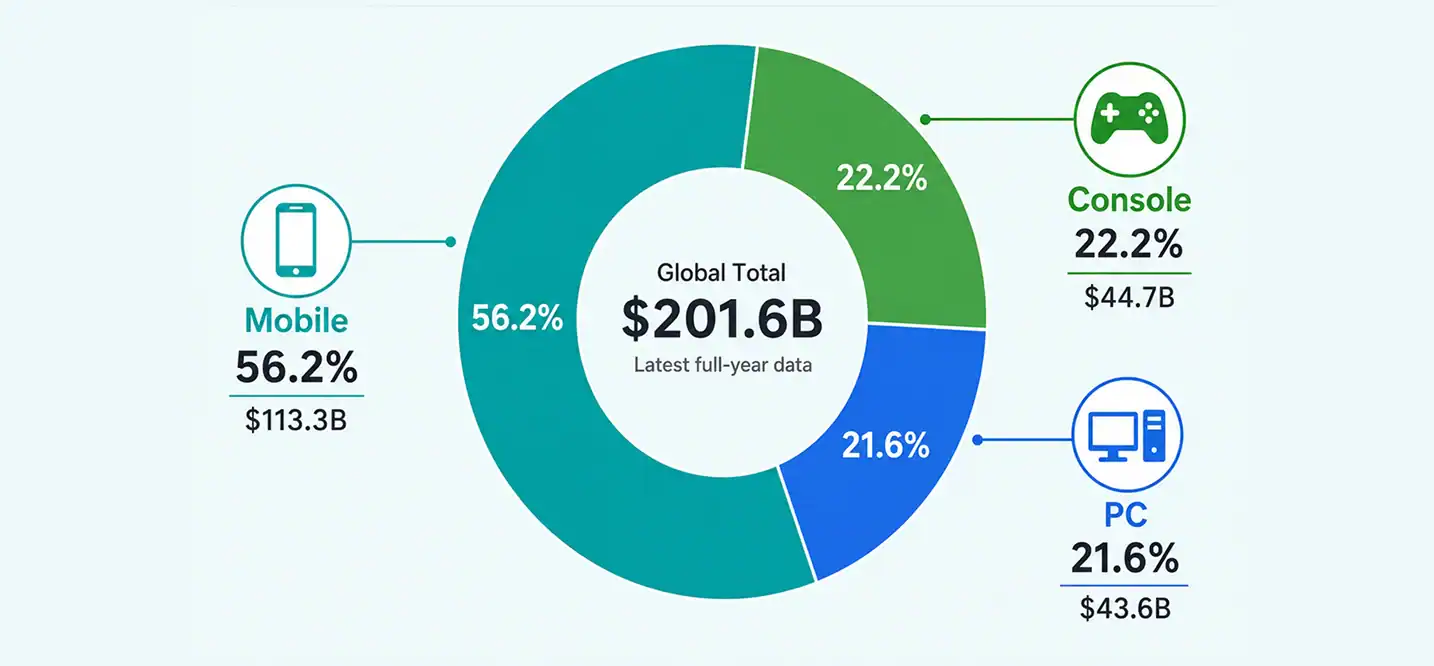
When people ask which gaming platform is “winning,” they’re usually referring to market share. But market leadership depends entirely on what metric you’re measuring.
- Is it revenue?
- Player count?
- Average spending?
- Engagement?
- Growth?
The reality is that each platform dominates a different category.
Gaming Platform Comparison (2026)
| Platform | Estimated Revenue | Global Market Share | Active Players | Average Spend per User |
| Mobile | $140–150 Billion | ~55% | 3+ Billion | Low–Moderate |
| Console | $46–50 Billion | ~18–20% | ~650 Million | Highest |
| PC | $55–60 Billion (Software) | ~22–24% | ~1.9 Billion | Moderate–High |
At first glance, mobile appears to dominate every category, and in terms of total revenue and player volume, it certainly does.
Yet, a closer look reveals a far more nuanced picture.
Console gamers consistently generate the highest Average Revenue Per User (ARPU). Purchasing a console often represents just the beginning of their investment. Many players also buy premium games priced between $60 and $80, subscribe to online gaming services, purchase downloadable expansions, and spend regularly on cosmetics or battle passes.
Why Mobile Gaming Continues to Dominate

If someone had predicted fifteen years ago that smartphones would become the world’s most popular gaming platform, many industry experts would have been skeptical.
Today, that prediction has become reality.
Mobile gaming now contributes more than half of global gaming revenue and serves over three billion players worldwide, making it the largest entertainment platform on the planet.
But why has mobile maintained such a commanding lead? The answer extends far beyond convenience.
Smartphones Removed the Biggest Barrier to Gaming
Unlike gaming PCs or consoles, smartphones are already part of everyday life.
Consumers don’t buy a phone solely to play games, they purchase one for communication, work, navigation, banking, shopping, and entertainment. Gaming simply becomes another capability on a device they already own.
Compare the cost of entry:
| Platform | Approximate Entry Cost |
| Mobile | Often Free |
| Console | $500–700 + Game Purchases |
| Gaming PC | $1,000–2,000+ |
This dramatically lower barrier has allowed mobile gaming to expand into regions where consoles and gaming PCs remain relatively expensive.
Emerging markets across Southeast Asia, Africa, Latin America, and the Middle East continue driving millions of new mobile gamers every year.
Free-to-Play Changed Everything
One of the biggest reasons behind mobile gaming’s explosive success is the Free-to-Play (F2P) business model.
Instead of asking players to purchase a game upfront, developers allow users to start playing immediately. Revenue is generated later through optional purchases such as:
- Character skins
- Battle passes
- Cosmetic items
- Energy refills
- Loot systems
- Gacha mechanics
- Limited-time events
The custom game development company industry estimates suggest that over 85% of mobile gaming revenue now comes from in-app purchases, making LiveOps one of the most profitable strategies in modern game development.
Games like Honor of Kings, MONOPOLY GO!, Royal Match, and PUBG Mobile continue generating billions of dollars annually despite being free to download.
LiveOps Keeps Players Coming Back
The mobile gaming industry rarely relies on one-time purchases anymore.
Instead, successful titles operate as live services.
Developers continuously introduce:
- Weekly events
- Seasonal content
- New characters
- Collaborations
- Holiday campaigns
- Competitive tournaments
- Time-limited rewards
This steady stream of fresh content significantly improves player retention while increasing lifetime customer value.
For developers, retaining existing players is often considerably more cost-effective than constantly acquiring new ones.
Emerging Markets Are Driving the Next Billion Players
Much of mobile gaming’s future growth won’t come from North America or Western Europe.
Instead, it’s being powered by rapidly developing economies where smartphone adoption continues accelerating.
Countries such as India, Indonesia, Brazil, Nigeria, Saudi Arabia, Vietnam, and Egypt have witnessed remarkable increases in mobile gaming participation due to:
- Affordable Android devices
- Expanding 5G coverage
- Digital payment adoption
- Younger populations
- Increased mobile internet accessibility
For developers targeting global audiences, mobile remains the most scalable platform available today.
Console Gaming: Still the Home of Premium Entertainment

Despite representing a smaller share of the overall gaming market, console gaming remains one of the industry’s most valuable segments.
Why?
Because console players consistently spend more.
Major console manufacturers, including Sony, Microsoft, and Nintendo, continue building entire ecosystems rather than simply selling hardware.
Console Gaming Snapshot (2026)
| Metric | Estimate |
| Console Market Revenue | ~$46–50 Billion |
| Active Players | ~650 Million |
| Average Game Price | $70–80 |
| Primary Revenue Sources | Hardware, Premium Games, DLC, Subscriptions |
Exclusive Games Still Sell Consoles
Hardware specifications certainly matter.
But exclusive content remains the biggest reason players purchase a console.
Franchises like God of War, The Legend of Zelda, Mario, Spider-Man, and Halo continue driving hardware adoption because they simply cannot be experienced the same way elsewhere at launch.
Exclusive releases also create powerful communities and long-term brand loyalty, something that’s much harder to replicate in the fragmented PC ecosystem.
Subscription Services Continue Expanding
Console gaming has also embraced recurring revenue. Platforms now encourage players to subscribe through services that offer:
- Extensive game libraries
- Cloud saves
- Multiplayer access
- Day-one releases (for selected titles)
- Exclusive member discounts
- Cloud streaming capabilities
This subscription-first approach provides publishers with predictable, recurring income while offering players greater value over time.
The Console Challenge
Even so, consoles face increasing competition from both ends of the market.
At the entry level, flagship smartphones can now run visually demanding games that were once considered console-exclusive experiences.
At the premium end, modern gaming PCs offer significantly greater flexibility, customization, and graphical performance.
As a result, console manufacturers are increasingly investing in cross-platform ecosystems, cloud integration, and digital services rather than relying solely on hardware sales.
PC Gaming: The Home of Competitive and High-Performance Gaming

While mobile dominates in accessibility and consoles continue delivering premium entertainment, PC gaming remains the industry’s most versatile platform.
It is the preferred choice for competitive gamers, content creators, streamers, esports professionals, modding communities, and players who demand the highest graphical fidelity.
In 2026, PC gaming continues to grow steadily, supported by advances in hardware, digital distribution, artificial intelligence, and a thriving creator ecosystem.
PC Gaming by the Numbers (2026)
| Metric | Estimate |
| Active PC Gamers | ~1.9 Billion |
| PC Software Revenue | $55–60 Billion |
| PC Hardware Revenue | $70+ Billion |
| Steam Monthly Active Users | 140+ Million |
| Global Esports Audience | 700+ Million |
Steam Continues to Lead Digital Distribution
The PC ecosystem is largely powered by digital storefronts.
Platforms like Steam, Epic Games Store, GOG, Battle.net, and Microsoft Store have made game distribution faster and more accessible than ever.
Steam alone regularly hosts more than 40 million concurrent users during peak periods, while thousands of new titles are released annually.
For indie developers, this creates unprecedented opportunities to publish games without relying on physical distribution or console certification.
Esports Keeps PC Gaming at the Center of Competitive Play
If there’s one platform synonymous with competitive gaming, it’s PC.
Many of the world’s largest esports titles, including Counter-Strike 2, Dota 2, League of Legends, VALORANT, and PUBG, continue to thrive primarily on PC.
The esports ecosystem now generates billions of dollars through sponsorships, advertising, media rights, merchandise, and tournament prize pools.
This has created a ripple effect across the hardware industry.
Competitive gamers increasingly invest in:
- High-refresh-rate monitors
- Mechanical keyboards
- Precision gaming mice
- Low-latency headsets
- High-performance GPUs
Gaming has become both entertainment and professional sport.
AI Is Redefining the PC Experience
Artificial intelligence is becoming one of PC gaming’s biggest differentiators.
Modern graphics technologies such as AI-powered frame generation, intelligent upscaling, and real-time rendering improvements allow developers to deliver cinematic visuals while maintaining high frame rates.
At the same time, AI is helping studios build smarter NPCs, procedural worlds, automated testing pipelines, and faster content production.
For developers, PC often serves as the first platform to adopt these innovations before they eventually reach consoles and mobile devices.
Regional Gaming Trends: Where Growth Is Happening
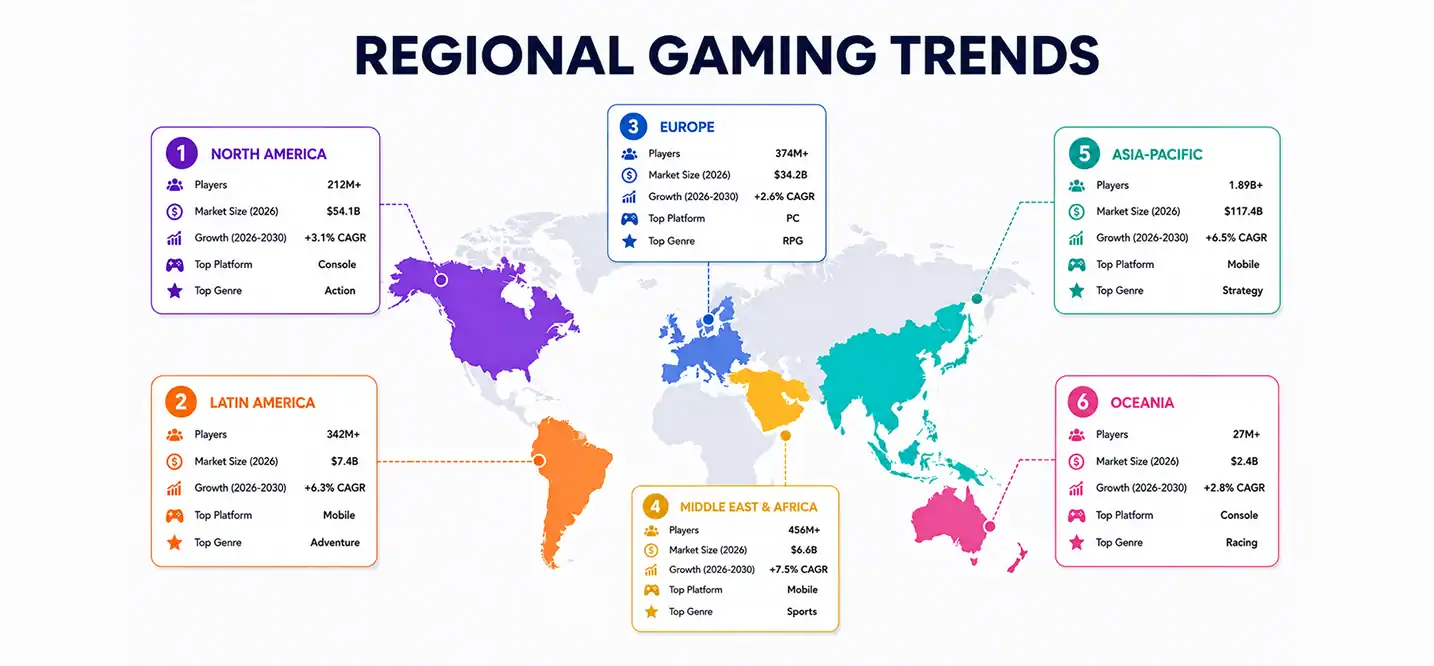
Gaming isn’t growing at the same pace everywhere.
Different regions have unique player behaviors, preferred platforms, spending habits, and technological infrastructure.
Understanding these differences is critical for developers planning global launches.
Asia-Pacific Remains the Largest Gaming Market
Asia-Pacific continues leading the global gaming industry in both player count and revenue.
Countries including China, Japan, South Korea, and India collectively represent billions of gamers.
Mobile gaming dominates much of the region due to:
- Affordable smartphones
- High mobile internet penetration
- Established digital payment systems
- Strong esports culture
- Mobile-first consumer behavior
China alone remains one of the world’s highest-grossing gaming markets despite ongoing regulatory oversight.
Meanwhile, India’s gaming audience continues expanding rapidly thanks to inexpensive Android devices and widespread internet access.
North America and Europe Focus on Premium Gaming
Although player growth has slowed compared to emerging markets, North America and Europe remain among the highest-spending gaming regions.
Console ownership remains particularly strong, while PC gaming continues thriving among enthusiasts.
Consumers in these markets typically spend more on:
- AAA releases
- Gaming hardware
- DLC
- Subscription services
- Accessories
These regions also account for a significant portion of esports viewership and livestreaming audiences.
The Middle East Is Becoming a Gaming Powerhouse
One of the fastest-growing gaming regions today is the Middle East.
Saudi Arabia, the UAE, and neighboring countries are investing heavily in gaming infrastructure, esports, and digital entertainment.
Saudi Arabia’s Vision 2030 initiative has accelerated investment across:
- Game development
- Esports
- Gaming events
- Publishing
- Education
- Technology startups
The Kingdom has also hosted globally recognized esports tournaments while attracting international publishers and development studios.
For developers, the Middle East is quickly transitioning from an emerging market to a strategic growth region.
Mobile vs. PC vs. Console: Side-by-Side Comparison
| Category | Mobile | PC | Console |
| Global Market Share | Highest | Medium | Medium |
| Accessibility | Excellent | Moderate | Moderate |
| Hardware Cost | Low | High | Medium |
| Graphics Quality | Good | Excellent | Excellent |
| Largest Player Base | This One | ||
| Highest Spending per User | The One | ||
| Competitive Gaming | Moderate | Highest | High |
| Portability | Highest | Low | Low |
| Development Cost | Low – Medium | High | High |
| Monetization Flexibility | Excellent | High | High |
Which Platform Should Game Studios Prioritize?
The answer depends entirely on the type of game being developed.
| Game Type | Best Platform |
| Hypercasual | Mobile |
| Casual Puzzle | Mobile |
| MMORPG | PC |
| Competitive FPS | PC |
| AAA Story-Driven | Console |
| Sports Games | Console + PC |
| Battle Royale | Cross-Platform |
| Live-Service Multiplayer | Cross-Platform |
Increasingly, studios are choosing cross-platform development from the beginning.
Launching simultaneously across mobile, PC, and consoles expands reach, strengthens communities, and reduces reliance on a single platform’s ecosystem.
Build Cross-Platform Games That Players Love with Cubix

The future of gaming is cross-platform, connected, and player-centric, and that’s exactly where Cubix helps studios succeed as the best virtual reality game development company.
From mobile and PC titles to console experiences, our team specializes in developing scalable, high-performance games that deliver consistent gameplay across multiple platforms. We combine technical expertise with player-first design to bring your vision to life.
If you’re ready to create engaging games that reach audiences wherever they play, Cubix Games has the expertise to help you build, scale, and grow.
Want to discuss your project? Our experts are just a click away.
Contact UsFAQs
1. Which gaming platform has the largest market share in 2026?
Mobile gaming holds the largest share of the global gaming market in 2026, accounting for approximately 55% of total gaming revenue. With more than 3 billion mobile gamers worldwide, smartphones have become the most accessible gaming platform thanks to affordable devices, free-to-play games, and widespread internet connectivity. However, PC and console gaming continue to generate significant revenue through premium titles, hardware sales, and subscription services.
2. Is PC gaming growing faster than console gaming?
Yes, PC gaming is expected to experience steady growth over the next several years, driven by esports, digital game distribution, AI-powered graphics technologies, and high-performance hardware. While console gaming remains a strong market for blockbuster titles and exclusive franchises, analysts predict that PC gaming will continue to outpace consoles in software revenue growth through the latter part of the decade.
3. Why is mobile gaming more profitable than PC and console gaming?
Mobile gaming generates higher overall revenue because of its massive global player base and highly effective free-to-play monetization model. Rather than relying on upfront game purchases, mobile games earn revenue through in-app purchases, battle passes, advertisements, and live-service events. Although individual players typically spend less than console gamers, the enormous number of active users creates significantly higher total revenue.
4. Which platform is best for game developers to target?
The ideal platform depends on the game’s genre, target audience, and business model. Mobile is often the best choice for casual and free-to-play games, while PC excels in competitive multiplayer, strategy, simulation, and mod-friendly titles. Consoles remain the preferred platform for premium AAA games and story-driven experiences. Many modern studios now prioritize cross-platform development to maximize player reach and long-term engagement.