Building an MVP is not about spending less. It is about learning what deserves more investment.
The U.S. Bureau of Labor Statistics found that 57.3% of U.S. private-sector establishments born in 2018 were still operating five years later, highlighting how much uncertainty can exist in the early stages of a business. For product teams, that makes the choice between a No-Code MVP and a Custom MVP more than a development preference.
A No-Code MVP can reduce initial development effort and speed up idea validation, while custom development provides greater control over architecture, functionality, integrations, and long-term scalability. The right choice depends on what you need to validate, how complex the product is, and what you expect to build after the MVP.
For a broader view of the factors that affect MVP cost and timeline, scope, features, integrations, team requirements, and technical complexity all need to be considered before development begins.
Key Takeaways
- No-Code MVPs can lower upfront costs and speed up idea validation through prebuilt tools and workflows.
- Custom MVPs require more initial investment but offer greater control over functionality, architecture, integrations, and scalability.
- No-Code MVP cost also includes platform fees, integrations, plugins, maintenance, and potential migration expenses.
- Speed to market depends on complexity. No-code works well for straightforward products, while complex requirements may reduce its time advantage.
- Choose based on what you need to validate, not simply the lowest development cost.
- Migration and future scalability matter. A no-code MVP can transition to custom development, but rebuilding core components may add cost later.
- Hybrid development can combine no-code speed with custom engineering where deeper technical control is required.
No-Code MVP vs Custom MVP: What’s the Difference?
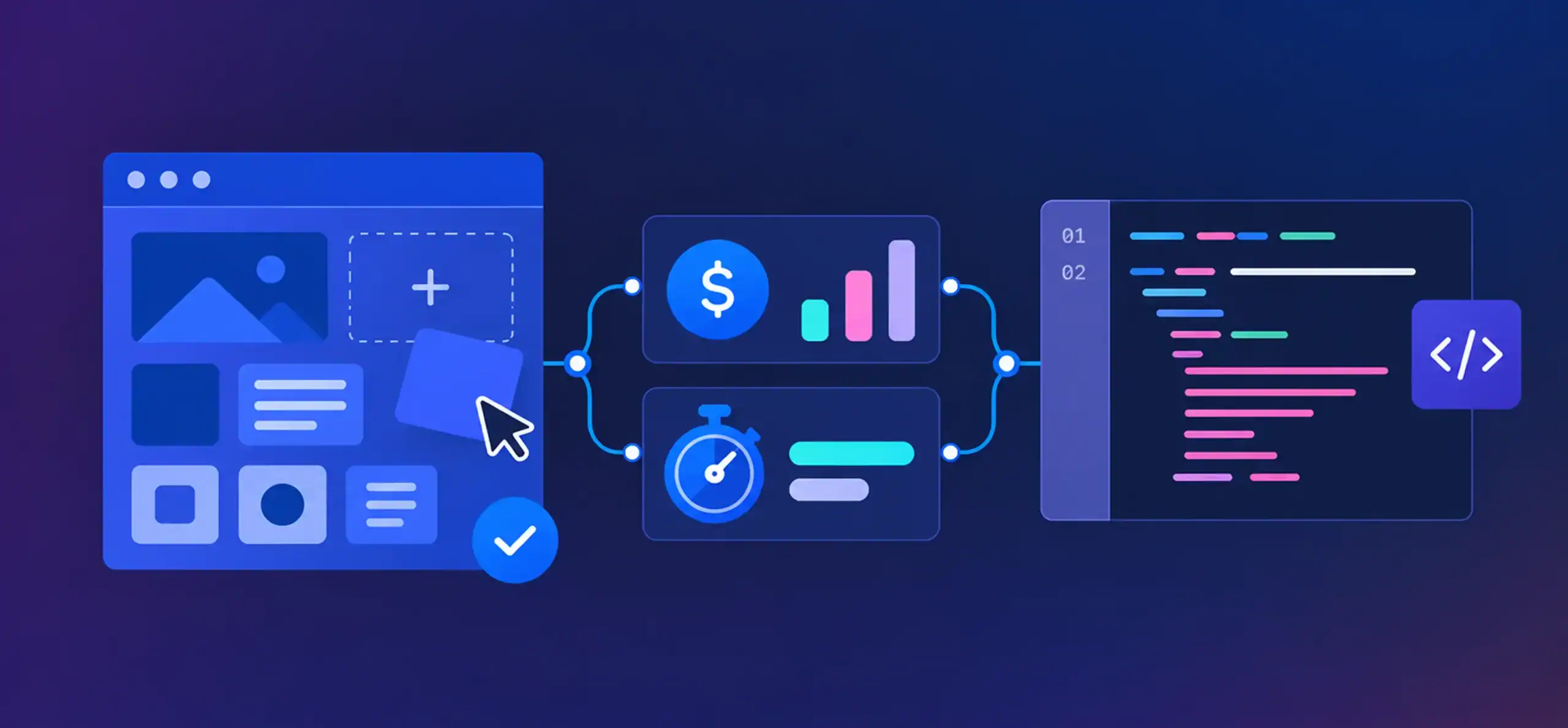
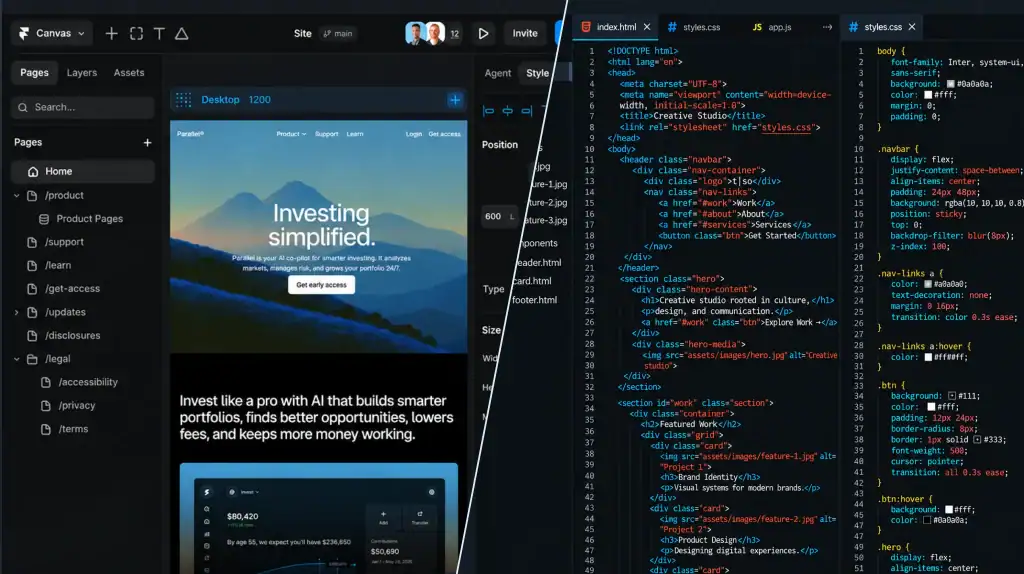
A No-Code MVP uses a visual development platform to assemble an initial product with little or no traditional programming. A Custom MVP is built with code using a technology stack selected around the product’s requirements.
The difference is not simply “easy versus difficult.” It is primarily about how much control you need over the technology behind the MVP.
What Is a No-Code MVP?
A No-Code MVP uses visual development tools for interfaces, workflows, databases, authentication, integrations, and other product functions.
Platforms such as Bubble and FlutterFlow provide visual development environments and prebuilt capabilities that can reduce the amount of code required. Bubble, for example, combines application plans with workload-based usage, while FlutterFlow provides visual development alongside API integrations and code extensibility.
This approach can work well when the product’s core value comes from a straightforward workflow rather than highly specialized technology.
Typical examples include:
- Marketplaces
- Booking platforms
- Directories
- Internal business tools
- Basic customer portals
- Simple SaaS products
- Community platforms
- Operational dashboards
- Early-stage validation products
What Is a Custom MVP?
A Custom MVP is engineered specifically for the product. Developers define the frontend, backend, database structure, APIs, authentication, infrastructure, testing strategy, and deployment process according to the requirements.
That does not mean every Custom MVP needs an elaborate architecture. Good custom development is still selective. The goal is to build the minimum technical foundation required for the product to work reliably and evolve without unnecessary rework.
For products with complex technical requirements, working with a team that provides software development services can help cover architecture, development, integration, testing, and deployment as one engineering workflow.
No-Code MVP vs Custom MVP at a Glance
| Factor | No-Code MVP | Custom MVP |
| Initial development effort | Lower | Higher |
| Speed to first version | Usually faster | Usually slower |
| Technical control | Limited by platform | High |
| Custom business logic | Suitable for straightforward logic | Suitable for complex logic |
| Integrations | Depends on connectors/APIs | APIs can be built and customized |
| UI flexibility | Depends on platform | High |
| Infrastructure control | Platform-dependent | Team-controlled |
| Scalability | Depends on platform and architecture | Determined by architecture |
| Maintenance | Platform + product maintenance | Product and infrastructure maintenance |
| Migration risk | Higher if platform limits are reached | Lower platform dependency |
| Best fit | Fast validation | Complex or long-term products |
How Much Does a No-Code MVP Cost?
The No-Code MVP cost is usually lower at the development stage because the platform already provides capabilities that would otherwise require engineering time.
But the platform subscription is only one part of the budget.
A realistic No-Code MVP cost can include:
- Platform subscription
- UI/UX design
- Product configuration
- Database setup
- Workflow development
- API integrations
- Authentication
- Payment integration
- Testing
- Analytics
- Hosting or usage charges
- Plugins and third-party services
- Ongoing platform fees
For example, Bubble currently uses both plan tiers and workload-based usage, meaning an application’s ongoing cost can change as usage and processing requirements increase.
That is why No-Code MVP pricing should be evaluated as a combination of setup costs and recurring operating costs rather than a single platform subscription.
What Affects No-Code MVP Pricing?
Several factors can change the No-Code MVP development cost:
- Number of workflows: More complex workflows require more configuration and testing.
- Integrations: CRM, payment, messaging, analytics, and external APIs add implementation work.
- User roles: Admins, customers, vendors, managers, and other roles introduce additional permissions and workflows.
- Data structure: Complex relationships between records can make the application harder to configure.
- UI requirements: A highly customized interface can require substantially more design and implementation work.
- Platform usage: Usage-based pricing can become relevant as traffic and data processing increase.
- Third-party services: Plugins and external services can introduce recurring costs.
So while a No-Code MVP can reduce the initial engineering bill, it does not automatically mean the product has a low total cost of ownership.
Is a DIY No-Code MVP Really Cheap?
Not always.
A founder may be able to create a basic prototype with little direct development expenditure. But building a usable MVP still requires product planning, UX decisions, workflow configuration, testing, integration work, analytics, and launch preparation.
There is also an opportunity cost.
Spending weeks learning a platform, troubleshooting workflows, and rebuilding poorly structured features is still development time. For a business owner, that time has a cost even when no developer invoice is involved.
A No-Code MVP becomes financially attractive when the platform removes meaningful engineering work without creating excessive workarounds later.
How Much Does a Custom MVP Cost?
The Custom MVP cost is higher upfront because the product needs to be engineered rather than assembled primarily from existing platform capabilities.
A typical custom MVP budget can include:
- Product discovery
- Technical architecture
- UI/UX design
- Frontend development
- Backend development
- Database design
- API development
- Third-party integrations
- Authentication and authorization
- Quality assurance
- DevOps and deployment
- Security implementation
- Monitoring and post-launch maintenance
The exact MVP development cost depends heavily on what the product actually needs. Platform count, feature complexity, integrations, UI/UX, testing, infrastructure, and technical requirements can all change the budget.
For mobile products, factors such as the number of platforms, native functionality, backend complexity, and integrations also influence the cost of mobile app development.
The important distinction is that custom development gives you more control over where that investment goes. You can choose the database, APIs, cloud environment, architecture, programming languages, and infrastructure based on the product rather than the limitations of a particular platform.
No-Code MVP vs Custom MVP: Which Is Faster?
For the first working version, no-code usually has an advantage because many foundational capabilities already exist.
A visual platform can provide:
- Prebuilt interface components
- Database functionality
- Authentication
- Workflow builders
- API connectors
- Hosting
- Deployment tools
- Reusable templates
That removes work that would otherwise need to be designed, developed, tested, and deployed.
However, speed to market is not the same as speed to a production-ready product.
Prototype vs Functional MVP vs Production-Ready MVP
| Product stage | No-Code | Custom Development |
| Clickable prototype | Very fast | Fast |
| Basic functional MVP | Fast | Moderate |
| Complex functional MVP | Moderate | Moderate to slow |
| Production-ready MVP | Depends on platform limits | Depends on scope |
| Highly customized product | Can slow down | More predictable |
| Complex integrations | Can require workarounds | More engineering upfront |
A tightly scoped product can move either way quickly. The difference becomes more noticeable when requirements move beyond the capabilities of the chosen no-code platform.
Reducing unnecessary features and keeping validation focused can help teams develop an MVP in less than a month when the scope and team structure support that timeline.
No-Code vs Custom Development: Cost and Speed Compared
The cost and speed tradeoff becomes clearer when you separate initial development from long-term product economics.
1. Upfront Cost
No-code generally requires less engineering effort, which can lower the initial MVP investment.
Custom development requires more work for architecture, frontend and backend development, integrations, testing, and deployment.
2. Development Speed
No-code can shorten the first development cycle because the platform supplies reusable functionality.
Custom development takes longer when the same functionality needs to be engineered from scratch.
3. Long-Term Cost
No-code may introduce recurring platform, usage, plugin, and integration expenses. Custom software generally shifts more of the cost toward engineering, infrastructure, maintenance, and future development.
4. Long-Term Development Speed
No-code can remain fast if the product stays within the platform’s capabilities. If developers repeatedly need workarounds, custom integrations, or platform-specific compromises, the speed advantage can narrow.
Custom development takes longer initially but can make future changes more direct when the architecture was built around the product’s actual requirements.
What Are the Hidden Costs of a No-Code MVP?
The most overlooked part of No-Code MVP cost is what happens when the product starts growing.
Potential hidden costs include:
1. Platform and Usage Fees
Some platforms charge based on plans, users, usage, workload, storage, or other resources. Bubble, for example, measures workload based on the resources required to run application processes and offers additional workload options as usage increases.
2. Third-Party Integrations
An MVP may depend on payment gateways, email services, maps, analytics, authentication providers, or automation platforms.
Each dependency can introduce its own pricing and maintenance requirements.
3. Workarounds
A feature that takes an hour to configure initially may become much harder when the product requires unusual business logic that the platform does not support directly.
4. Migration
If the product gains traction but the platform cannot support an important requirement, rebuilding the product becomes a new cost.
That does not make no-code a bad choice. It means the potential migration path should be considered before committing to the platform.
What Are the Hidden Costs of Custom MVP Development?
Custom development has different risks.
1. Overbuilding
A team can spend too much time building features that have not been validated.
An MVP should not become a full product disguised as an early release.
2. Architecture Work
Custom products need decisions around databases, APIs, infrastructure, authentication, deployment, testing, and monitoring. That work adds time but can prevent expensive changes later.
3. Specialized Engineering
Products involving real-time systems, complex integrations, advanced data processing, or specialized algorithms may require engineers with specific technical expertise.
4. Infrastructure and Maintenance
Custom software also requires ongoing maintenance, security updates, monitoring, cloud infrastructure, bug fixes, and future development.
The right approach is not to eliminate these costs. It is to keep them proportional to what the MVP actually needs.
What Should You Validate With Your MVP?

The technology decision should start with the validation question, not the development method.
Ask what evidence the MVP needs to produce.
| What you need to validate | Potentially suitable approach |
| Customer demand | No-code or custom |
| Basic user workflow | No-code |
| Pricing behavior | No-code or custom |
| Marketplace mechanics | Often no-code |
| Complex business logic | Custom |
| Real-time performance | Custom |
| Specialized algorithms | Custom |
| Deep system integrations | Often custom |
| Highly customized mobile functionality | Custom |
| Product-market fit hypothesis | Either, depending on product |
If the primary question is “Will customers use this workflow?”, building a large custom architecture may introduce unnecessary cost.
If the question is “Can this technically complex system perform reliably under real usage?”, the MVP may need the same core technical characteristics as the eventual product.
A structured app idea validation process can help determine what actually needs to be built before development expands.
When Should You Choose a No-Code MVP?
A No-Code MVP can make sense when:
- Speed to market is a major priority.
- The core workflow is straightforward.
- You need to test customer demand quickly.
- Available integrations cover the required functionality.
- The product does not depend on specialized algorithms.
- Performance requirements are moderate.
- You expect significant changes during early validation.
- Platform dependency is an acceptable tradeoff.
For example, a startup testing a booking workflow may not need a custom backend if its primary question is whether customers will book and pay for the service.
The same logic can apply to marketplaces, directories, internal tools, simple portals, and early SaaS concepts.
For startups that need a broader product strategy around mobile development, mobile app development for startups can also help frame the MVP around the product’s actual launch requirements rather than feature volume.
When Should You Build a Custom MVP?
Custom development becomes more relevant when the technology itself is part of the product’s value or risk.
Consider a Custom MVP when you need:
- Complex business logic
- Real-time functionality
- Advanced data processing
- Custom algorithms
- Deep third-party integrations
- Complex role and permission systems
- High-performance requirements
- Specialized mobile device capabilities
- Greater infrastructure control
- Strict security requirements
- A product architecture expected to evolve quickly after validation
Fintech, healthtech, logistics, AI-intensive applications, real-time collaboration tools, data-heavy SaaS products, and specialized B2B platforms can fall into this category depending on their requirements.
The key question is not whether the product sounds complex. It is whether its core validation depends on technical capabilities that no-code cannot provide reliably.
Can a No-Code MVP Scale to Production?

Sometimes.
A no-code product can move beyond initial validation when its platform continues to meet requirements for performance, integrations, security, data management, workflows, and operating cost.
The problem is that growth can expose constraints that were invisible during early testing.
Watch for:
- Increasing platform costs
- Performance problems
- Growing workflow complexity
- API limitations
- Difficult database structures
- Increasing numbers of workarounds
- Limited infrastructure control
- Features that cannot be implemented cleanly
- Security or compliance requirements the platform cannot satisfy
Platform pricing and resource models can also change as usage grows. Bubble, for example, explicitly ties workload consumption to the resources used by an application and provides additional workload options for growing applications.
So the question is not simply “Can no-code scale?”
It is “Can this particular product scale within the platform’s technical and economic constraints?”
When Should You Move From No-Code to Custom Development?
A migration becomes easier to justify when the platform starts interfering with the product roadmap.
Common signals include:
- A core feature cannot be implemented without a workaround.
- Platform limitations are slowing development.
- Performance no longer meets product requirements.
- Usage-based costs are becoming difficult to justify.
- Important integrations are unreliable or difficult to maintain.
- The data model has become too complex.
- The team needs deeper infrastructure control.
- Security or compliance requirements have changed.
- The product now depends on functionality that requires custom engineering.
The transition should be planned before the platform becomes a bottleneck.
Document the workflows, export usable data, identify integrations, define the target architecture, and separate validated features from experiments that do not need to be rebuilt.
Can You Transition From No-Code to Custom Later?
Yes, but it is rarely a simple export-and-import process.
Depending on the platform and product, migration may involve rebuilding:
- Frontend interfaces
- Backend services
- Database structures
- Authentication
- Business logic
- APIs
- Integrations
- Automated workflows
- Admin systems
- Testing infrastructure
This is why platform dependency should be considered during the first MVP.
If migration is likely, keep the product’s requirements, data structures, workflows, and integration logic documented. Avoid building unnecessary platform-specific workarounds just because they are convenient during the first release.
Once the product has validated its core assumptions, scaling mobile apps beyond the MVP becomes a question of architecture, infrastructure, performance, and product priorities rather than simply adding more features.
No-Code MVP vs Custom MVP: Which Approach Fits Your Product?
Use the following decision framework:
| Your priority | Consider |
| Validate demand quickly | No-Code MVP |
| Test a simple workflow | No-Code MVP |
| Keep initial engineering low | No-Code MVP |
| Test pricing or customer behavior | No-Code or Custom |
| Build complex business logic | Custom MVP |
| Need specialized integrations | Custom MVP |
| Require high technical control | Custom MVP |
| Need advanced performance | Custom MVP |
| Expect heavy customization | Custom MVP |
| Unsure whether no-code can support the core feature | Prototype the requirement before committing |
The simplest rule is this:
Choose the technology that can prove your most important product assumption with the least unnecessary technical and financial risk.
That may mean no-code for one product and custom development for another.
What About a Hybrid MVP Approach?
A hybrid approach can combine the speed of no-code with custom engineering where it matters.
For example, a team could use:
- A no-code admin dashboard with a custom customer-facing application
- No-code workflows with a custom backend
- A no-code prototype before building the validated product in code
- No-code internal tools alongside a custom SaaS product
- Existing services for standard functions and custom code for differentiated functionality
This works when the product contains both standard and specialized components.
The important part is defining the boundary clearly. Using custom development for everything can increase the initial budget. Using no-code for everything can create limitations later.
No-Code MVP vs Custom MVP: Final Comparison
| Factor | No-Code MVP | Custom MVP |
| Initial cost | Usually lower | Usually higher |
| Speed to first release | Usually faster | Usually slower |
| Flexibility | Platform-dependent | High |
| Custom functionality | Limited by platform | High |
| Integrations | Depends on available connectors/APIs | Fully customizable |
| Infrastructure control | Limited | High |
| Scalability | Depends on platform and workload | Depends on architecture |
| Recurring platform costs | Common | Depends on infrastructure |
| Migration risk | Higher if platform limits are reached | Lower platform dependency |
| Best use | Rapid idea validation | Complex or technically differentiated products |
There is no universal MVP cost or timeline.
A simple product with a narrow validation goal may be unnecessarily expensive to custom-build. A technically demanding product may create more risk if its MVP is forced into a platform that cannot support the core functionality.
The most useful comparison is therefore not No-Code MVP vs Custom MVP in isolation, but which approach can validate the product’s most important assumption while keeping future rework under control.
How Much Does an MVP Really Cost?
The final MVP cost depends on scope, product type, platform requirements, design, integrations, team structure, testing, infrastructure, and what you plan to do after launch.
A useful estimate should separate:
- Product discovery
- Design
- Development
- Integrations
- Testing
- Infrastructure
- Launch
- Maintenance
- Potential migration or future rebuild
For a mobile product, it also helps to distinguish between a small validation build and a production-oriented application. The requirements covered in mobile app development MVP can vary significantly depending on platform and feature scope.
Conclusion
Choosing between a No-Code MVP and a Custom MVP comes down to what you need to validate, how complex the product is, and how much technical flexibility you expect after launch. No-code can make sense for fast, straightforward validation, while custom development is better suited to products that depend on complex functionality, integrations, performance, or greater technical control. In either case, keeping the MVP focused helps control both cost and development time.
Once the scope and technical direction are clear, the next step is turning the validation plan into a functional product without overbuilding it. Teams that need support with product discovery, architecture, design, development, and testing can explore MVP development services to shape an MVP around their specific requirements and launch goals.
Have an MVP idea? Our experts are just a click away.
Contact UsFrequently Asked Questions
1. What Is the Average Cost Difference Between No-Code and Custom MVPs?
There is no reliable universal percentage because MVP requirements vary widely. No-code can reduce engineering effort for standard workflows, while custom development requires more upfront work but provides greater control. Compare the full scope, recurring platform costs, maintenance, and potential migration costs rather than comparing development quotes alone.
2. How Much Faster Is No-Code MVP Development?
No-code can shorten development when the required features already exist within the platform. The time advantage can decrease when the product needs complex workflows, unusual integrations, custom interfaces, or functionality outside the platform’s normal capabilities.
3. Can a No-Code MVP Scale to Production?
Yes, in some cases. The answer depends on the platform, architecture, traffic, workflows, integrations, performance requirements, security needs, and operating costs. Scaling should be evaluated against the specific product rather than assumed from the platform alone.
4. When Should I Choose No-Code for an MVP?
No-code can be appropriate when the main goal is to test demand, workflows, pricing, or customer behavior and the product does not require unusual technical functionality.
5. When Should I Build a Custom MVP?
Custom development is more suitable when the MVP depends on complex business logic, specialized algorithms, real-time functionality, advanced integrations, performance requirements, infrastructure control, or other capabilities that require deeper engineering.
6. What Are the Hidden Costs in No-Code MVPs?
Potential costs include platform subscriptions, usage fees, plugins, third-party services, workarounds, maintenance, and eventual migration. These costs do not necessarily make no-code expensive, but they should be included when calculating total cost of ownership.
7. Can I Transition From No-Code to Custom Later?
Yes. However, the transition may require rebuilding the frontend, backend, database, authentication, workflows, APIs, and integrations. Keeping requirements and data organized from the beginning can reduce migration complexity.
8. How Do I Validate My Idea With an MVP?
Start with the assumption that creates the greatest business risk. Define what evidence would confirm or challenge it, build only the functionality required to collect that evidence, and measure actual user behavior instead of relying only on feedback.
9. What Is the Average Timeline for MVP Development?
There is no single timeline. A focused MVP can take weeks, while a complex product can require several months. Scope, platform choice, design requirements, integrations, testing, team size, and technical complexity all affect the development timeline. Teams planning a broader schedule should also account for the app development timeline beyond the initial coding phase.
10. Which Approach Has Better Long-Term ROI?
Neither approach guarantees better ROI. No-code may reduce initial investment and speed up validation, while custom development may provide greater control for products that require substantial technical differentiation. The relevant comparison is the total cost of building, operating, changing, and potentially rebuilding the product over its expected lifecycle.