You have mapped out your core users and refined your product concept. Now comes the defining execution step: building a high-performance mobile interface that turns those users into highly engaged customers.
Here is a number worth sitting with: mobile users now spend over 90% of their phone time inside apps, not in browsers. That is not a trend. That is a behavioral shift that already happened. If your startup is not present where users spend most of their digital time, you risk losing visibility, engagement, and revenue opportunities to competitors.
Partnering with an experienced development firm like Cubix for comprehensive mobile app development services streamlines this entire journey.. From early wireframing to final store deployment, Cubix builds stable, scalable architectures that support your long-term business metrics. Having a dedicated engineering ally allows your founding team to focus on customer acquisition, funding rounds, and product-market fit.
Why Does Every Startup Need a Mobile Application?
If your product lives only on the web, you are working against how your users actually behave. Startup mobile app development addresses this gap directly by giving you a product that lives on the one device your users check 150+ times a day.
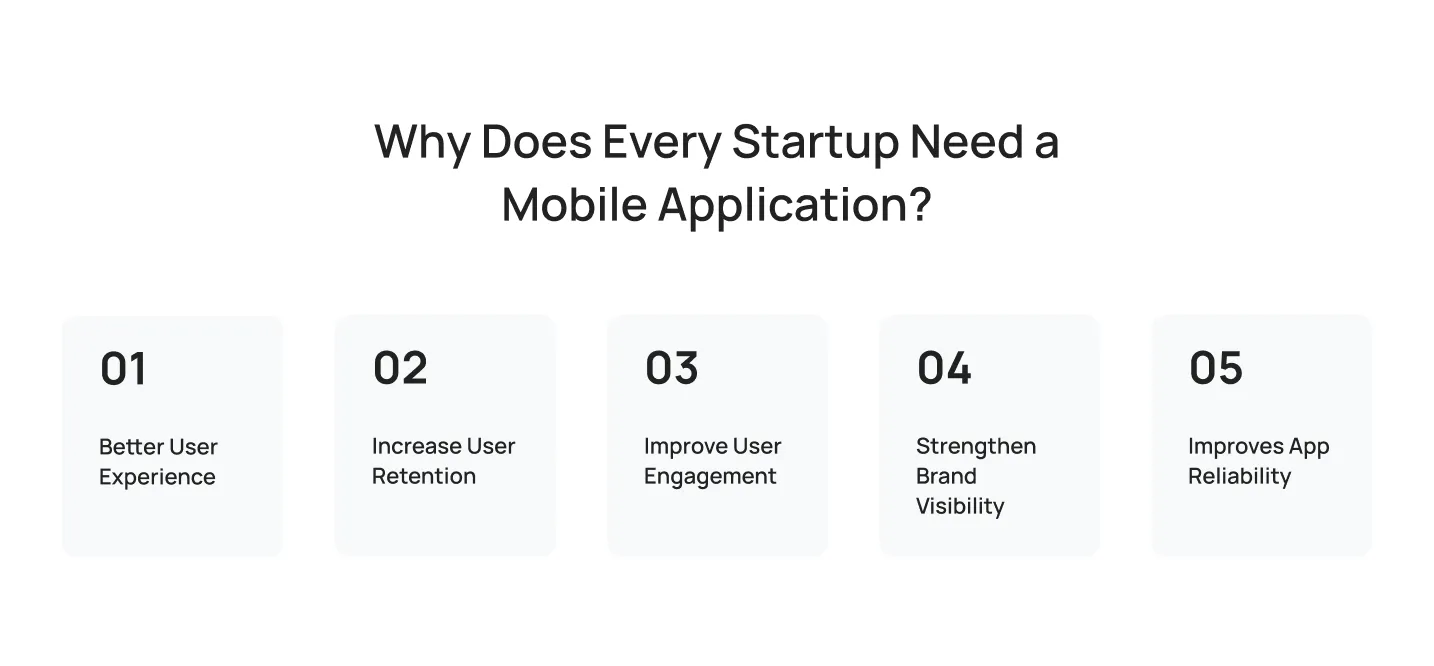
Here is what a mobile app actually does for your startup.
1. Better User Experience
Slow load times. Broken touch interfaces. Sessions that drop the moment the connection dips. That is the mobile web experience for most users.
Apps are different. They are built for the device, not adapted to it. They respond to gestures, work offline, and do not punish users for having an imperfect signal. That difference in feel is not cosmetic. It decides whether a first-time user comes back or never opens your product again.
2. Increase User Retention
Apps generate three times higher session lengths than mobile web and convert users at nearly double the rate, according to Adjust’s 2025 Mobile App Trends Report.
Users who open an app three or more times in the first week are far more likely to still be active a month later. The mobile web version of your product does not produce those numbers. Full stop.
3. Improve User Engagement
Email sits unread. Social posts get buried by algorithms.
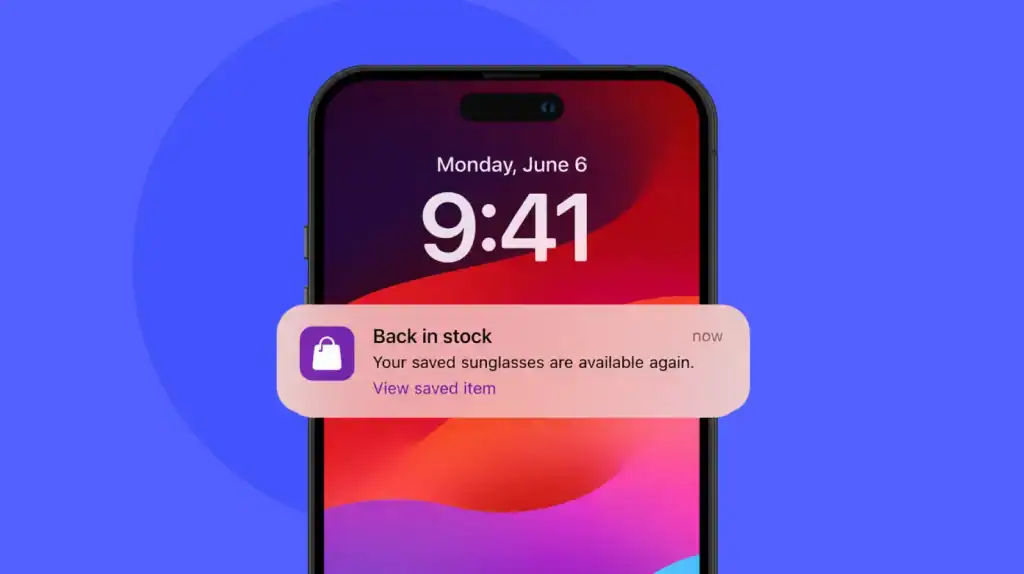
Push notifications land on the lock screen in real time. You can re-engage dormant users, send time-sensitive alerts, and drive action without paying for placement. This is a channel you own completely, and no platform can take it away from you.
4. Strengthen Brand Visibility
Every time a user picks up their phone, your icon is there. No click required. No ad spend needed.
That passive visibility builds familiarity faster than any campaign. Apps that users open daily become part of their routine, and routines are genuinely hard to replace. That stickiness is one of the most durable advantages a startup can build early on.
5. Improves App Reliability
Your app does not stop functioning when the connection drops. Users can log data, fill forms, access content, and take action offline. When connectivity returns, everything syncs automatically.
For users in logistics, fieldwork, travel, or regions with inconsistent networks, this is not a bonus feature. It is the reason they choose your product over a web-based alternative.
Types of Mobile App Development for Startups
Not every app is the same, and not every startup needs the same type. Before you talk to a developer, know which category your product fits into.
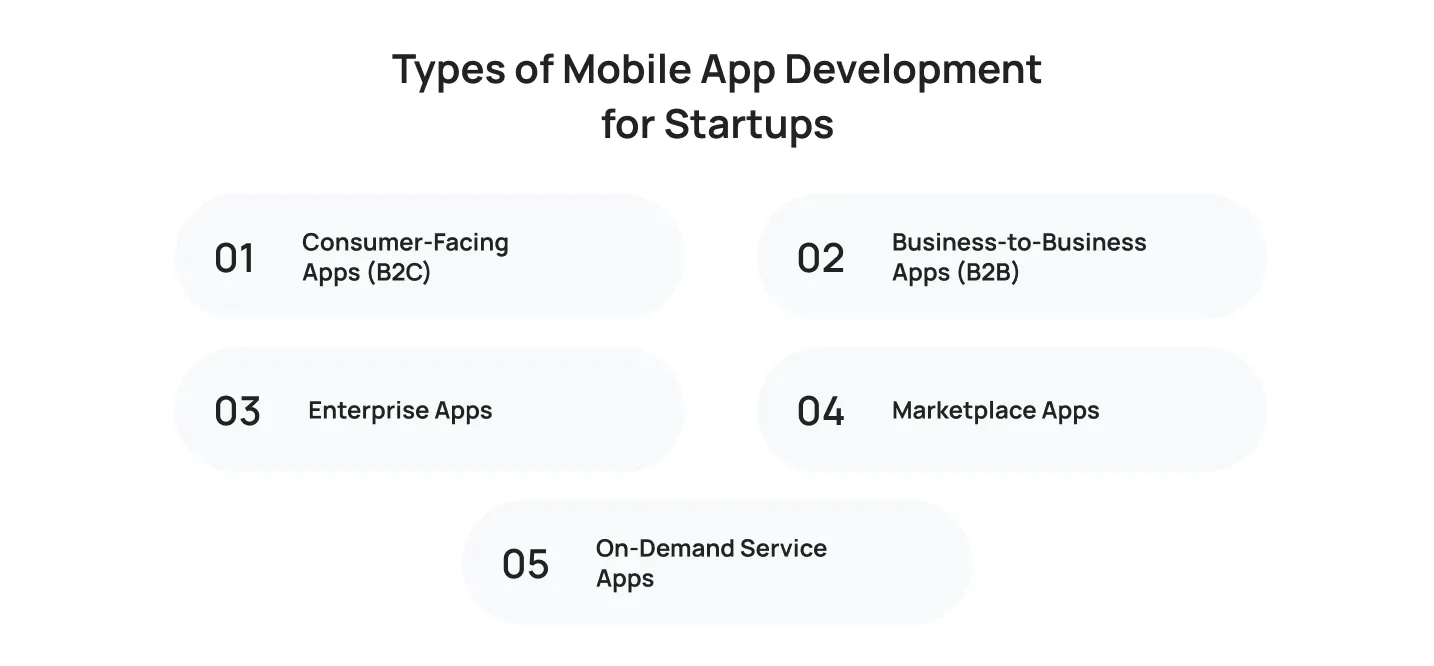
1. Consumer-Facing Apps (B2C)
These are the apps most people picture first. Designed for general audiences, they prioritize ease of use, speed, and onboarding simplicity. Think food delivery, fitness tracking, or social networking. When people talk about developing mobile apps for startups, this category is usually what they mean.
2. Business-to-Business Apps (B2B)
B2B apps serve teams inside companies. They require features like role-based permissions, integrations with third-party tools, admin dashboards, and often compliance with industry regulations. The sales cycle is longer, but average contract values are much higher.
3. Enterprise Apps
Mobile app development for enterprises is its own discipline. These products handle complex workflows, serve large internal user bases, and often need to integrate with legacy systems. Enterprise apps demand stricter security standards and more thorough QA than consumer apps.
4. Marketplace Apps
Two-sided platforms serve two distinct user groups at once, like buyers and sellers or drivers and riders. They are architecturally more complex because you are effectively building two apps in one, with a backend that connects them in real time.
5. On-Demand Service Apps
These power deliveries, logistics, and service bookings include real-time GPS tracking, live status updates, and integrated payments. The backend infrastructure required is significant from day one.
Step-by-Step Mobile App Development Process for Startups
The difference between apps that succeed and apps that fail is rarely the idea. It is the process. Here is what a disciplined startup application development process actually looks like.
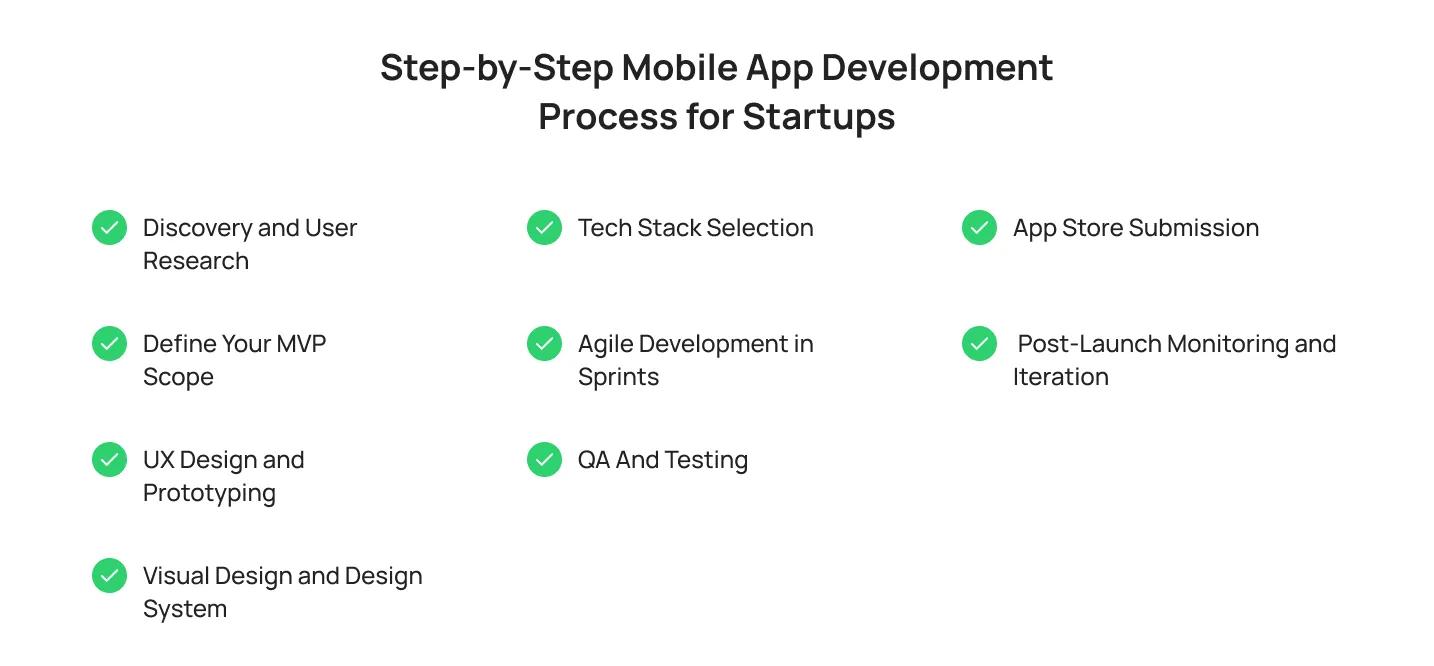
Step 1: Discovery and User Research
Talk to real potential users before you open a design tool. Conduct at least 15 to 20 interviews. Identify the one core problem your app solves. Everything else is secondary until you validate this.
Step 2: Define Your MVP Scope
Your MVP is not a lite version of your full vision. It is the smallest product that lets you test your core assumption with real users. Cut aggressively. Every feature you add to the MVP extends your timeline and increases your burn.
Step 3: UX Design and Prototyping
Build wireframes first. Map every user flow on paper or in Figma before you touch visual design. Share the wireframe with users. The feedback you get here costs almost nothing to act on. The same feedback after development costs a lot.
Step 4: Visual Design and Design System
Once the flows are validated, build your visual design. Establish a design system with consistent components. This speeds up development and keeps the product looking coherent as it grows.
Step 5: Tech Stack Selection
Your stack determines your speed, your performance ceiling, and the talent market you hire from. This decision deserves serious thought, not a default. More on this in the next section.
Step 6: Agile Development in Sprints
Two-week sprints with testable deliverables at the end of each. This keeps the scope under control and gives you checkpoints to course-correct before you have committed six months of budget to the wrong direction.
Step 7: QA and Testing
Testing throughout development, not just at the end. Unit tests, integration tests, and manual testing on real devices. A broken app at launch generates one-star reviews that take months to reverse.
Step 8: App Store Submission
Apple’s review process takes one to three days on average. Google Play is faster but less predictable. First submissions often get rejected. Build extra time into your launch schedule for at least one resubmission cycle.
Step 9: Post-Launch Monitoring and Iteration
Watch your crash logs, session analytics, and user reviews from day one. Your first week of real-user data will tell you more than six months of internal testing. Act on it fast.
Cost and Timeline of Mobile App Development for Startups
The honest answer to “How much does an app cost” is: it depends. But vague answers do not help you budget, so here is what you need to understand about app development costs before you commit to anything.
The Main Cost Drivers
Complexity is the biggest variable. A four-screen app with user login and a content feed costs a fraction of what a real-time logistics platform with payment processing and admin dashboards costs.
Platform choice matters. Building for iOS only is cheaper than building for both iOS and Android natively. Cross-platform frameworks reduce that gap significantly.
Team location and experience set your hourly rate. Rates range from $25 to $250 per hour, depending on geography, seniority, and specialization.
Design quality has a direct cost. Template-based UI is faster and cheaper. Custom design systems with animations and branded interactions take more time.
Cost Estimates by Complexity
| App Type | Estimated Cost | Timeline |
|---|---|---|
| Simple MVP | $15,000 to $40,000 | 2 to 4 months |
| Mid-complexity app | $40,000 to $120,000 | 4 to 8 months |
| Complex platform | $120,000 to $350,000+ | 8 to 18 months |
Native vs Cross-Platform vs Web Apps: Where Do You Want to Build Your App?
This is the decision that shapes everything else: your team, your budget, your timeline, and your product’s performance ceiling. In 2026, you have better options than ever, but you still need to choose.
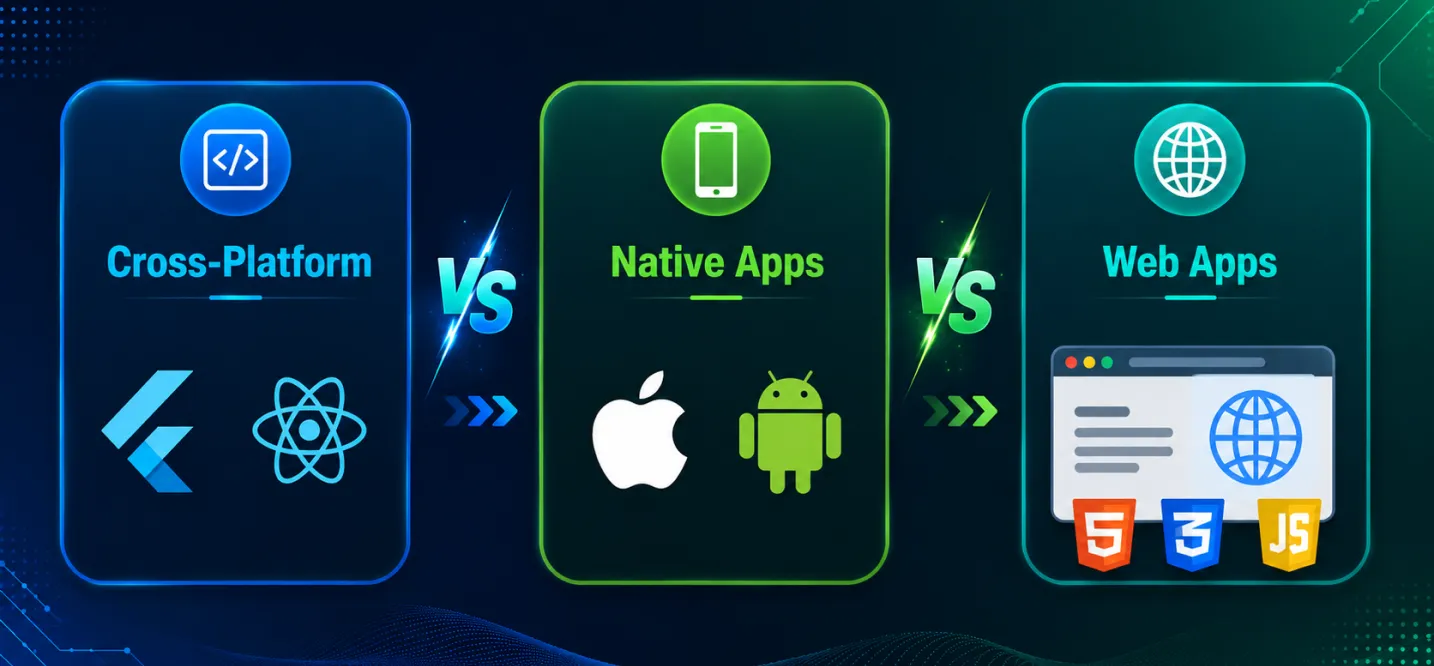
Native Apps
Native apps are built specifically for one platform. Swift and SwiftUI for iOS. Kotlin and Jetpack Compose for Android app development. You get the best possible performance, full access to every device feature, and a user experience that feels exactly right on that platform.
Best for: Apps where performance is non-negotiable. Real-time processing, complex animations, AR features, or deep hardware integrations like cameras, biometrics, or wearables.
Cross-Platform Apps
Frameworks like Flutter and React Native let you write one codebase that deploys to both iOS and Android. Flutter now leads the cross-platform space by active usage, with 46% of developers choosing it.
Best for: The majority of early-stage startups. If you need to validate on both platforms without doubling your budget, Flutter is the default choice in 2026.
Progressive Web Apps (PWAs)
PWAs run in the browser but install on a home screen and work offline. They require no app store approval and work on any device.
Best for: Content-heavy products, very early MVPs where speed to market matters more than experience quality, or internal tools where users are on Android.
Common Challenges in Startup App Development and How to Overcome Them
The development Challenges that sink startup apps are almost all predictable. Here is what you need to watch for.

1. Scope Creep During Build
Every feature that gets added mid-development extends your timeline and budget. Product teams feel pressure to add things constantly because every new idea looks important from the inside. Most are not.
Fix it: Lock your MVP scope in writing before development starts. Create a Product Requirements Document. Any change after development begins requires a formal scope change discussion with timeline and cost implications attached. Make the cost of change visible.
2. Choosing the Wrong Development Partner
The market for Development companies is enormous and highly variable in quality. A cheap team looks attractive until you factor in rework, post-launch bugs, security vulnerabilities, and the cost of switching partners mid-project.
Fix it: Request references and actually call them. Review past apps in the stores and test them yourself. Ask the team hard questions about your product before they give you a quote. A good partner pushes back on decisions that do not serve users. A bad one just agrees with everything.
3. Underinvesting in Quality Assurance
Teams cut QA when they fall behind schedule. This is the most expensive shortcut in software development. Crash-prone apps generate negative reviews that take 6 to 12 months of positive reviews to dilute. You do not have 12 months.
Fix it: Budget QA at 20 to 25% of development time. Test on real devices, not just simulators. Start testing at sprint one, not sprint eight.
4. Ignoring App Store Optimization at Launch
You can build a technically excellent product and still have no one download it. App store rankings are determined by keyword relevance, screenshot quality, ratings velocity, and conversion rate from store listing to install.
Fix it: Treat marketing as a parallel workstream that starts six to eight weeks before launch. Write your store listing copy before development ends. Have your keyword strategy, screenshots, preview video, and pre-launch audience ready when you submit.
5. Skipping Security and Compliance Planning
If your app handles payments, health data, personal information, or financial records, you face legal obligations. GDPR, HIPAA, PCI-DSS. Missing these is not a technical problem. It is a business risk that can shut you down.
Fix it: Identify your compliance requirements in the discovery phase. Build with a future-ready application architecture from the start. Plan for security audits before launch, not after a breach.
6. Backend That Cannot Scale
A backend that handles 500 users well often collapses at 50,000. A viral moment without scalable infrastructure turns your best growth opportunity into your worst PR crisis.
Fix it: Use managed cloud infrastructure from day one. AWS, Google Cloud, and Azure all have startup programs with significant credits. Design your API to handle horizontal scaling, even if you do not implement every optimization immediately. The cost of fixing an unscalable backend mid-growth is far higher than building it right initially.
Cubix Can Be Your Next Partner for Mobile App Development
Finding the right development partner at the startup stage is one of the highest-leverage decisions you make. The wrong choice costs you months and a significant portion of your runway. The right one gets you to market faster and with a more resilient product.
As the best mobile app development company for enterprises and startups, Cubix has spent over 17 years building mobile products across fintech, health tech, logistics, edtech, and consumer apps. The team operates across the full product lifecycle: from discovery and UX design, through native and cross-platform development, to QA, launch, and ongoing product evolution.
What sets Cubix apart from standard Software companies are the rigour they apply before a line of code is written. Discovery is treated as a strategic investment, not a box-checking exercise. The team challenges scope, flags technical risks early, and builds architecture that supports growth rather than just the immediate deliverable.
If you are planning your first app build, rebuilding a product that has accumulated technical debt, or scaling a platform that has outgrown its original architecture, Cubix brings the experience and process discipline to get you there.
Bottom Line
Building a mobile app is a significant commitment. It takes real money, real time, and consistent leadership attention. Startups that treat it as a tech project almost always struggle. Startups that treat it as a business process, with the same rigour they apply to hiring or fundraising, get to market with something that works.
In 2026, the tools and frameworks available make it faster and more affordable to build quality mobile products than ever before. The competitive advantage does not come from the technology itself. It comes from using that technology with discipline, focusing on real user problems, and iterating faster than anyone else in your market.
Frequently Asked Questions:
1. Should a startup build a native or cross-platform app?
For most early-stage startups, cross-platform is the right starting point. It reduces build cost by 30 to 40% and gets you to both iOS and Android faster. Native development makes sense when you need maximum performance, deep hardware integration, or your product has platform-specific features that cross-platform frameworks do not support well.
2. What is the most common reason startup apps fail?
Building too many features before validating the core problem. Scope creep during development is the single most common reason projects run over budget and timeline. Startups that define a tight MVP, ship it, and iterate based on real user data dramatically outperform those that try to build a complete product before launch.
3. Do I need a mobile app, or will a website be enough?
If your product requires daily use habits, push notifications, offline access, camera or GPS functionality, or real-time features, a mobile app is the right choice. If you are primarily sharing information, generating leads, or running a content business, a well-built mobile website is sufficient to start and is significantly cheaper to build and maintain.
4. How do I find the right mobile app development company for my startup?
Ask for references and call them. Test the apps the company has shipped by downloading them and using them. Look for a partner that asks hard questions about your product before quoting a price. Avoid companies that immediately agree with everything you propose. A competent partner challenges decisions that do not serve your users. That friction early in the process saves you high cost and time later.