Key Takeaways
- Offshore app development and local app development solutions solve different problems. The right pick depends on your budget, your timeline, and how hands-on you want to be.
- Cost is the biggest reason businesses look offshore, but it’s rarely the only reason that ends up mattering once the project starts.
- A dedicated development team and a locally staffed team can both work well. The real difference is control versus convenience, not quality.
- Communication, time zone overlap, and IP protection are solvable problems when you pick the right partner, not automatic dealbreakers.
- Compliance (HIPAA, GDPR) and data security deserve real attention before you sign a contract, not after your app is already in the App Store.
- Cubix works as both an onshore-accountable and offshore-efficient partner, which is exactly the mix most US businesses are actually looking for.
If you’re a US founder, product lead, or IT director trying to bring an app to life, you’ve almost certainly hit the exact same wall as everyone before you: Do you hire the local team down the street, or do you go global and build across the ocean?
This is the one decision that will shape your budget, set your launch date, and dictate how many sleepless nights you spend stressing over project updates. If you’re specifically building your first app as a startup, our guide to the best mobile app development company for startups is worth reading alongside this one, since a lot of the same decisions apply.
Here’s why this matters far more than most leaders expect: the global IT outsourcing market is set to top $591 billion in 2026. That means a massive chunk of app development that used to happen in-house is now living with offshore or hybrid teams instead.
Want to discuss your project? Our experts are just a click away.
Contact Us
What Do “Offshore,” “Onshore,” and “Local” Really Mean?
Before comparing costs, it helps to get the vocabulary straight, since these terms get used loosely all the time.
Local app development solutions come from a team based in your own city or state. Onshore means a team still inside your own country, just not necessarily your city. Offshore app development means the team is based in another country entirely, often on a different continent and in a very different time zone. There’s also nearshore, a middle ground where the team is in a nearby country with a closer or overlapping time zone.
| Model | What It Means | Typical Use Case |
| Local development | A team based in your own city or state | Businesses that want in-person meetings and same-day turnaround |
| Onshore development | A team in your own country, different city or state | Businesses that want the same time zone but a wider talent pool |
| Offshore app development | A team based in another country, often another continent | Businesses prioritizing cost savings and global talent access |
| Nearshore development | A team in a nearby country with overlapping working hours | A middle ground between offshore savings and onshore overlap |
Most businesses don’t pick one model and stick to it forever. It’s common to start with local app development solutions for strategy and product ownership, then bring in an offshore vs onshore app development mix once the roadmap is clear and execution needs to scale.
How Much Does Mobile App Development Cost in 2026?
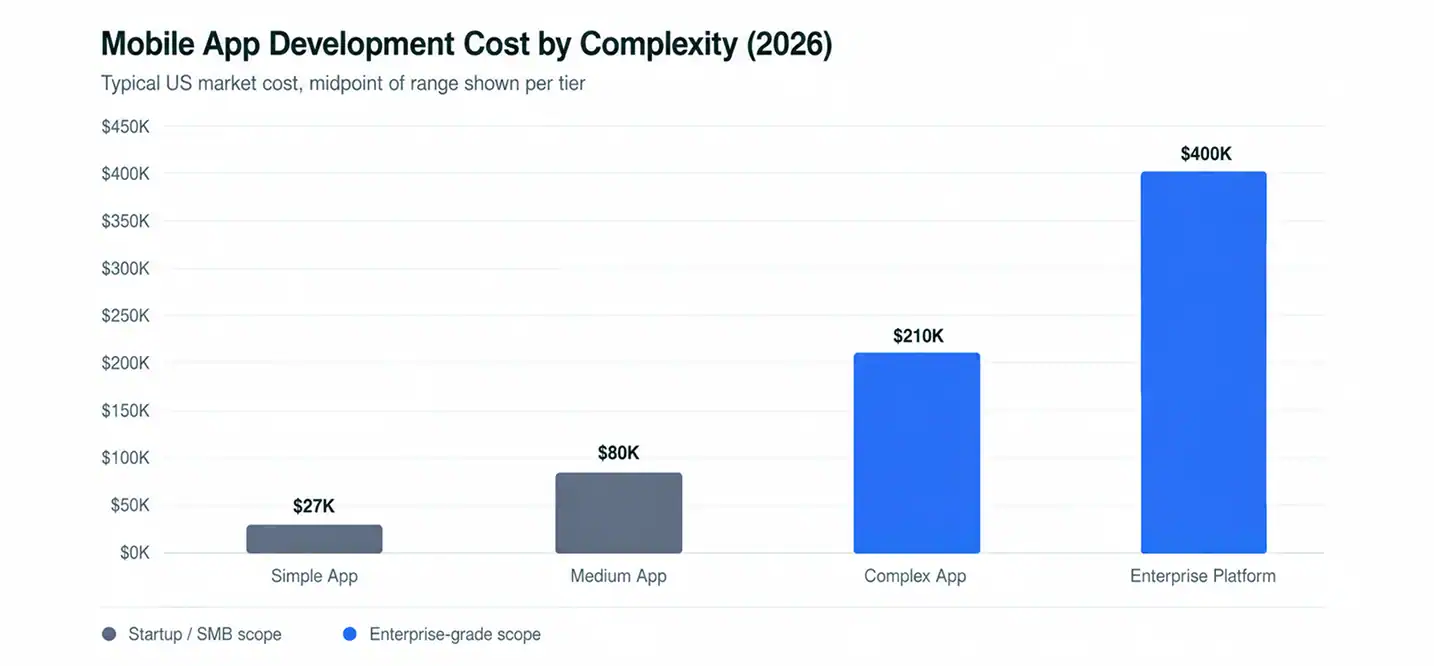
This is the question everyone actually wants answered, so let’s get straight to it. Mobile app development cost depends heavily on complexity, platform choice, and who’s building it, but here’s a realistic breakdown for 2026.
The global mobile app market itself is expected to grow from $338.65 billion in 2026 to $844.5 billion by 2034, which is exactly why so much competition exists for user attention, and why getting your app development pricing right from day one matters. If you want the full picture beyond just tiers, our dedicated post on Custom mobile app development agency walks through the entire process end to end.
| Complexity | Typical Cost Range | Timeline | Example |
| Simple App | $15,000 – $40,000 | 6–10 weeks | Single-feature booking or content app |
| Medium App | $40,000 – $120,000 | 3–5 months | Marketplace app with in-app payments |
| Complex App | $120,000 – $300,000 | 5–9 months | AI features, real-time data, multiple integrations |
| Enterprise Platform | $300,000 – $500,000+ | 9–14+ months | Multi-role systems, heavy compliance needs |
So when someone asks how much does it cost to develop a mobile app, the honest answer is “it depends on the tier above,” but most mid-sized US businesses land in the medium-to-complex range. The cost to develop mobile app projects with genuinely custom features rarely comes in under six figures once design, backend, and testing are all included, and that’s true whether you build locally or offshore. Founders searching for how much does a mobile app cost to build before they’ve scoped a single feature should treat the table above as their starting point, not a final number, since the real cost to build a mobile app only firms up once requirements are locked.
Offshore vs Local App Development Cost: Side-by-Side
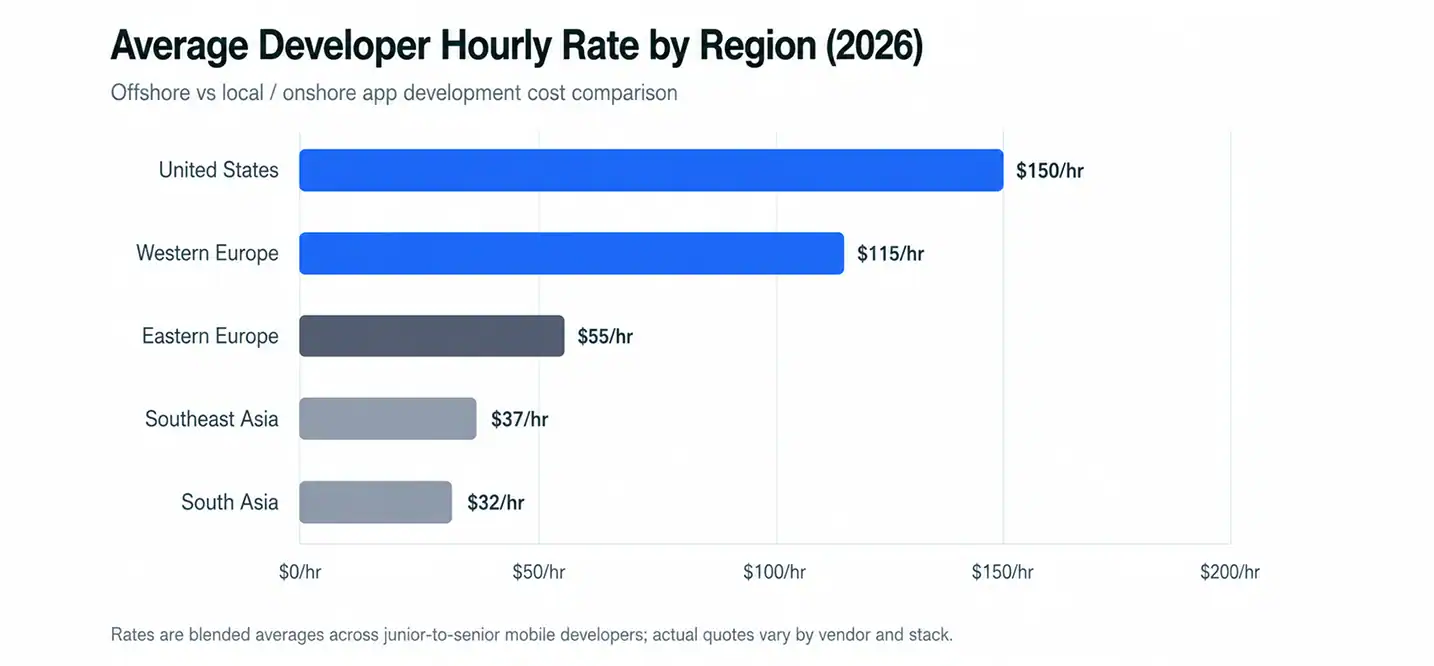
This is where the real decision usually gets made. The offshore vs local app development cost gap is large enough that it changes what kind of app you can afford to build, not just how much you pay for the same app.
| Region | Average Hourly Rate | Typical Cost Savings vs. US |
| United States (local/onshore) | $100 – $200+ | Baseline |
| Western Europe | $80 – $150 | 15% – 30% |
| Eastern Europe | $35 – $75 | 40% – 60% |
| Southeast Asia | $20 – $55 | 45% – 65% |
| South Asia | $15 – $50 | 50% – 70% |
Businesses that go offshore typically cut development costs by 40% to 70%, and that gap mainly reflects regional salary and overhead differences, not a quality gap. So how much does offshore app development cost compared to staying local? For a medium-complexity app that might run $80,000 locally, an experienced offshore team can often deliver the same scope for $30,000 to $45,000. That difference is usually enough to fund a second feature set, an extra QA cycle, or six more months of runway.
App Development Cost Breakdown: Where the Budget Actually Goes
A full app development cost breakdown rarely looks like a single number. It’s spread across distinct phases, and skipping or underfunding any one of them is how projects blow past budget later.
| Phase | Share of Total Budget |
| Discovery & Product Planning | 8% |
| UI/UX Design | 12% |
| Core Development | 45% |
| QA & Testing | 17% |
| Deployment & Launch | 8% |
| Post-Launch Buffer / PM | 10% |
Notice that QA and testing alone claims almost the same share as design. That’s usually the biggest surprise for first-time founders who assume “development” is the only real cost. At Cubix, we break every estimate down by exactly these phases before writing a single line of code, partly because it’s the only way to give a client a number they can actually plan around instead of a rough guess.
Cost by App Type: Flutter, Healthcare & Blockchain Apps
Not all apps cost the same per feature. A few categories deserve their own numbers because they come with extra technical or regulatory weight.
Flutter App Development Cost
Flutter app development cost tends to sit below native development for the same feature set, since one codebase covers both iOS and Android. Cross-platform frameworks like Flutter can cut your overall build cost by 30% to 40% compared to building two separate native apps, which is exactly why so many startups default to it. Our Flutter app development team sees this play out constantly on client budgets.
| Complexity | Typical Cost Range | Notes |
| Simple App | $15,000 – $35,000 | Single codebase, basic UI, limited backend |
| Medium App | $35,000 – $90,000 | Custom UI, API integrations, moderate backend logic |
| Complex App | $90,000 – $200,000+ | Real-time features, heavy third-party integrations |
Healthcare App Development Cost
Healthcare app development cost runs higher than a typical consumer app, usually starting around $80,000 and climbing well past $250,000 once HIPAA-compliant data handling, secure messaging, and EHR integrations are in scope.
| Complexity | Typical Cost Range | Notes |
| Basic Healthcare App | $80,000 – $130,000 | Appointment booking, basic patient records |
| Standard Healthcare App | $130,000 – $200,000 | Secure messaging, HIPAA compliance, telehealth features |
| Advanced Healthcare Platform | $200,000 – $250,000+ | EHR integrations, multi-provider systems, advanced compliance |
Blockchain App Development Cost
Blockchain app development cost has its own range too: a basic MVP DApp can start around $15,000, while a full DeFi protocol or enterprise blockchain platform can run past $300,000, largely because smart contract security audits alone often eat 15% of the total budget. Our complete blockchain app development cost guide breaks this down by app type in far more detail if that’s the category you’re building in.
| Complexity | Typical Cost Range | Notes |
| MVP DApp | $15,000 – $50,000 | Basic smart contracts, limited functionality |
| Mid-Size Blockchain App | $50,000 – $150,000 | Custom smart contracts, wallet integration |
| Enterprise / DeFi Platform | $150,000 – $300,000+ | Security audits, complex protocol logic, high compliance needs |
Is Offshore App Development Worth It?
This is the question that actually keeps decision-makers up at night, more than the cost numbers themselves. So, is offshore app development worth it, or does it introduce more risk than it saves in dollars?
For most businesses, yes, provided you pick a partner with real process discipline. Modern offshore teams run Agile development, hold proper product discovery sessions before writing code, and follow structured MVP development cycles instead of guessing at scope. Project management tools like Jira and Slack have made time zone differences far less painful than they used to be, and most established offshore firms now build in overlapping working hours specifically to reduce communication challenges with US clients.
The bigger factors to actually vet are code quality and quality assurance discipline, not the passport of the developer writing the code. Strong offshore partners run the same UI/UX design and DevOps practices you’d expect locally, backed by real cloud infrastructure experience and a track record of building for scalability, not just shipping a first version and disappearing. If you’re weighing framework choices as part of this decision, our breakdown of hybrid vs native app development and our piece on how app UX design has evolved are both useful next reads.
Offshore development for startups specifically tends to work well because early-stage companies need speed and flexibility more than they need a team sitting in the next room. Adoption reflects that shift clearly: the share of startups outsourcing some or all of their app development work has climbed from roughly 30% in 2020 to about 47% in 2026.
This kind of shift is also part of a broader wave of digital transformation, where more of the actual build work, not just the strategy, happens through distributed teams instead of a single in-house department.
Should You Outsource App Development? A Simple Decision Framework
So, should I outsource app development, or keep it in-house? Rather than a yes-or-no answer, run your project through these four questions.
Budget reality: If local quotes are stretching your runway thin, outsourcing app development is usually the more responsible move, not a compromise.
Timeline pressure: Need to launch in months, not a year? Offshore and dedicated teams scale up faster than local hiring, which can take months on its own.
In-house oversight capacity: Do you have a technical lead who can manage a remote team properly? If not, look for a partner offering full project management, not just developer hours.
Regulatory complexity: Building something like an enterprise platform with heavy compliance needs may benefit from a partner with dedicated enterprise software development experience, regardless of location.
There’s no universal right answer here. Many companies land on a hybrid: local leadership owning the product vision, offshore engineering handling the build.
How to Hire the Right Team, Offshore or Local
Once you’ve decided on a direction, the actual hiring process is where projects succeed or quietly fall apart. Here’s a practical checklist whether you’re trying to hire offshore app developers or hire app developers USA-based.
- Check real portfolio depth, not slide decks. Ask for live apps on the App Store or Google Play, not just case study screenshots.
- Confirm platform-specific expertise. If you need native Android work, look for a genuine onshore android app development company or offshore equivalent with recent Android projects, not a generalist shop. Our guides on top Android app development trends and top Android app development companies are good starting points for vetting.
- Ask about cross-platform capability. Among the best cross-platform app development companies, look for real Flutter and React Native delivery history, not just a services page that lists both. Our React Native app development page shows how we approach this specifically.
- Verify iOS depth too. If iOS matters to your roadmap, check experience with the programming languages used in iOS app development and read up on leveraging custom iOS development for your specific use case.
- Get itemized pricing, not a vague range. A trustworthy offshore mobile app development company will break costs down by phase, the same way we outlined earlier in this guide.
- Confirm post-launch support terms upfront. Ask what happens after launch, not just during it.
If your business is customer-facing and mobile-first, our piece on iPhone application development for business is worth a read too, since platform choice often shapes which hiring model makes the most sense.
Start Your App Development Project With Cubix
Cubix has spent over 18 years building mobile apps, enterprise software, and blockchain products across fintech, healthcare, logistics, and e-commerce, delivering more than 1,300 completed projects with a team of 350+ designers and developers. That combination, deep technical bench plus long track record, is exactly what businesses should be screening for when comparing any best offshore app development company shortlist.
What makes Cubix a slightly different fit for US businesses specifically is the structure: US-based account leadership and project management paired with global delivery capacity, so clients get the accountability of a local point of contact without paying purely local rates for every hour of development. That’s the practical answer to “offshore vs local,” treat it less like a binary choice and more like a structure you can design on purpose. Cubix’s engineering teams work across native iOS and Android, Flutter, React Native, and full custom software development, so the technology conversation doesn’t start with “can you build this” but with “here’s how we’d build this well.”
For startups specifically validating an idea before a full build, Cubix’s MVP development process is built around getting a real, testable product in front of users fast, without over-building features nobody has asked for yet.
Want to discuss your project? Our experts are just a click away.
Contact Us
Frequently Asked Questions
1. How to choose the best offshore software development company?
Check their live portfolio, ask for client references, confirm their tech stack matches your project, and get a clear, itemized quote before signing anything. Communication style during the sales process is usually a preview of what working together will actually feel like.
2. How much does it cost to develop a FinTech app?
Most fintech apps cost between $40,000 and $300,000+, depending on features like payments, KYC/AML compliance, and integrations with banking APIs. Security testing typically adds a meaningful share on top of standard development costs.
3. What are the 4 types of apps to develop?
The four main types are native apps (built for one platform like iOS or Android), cross-platform apps (one codebase for multiple platforms), hybrid apps (web technology wrapped in a native shell), and progressive web apps, which run in a browser but feel app-like.
4. Which country is best for app development?
There’s no single “best” country, it depends on your priority. The US and Western Europe offer the easiest time zone overlap and communication. India, Pakistan, and the Philippines offer the strongest cost savings. Eastern Europe often balances both fairly well.
5. Does offshore mean remote?
Not exactly. Offshore always means remote, since the team is in another country, but “remote” can also describe a team in your own country working from home. Offshore specifically refers to the geographic and often time zone distance.
6. What is onshore and offshore software development?
Onshore development happens within your own country, even if it’s a different city. Offshore development happens in another country entirely, usually chosen for cost savings or access to specialized talent.
7. What is the difference between offshore and onshore?
The main differences are cost, time zone overlap, and ease of in-person collaboration. Onshore usually costs more but offers easier real-time communication, while offshore offers lower costs and a much larger talent pool.
8. What does “offshore” mean?
In software development, “offshore” simply means hiring a team or company based in a different country from your own, typically to reduce costs or access specialized skills not readily available locally.