Key Takeaways
| Trend | Why It Matters |
| Better physics | Creates believable gameplay |
| AI-assisted development | Reduces production time |
| VR adoption | Improves immersion |
| Smarter NPCs | Makes worlds feel alive |
| Procedural generation | Helps developers build larger environments efficiently |
| Cross-platform support | Reaches more players |
| Community-created content | Extends a game’s lifespan |
Simulation games aren’t just for farming or truck driving anymore. Today, millions of players spend their evenings managing hospitals, designing cities, flying commercial aircraft, operating construction equipment, racing on professional-grade simulators, and building entire virtual lives.
The genre has quietly become one of the fastest-growing parts of the gaming industry. And unlike many gaming trends that disappear after a few years, simulation games continue to attract both casual players and serious enthusiasts.
The numbers explain why.
The global racing simulator market reached USD 1.19 billion in 2025 and is expected to grow to USD 2.46 billion by 2034, expanding at a compound annual growth rate (CAGR) of 8.3%. Even more interesting, simulation software alone is projected to grow at 9.9% CAGR, while demand from professional racing teams is expected to increase at 10.8% CAGR during the same period.
But racing is only one piece of the story.
The online simulation games market now includes farming, city-building, aviation, life simulation, construction, transportation, business management, healthcare, and military training. These games appeal to players because they reward patience, creativity, and problem-solving instead of quick reflexes alone.
And technology has finally caught up with player expectations. Better graphics cards, faster processors, AI-powered NPCs, realistic physics, cloud gaming, and virtual reality are making today’s simulation games feel remarkably close to real life.
So, what exactly is driving this demand in 2026?
Let’s look at the facts.
What Is Driving the Massive Growth of Simulation Games?

The growth of simulator games didn’t happen overnight. Several trends have come together over the last few years, creating the perfect environment for the genre to thrive.
Players no longer see simulation games as “slow” or “boring.” Instead, they see them as immersive experiences where every decision matters.
The market numbers tell the story
| Market Statistic | 2025-2026 Data |
| Global Racing Simulator Market (2025) | USD 1.19 Billion |
| Expected Market Size (2034) | USD 2.46 Billion |
| Overall CAGR | 8.3% |
| Software Segment CAGR | 9.9% |
| Motion Racing Simulator CAGR | 9.2% |
| High-End Simulator CAGR | 9.6% |
| Professional Racing Teams CAGR | 10.8% |
| Europe’s Global Market Share | 35.29% |
Simulation games have become more accessible
Five years ago, building a realistic simulator setup required expensive equipment.
Today, entry-level steering wheels, flight sticks, VR headsets, and gaming PCs are far more affordable. At the same time, developers have optimized their games to run well on mainstream hardware.
This accessibility has opened the door for millions of new players entering the online simulation games market.
Streaming has made simulation games entertaining to watch
One of the biggest reasons behind the genre’s popularity isn’t actually the games themselves.
It’s content creators.
Thousands of streamers now build communities around simulator games that many people once thought would never attract viewers.
Games like:
- Microsoft Flight Simulator
- Euro Truck Simulator 2
- American Truck Simulator
- Farming Simulator
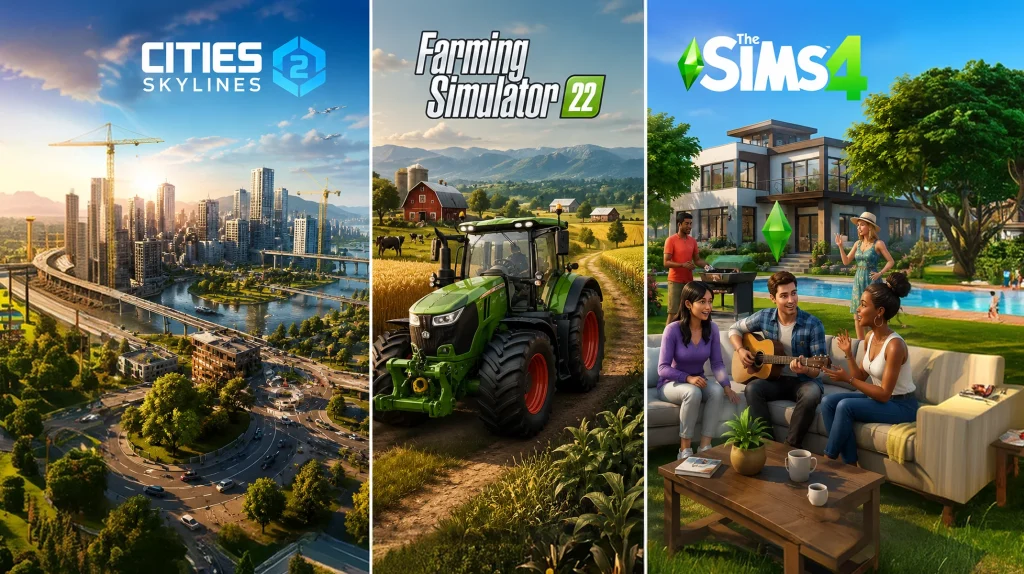
- Cities: Skylines II
- iRacing
Players are looking for less stressful games
Competitive shooters and battle royale games remain popular, but many players now want experiences that help them relax.
Simulation games offer exactly that.
Instead of chasing rankings or reacting in milliseconds, players can:
- Build something meaningful.
- Experiment without pressure.
- Learn new systems.
- Play at their own pace.
- Return to long-term saves over months or years.
This shift is especially noticeable among adult gamers.
Simulation games teach real-world skills
Another reason for the genre’s success is educational value. Many simulation games accurately model real systems.
For example:
| Simulation Genre | Real Skills Players Learn |
| Flight Simulators | Navigation, aviation procedures, weather awareness |
| City Builders | Budget planning, infrastructure management |
| Farming Simulators | Crop cycles, machinery operation |
| Racing Simulators | Racing lines, braking points, vehicle control |
| Business Simulators | Financial planning and resource management |
In late 2025, some motorsport authorities began acknowledging sim racing participation as part of official driver development pathways. Professional teams increasingly use racing simulators to analyze driver performance before testing on real tracks.
Better hardware is making everything more realistic
Today’s video games simulator experiences include:
- Force-feedback steering wheels
- Motion platforms
- VR headsets
- Haptic feedback seats
- Triple-monitor setups
- High-refresh-rate displays
- Direct-drive wheelbases
This is one reason why the best simulator games continue attracting new audiences every year.
Why players keep coming back
Unlike many multiplayer games that lose players after finishing the main story, simulation games rarely have a true ending.
Instead, they encourage long-term progression. Players return because they want to:
| Player Motivation | Example |
| Improve efficiency | Optimize a transport network |
| Build something bigger | Expand a city |
| Master difficult mechanics | Perfect aircraft landings |
| Create realistic worlds | Design farms or parks |
| Compete online | Sim racing leagues |
Players Want Realism More Than Ever

If there’s one word that defines simulation games in 2026, it’s realism. Players don’t just want better graphics anymore. They want believable worlds.
That means realistic weather, convincing vehicle handling, natural character animations, accurate sound design, and environments that respond to player actions.
Developers have spent years improving these systems, and today’s games are closer to reality than ever before.
Graphics alone are no longer enough
Ten years ago, developers focused heavily on visual quality. Today, players notice something different.
They ask questions like:
- Does the suspension behave correctly?
- Does the weather affect driving?
- Do vehicles lose traction naturally?
- Do pedestrians react realistically?
- Does water flow the way it should?
Why ray tracing has become such a big deal
One of the biggest improvements in recent years has been ray tracing. You may have heard the term many times, but what actually makes it important?
Traditional lighting systems estimate how light behaves. Ray tracing calculates how light would naturally bounce around a scene based on real physics.
That produces more believable:
- Reflections
- Shadows
- Glass
- Water
- Metallic surfaces
- Indoor lighting
| Traditional Rendering | Ray Tracing |
| Estimated lighting | Physics-based lighting |
| Basic reflections | Accurate reflections |
| Static shadows | Dynamic shadows |
| Lower realism | Higher realism |
Physics engines are the real heroes
Graphics grab attention. Physics keeps players immersed.
Every time a car drifts through a corner, a tree falls during a storm, or a basketball bounces naturally, a physics engine is doing the work behind the scenes.
Modern engines like Unreal Engine’s Chaos Physics, Havok, and NVIDIA PhysX simulate:
- Gravity
- Friction
- Tire grip
- Suspension movement
- Water interaction
- Cloth simulation
- Object collisions
These calculations happen every second while you play. Without them, today’s simulation games wouldn’t feel believable.
Virtual reality is changing player expectations
Virtual reality has become much more practical in 2026. Many racing and flight enthusiasts now consider VR essential rather than optional. Instead of looking at a monitor, players can naturally:
- Check mirrors while driving.
- Look around aircraft cockpits.
- Judge distances accurately.
- Feel more connected to the environment.
AI Is Changing How Simulation Games Are Made
Players usually notice the finished product. They see better graphics, smarter NPCs, and larger worlds.
Developers see something else.
They see hundreds of hours saved during production.
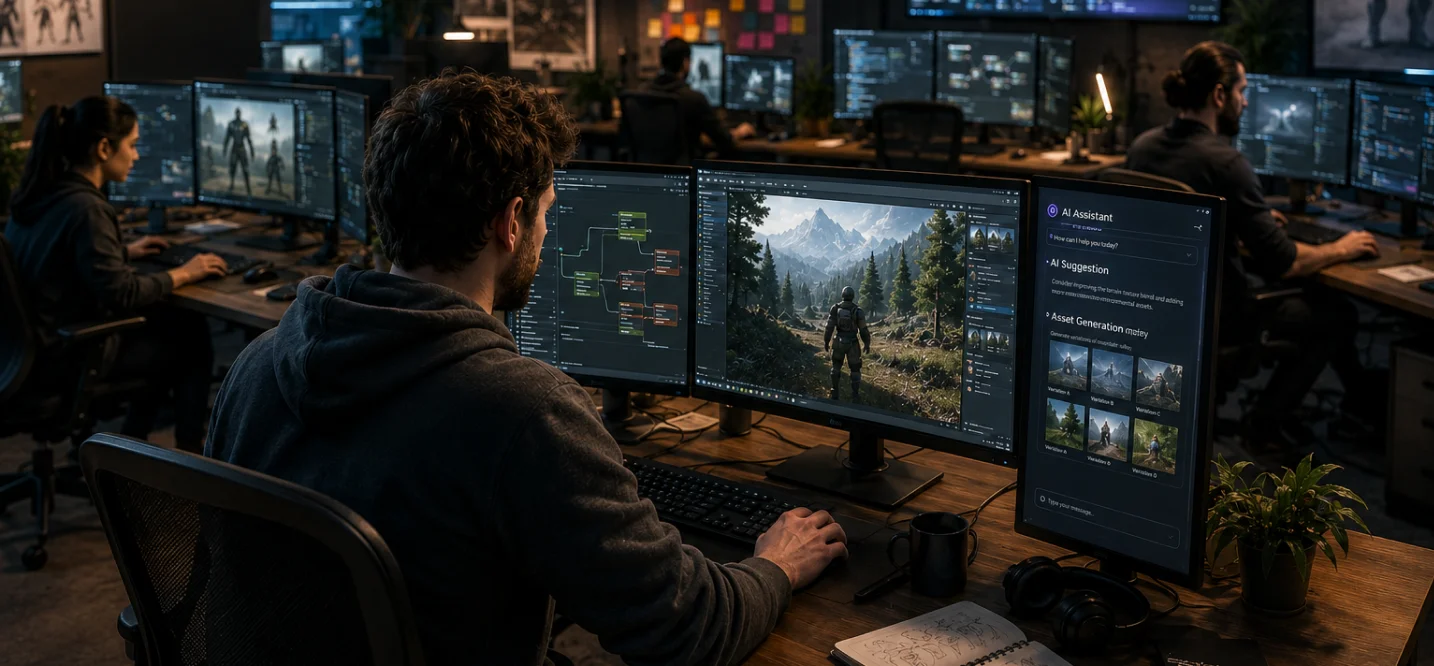
Artificial intelligence is no longer just a feature inside games. It has become part of how modern simulation games are planned, built, tested, and maintained. Studios are using AI to automate repetitive work so artists, designers, and programmers can spend more time creating experiences players actually notice.
That doesn’t mean AI is replacing game developers. It means developers can focus on creativity instead of spending weeks on repetitive tasks.
Where AI is making the biggest impact
Today, many studios use AI throughout the development pipeline.
| Development Stage | Traditional Workflow | AI-Assisted Workflow |
| Quality Assurance | Manual testing | Automated bug detection and gameplay testing |
| NPC Behaviors | Hand-written routines | Dynamic AI decision-making |
| Environment Design | Manual placement of assets | Procedural generation with designer oversight |
| Animation | Motion captured frame by frame | AI-assisted animation blending |
| Voice Production | Separate recordings for every line | AI tools help prototype dialogue before final recording |
| Localization | Manual translation | AI-assisted translation with human review |
How developers build huge cities without overwhelming your PC
One question comes up again and again.
How do game developers like Rockstar create such detailed cities like Los Santos without blowing up memory requirements?
The answer isn’t one technology. It’s several working together. Large open worlds only load what the player actually needs to see. Developers use techniques such as:
Level of Detail (LOD)
Objects far away use simpler models.
The New Generation of Simulation Games Is Bigger Than Farming
Ask someone ten years ago to name a simulation game. Most people would probably say Farming Simulator. Today, that’s only one part of a much larger genre.
The variety of all simulator games has expanded dramatically, giving players more choices than ever before. Before looking at the categories, it’s worth answering one common question.
What is a simulation game?
A simulation game recreates real-world activities or systems as accurately as possible while still being enjoyable to play.
Today’s biggest simulation genres
| Genre | Popular Examples | Why Players Keep Playing |
| Farming | Farming Simulator 25 | Long-term progression and equipment upgrades |
| Life Simulation | The Sims 4, inZOI | Freedom and creativity |
| Flight | Microsoft Flight Simulator | Real-world accuracy |
| Trucking | Euro Truck Simulator 2 | Relaxing gameplay |
| Racing | iRacing, Assetto Corsa EVO | Competitive realism |
| City Building | Cities: Skylines II | Strategic planning |
| Hospital Management | Two Point Hospital | Problem-solving |
| Construction | Construction Simulator | Heavy machinery realism |
This diversity is one reason the online simulation games market continues to grow every year.
Life simulation games continue to dominate
Among every category, life simulator games remain some of the most popular. Players enjoy building homes, managing relationships, finding careers, and creating stories that unfold naturally over time.
Newer entries have pushed realism even further. Better character animation, smarter AI, realistic weather, and detailed customization are making realistic life simulation games feel more personal than ever.
Instead of completing missions, players simply live inside these virtual worlds. That freedom keeps engagement remarkably high.
Racing simulation is becoming a professional sport
Racing simulators have evolved far beyond entertainment. Professional drivers now train using advanced simulation rigs before arriving at real race tracks.
Esports organizations are investing heavily in dedicated racing facilities.
According to recent market data:
- Individual gamers remain the largest customer segment.
- Professional racing teams are the fastest-growing segment with a projected 10.8% CAGR.
- Motion racing simulators are expected to grow at 9.2% CAGR through 2034.
This growth explains why auto simulator games continue attracting investments from both hardware manufacturers and game developers.
What is the best farm simulator game?
It’s one of the most searched questions in this genre. The answer depends on what you’re looking for.
| Game | Best For |
| Farming Simulator 25 | Realistic farming equipment and multiplayer |
| Stardew Valley | Relaxed farming with RPG elements |
| Coral Island | Farming mixed with life simulation |
| Ranch Simulator | Ranch management and co-op gameplay |
If realism is your priority, Farming Simulator 25 remains the benchmark.
How to make a simulator game in 2026
Many aspiring developers ask another important question.
How to make a simulator game?
The answer starts with choosing the right technology.
Most successful projects follow a similar process:
- Define the real-world activity you want to simulate.
- Research how that system actually works.
- Build realistic mechanics before focusing on graphics.
- Prototype gameplay quickly.
- Test with real users.
- Improve based on feedback.
- Optimize performance for multiple platforms.
Choosing the right engine also matters.
For many indie teams, Unity and Godot remain excellent choices because of their flexibility and large communities. Studios building highly realistic experiences often choose Unreal Engine for its advanced rendering and physics capabilities.
If you’re creating a commercial product, working with an experienced custom game development company can significantly reduce production risks, especially for multiplayer, VR, or simulation-heavy projects.
Similarly, developers planning to launch across multiple platforms often rely on professional game porting services to maintain consistent performance on PC, consoles, and mobile devices.
What This Means for Game Developers in 2026
The demand for simulation games is creating new opportunities for studios of every size. But player expectations have changed.
Should developers build smarter characters instead of bigger maps?
This is one of the biggest design debates today. A massive world sounds impressive on paper. But if it feels empty, players quickly lose interest.
Many of the most memorable games don’t have the largest maps. They have worlds that feel alive.
Take Whiterun in The Elder Scrolls V: Skyrim. The city isn’t enormous. Yet players remember it because every shop, guard, and resident has a purpose.
The same applies to villages in The Legend of Zelda: Tears of the Kingdom. NPCs react to weather, time of day, quests, and player actions. Those small details make the world feel populated.
Developers achieve this by focusing on:
- NPC schedules
- Dynamic conversations
- Environmental storytelling
- Interactive objects
- Local events
- Reactive AI
How developers make small worlds feel huge
Another common question is:
What strategies do developers use to make places like Whiterun or Hyrule feel larger than they actually are?
The answer comes down to smart design. Developers use techniques like:
| Design Technique | Why It Works |
| Layered paths | Encourages exploration without making maps enormous |
| Limited sightlines | Players can’t see everything at once, making areas feel larger |
| Background landmarks | Mountains, castles, and skylines create a sense of scale |
| Ambient sounds | Wildlife, traffic, and conversations make environments feel busy |
| NPC routines | Characters appear to have real lives instead of standing still |
| Dynamic events | Random encounters make the same location feel different each visit |
What are the best game engines for simulation games in 2026?
Choosing the right engine depends on the type of game you’re building. Here’s how many studios are approaching the decision today.
| Game Engine | Best For | Key Strengths |
| Unity 6 | Mobile, indie simulation games | Fast development, large asset ecosystem |
| Unreal Engine 5.6 | AAA simulations | Nanite, Lumen, Chaos Physics |
| Godot 4 | Independent developers | Open source, lightweight |
| GameMaker | 2D simulator games | Beginner-friendly |
| Construct 3 | Browser and educational games | No-code development |
How will Unreal Engine 6 change AAA game development?
Although Unreal Engine 6 has not been officially released or fully detailed, many developers expect it to continue the direction established by Unreal Engine 5.
Based on industry discussions and current technology trends, future improvements may include:
- Better AI-assisted content creation.
- Faster world streaming for larger environments.
- Improved animation systems.
- More efficient rendering.
- Enhanced procedural generation tools.
- Better workflows for massive open worlds.
Where the Simulation Games Market Goes Next

If you look at market forecasts, one thing is clear. Moreover, simulation games are not slowing down.
The racing simulator market alone is projected to grow from USD 1.30 billion in 2026 to USD 2.46 billion by 2034. That reflects growing interest from consumers, esports organizations, automotive companies, and professional training centers.
But the future extends well beyond racing.
The broader online simulation games market continues expanding because new technologies are making virtual experiences more realistic and accessible.
Four trends shaping the next generation of simulation games
1. AI-powered worlds
NPCs will continue becoming smarter.
Instead of following fixed schedules, they’ll react dynamically to player choices, weather, economics, and events happening around them.
2. Virtual reality becomes more mainstream
Lighter headsets, higher resolutions, and better comfort are making VR practical for everyday gaming.
Simulation titles remain one of VR’s strongest use cases because they naturally benefit from immersion.
3. Cross-platform play
Players increasingly expect to continue the same save across PC, console, and cloud gaming platforms.
Developers are building simulation games with this flexibility in mind from day one.
4. User-generated content keeps games alive
Many of today’s most successful simulator games owe part of their longevity to community-created content.
Mods, custom maps, vehicles, aircraft, buildings, and gameplay expansions keep players engaged for years after release.
Build Next-Generation Simulation Games with Cubix

As player expectations continue to rise, building a successful simulation game requires much more than realistic graphics. It takes robust gameplay systems, scalable architecture, optimized performance, and immersive design.
At Cubix, we help studios, startups, and enterprises turn ambitious ideas into engaging simulation experiences.
From mobile and PC titles to VR-powered training applications, our team delivers end-to-end development tailored to your vision.
Explore our:
Frequently Asked Questions
1. What is a simulation game?
A simulation game recreates real-world activities or systems, allowing players to experience and manage them in a realistic way. Popular examples include farming, flight, city-building, and life simulation games.
2. What are the best simulator games to play in 2026?
Some of the most popular titles include Microsoft Flight Simulator, Farming Simulator 25, Euro Truck Simulator 2, Cities: Skylines II, The Sims 4, inZOI, and iRacing.
3. What is the best farm simulator game?
For players looking for realism, Farming Simulator 25 remains one of the strongest choices. If you prefer a more relaxed experience, Stardew Valley and Coral Island are excellent alternatives.
4. How do developers make simulation games feel realistic?
Developers combine advanced physics engines, AI-driven NPC behavior, realistic lighting, detailed sound design, procedural generation, and high-quality 3D assets to create immersive worlds.
5. How do you make a simulator game?
Start by choosing a real-world activity to simulate, research how it works, prototype the core mechanics, test regularly with players, optimize performance, and select an engine such as Unity, Unreal Engine, or Godot based on your project goals.