Key Takeaways
- MVG means testing before building. A minimum viable game is the smallest playable version of a game built to prove the core mechanic is fun before full production starts.
- Cost typically ranges from $8,000 to $150,000. Budget depends on genre, platform, and how much custom technology the concept needs.
- The timeline runs 4 to 16 weeks. Simple mobile concepts move fastest, while multiplayer and console builds take longer.
- An MVG is not a prototype or a vertical slice. A prototype tests a mechanic internally, an MVG tests the loop with real players, and a vertical slice shows near-final quality.
- Early validation lowers risk. Most new game launches fail to earn back their budget, so testing the core loop first protects time and money.
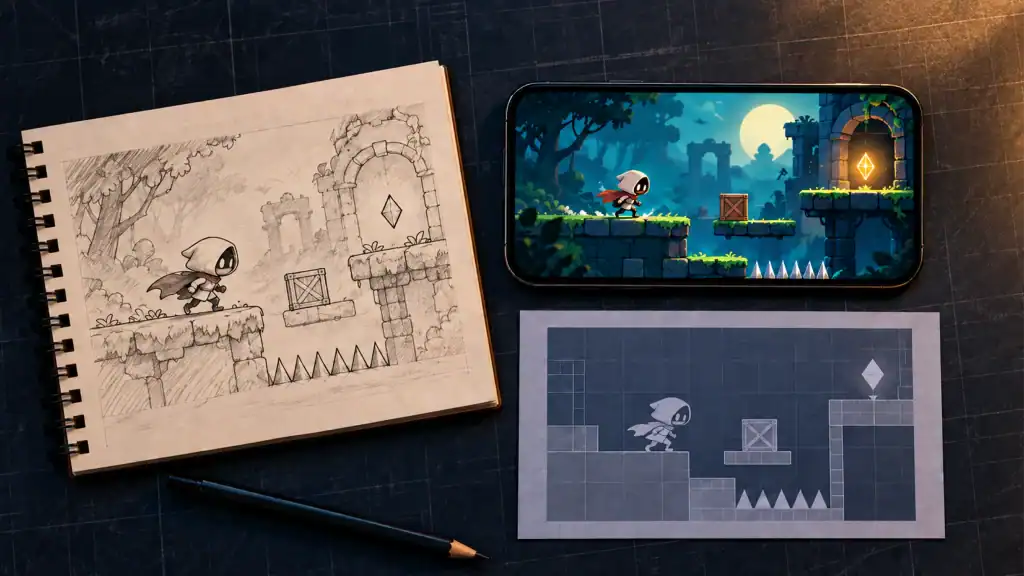
A Minimum Viable Game (MVG) is the smallest playable version of a game built to test whether its core idea and gameplay loop work before you commit months of development time and a larger production budget.
That validation matters in an increasingly crowded mobile gaming market. The App Store saw more than 55,300 new game titles in 2025, up 11.4% year over year, while Google Play surpassed 150,000 games, up 45.9%. Over the same period, mobile game downloads fell 7.2% to 50.41 billion, according to Sensor Tower’s State of Gaming 2026 report. With more games competing for player attention, testing the core experience before full production can help studios make better development decisions.
This guide explains what an MVG is, why studios build one, what it should include, and how to create and test one step by step.
Want to discuss your project? Our experts are just a click away.
Contact UsWhat Is a Minimum Viable Game?
A minimum viable game is a stripped down, playable build made to answer one question. Is this idea worth pursuing further?
It borrows its logic from the Minimum Viable Product (MVP) model used in software and startups. Instead of building a complete app, teams launch a lean version, then measure real usage. Game teams apply the same approach to interactive entertainment.
Some studios call this a game MVP, since it follows the same validation logic as a minimum viable product game built for any other industry. The label changes, but the goal stays the same. Test the idea with real players before committing a full budget.
An MVG usually includes:
- One working core mechanic
- Basic, functional controls
- A single environment or level
- Just enough feedback and UI to make the loop understandable
- No story, live ops, or monetization systems yet
If players engage with that stripped down loop, you have a signal worth building on. If they do not, you have saved months of production time and a large share of your budget.
For first time teams, it also helps to review the broader steps to design your first video game before locking in your MVG scope.
Why Build a Minimum Viable Game?
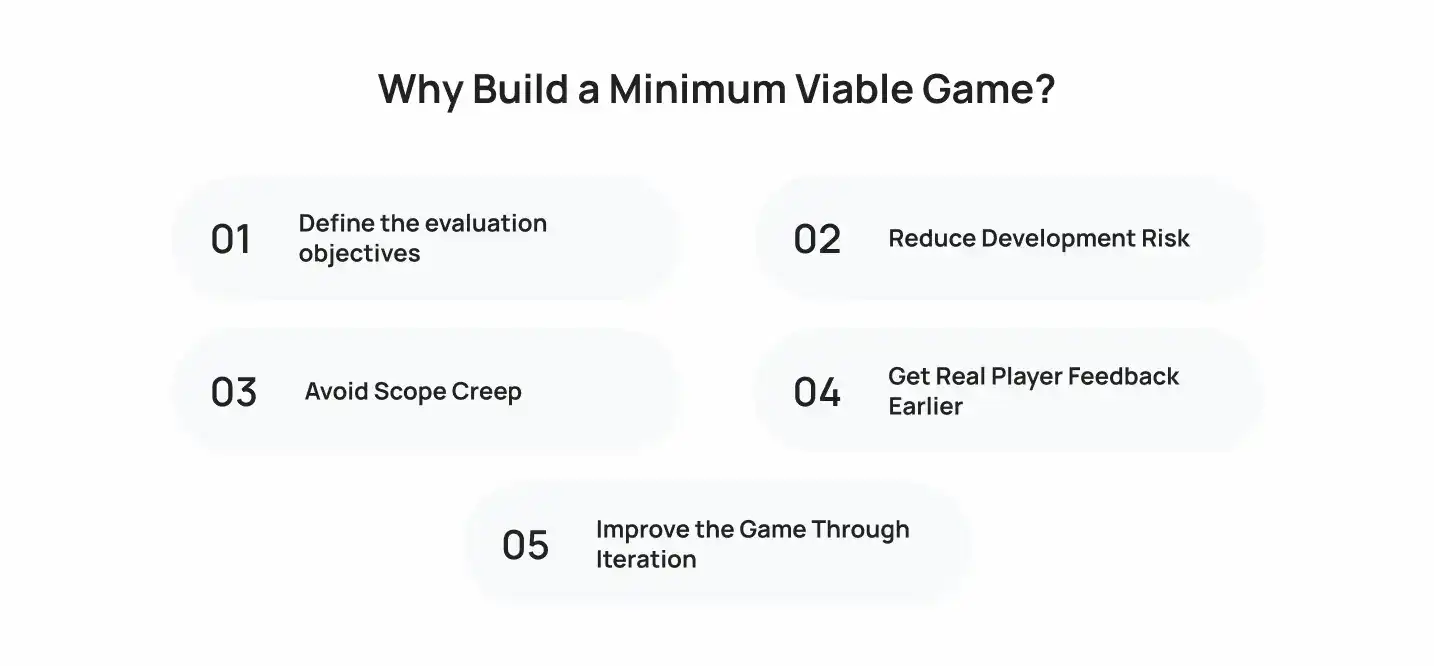
Building a full game before validating the idea can lead to wasted time, budget, and development effort. An MVG lets you test the core gameplay early, identify problems, gather player feedback, and make informed decisions before moving into full production.
Validate the Core Game Idea
Player response to your core gameplay loop can reveal whether the idea has real potential. An MVG puts the central mechanic in front of players early, before significant time and budget go into full production.
An MVG lets you test the core loop against real players before you compete in that environment. You learn quickly whether people return to the mechanic on their own, without marketing spend keeping them engaged.
Reduce Development Risk
Full production without validation puts your entire budget on one untested bet. Unity’s 2026 Game Development Report found that 52% of developers now prioritize smaller scale projects as their main way to manage risk, and 48% have become more selective about which prototypes move into full development.
An MVG applies that same discipline. You commit real budget only after the core idea proves itself, not before. This also lowers the odds of ending up among the reasons game projects fail before launch.
Avoid Scope Creep
Feature lists grow fast once a team gets excited about an idea. An MVG forces a hard limit. You build only what is needed to test the core loop, and nothing else.
This constraint protects your timeline and your budget. It also keeps the team focused on one clear goal instead of splitting attention across systems nobody has validated yet.
Get Real Player Feedback Earlier
Assumptions about what players want are often wrong, even for experienced teams. An MVG puts a real, working build in front of players months before a full launch.
That feedback replaces guesswork with evidence. You can see where players lose interest, which controls confuse them, and whether the core mechanic is actually fun before you add art, story, or monetization on top of it.
Improve the Game Through Iteration
An MVG is a starting point, not a finished product. Each round of testing gives you data to refine the core loop, cut what does not work, and strengthen what does.
This cycle of building, testing, and adjusting costs far less than reworking a finished game after launch. As a result, your final release ends up shaped by real player behavior instead of internal opinion.
What Should an MVG Include?
Scope is the hardest part of building an MVG. Include too little, and testers cannot judge whether the idea works. Include too much, and you lose the speed and low cost that make an MVG useful in the first place.
The right scope covers only what is needed to test the core gameplay loop. Everything else waits until after validation. For a broader view of how this fits into a full production timeline, see our guide to the game development process.
Core Gameplay Loop
This is the single mechanic players repeat again and again, like matching tiles, dodging obstacles, or building a base. It is the reason players stay or leave.
Your MVG should isolate this loop and remove everything that does not directly support it. If the loop is not fun on its own, art and story will not fix that later.
Basic Controls
Controls need to work, not impress. Players should be able to move, act, and interact without confusion or lag.
Skip advanced input options, accessibility settings, and control customization at this stage. Add those once you confirm the core mechanic is worth building around.
One Playable Environment
A single level or arena is enough to test the loop. You do not need multiple biomes, level progression, or content variety yet.
Keep the environment simple so art and level design time go toward testing, not decoration.
Basic Player Feedback
Players need to know what is happening. Whether they scored, failed, or made progress. Simple visual and audio cues cover this.
Skip polished animations, particle effects, and full sound design. Functional feedback is enough to judge whether players understand and enjoy the loop.
A Clear Start and End State
Every test session needs a defined beginning and end, whether that is level completion, a game over state, or a time limit.
This structure gives you a clean way to measure sessions, track completion rates, and compare results across different testers.
Lightweight Analytics
You cannot improve what you do not measure. Basic analytics, like session length, retry rate, and drop off points, turn player behavior into usable data.
You do not need a full live ops dashboard at this stage. A simple event tracker built into the prototype is enough to guide your next iteration.
How to Build a Minimum Viable Game?
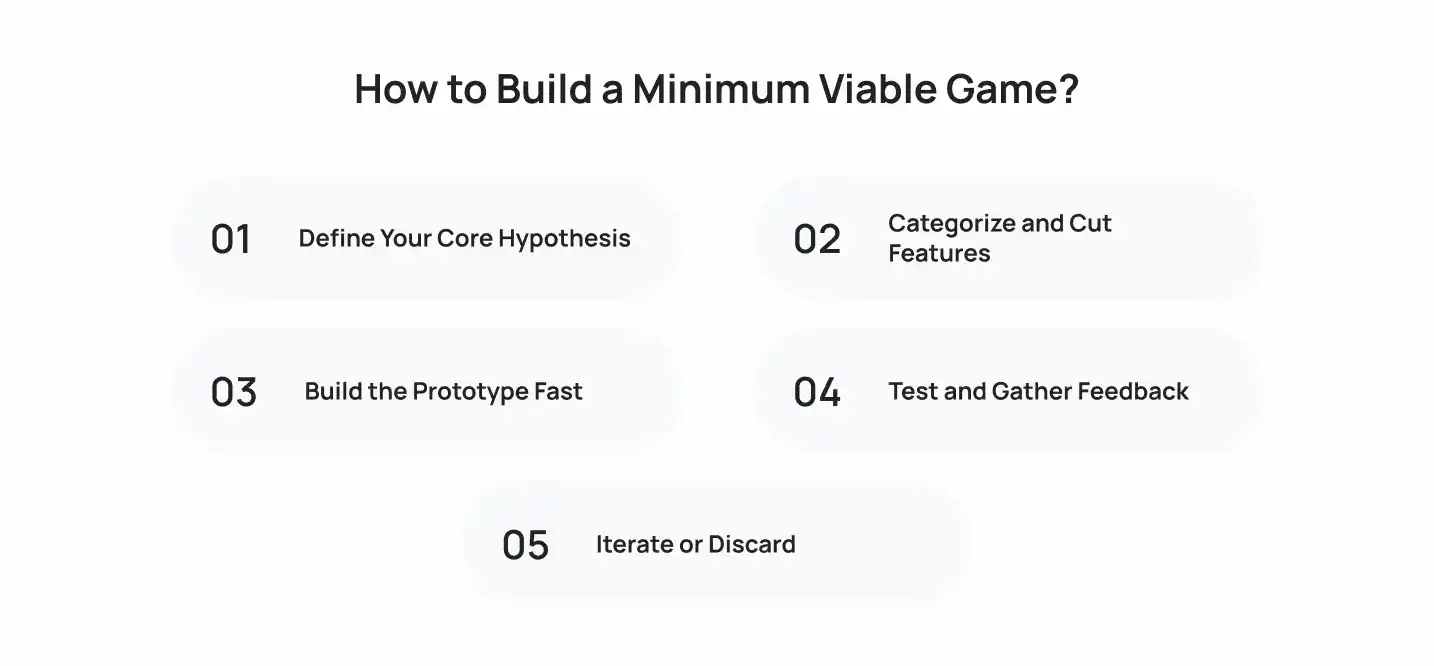
Minimum viable game development follows a repeatable process. Treat it as a short game development roadmap rather than a full production plan, since speed and clarity matter more than completeness at this stage. Here is how most teams move from idea to a testable build.
1. Define Your Core Hypothesis
Start by writing down exactly what you want to test. For example, do players enjoy this specific combat mechanic, or does this puzzle format hold attention for more than two minutes.
Keep this hypothesis narrow. A clear, single question focus keeps your MVG scope tight and your results easy to interpret. Documenting this early, even in a short game design document, keeps the whole team aligned on what you are actually testing.
2. Categorize and Cut Features
List every feature you want in the eventual full game. Then sort them into three groups: must test now, needed later, and not needed yet.
Only the first group belongs in your MVG. Everything else waits, no matter how appealing it seems during planning. This step is where most scope creep gets stopped before it starts.
3. Build the Prototype Fast
Speed matters more than polish here. Unity’s 2026 Game Development Report found that 67% of developers now spend three months or less in the prototyping phase, a clear shift toward faster, lower fidelity testing.
Use placeholder art, simple shapes, and existing engine assets wherever possible. The goal is a functional game prototype that tests the mechanic, not a visual showcase.
4. Test and Gather Feedback
Put the build in front of real players as early as possible, not just your internal team. Internal opinions carry bias that outside testers do not.
Structured video game testing at this stage should track completion rate, session length, and where players quit. Combine that data with direct player comments to understand both what happened and why.
5. Iterate or Discard
Use the test data to make one of three calls: refine the loop and test again, pivot to a different mechanic, or discard the idea entirely.
This is also the point where a validated MVG can grow into what some teams call a Minimum Lovable Game, a version built to make players genuinely enjoy the experience, not just tolerate it.
Minimum Viable Game vs. Prototype vs. Vertical Slice
These three terms get used interchangeably, but they answer different questions. A prototype tests a mechanic in isolation. A minimum viable game prototype tests whether that mechanic holds up as a real, playable loop. A vertical slice tests whether the finished game, at a small scale, meets your quality bar.
| Aspect | Prototype | MVG | Vertical Slice |
| Main question | Does this mechanic work at all | Do players enjoy the core loop | Does the finished game meet our quality bar |
| Player facing | Rarely, internal only | Yes, external testers | Yes, often press or investors |
| Art and polish | None | Placeholder | Near final |
| Typical scope | One mechanic | One loop, one level | One full level or mission |
| Built to be discarded | Often | Sometimes | No |
| Comes before | MVG | Vertical slice | Full production |
How Long Does It Take to Build an MVG?
Your minimum viable game timeline depends mainly on genre, platform, and team size, not on how big the eventual game will be. Most MVGs take between 4 and 16 weeks from hypothesis to test results. For a broader breakdown of how time and money scale together across a full project, see our guide on how much it costs to make a video game.
| Game Type | Typical MVG Timeline | What Slows It Down |
| Hypercasual or simple 2D mobile | 3 to 5 weeks | Custom art, extra levels |
| Mid-core mobile or casual | 5 to 9 weeks | Meta systems, progression logic |
| Multiplayer or systems-heavy | 9 to 14 weeks | Networking, server infrastructure |
| PC or console, narrative driven | 10 to 16 weeks | Custom tooling, cinematic systems |
How Much Does It Cost to Build an MVG?
Your minimum viable game cost depends heavily on team location, genre complexity, and how much custom technology the concept needs. A simple mobile MVG built in an existing engine costs far less than a systems-heavy multiplayer test. Engine choice also affects your minimum viable game development cost directly. Licensing and tooling decisions, covered in our Unity game development cost guide, can shift your budget before a single feature gets built.
| Game Type | Typical MVG Cost Range | What It Covers |
| Hypercasual or simple 2D mobile | $8,000 to $25,000 | One core loop, placeholder art, basic analytics |
| Mid-core mobile or casual | $25,000 to $60,000 | Core loop, simple UI, one test environment |
| Multiplayer or systems-heavy | $60,000 to $120,000 | Core loop, basic netcode, server setup for testing |
| PC or console focused build | $70,000 to $150,000 | Core loop, engine tooling, small scale test environment |
Common Mistakes When Building an MVG
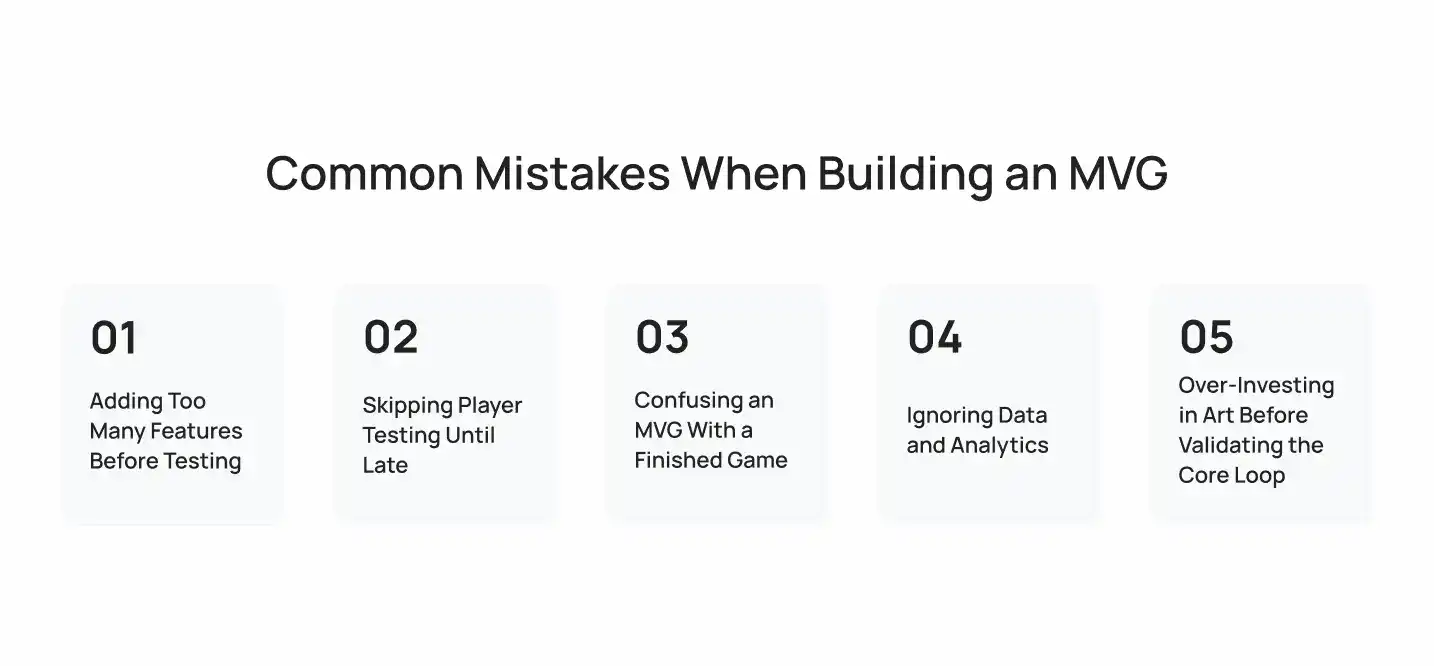
Even teams that understand the concept get the execution wrong. These mistakes show up again and again across game projects, regardless of budget or team size.
1. Adding Too Many Features Before Testing
Teams often add a second mechanic, a story beat, or a progression system before confirming the first mechanic works. This defeats the purpose of the MVG.
Every extra feature adds time, cost, and noise to your test results. Stick to the single hypothesis you defined at the start.
2. Skipping Player Testing Until Late
Some teams build the entire MVG, then only show it to players once, right before deciding whether to continue. That approach wastes the speed advantage an MVG offers.
Test early and often, even with a small group of five or ten players. Small rounds of feedback catch problems before they compound.
3. Confusing an MVG With a Finished Game
An MVG is not a soft launch build or a beta. Treating it as a near final product leads teams to add polish, monetization, and content that has no place at this stage.
Keep the build rough on purpose. Polish comes after the core idea earns it.
4. Ignoring Data and Analytics
Player opinions matter, but they do not tell the whole story. A player might say they enjoyed a session, then quit after two minutes without realizing it.
Pair qualitative feedback with basic analytics like session length and retry rate. The combination gives a far clearer picture than either one alone.
5. Over-Investing in Art Before Validating the Core Loop
Custom art and animation take real time and money, and none of it matters if the core mechanic is not fun. Teams that skip this order often end up polishing a game nobody wants to play.
Validate the loop first, using placeholder or free asset packs. Invest in art once player data supports the decision.
Why Choose Cubix for Minimum Viable Game Development
Cubix has spent 18 years building games and mobile apps across a wide range of genres and platforms. If you want to build a minimum viable game that gives you real answers instead of guesses, our game development services team can take you from a rough concept to a tested, data-backed build.
Why Choose Cubix for MVG Development?
- Game Development Expertise: Experienced teams across mobile, PC, and console game development, with the technical knowledge to handle different game concepts and requirements.
- Rapid Prototyping: Fast MVG builds that focus on the core gameplay loop, helping teams test ideas early without spending resources on unnecessary features.
- Data-Driven Iteration: Player feedback and analytics help identify what works, what needs improvement, and whether the game should move forward or pivot.
- End-to-End Support: Clear milestones and support from initial concept and testing through refinement and full-scale game production.
Want to discuss your project? Our experts are just a click away.
Contact UsFrequently Asked Questions
1. How much does it cost to build a minimum viable game?
Most MVGs cost between $8,000 and $150,000, depending on genre and platform. Simple mobile concepts sit at the low end, while multiplayer or console builds cost more due to added technical complexity.
2. How long does it take to develop a minimum viable game?
Most MVGs take 4 to 16 weeks from hypothesis to test results. Simple mobile games move fastest, while multiplayer or narrative-heavy builds take longer.
3. What features should be included in a minimum viable game?
An MVG needs one core mechanic, basic controls, a single test environment, simple feedback, and lightweight analytics. Story, monetization, and live ops systems can wait until after validation.
4. What is the difference between an MVG, MVP, and game prototype?
An MVP is the broader business term for a lean, testable version of any product. A game prototype tests one mechanic internally, while an MVG tests the full core loop with real players.
5. When should a minimum viable game move into full production?
Move forward once player data shows strong engagement with the core loop, such as high retry rates or long session times. If the data is weak, refine the mechanic or pivot before investing in full production.
6. Can a game development company build and validate an MVG?
Yes. A studio with prototyping and testing experience can define the hypothesis, build the test version, and set up analytics to validate it. This is typically faster and less risky than validating an MVG in-house without prior testing experience.