Key Takeaways
- AI is making solo game development viable. A single developer can now handle coding, art, writing, QA, and voice generation with AI-assisted tools.
- In a 2026 Gamescom survey, 33% of respondents expected AI to directly reduce team sizes, while 36% expected it to change roles instead.
- AI game development tools now cover most of the production pipeline, from engines to asset generators to automated QA.
- AI reduces costs and speeds up production, but it can’t replace creative judgment. Human developers still lead creative vision, storytelling, player experience, and quality control.
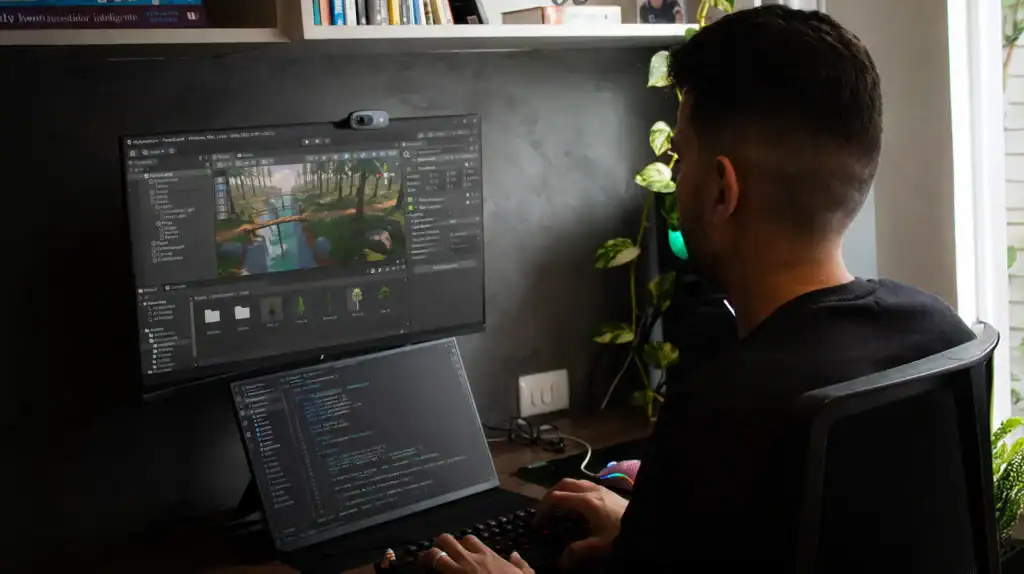
A single developer can now build, ship, and market a full game without a studio behind them. Five years ago, that was far harder to achieve. Today, AI tools make solo and small-team development far more practical.
AI in video game development is why. Coding assistants write functional gameplay logic in minutes. Generative art tools produce textures, characters, and environments on demand. Writing assistants draft dialogue and narrative branches. As a result, jobs that once required ten people now need one.
This shift is already reshaping studios in Turkey, driving layoffs at Xbox and Unity, and fueling a wave of solo-built games on Steam. This article covers how AI is changing team sizes, which tools make solo development possible, which companies are driving the change, and what AI still can’t do on its own.
AI’s Impact on Game Development Teams in 2026

The numbers tell the story clearly. Between 2023 and early 2025, the game industry lost more than 20,000 jobs worldwide, according to an analysis by WebProNews. Unity Technologies cut roughly 25% of its workforce, Riot Games eliminated 530 positions, and Epic Games laid off 830 people, or 16% of its staff.
Xbox has continued trimming staff through 2026, and the pressure is now hitting junior roles hardest. The entry-level pipeline that once trained new talent no longer functions the way it used to.
At the same time, solo and small-team development is booming. A 2026 industry survey found that over 35% of developers now primarily self-fund their work, with AI tools making solo and small-team development more viable than ever.
This is the paradox of 2026: studios are shrinking, yet more games are getting made than ever, because one motivated person with the right AI stack can now do what used to take a full department.
Why AI Is Reducing Game Development Team Sizes
A 2026 Gamescom developer survey, completed by 100 industry speakers, put numbers on the trend:
- 33% of respondents expect AI to reduce team sizes directly.
- 36% believe AI will change roles rather than shrink teams outright.
- Code and production topped the list of areas where AI adds the most value, at 34% of responses.
A Wharton study of AI-first game studios found similar patterns on the ground. One AI-first studio ran with just five technical team members, all generalists, while researchers found a single developer who had built an entire, fully featured game alone using AI. That isn’t a hypothetical case study. Other founders are already copying the template.
How AI Is Changing Roles in Game Development
Traditional game development split work into narrow lanes: programmers, 3D artists, animators, writers, sound designers, and QA testers. Each lane needed a specialist. AI collapses those lanes into one workflow that a single generalist can run.
Roles aren’t disappearing so much as merging. A developer today might write code in the morning, generate concept art in the afternoon, and draft dialogue by evening, all with AI tools handling the heavy lifting at each step.
If you’re still hiring across disciplines rather than going solo, our guide on how to build a team for app development covers the same team-structuring questions that apply to game projects.
The Turkey Case Study: A Warning Sign for Junior Roles
Nowhere is this shift clearer than in Turkey, home to a large mobile gaming workforce. AI tools are helping individual developers and small studios build video games independently, which is reducing the need for large teams and causing a sharp decline in jobs for junior developers, artists, and writers.
One Istanbul developer’s story illustrates the pressure. He joined a gaming startup fresh out of university and worked on 23 games in five months before burning out, largely because studios kept budgets tight while output demands kept climbing. That pattern of fewer people doing more is now spreading well beyond Turkey.
How AI Enables Single-Person Game Development
AI now covers most of the game development pipeline. Here’s how it breaks down by discipline.
1. AI for Game Programming
Code generation handles boilerplate, gameplay logic, and bug fixes. As a result, one person can write systems that used to require an entire programming team. AI coding assistants can also refactor legacy code, suggest optimizations, and catch errors before they reach production.
2. AI for Game Art and Animation
Generative art tools create concept art, textures, and 3D assets in hours instead of weeks. Art used to be the reason small teams stayed small. Now, a single artist-programmer hybrid can output a visual style that once required three or four dedicated artists working full time.
3. AI for Game Writing and Narrative
AI writing assistants draft dialogue trees, quest text, and localization drafts. This lets solo developers build branching narratives and multi-language releases without hiring a dedicated writing team.
4. AI for Voice and Audio Production
AI voice generation produces character voice lines without booking studio time. Music and sound generators handle ambient audio and combat sound design, cutting one of the more expensive line items in traditional production budgets.
5. AI for Game Testing and QA
Automated QA tools run playtests and flag bugs without a dedicated testing team. This shortens the feedback loop between building a feature and knowing whether it works as intended.
An indie developer who builds solo games on itch.io described the shift directly: a single generalist can now develop full games alone, and the work is more cost-effective and faster than traditional development, letting one person compete with teams of a dozen or more.
This isn’t about replacing creativity. It’s about removing the bottlenecks that used to force small ideas to wait for large budgets. Our breakdown of the impact of AI on modern game development covers this shift in more technical detail, including how engines have adapted their pipelines to support AI-assisted workflows.
AI Tools for Building a Game as a Solo Developer
Solo developers today can realistically piece together an entire production pipeline using AI tools. Here’s a practical breakdown by category.
| Discipline | What AI Handles | Example Use Case |
| Programming | Code generation, debugging, refactoring | Writing gameplay scripts and combat systems |
| Art and Textures | Concept art, sprites, environment textures | Generating a full tileset in one afternoon |
| 3D Assets | Model generation, texturing, retopology | Producing props and characters at scale |
| Narrative | Dialogue, branching story text, localization | Drafting an entire quest line |
| Audio | Voice lines, sound effects, music stems | Voicing NPCs without a recording studio |
| QA | Automated bug detection, playtest simulation | Catching edge cases before launch |
Game Engine and Development Tools
Most solo developers build on Unity, Unreal Engine, or Godot, all of which now ship AI-assisted plugins for coding and asset pipelines. Picking one engine and learning its AI ecosystem well beats spreading effort across several. Not every project fits a solo build, though.
Our overview of game development outsourcing benefits explains when handing off part of the pipeline still makes sense, even with AI tools available.
AI Coding Assistants
The Unity 2026 Game Development Report shows how deep AI adoption has gone. Among surveyed developers:
- 62% use AI tools for coding assistance.
- 44% use AI for writing and narrative design, the second most common use case.
- Only 5% said they don’t use AI at all.
That last figure matters. Five years ago, AI adoption in game studios was a niche experiment. Now, not using it is the outlier position.
AI Tools for Game Art and Textures
Generative image and texture tools now let a solo developer produce production-ready assets without a dedicated art team. The 2026 GoodFirms report on game development found that generative content has already become standard practice, with 7,300 Steam games reporting the use of generative AI assets in 2026. Generative AI assets are now a production baseline, not an experiment.
AI Tools for 3D Game Assets
3D model generators output game-ready meshes with basic rigging, letting solo developers populate environments with props and characters without manual modeling from scratch.
AI Tools for Voice, Music, and Sound
Voice synthesis platforms handle NPC dialogue and narration. Music and sound effect generators cover ambient audio and combat sound design, closing another gap that used to require outside contractors.
AI Tools for Game Testing and QA
Automated QA platforms simulate playtests and catch edge cases before launch, reducing the manual testing hours a small team would otherwise need to budget for.
Developers building solo or in small teams should think about three layers of tooling:
- Engine layer: Unity, Unreal Engine, or Godot, each with AI-assisted plugins for coding and asset pipelines.
- Asset generation layer: image, texture, and 3D model generators that plug directly into the engine.
- Coding assistant layer: an AI pair programmer that writes, tests, and debugs gameplay scripts inline.
If you’re scoping a project and unsure whether to build in-house or bring in outside support, our guide on questions to ask before hiring a game dev studio walks through the tradeoffs, including where AI tooling changes the calculus compared to five years ago.
How AI Is Changing Game Design
AI’s role now extends past programming and into core design decisions. Procedural systems generate levels, balance difficulty in real time, and adjust content based on player behavior.
AI-Powered Procedural Content Generation
AI-powered procedural content generation builds personalized game worlds at scale, reflecting each player’s history, preferences, and playstyle. In fact, 78% of players say they’re more likely to keep playing a game that adapts to their skill level over time.
This means AI design in video game development isn’t just about saving labor. It’s changing what games can do once they ship, adapting long after launch instead of staying static.
How to Learn AI Game Development as a Solo Creator?
If you want to build games solo, the learning curve looks different than it did a decade ago. You no longer need to master every discipline. Instead, you need to know how to direct AI tools effectively and where to draw the line on quality control.
1. Choose the Right Game Engine
Pick one engine and stick with it. Unity and Godot both have strong AI plugin ecosystems and active communities, which makes troubleshooting easier as you learn.
2. Learn AI-Assisted Asset Generation
Start with art and texture tools first. They have the shortest learning curve and the fastest visible payoff, so you’ll see results early and stay motivated.
3. Use AI Coding Assistants Carefully
Use an AI coding assistant for gameplay logic, but review every function it writes. Don’t ship code you don’t understand, because debugging code you didn’t write is far harder than debugging your own.
4. Start With a Small Game Prototype
Build small before you build big. A two-week prototype teaches you more about your AI stack than a six-month plan ever will.
5. Playtest AI-Generated Content
Playtest constantly. AI-generated content can look right and still play wrong, so testing catches problems that a code review or art pass won’t.
Our piece on the rise of generative AI in video games is a useful next read if you want a deeper technical grounding before you start building.
Companies Driving AI Adoption in Game Development
Several categories of companies are driving this shift, from engine makers to specialized studios that build custom AI pipelines for games.
1. Game Engine Companies
Engine providers like Unity and Epic Games have built AI features directly into their toolchains, so developers don’t need to bolt on third-party software.
2. Publishers and Game Studios
AAA publishers including EA and Ubisoft are experimenting with internal AI tools, though not without friction. According to Creative Bloq, EA’s internal AI rollout hasn’t gone entirely smoothly, with developers wrestling with unreliable outputs and some teams resisting systems they don’t yet trust.
3. Specialized AI Development Partners
Specialized AI development partners build custom pipelines for studios that want automation without adopting a one-size-fits-all product. A custom AI development company can design tools tailored to a specific game’s art style, engine, and production timeline, rather than forcing a team to adapt to generic software.
For studios exploring more advanced systems, such as in-game NPCs that hold real conversations or adapt dialogue dynamically, a large language models development company can build and fine-tune models specifically for interactive narrative and character behavior, work that off-the-shelf tools rarely handle well out of the box. Choosing the right approach matters here: our comparison of RAG vs. fine-tuning breaks down which method fits dynamic NPC dialogue versus static knowledge retrieval.
Can AI Replace Traditional Game Development Teams?
No, not entirely, and the industry itself is fairly split on this question. More developers now believe AI will change roles rather than eliminate them outright: 36% of Gamescom survey respondents expect role changes, compared to 33% who expect direct team reductions.
What AI Can Automate
- Coding: gameplay logic, debugging, and refactoring
- Art: concept art, textures, and environment assets
- Narrative: dialogue trees and localization drafts
- Audio: voice lines, music stems, and sound effects
- QA: playtest simulation and bug detection
What AI Cannot Replace
AI is excellent at execution. It’s far weaker at judgment. Here’s where human developers still lead:
- Creative vision and taste: deciding what makes a game fun, not just functional
- Emotional storytelling: writing narrative beats that land, not just text that reads correctly
- Player experience tuning: balancing difficulty and pacing based on real intuition
- Strategic direction: deciding what to build next, and why, based on market and player feedback
- Quality judgment: knowing when an AI-generated asset or line of code is good enough to ship
A Forbes Technology Council piece framed this well: AI is shrinking the distance between imagination and execution in an industry where that distance has always been long, expensive, and technically demanding. When friction is removed without removing creative ownership, more ideas survive long enough to become playable.
A game industry CTO put it plainly in a Fortune commentary: AI, implemented without careful thought, risks eroding the human creativity and artistic vision that make games worth playing in the first place.
The studios struggling with AI right now are usually the ones treating it as a full replacement rather than a production accelerator.
Why Junior Game Development Roles Are Most Vulnerable
Junior roles are at the highest risk right now, not senior creative leads. Entry-level art, writing, and QA roles may face greater pressure as studios use AI to automate repetitive, well-defined tasks that traditionally gave junior employees a starting point.
This creates a real problem for the industry’s talent pipeline. If fewer junior developers get hired, fewer people gain the experience needed to become senior developers a decade from now. That’s a long-term risk the industry hasn’t solved yet.
Benefits of AI for One-Person Game Studios
Artificial intelligence helps one-person game studios save time and money by automating routine tasks like coding, testing, and asset creation.
1. Lower Game Development Costs
You’re not paying salaries across a dozen specialized roles, which cuts the largest line item in most game budgets. This effect is even more pronounced on mobile titles, where this effect can be especially relevant for mobile titles, where smaller teams can use AI-assisted workflows to reduce the amount of manual production work required.
2. Faster Prototyping and Iteration
You can prototype and test ideas in days instead of months, since AI tools remove much of the manual production work.
3. Greater Creative Control
One person makes every decision without committee approval, which keeps the creative vision consistent from concept to launch.
4. Lower Financial Risk
Smaller budgets mean smaller losses if a game doesn’t land, which makes solo development a lower-stakes way to test ideas.
5. Faster Response to Player Feedback
You can pivot quickly based on player feedback, without the coordination overhead a larger team requires.
That said, working alone has real limits, particularly for larger, multiplayer, or live-service games. Those projects still benefit from dedicated teams who understand networking, server infrastructure, and live operations at scale. If you’re building something with real-time multiplayer requirements, multiplayer game development services bring infrastructure expertise that AI tools alone don’t replace.
AI for Gaming: How Cubix Helps Studios Build Smarter
If you’re planning your next game and want to determine where AI can improve your development pipeline, Game Development Company can help you define the right technology and team structure for your project. For mobile-first titles, we can help you integrate AI-assisted workflows while keeping performance, gameplay, and player experience at the center.
At Cubix, we see AI in video game development as a practical way to help studios move faster without compromising creative control.
AI-Assisted Game Development
As an experienced Game Development Studio, we combine AI-assisted workflows with human expertise to help businesses choose where automation makes sense and where experienced developers, designers, and artists still need to lead.
AI Prototyping and Production
From automating repetitive development tasks to accelerating prototyping, AI helps teams make better use of their time and resources at every stage of production.
AI for Game Testing and Content Creation
AI supports faster testing and content creation cycles, so teams catch issues earlier and iterate without waiting on manual QA passes.
Want to discuss your project? Our experts are just a click away.
Contact UsFrequently Asked Questions
1. How is AI enabling single-person video game development teams?
AI automates coding, art, writing, voice generation, and QA tasks. This allows one developer to handle work that once required multiple specialists.
2. What AI tools help a single person make an entire video game?
Solo developers can combine AI coding assistants, generative art tools, 3D asset generators, and AI voice tools. Together, these tools support most stages of the game development pipeline.
3. What software tools are best for solo game developers using AI?
Unity, Unreal Engine, and Godot serve as the core development platforms. Developers combine them with AI asset-generation and coding-assistant tools.
4. What is the best AI software for generating game art and textures?
Generative image and texture tools create sprites, concept art, environments, and textures quickly, helping solo developers produce assets without a dedicated art team.
5. Which companies offer AI solutions that reduce video game team sizes?
Engine providers such as Unity and Epic Games are adding AI capabilities to their development ecosystems. Specialized AI development partners also build custom automation pipelines for studios.
6. How can you learn AI game development as a solo creator?
Start with one game engine, learn AI-based asset generation, and use an AI coding assistant. Build small prototypes, review AI-generated code, and playtest frequently.
7. What platforms can solo game developers use for AI asset creation?
Developers can use platforms for 2D art, 3D models, voice synthesis, music, and sound effects. Combining a few specialized tools creates a streamlined asset-production pipeline.
8. Can AI replace traditional game development teams entirely?
No. AI reduces team sizes and automates repetitive tasks, but human creativity and judgment remain essential. Creative direction, storytelling, player experience, and quality control still require people.
9. What are the top AI platforms for automating game art and design?
AI-powered tools automate concept art, textures, 3D assets, and procedural content. The best setup depends on the game engine, visual style, and production requirements.
10. What are the benefits of using AI for a one-person game studio?
AI lowers production costs, speeds up iteration, and gives solo creators greater creative control. It also reduces financial risk and makes it easier to respond quickly to player feedback.