Key Takeaways
- Enterprise apps now sit at the center of most digital transformation budgets in the USA.
- Native, hybrid, and cross-platform each fit different enterprise goals. Pick based on integration needs, not trends.
- ERP, CRM, and SSO integration are the top three things CIOs ask for.
- HIPAA, SOC 2, and GDPR compliance are non-negotiable for regulated industries.
- Costs vary a lot. Complexity, integrations, and compliance drive the price more than app size.
- Cubix ranks among the top enterprise app development partners in the USA, with over 1,300 projects delivered.
- A good vendor gives you SLAs, post-launch support, and proof of past enterprise work.
Here’s a number that should stop you for a second. Over 70% of enterprise mobility projects fail to hit their original timeline. That’s not a small gap. It’s a sign that most companies pick the wrong partner, or skip proper planning.
Enterprises don’t build apps for fun. They build them to fix broken workflows, connect old systems, and give employees tools that actually work on a phone. But picking the right enterprise app development solutions partner is hard. There are hundreds of agencies claiming to be “the best.” Most of them can’t back that claim with real enterprise work.
This guide cuts through that noise. We’ll walk through the top enterprise mobile app development companies in the USA, what makes them stand out, and how to judge them yourself. You’ll also get real stats, comparison tables, and a few charts to make the decision easier. No fluff. Just what you need to pick the right team.
Want to discuss your project? Our experts are just a click away.
Contact Us
Why Enterprises Are Investing in Mobile Apps Right Now
Lower Costs and Faster Delivery: Cross-platform frameworks and AI-assisted development tools can help reduce development time and costs. Enterprise mobile app development can also deliver experiences across iOS and Android without maintaining completely separate products.
Direct Customer Engagement: A mobile app gives brands a direct channel to customers. Push notifications can support timely updates, promotions, reminders, and other communications without relying entirely on third-party advertising platforms.
Streamlined Internal Operations: Enterprises are building mobile apps for inventory management, field operations, employee workflows, and other internal processes. These apps can also connect with existing CRM and ERP systems, helping teams access important information from one place.
Data-Driven Personalization: Mobile apps can provide valuable insights into how customers interact with products and services. Enterprises can use this information to personalize content, simplify purchasing journeys, and create more relevant experiences.
Competitive Necessity: Mobile apps are increasingly becoming part of the expected digital experience. In many industries, businesses need a strong mobile presence to keep pace with competitors and meet customer and employee expectations.
This is also tied to broader enterprise mobility trends that keep pushing companies toward mobile-first thinking.
How We Picked These Companies (Our Methodology)
Here’s what we checked for each company.
| Criteria | Why It Matters |
| Years in enterprise app development | Shows real experience, not just mobile app hype |
| Industries served | Healthcare, finance, and logistics need specialized know-how |
| Technology stack depth | Native, hybrid, cloud, and AI capability all matter |
| Compliance track record | HIPAA, SOC 2, and GDPR readiness for regulated clients |
| Client reviews and case studies | Real proof beats marketing claims |
| Post-launch support model | Apps need maintenance, not just a launch day |
Top Enterprise Mobile App Development Companies in the USA
Below is a snapshot of leading enterprise app development companies serving the US market. This isn’t ranked by size alone. We factored in specialization, compliance readiness, and client feedback.
| Company | Founded | HQ | Specialty | Notable Strength |
| Cubix | 2008 | West Palm Beach, FL | Enterprise mobility, AI, cloud apps | 1,300+ projects, 15+ years in enterprise |
| Intellectsoft | 2007 | New York, NY | Enterprise digital transformation | Strong in fintech and healthcare |
| Chetu | 2000 | Plantation, FL | Custom enterprise software | Large developer bench, niche verticals |
| ScienceSoft | 1989 | McKinney, TX | Enterprise consulting and dev | Long-standing consulting background |
| Space-O Technologies | 2010 | Los Angeles, CA | Enterprise and startup mobile apps | Flexible engagement models |
If you want to see how a company actually builds apps, not just what they claim, check their work as a mobile app development agency. Case studies tell you more than a sales pitch ever will.
1. Cubix

Cubix is a leading enterprise mobile app development company specializing in secure, scalable, and integration-heavy apps for regulated industries. Founded in 2008 and headquartered in West Palm Beach, FL, Cubix has delivered over 1,300 projects across healthcare, finance, logistics, and retail, backed by 15-plus years of enterprise-specific experience.
Key Enterprise Services:
- Custom enterprise mobile app development (native, cross-platform, cloud, and AI-driven builds)
- ERP/CRM and legacy system integrations
- Cloud architecture (AWS, Azure, GCP)
- UX/UI for enterprise workflows
- Compliance and security (HIPAA, SOC 2, GDPR)
- Dedicated agile development teams
- Post-launch support, monitoring, and maintenance
- API architecture and microservices enablement
Strengths:
- 1,300+ enterprise projects delivered
- 350+ designers and developers on staff
- Enterprise consulting, legacy modernization, and full-scale mobility under one roof
- Proven track record across regulated industries
Get in touch with Cubix to talk through your enterprise app project.
2. Intellectsoft
Founded in 2007 and based in New York, NY, Intellectsoft focuses on enterprise digital transformation. They’ve built a strong reputation in fintech and healthcare, where compliance and integration complexity run high.
Strengths: Strong in fintech and healthcare, enterprise digital transformation experience, established US presence.
3. Chetu
Chetu, founded in 2000 and headquartered in Plantation, FL, specializes in custom enterprise software. Their large developer bench lets them cover niche verticals that smaller agencies typically can’t staff for.
Strengths: Large developer bench, custom enterprise software focus, niche vertical experience.
4. ScienceSoft

ScienceSoft has been in business since 1989, making it one of the longest-standing names on this list. Based in McKinney, TX, they combine enterprise consulting with development, which helps when a project needs strategy work before a single line of code gets written.
Strengths: Long-standing consulting background, enterprise consulting plus development under one roof.
5. Space-O Technologies

Founded in 2010 and based in Los Angeles, CA, Space-O Technologies works with both enterprises and startups. Their flexible engagement models make them a fit for companies that aren’t ready to commit to a large, rigid contract structure.
Strengths: Flexible engagement models, works across enterprise and startup scale, mobile-first focus.
If you want to see how a company actually builds apps, not just what they claim, check their work as a mobile app development agency. Case studies tell you more than a sales pitch ever will.
What to Look for in an Enterprise App Partner
CIOs and CTOs don’t just want a good-looking app. They want something that fits into a much bigger system without breaking it.
Here’s a rough breakdown of what matters most, based on enterprise buyer surveys.
| Capability | Why It Matters |
| Legacy system integration | Most enterprises run on old systems that can’t just be replaced |
| Scalable cloud architecture | Apps need to grow with the business, not slow it down |
| Role-based access control | Different teams need different permissions and visibility |
| SLA-backed support | Downtime costs money. SLAs hold vendors accountable |
| Security-first development | One breach can cost more than the whole project |
One stat that stands out: 58% of enterprises say integration complexity is their biggest fear when starting a new app project. That fear is valid. A poorly integrated app just creates more work, not less.
This is exactly why enterprise app security needs to be part of the conversation from day one, not an afterthought bolted on before launch.
Cost of Enterprise Mobile App Development in the USA
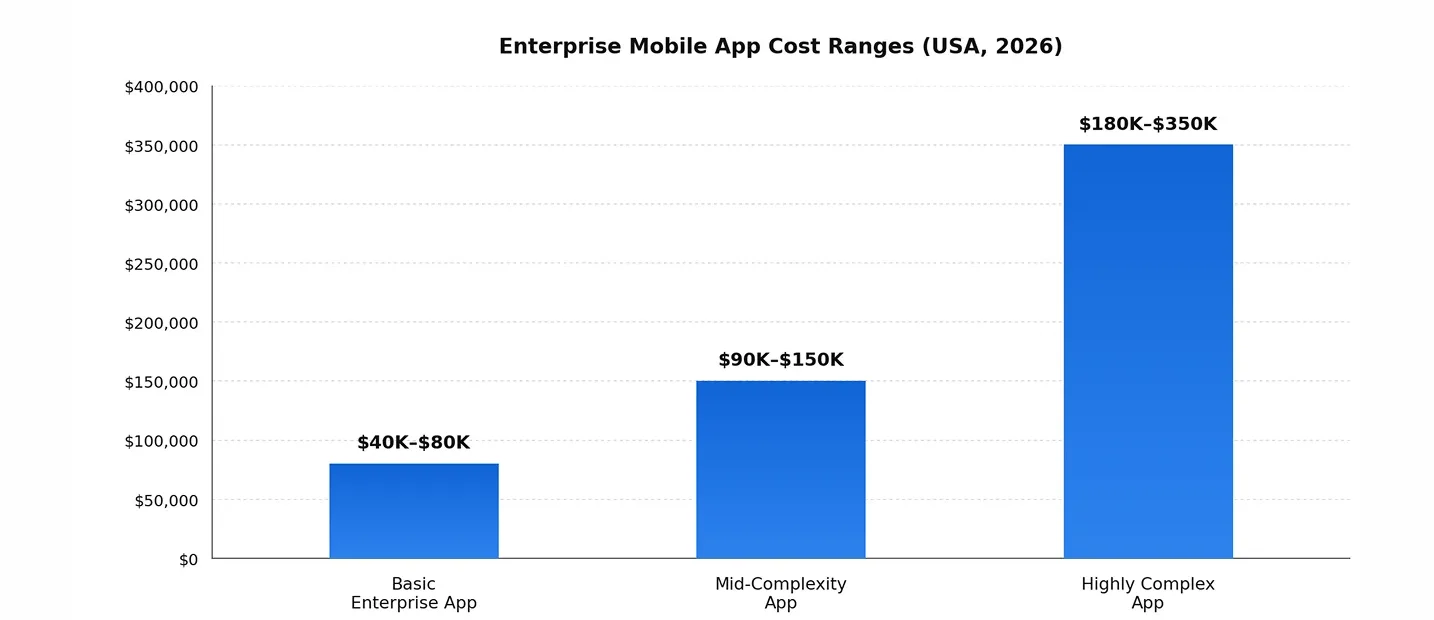
Cost is always the question everyone wants answered first. Fair enough. Here’s a realistic range based on complexity.
For a full breakdown of what drives pricing, this guide on mobile app development cost explains it well. It’s worth reading before you request quotes from vendors, so you know what questions to ask.
One tip here. Don’t just compare final quotes across vendors. Compare what’s included in each one. Some agencies quote low and then charge extra for QA, integrations, or post-launch support. Others build all of that into one transparent number. Ask for a full breakdown before signing anything.
Timeline & Development Process
Enterprise apps take time. Anyone promising a complex app in three weeks is cutting corners somewhere.
A basic app usually takes around 3 months. Mid-complexity projects stretch to about 6 months. Complex, multi-module enterprise apps can take 11 months or more.
A structured mobile app development process matters here. Discovery, design, development, QA, deployment, and support each need real time. Skipping steps to save weeks usually costs more later in bug fixes and rework.
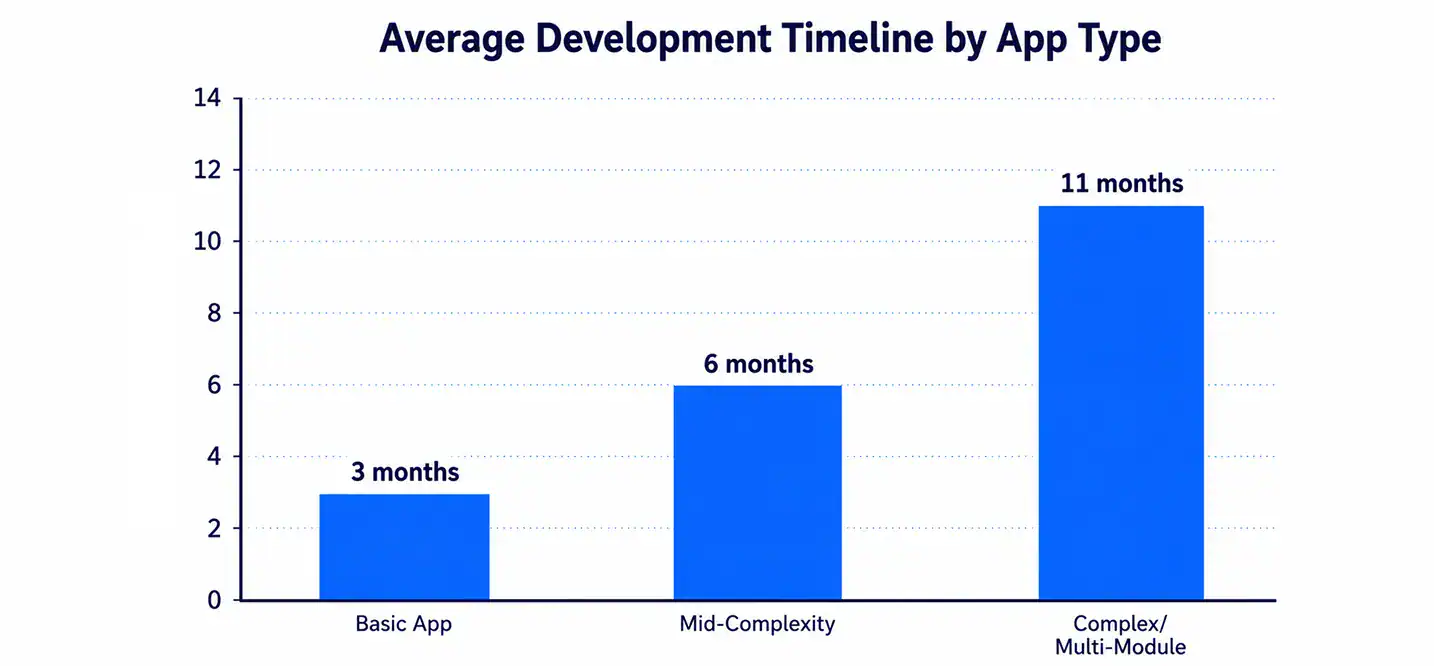
Timelines also shift depending on how many stakeholders are involved. A single department building an internal tool moves faster than a company-wide rollout touching five departments. More stakeholders mean more approvals, more feedback rounds, and more testing scenarios. Plan for that upfront instead of getting surprised by it halfway through.
Common Mistakes to Avoid When Hiring an Enterprise App Partner
- Choosing based only on price. The cheapest quote often means compromised quality, missed deadlines, or hidden costs later in the project.
- Not reviewing enterprise-specific portfolio work. A slick consumer app portfolio doesn’t prove a vendor can handle ERP integrations or compliance-heavy builds.
- Ignoring client reviews and references. Skipping this step can cause you to overlook red flags around communication, reliability, or delivery discipline.
- Vague requirements and scope. Undefined scope almost always leads to scope creep, higher costs, and longer timelines than promised.
- Overlooking post-launch support. Enterprise apps don’t stop needing attention at launch. Skipping SLA discussions upfront is a common, costly mistake.
- Underestimating integration complexity. Assuming legacy systems will “just connect” without real technical discovery is one of the most common reasons projects go over budget.
- Not asking about compliance track record directly. Don’t accept “we can handle that” without proof. Ask for a specific past example, ideally with an auditable outcome.
Cubix’s Enterprise App Development Approach
Cubix follows a clear, repeatable process. Discovery and planning come first, making sure the app strategy actually matches business goals. Design and prototyping come next, followed by development and integration with existing systems.
Quality assurance isn’t an afterthought here. Every build goes through rigorous testing before deployment. After launch, Cubix provides ongoing monitoring and support, so the app stays secure and current as needs change.
This approach works across platforms too. Whether it’s iOS, cross-platform, or an android app development company style native build, the same discipline applies. If you’re evaluating vendors, ask each one to walk you through their process step by step. If they can’t explain it clearly, that’s a red flag. Their development guide of mobile app resource is also a solid read if you want to understand how a serious enterprise partner structures a project from day one.
Ready to talk through your enterprise app project? Get in touch with Cubix and start with a real conversation, not a sales script.
Want to discuss your project? Our experts are just a click away.
Contact UsFrequently Asked Questions
1. How do I choose an enterprise mobile app development company in the USA?
Look at their enterprise-specific experience, not just general app portfolio size. Check case studies, compliance certifications, and client reviews. Ask about their integration experience with your existing systems.
2. What should an enterprise app development company be able to deliver?
They should handle consulting, custom development, integration with ERP/CRM systems, security compliance, and post-launch support. A partner that only builds and disappears isn’t enough for enterprise needs.
3. How much does enterprise mobile app development cost in the USA?
Costs typically range from $40,000 for basic apps to $350,000 or more for highly complex, multi-system enterprise apps. Integrations and compliance needs push costs higher.
4. How long does it take to build an enterprise mobile app?
Basic apps take around 3 months. Mid-complexity apps take 5 to 6 months. Complex enterprise apps with multiple integrations can take 10 to 12 months or longer.
5. Should enterprises hire a US-based or offshore app development company?
Both can work well. US-based teams offer easier time zone alignment and in-person meetings. Offshore or hybrid teams often offer cost savings without sacrificing quality, as long as the vendor has proven enterprise experience.
6. What security standards should enterprise mobile apps follow?
HIPAA for healthcare data, SOC 2 for general security and availability controls, and GDPR if you handle EU user data. Regulated industries often need more than one standard at once.
7. Can an enterprise app integrate with ERP and CRM systems?
Yes, and it usually should. Integration with platforms like Microsoft Dynamics, Salesforce, or SAP is one of the most requested features in enterprise app projects today.
8. What industries need specialized enterprise mobile app experience?
Healthcare, finance, logistics, manufacturing, and legal all have unique compliance and workflow needs. A generalist agency without industry-specific experience can miss critical requirements.
9. Do enterprise app development companies provide post-launch support?
The good ones do. Look for SLA-backed support plans, regular updates, and monitoring. An app without ongoing support becomes outdated and vulnerable fast.
10. What evidence should I request before selecting a vendor?
Ask for case studies in your industry, references from past enterprise clients, proof of compliance certifications, and a clear breakdown of their development process and support model.