You built the app. You launched it. And now you’re wondering why there’s still a monthly bill.
Mobile App Maintenance Cost is often the expense businesses overlook after launch. Building the app is only the beginning. To keep it running smoothly, businesses typically spend $2,500 to $5,000 per month on maintenance, or about 15% to 20% of the app’s initial mobile application development cost each year.
Annual maintenance budget = initial development cost × 15%–20%
Ongoing maintenance is one of those expenses that surprises founders and product teams alike. Most budgets focus heavily on development and almost ignore what comes after. That’s a mistake.
At Cubix, our custom mobile app development services consider factors such as platform coverage, app complexity, integrations, user volume, technical debt, and support-level requirements when estimating ongoing maintenance needs.
What Is Mobile App Maintenance?
Mobile app maintenance covers everything you do to keep your app running smoothly after launch. That includes fixing bugs, releasing updates for new OS versions, patching security vulnerabilities, improving performance, and adding features based on user feedback.
It’s not optional. Apple and Google regularly update iOS and Android, and apps that don’t keep pace can stop working properly or become outdated. On top of that, third-party APIs change, user expectations shift, and security standards evolve.
Maintenance is the ongoing work that keeps your mobile app secure, functional, compatible, and relevant over time.
Different types of mobile application maintenance services
The work breaks down into a few categories:
- Corrective maintenance fixes things that break: bugs, crashes, and unexpected behavior after an OS update.
- Adaptive maintenance keeps your app compatible with new devices, screen sizes, operating systems, and external services.
- Perfective maintenance improves what already works, whether that’s faster load times, better UX, or cleaner code.
- Preventive maintenance addresses issues before they become problems through code refactoring, security audits, and dependency updates.
Most apps need all four, just at different frequencies.
How Much Does Mobile App Maintenance Cost?
The honest answer: it depends on the app. But you need real numbers to plan, so here they are.
The 15-20% Rule
A widely used benchmark in the industry is that the mobile app maintenance cost typically runs 15% to 20% of your original development cost annually. If your app cost $100,000 to build, expect to spend $15,000 to $20,000 per year keeping it alive.
This figure holds reasonably well for mid-complexity apps with a standard feature set. It shifts based on what your app actually does. For a deeper look at what drives initial build costs, see our breakdown of Mobile app development cost.
Maintenance Cost by App Type
| App Type | Estimated Annual Maintenance Cost |
|---|---|
| Simple informational app | $5,000 to $15,000 |
| Mid-complexity app (e-commerce, social) | $15,000 to $50,000 |
| Complex app (fintech, healthcare, marketplace) | $50,000 to $150,000+ |
| Enterprise-level app | $150,000 and above |
These ranges assume a professional development team handling updates, testing, and deployment. If you’re relying on a single freelancer, costs drop but so does reliability and turnaround speed.
Monthly mobile app development cost Breakdown
Breaking it down monthly helps with cash flow planning. For a mid-complexity app, the ongoing app maintenance cost typically looks like this:
- Bug fixes and minor updates: $1,000 to $3,000/month
- Performance monitoring tools: $100 to $500/month
- Third-party service fees (push notifications, analytics, payments): $200 to $2,000/month
- Security patches and compliance updates: $500 to $2,000/quarter
- Major feature updates: $5,000 to $20,000 per release
Want to discuss your project? Our experts are just a click away.
Contact UsWhat Factors Influence the Cost of Maintaining a Mobile App?
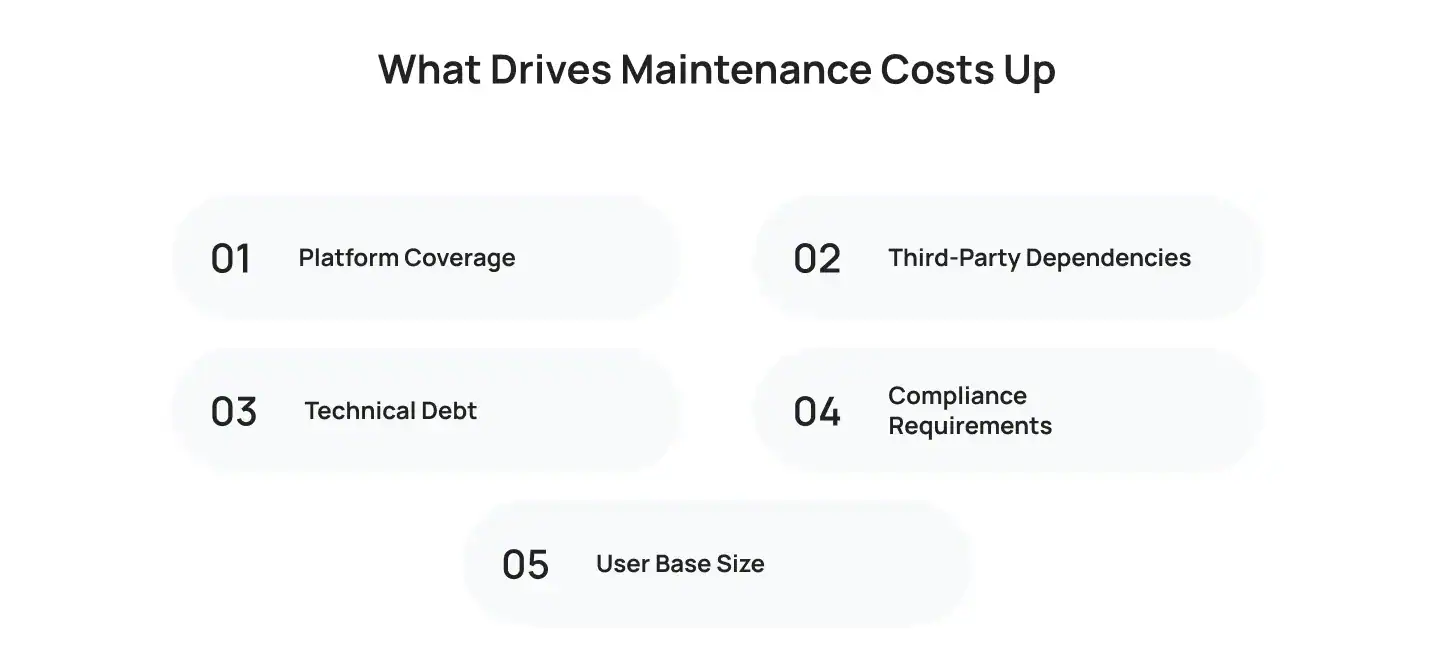
Understanding the factors that influence mobile app maintenance cost helps you make smarter decisions early in development.
1. Platform Coverage
Platform maintenance is not optional because app stores impose technical deadlines. Apple states that, starting in April 2026, iOS and iPadOS apps uploaded to App Store Connect must be built with the iOS 26 and iPadOS 26 SDK or later. This means teams must reserve time for Xcode upgrades, SDK migration, regression testing, and device compatibility checks.
According to Statista, Android holds over 70% of the global mobile market share, while iOS dominates in the US and Western Europe. Your user base determines which platform demands more maintenance attention.
2. Third-Party Dependencies
Every SDK, API, and library you integrate is a potential maintenance liability. Payment gateways update their SDKs. Social login providers change authentication flows. Maps APIs adjust their pricing and endpoints. Each change requires your team to adapt.
The more dependencies your app has, the more unpredictable your maintenance schedule becomes, which can also increase your app maintenance services requirements over time.
3. Technical Debt
Rushed development creates technical debt. The shortcuts that got you to launch faster become expensive to maintain later. Poorly documented code, missing test coverage, and tangled architecture all increase the time your team spends on every fix.
4. Compliance Requirements
Apps in regulated industries face additional software maintenance cost overhead. Healthcare apps need HIPAA compliance. Fintech apps deal with PCI-DSS and evolving financial regulations. Apps serving EU users must stay current with GDPR requirements. Each of these adds audits, documentation, and code changes to your maintenance calendar.
5. User Base Size
More users mean more edge cases, more crash reports, more feedback to process, and more pressure to push fixes quickly. A 100-user beta app and a 500,000-user production app have very different maintenance demands, even if the codebase is identical.
2026 Trends Shaping App Maintenance Costs

Two trends are reshaping mobile app maintenance costs across the industry.
AI-Assisted Development
The 2025 Stack Overflow Developer Survey found that 84% of respondents use or plan to use AI tools in their development process, while 51% of professional developers use AI tools daily. However, many developers remain cautious about the accuracy of AI-generated output. For maintenance teams, AI tools can help identify bugs, generate test cases, explain unfamiliar code, and automate routine development tasks. However, AI-generated code still requires human review, testing, and security validation. As a result, AI may reduce the time required for some maintenance tasks without eliminating the need for experienced developers.
Rising Security and Compliance Requirements
Security is becoming a more important part of post-launch app maintenance. IBM’s 2026 Cost of a Data Breach Report found that the global average cost of a data breach reached approximately $4.99 million. This figure applies to data breaches across organizations and should not be interpreted as a mobile-app-specific average.
For apps that handle payments, health information, financial data, or personal information, maintenance budgets should include dependency updates, vulnerability monitoring, security testing, access-control reviews, incident-response planning, and compliance work. Businesses may also choose to schedule periodic security reviews so that vulnerabilities are identified before they become costly incidents.
Investing in mobile app support and maintenance can help businesses reduce avoidable security exposure, preserve user trust, and maintain compliance with applicable requirements.
Want to know which are the top mobile app development and maintenance companies? Check out our curated list of the industry’s leading providers.
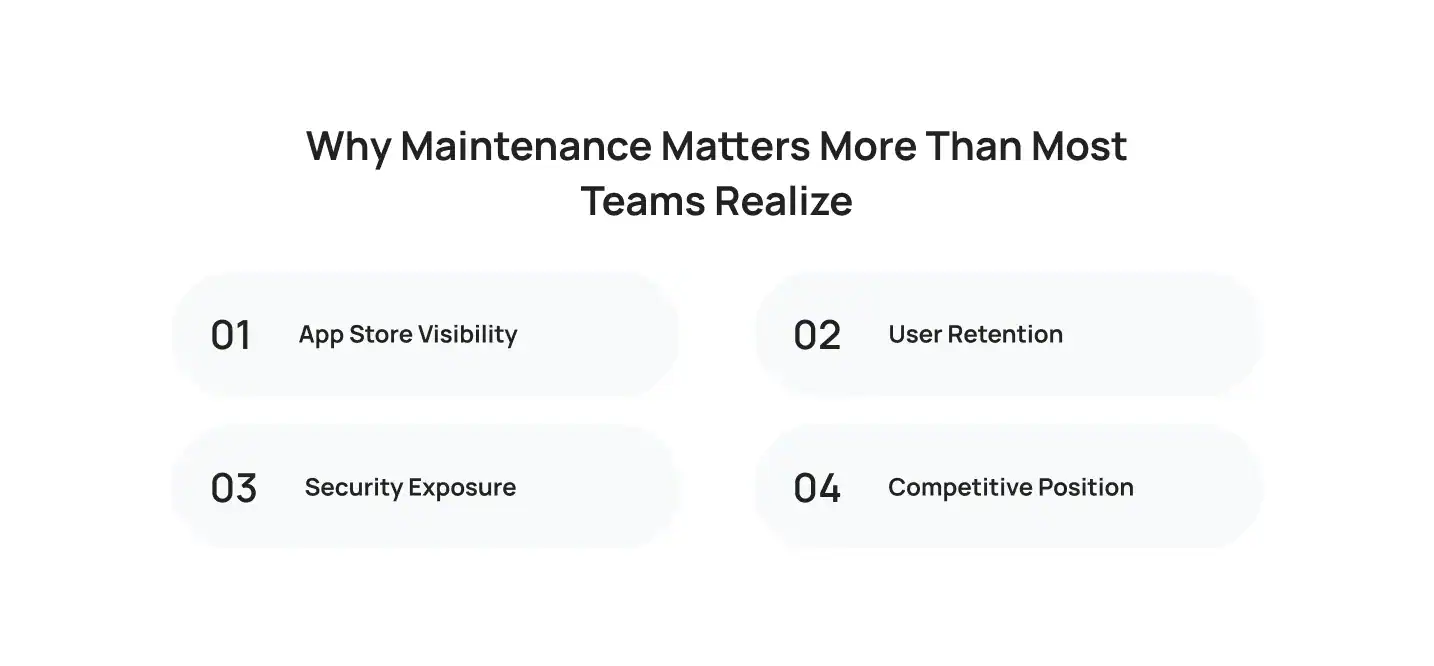
Why Maintenance Matters More Than Most Teams Realize
“The apps that survive long-term are the ones where teams treat maintenance as a product investment, not an afterthought. You’re not just fixing bugs. You’re protecting your reputation, your users, and your revenue.” Salman Lakhani, founder and CEO at Cubix
That framing is important. Maintenance isn’t just technical housekeeping. It has real business consequences.
1. App Store Visibility
App quality can affect store visibility. Google Play states that apps exceeding certain Android Vitals thresholds may receive reduced visibility or a warning on their store listing. Apps that go months without updates drop in search rankings. Users also see the “last updated” date on your store listing. A stale update history signals neglect and affects download rates.
Regular updates are an essential part of mobile app maintenance, helping your app remain visible, competitive, and compliant with the latest platform requirements.
2. User Retention
App crashes and bugs drive users away permanently. Research consistently shows that most users delete an app after two or three bad experiences. App performance maintenance keeps your crash rate low and your ratings high. High ratings drive organic installs. It compounds.
3. Security Exposure
Unpatched apps are targets. Outdated libraries contain known vulnerabilities that attackers actively exploit. If your app handles user data, payments, or personal information, a breach doesn’t just cost money. It costs user trust, and that’s much harder to recover.
4. Competitive Position
Your competitors update their apps. They add features, improve UX, and fix what’s broken. If you’re standing still, you’re falling behind relative to every app that’s moving forward.
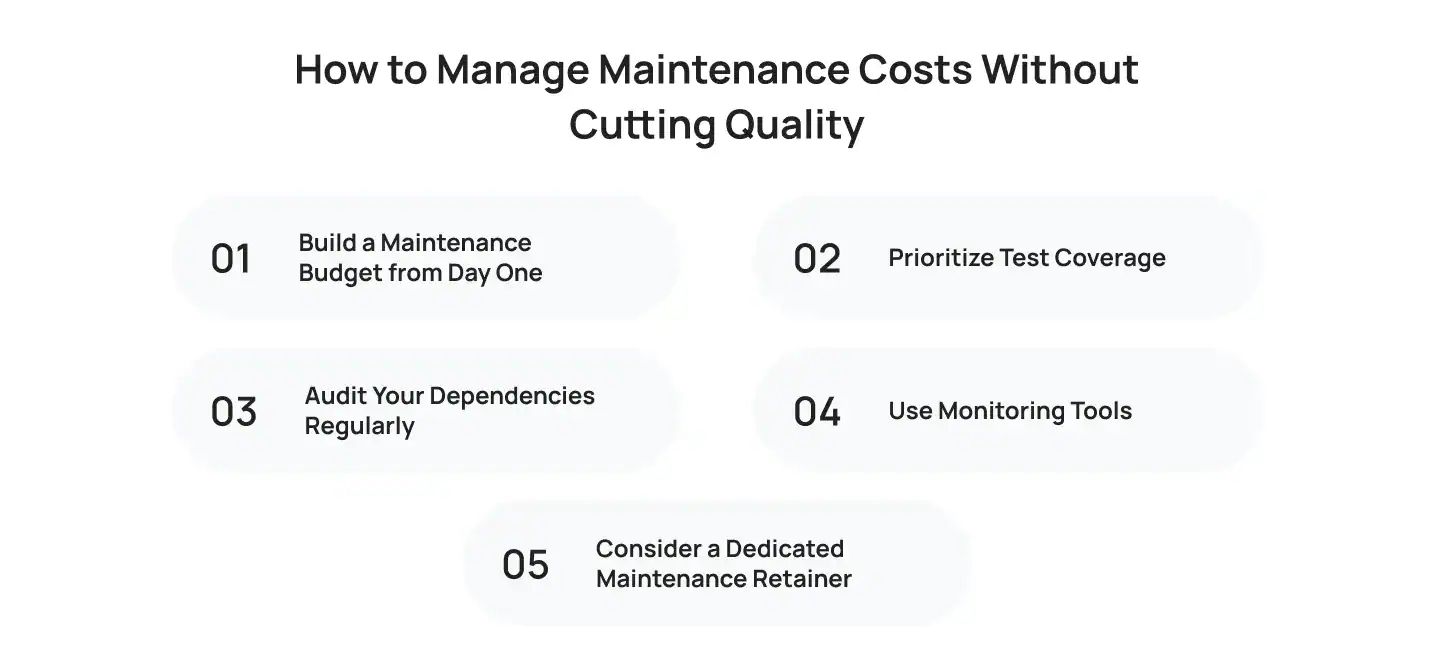
How to Manage Maintenance Costs Without Cutting Quality
You don’t need to spend recklessly to maintain a healthy app. A few structural decisions make a big difference.
Build a Maintenance Budget from day one
Set aside 15% to 20% of your development budget annually for mobile app maintenance costs before you launch. Treating it as an afterthought means scrambling for budget every time something breaks. Factor it into your app development roadmap from day one.
Prioritize Test Coverage
Apps with strong automated test coverage are faster and cheaper to maintain. Tests catch regressions before they reach users, which means fewer emergency patches and faster release cycles. The upfront investment in testing pays off quickly in reduced app bug fixing cost.
Audit Your Dependencies Regularly
Schedule a quarterly dependency review. Remove integrations you no longer use. Update libraries before they become security liabilities. Flag anything that hasn’t had a maintainer commit in six months or more.
Use Monitoring Tools
Tools like Firebase Crashlytics, Sentry, and Datadog give you real-time visibility into crashes and performance issues. You can fix problems before users report them instead of reacting after the damage is done. These tools also help reduce mobile app updates and maintenance efforts by identifying issues before they become major problems.
Consider a Dedicated Maintenance Retainer
Rather than hiring for maintenance in bursts, a monthly retainer with a team of mobile app developers gives you predictable mobile app maintenance pricing and faster response times. You get continuity: the team already knows your codebase and doesn’t spend the first week getting up to speed.
When comparing app maintenance services costs across providers, look beyond the hourly rate. Factor in response time guarantees, the team’s familiarity with your tech stack, and whether they cover both platforms.
How Cubix Empowers Partners with Long-Term Post-Launch Support

Launching an app is only the beginning. At Cubix, our support continues well beyond deployment to help clients keep their applications secure, stable, and ready for growth. Our post-launch maintenance services include performance monitoring, bug fixes, security updates, OS compatibility updates, and feature enhancements based on user feedback.
As business needs evolve, Cubix works closely with clients to scale infrastructure, optimize app performance, and implement new functionality that keeps their products competitive. Whether it’s routine maintenance or long-term product growth, our team provides ongoing technical support to ensure applications continue delivering value long after launch.
The Bottom Line
The mobile app maintenance cost you pay each month is the price of keeping your product secure, competitive, and reliable. Skipping maintenance or underfunding it often leads to higher expenses in the long run, including lost users, security incidents, lower app store rankings, and costly emergency fixes.
Budget 15% to 20% of development cost annually, build monitoring into your stack from launch, and treat mobile app maintenance pricing as a product function, not a technical chore. Your app’s lifespan, reputation, and revenue depend on it.
Frequently Asked Questions
1. What is the average cost of mobile app maintenance?
There is no universal average because maintenance costs depend on the app’s complexity and operational requirements. A common planning benchmark is 15%-20% of the original development cost per year. For example, an app that cost $100,000 to build may require approximately $15,000-$20,000 annually for routine maintenance. Complex, regulated, or high-traffic apps may require significantly more.
2. What are typical mobile app ongoing support expenses?
Typical ongoing support expenses may include the following:
- Bug fixes and minor updates: approximately $1,000-$3,000 per month.
- Performance monitoring and observability tools: approximately $100-$500 per month.
- Third-party services such as analytics, payments, push notifications, and maps: approximately $200-$2,000 per month.
- Security patches and compliance updates: approximately $500-$2,000 per quarter.
- Major feature enhancements: approximately $5,000-$20,000 per release.
3. How often should I budget for mobile app updates and maintenance?
Businesses should budget for mobile app maintenance continuously, not as a one-time expense. As a planning benchmark, allocate approximately 15%–20% of the original development cost annually for routine maintenance. Minor updates and bug fixes may follow a two- to four-week release cycle, while major feature updates may be released every two to three months. Critical security patches should be deployed as soon as necessary.
4. Why is mobile app maintenance important for business apps?
Mobile app maintenance keeps a business app secure, functional, compatible, and competitive after launch. It includes bug fixes, operating-system updates, security patches, performance improvements, dependency updates, and feature enhancements. Without regular maintenance, apps may develop crashes, compatibility issues, security vulnerabilities, poor ratings, and user-retention problems.
5. Why is consistent mobile application maintenance crucial for user retention?
Consistent maintenance reduces crashes, improves performance, resolves user-reported issues, and keeps the app compatible with newer devices and operating systems. A reliable app helps protect ratings, user trust, and repeat usage. In contrast, unresolved bugs, slow performance, and outdated functionality can increase uninstall rates and encourage users to switch to competitors.
6. Can I reduce maintenance costs by using cross-platform development?
Cross-platform frameworks like React Native and Flutter reduce maintenance overhead compared to maintaining two separate native codebases. You write once and update once for most changes. But cross-platform apps still require platform-specific testing, and some native features require platform-specific code. You save effort, not the entire maintenance requirement.