Key Takeaways
- Building an effective app development team requires clear role definitions, technical depth, and a structure that matches your project’s needs.
- Most mobile app teams today range from 6-12 people, but smaller teams are trending, with 60% of organizations expected to adopt smaller teams by 2029.
- Choosing between in-house, outsourced, or hybrid teams impacts cost, speed, and flexibility.
- The right mix of developers, designers, QA, product, and DevOps is critical for both MVPs and full-scale apps.
To build an app development team, first define your product scope, target platform, budget, and timeline. Then choose the roles your project requires, such as product manager, UI/UX designer, mobile developer, backend developer, and QA engineer. Start with a lean team for an MVP and add specialists such as DevOps, security, or AI engineers as the app becomes more complex
A 2026 Gartner forecast predicts that 60% of organizations will adopt smaller software engineering teams at scale by 2029, up from 15% in 2026. This forecast reflects the growing use of AI-enabled tools, multidisciplinary skills, and more flexible delivery models. However, there is no universal app development team size; your ideal structure should depend on the app’s complexity, platform, budget, and growth plans.
This guide covers every part of the process. You’ll get practical tips on roles, team structures, cost, hiring, remote and in-house options, and how your tech choices shape the team you build. If you need a clear roadmap for your mobile app development process and want to understand how to select and scale your team, you’re in the right place.
Want to discuss your project? Our experts are just a click away.
Contact UsWhy App Development Team Structure Matters
Most failed app projects do not fail because of bad code. They fail because of unclear ownership.
When a project lacks a defined product owner, priorities shift every week. When QA gets treated as an afterthought, bugs slip into production, and users notice fast. When nobody owns backend architecture, the app struggles to scale once real traffic hits.
A mobile app development team exists to prevent exactly this. Its job is to turn a business idea into a working product without creating a mess you have to clean up later. That means:
- Making key product decisions early, not mid-sprint
- Balancing speed against long-term code quality
- Catching risk before it turns into a costly fix
- Shipping, testing, and improving on a steady cycle
None of this happens automatically. It happens because someone defined the roles clearly and each person knows their lane.
Mobile App Development Team: Structure and Roles
An app development team brings together product strategy, design, engineering, testing, and delivery operations. The right mix depends on whether you are validating an MVP, building a consumer app, or launching a complex enterprise platform.
Here is what each role brings to your app development team composition.
1. Mobile App Product Manager
The product manager owns the roadmap and decides what gets built first. This role keeps priorities clear, protects the project scope, and ensures the team stays focused on business and user goals.
2. Business Analyst for App Development
A business analyst turns business requirements into clear specifications that developers can work from. This role helps identify gaps and ambiguities early, reducing misunderstandings and costly changes during development.
3. UI/UX Designer
A UI/UX designer creates user flows, wireframes, and the visual design of the app. Good UX makes the app easier to navigate, while a consistent interface improves usability and user engagement.
4. iOS Developer
An iOS developer builds and maintains the iOS version of the app using technologies such as Swift. This role also works with Apple’s design guidelines, Xcode, device testing, and App Store requirements.
5. Android Developer
An Android developer builds and maintains the Android version of the app using technologies such as Kotlin or Java. The role also involves testing across different screen sizes, devices, hardware configurations, and Android versions.
6. Backend Developer
The backend developer builds APIs, manages databases, and handles authentication, data processing, and server-side logic. Strong backend architecture helps ensure the app remains secure, reliable, and scalable as usage grows.
7. QA Engineer
A QA engineer tests features across devices, identifies bugs, catches regressions, and validates real-world use cases before release. Continuous QA helps maintain app quality and prevent issues from reaching users.
8. DevOps Engineer
A DevOps engineer manages CI/CD pipelines, cloud deployments, infrastructure, and application monitoring. This role helps automate releases and identify infrastructure issues before they affect users.
9. Technical Lead
A technical lead oversees architecture decisions, reviews code, and provides technical guidance to developers. On smaller teams, this role may also take on broader technical leadership responsibilities.
How to Build an App Development Team in 7 Steps
Building an app development team involves defining your project requirements, hiring the right professionals, and creating an efficient workflow. These seven steps can help you form a team that matches your app’s goals, budget, and timeline.
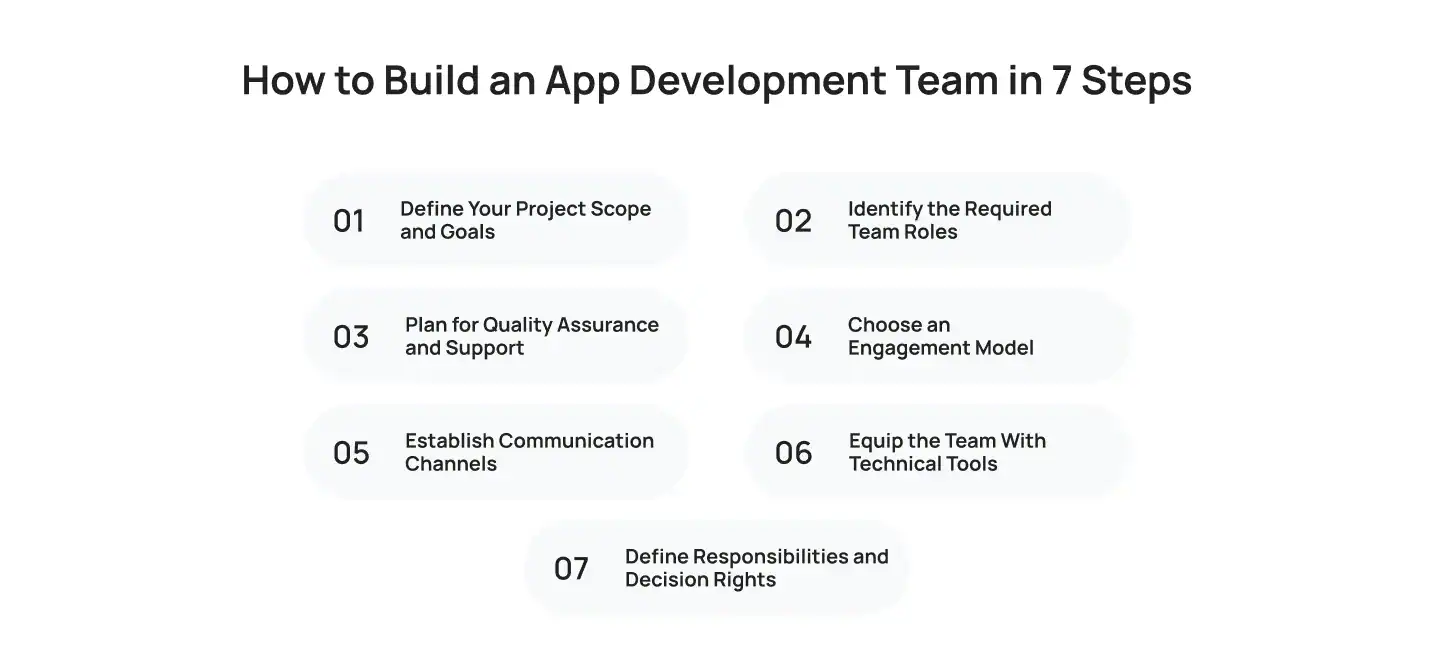
1. Define Your Project Scope and Goals
Start by identifying your app’s purpose, target audience, core features, and business objectives. Decide whether you need a simple Minimum Viable Product (MVP) or a complex enterprise application. Also, outline your preferred platforms, technical requirements, budget, and expected launch date before hiring.
2. Identify the Required Team Roles
Determine which professionals your project needs. A typical app development team may include a product manager, UI/UX designer, iOS or Android developer, backend developer, and QA engineer. Larger projects may also require a technical lead, DevOps engineer, security specialist, or business analyst.
3. Plan for Quality Assurance and Support
Include QA engineers throughout the development process to test features, performance, security, and device compatibility. You should also plan for post-launch maintenance, bug fixes, operating-system updates, and future feature improvements.
4. Choose an Engagement Model
Select an in-house, freelance, outsourced, or hybrid development team based on your budget, timeline, and level of control. If you work with an external partner, review its portfolio, case studies, technical expertise, communication process, and client feedback before making a decision.
5. Establish Communication Channels
Create a clear communication process for sharing updates, reporting issues, and approving decisions. Set daily or weekly check-ins and use tools such as Slack, Zoom, Microsoft Teams, or Trello to keep the team aligned.
6. Equip the Team With Technical Tools
Provide the tools needed for development, collaboration, and project tracking. Use GitHub or GitLab for version control, Jira or Trello for task management, and Confluence or Notion for project documentation.
7. Define Responsibilities and Decision Rights
Clearly assign ownership for product decisions, design approvals, technical choices, and release management. Define what “done” means for each feature and give cross-functional teams enough autonomy to solve routine problems quickly.
Mobile App Development Team Composition By Project Type
Team size should match project complexity, not the other way around. Here is how composition typically shifts across project types.
| Project Type | Typical Team Size | Core Additions |
| MVP | 4 to 6 people | Product manager, 1 to 2 developers, designer, part-time QA |
| Mid-scale app | 6 to 10 people | Business analyst, backend developer, dedicated QA, DevOps |
| Enterprise app | 10 to 16 people | Multiple leads, specialized QA, compliance and security roles |
A lean startup team can validate an idea fast without overspending on roles it does not need yet. This approach also lowers risk, since you are not locking in a large team before you know the app has traction. For a closer look at how startups structure lean, fast-moving teams, check out this guide to app development for startups.
Enterprise apps carry different pressure. Compliance, integrations, and performance under real load all demand specialized roles that a lean MVP team simply does not need.
In-House vs Outsourced vs Hybrid: Choosing Your App Development Team Structure
This is the decision that shapes your budget and your timeline more than any other. Get it wrong, and you either overspend on headcount you do not need or underspend on expertise you cannot do without.
Comparing The Three Models
| Model | Pros | Cons | Best Fit |
|---|---|---|---|
| In-house | Full control, deep product knowledge | Slow to hire, costly to scale | Long-term, IP-sensitive products |
| Outsourced | Fast start, senior talent on demand | Requires clear ownership and communication | Startups, MVPs, tight timelines |
| Hybrid | Internal ownership with external execution | Needs strong coordination | Growing teams with limited internal bandwidth |
An in-house team keeps knowledge close and gives you the most control, which matters when your app is core to your business long term. However, hiring in-house takes time, and scaling it up or down is neither fast nor cheap.
Outsourcing to a dedicated mobile app development team gets you moving fast with senior talent you do not have to recruit yourself. This works well for startups that need to launch and learn quickly. Before choosing a custom mobile app development agency, it helps to understand what separates mobile app developers from a team that just fills seats.
Remote and Distributed Teams
Remote work is now a standard in app development. Managing a remote app development team does bring challenges in communication and culture, but it opens up global talent pools. Top app studios rely on well-established processes and toolkits to keep distributed teams working smoothly.
Teams use Slack for chat, Jira for ticket tracking, GitHub for code, Figma for design, and Zoom for video meetings. With these, you reduce friction across time zones and keep documentation clear and accessible. With the right setup and onboarding, high-performance remote teams are absolutely achievable.
Mobile App Development Team Cost In 2026
Cost planning keeps expectations grounded, whether you build in-house or bring in outside help. Rates vary widely by location, seniority, and project complexity, so treat these numbers as a starting reference rather than a fixed quote.
| Role | Share Of Budget | Hourly Rate Range (USD) | Estimated Spend |
| Developers | 45% | $50 to $120 | $135,000 |
| Designers | 15% | $40 to $100 | $45,000 |
| QA and testing | 10% | $30 to $80 | $30,000 |
| Product and project management | 15% | $50 to $120 | $45,000 |
| DevOps & infrastructure | 10% | $60 to $130 | $30,000 |
| Miscellaneous | 5% | Varies | $15,000 |
Location plays a big role here. Teams based in North America and Western Europe generally charge more, while teams in South Asia and Eastern Europe offer strong talent at lower rates. A remote app development team often gives you the flexibility to mix locations and stretch your budget further without sacrificing quality.
Your final number also depends on how much existing code you can reuse, how complex your design system is, and how much QA and DevOps work the app actually needs.
Native vs Cross-Platform App Development Teams
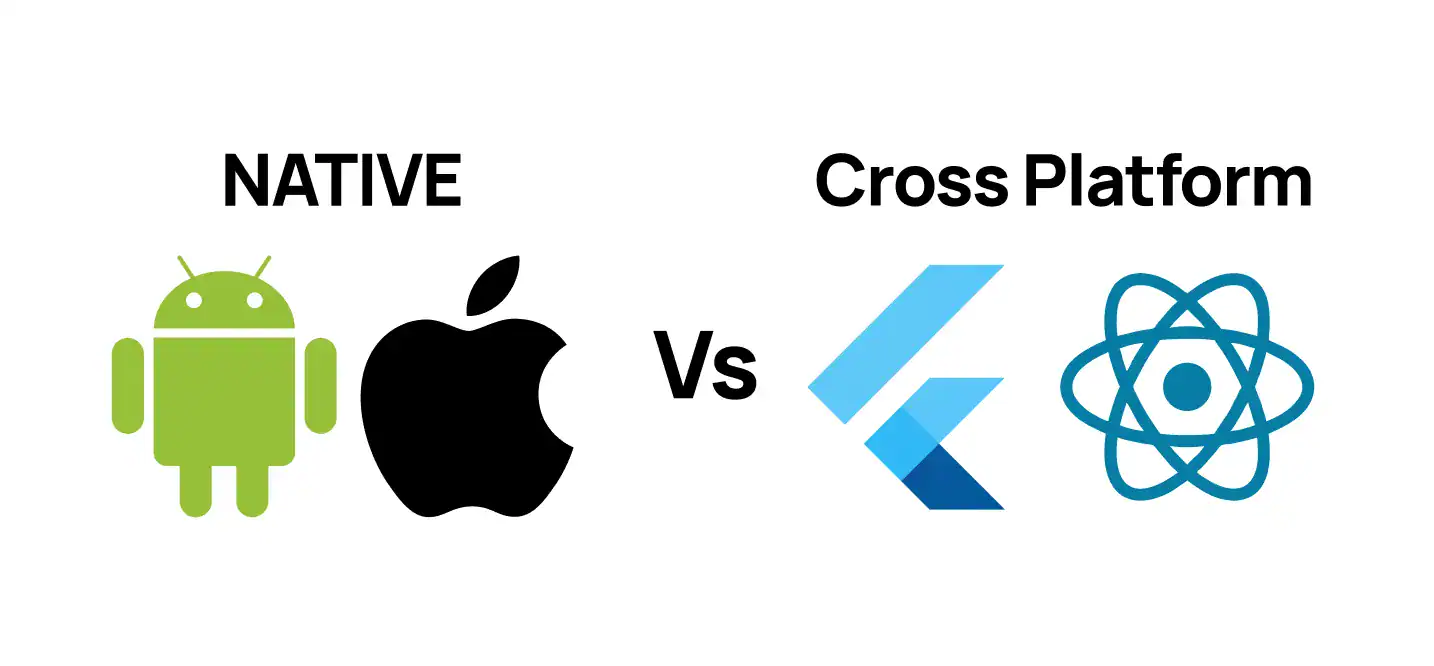
Every team faces a key choice: go native (building for iOS and Android separately) or use a cross-platform approach. Your decision affects your tech stack, team size, and hiring needs.
How Team Structure Changes with Technology Choice
| Approach | Required Roles | Typical Tools/Frameworks | Pros and Cons |
| Native | iOS, Android Devs | Swift, Kotlin, Xcode, AS | Best performance, costly |
| Cross-Platform | Cross-platform Devs | Flutter, React Native | Faster, cheaper, some limits |
Native App Development
Native app development means building separate codebases for iOS and Android. You need at least one iOS developer and one Android developer, each using platform-specific tools like Xcode and Android Studio. This route delivers the best performance and the deepest access to platform features, which matters for apps with heavy device integration.
Cross-Platform Development
Cross-platform development uses a shared codebase across both platforms through frameworks like Flutter or React Native. A smaller team, sometimes just one or two engineers, can cover both platforms at once. This saves time and money, though you may hit limits on deep OS-level customization.
Neither approach removes the need for a UI UX designer, QA engineer, or product manager. Those roles stay constant regardless of your tech stack. If you are still weighing which path fits your project, this cross-platform development guide walks through the frameworks and trade-offs in detail.
iOS vs Android Team Needs
An iOS team needs strong Swift or Objective-C skills, knowledge of Apple’s design standards, and experience with Xcode and device simulators. Design and QA should focus on the Apple ecosystem, test multiple devices, and prepare for App Store approval. Resources like the ios app development company page explain what matters for Apple-focused teams.
Agile App Development Team Workflow: Scrum And CI/CD In Practice
How your team works together matters as much as who is on it. Most high-performing app teams run on Agile principles, and many use Scrum specifically for its structured cadence.
An Agile app development team typically runs on:
- Daily standups to flag blockers before they grow
- Two-week sprints with clear, achievable goals
- Sprint retrospectives to fix what is not working
- A visible backlog so priorities stay transparent
Scrum adds defined ceremonies on top of this, like sprint planning and sprint review, which gives teams a predictable rhythm to plan around.
CI/CD pipelines complete the picture. Once a developer pushes code to a shared repository, automated builds and tests run immediately, so QA can check new features daily instead of waiting for a big release at the end of the sprint. Teams that adopt CI/CD consistently ship with fewer last-minute surprises. To see how this fits into the bigger delivery picture, take a look at this breakdown of the mobile app development process.
How to Hire a Mobile App Development Team
To hire an app developer, define your project scope, choose a hiring platform like Upwork or Toptal, and vet candidates through portfolios and trial projects.
Define Your Project Scope
- Platform: Decide if you need iOS, Android, or cross-platform tools like Flutter or React Native.
- Features: List core needs like user logins, database setups, or payment processing.
- Design: Prepare wireframes or mockups using a tool like Figma so developers understand your vision.
Choose Where to Find Developers
- Freelance Platforms: Use sites like Upwork or Freelancer for budget-friendly or specific task work.
- Vetted Talent Networks: Use platforms like Toptal for pre-screened, highly experienced professionals.
- Agencies: Hire a full-service development agency if you need end-to-end project management, design, and coding.
Screen and Interview Candidates
- Review Portfolios: Look for apps similar to your concept and check their app store quality.
- Test Skills: Assign a small, paid trial project to evaluate their coding quality and communication.
- Protect Your Work: Opinions are mixed on Reddit regarding Non-Disclosure Agreements (NDAs); some users on Reddit insist on an NDA before sharing details, while others believe execution matters more than secrecy
Interviews should probe technical skill, practical coding, teamwork, and conflict resolution. When choosing among the best mobile app developers, prioritize those with relevant project experience who can clearly explain technical decisions.
Common Mistakes Teams Make When Building An App Development Team
A few patterns show up again and again in projects that stall or run over budget.
- Starting development without a clear product owner, which leads to shifting priorities mid-sprint
- Skipping UX design to save time, which usually hurts adoption once the app ships
- Underestimating backend complexity, which creates scaling problems later
- Treating QA as optional instead of continuous, which shows up in bad reviews
- Overstaffing early, which slows decisions down instead of speeding them up
Most of these are not technical failures. They are structural ones, and they are avoidable with a clear plan from the start.
Building Your App Development Team With Cubix
At Cubix, team building starts with the app’s actual requirements, not a fixed template. Every engagement includes in-house designers, full-stack mobile specialists, QA experts, and product managers who work within Agile delivery cycles.
For startups, Cubix assembles compact teams built to iterate fast and adjust based on real user feedback. For enterprise clients, the structure expands to include technical leads, architects, and specialists for compliance and complex integrations.
Remote collaboration is built into how Cubix operates, backed by consistent workflows and tools that keep distributed teams aligned. Cross-disciplinary expertise across native and cross-platform projects means QA, CI/CD, and design quality stay consistent regardless of your tech stack. You can see how these pieces come together in this full overview of mobile app development at Cubix.
Want to discuss your project? Our experts are just a click away.
Contact UsFrequently Asked Questions
Most teams require a product manager, UI/UX designer, iOS and Android developers, a backend developer, QA engineer, DevOps, and sometimes a business analyst and technical lead.
Teams typically range from 4-16 people depending on project size, with 6-12 being most common for full-featured mobile apps in 2026.
Start with essential roles: a product manager, 1-2 developers, a designer, and a QA engineer. Focus on hiring multi-skilled people who can adapt as your needs evolve.
Choose in-house for long-term projects where you need maximum control and IP protection. Outsourcing suits startups, MVPs, and situations that require fast scaling or cost control.
Keep the team lean. One product manager, one or two developers, a designer, and a QA/tester usually suffice for early-stage validation.
A dedicated CTO is not always necessary, especially for small projects. A strong technical lead or architect can often fill this gap for many startups.
Typical budgets for MVPs start around $120,000, with mid-range projects running $200,000-$400,000. Large enterprise mobile projects can exceed $500,000 based on scope and location.
Look for experience in relevant programming languages (Swift, Kotlin, Flutter), portfolio apps, communication skills, and familiarity with best practices in security and APIs.
Review their project portfolio, check references, interview to assess technical and interpersonal skills, and ask for code samples or demo apps.
Agile (including Scrum or Kanban) is considered the best approach for mobile teams because it supports rapid iteration, transparency, and flexibility in changing requirements.