Key Takeaways
- E-commerce mobile app development depends on clear business goals, user needs, budget, features, and the right technology stack.
- Scalable architecture, including headless commerce and microservices, helps apps handle growth and changing business requirements.
- Secure payment processing, PCI DSS compliance, fraud detection, and reliable integrations protect customer data and business operations.
- A structured development process covering planning, design, development, testing, and launch helps control costs and reduce technical issues.
- Starting with an MVP, choosing the right development partner, and investing in post-launch maintenance support long-term growth.
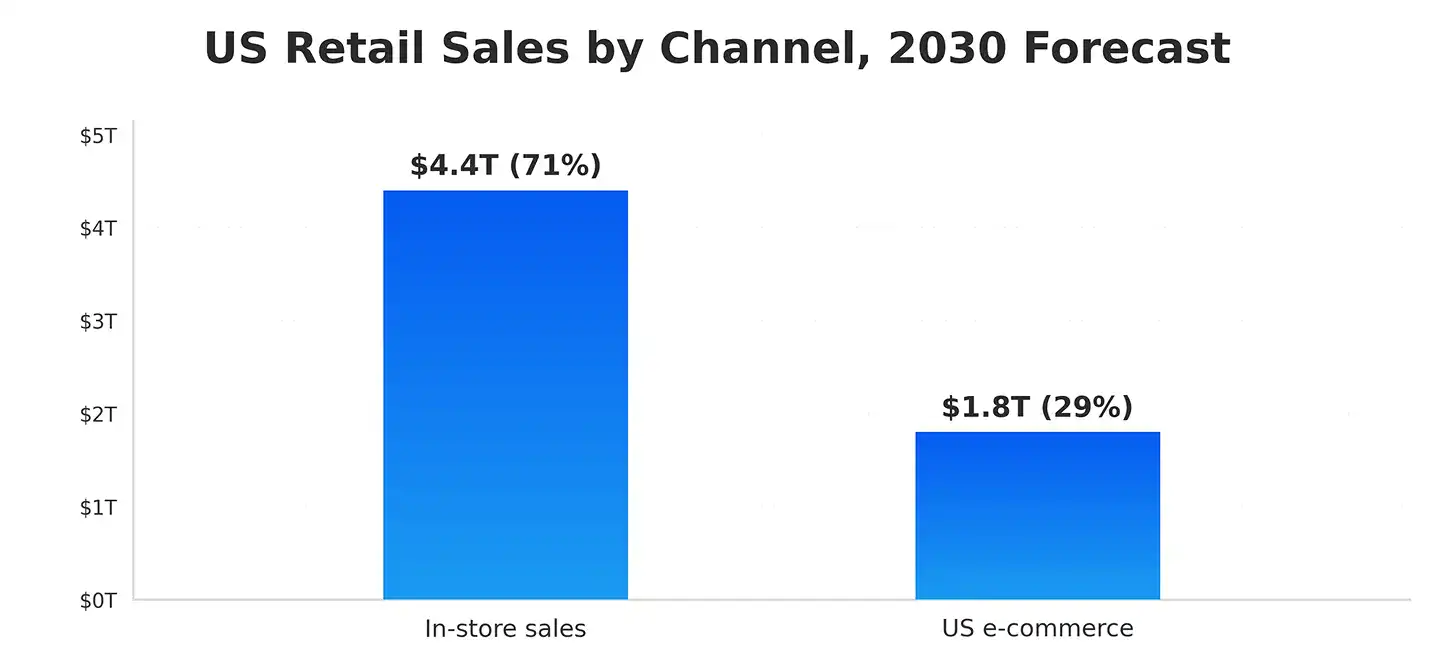
E-commerce Mobile App Development takes more than a good design and a developer team. Your results depend on clear goals, the right architecture, solid integrations, strong security, and a smart launch plan. Forrester projects that US e-commerce sales will reach $1.8 trillion by 2030, which is 29% of total retail. As shoppers move to their phones, your app has to keep pace.
This E-commerce App Development Guide explains the factors that shape cost, timeline, and quality. You will also find architecture options, a six step process, and tips for choosing a partner.
If you need expert help, a mobile app development company with retail experience shortens the path. Read the factors below first, because they drive most of your early decisions.
Talk to our experts and plan your e-commerce app today
Contact UsWhat Is E-commerce Application Development?
It is the work of building the software that sells products online. That includes the storefront, catalog, cart, checkout, and the admin tools behind them.
E-commerce mobile app development focuses on iOS and Android apps. These apps connect to your catalog, payment gateway, inventory, and shipping systems.
A complete solution has four parts:
- Customer app for browsing, search, and checkout
- Backend that runs catalog, pricing, and orders
- Admin dashboard for your operations team
- Integrations with payment, ERP, CRM, and shipping tools
Why Mobile Shopping App Development Matters
Phones are now the main shopping device. Statista expects mobile commerce revenue to reach about $2.5 trillion in 2025 and to cover 63% of retail e-commerce within four years.
An app gives you advantages that a mobile website lacks:
- Push notifications that bring buyers back
- Saved cards and biometric login for faster checkout
- Access to the camera, location, and wallet features
- Loyalty programs that live on the home screen
Key Factors That Influence E-commerce App Development Process
Nine factors decide how long your build takes and how much it costs. Treat them as a checklist before you write a single requirement.
1. Business Goals and Target Audience
Your e-commerce app development strategy starts with measurable goals. Without them, features pile up and budgets grow.
- Set targets for revenue, conversion rate, and repeat purchases
- Segment buyers by device, region, and payment habits
- Decide if you serve consumers (B2C), businesses (B2B), or both
- Study competitor apps to find gaps in speed and service
2. App Features and Shopping Experience
Features define scope. Every feature adds design, build, and test hours.
- Start with search, filters, product pages, cart, and checkout
- Add wishlists, reviews, and order tracking next
- Keep checkout to as few taps as possible
- Test the flow on small screens and slow networks
3. Budget, Timeline, and Development Resources
Mobile app development cost depends on features, platforms, integrations, and team location. In e-commerce mobile app development, integrations and security work often take the largest share.
A basic MVP typically costs $30,000 to $80,000. A feature-rich platform with custom integrations costs $100,000 to $300,000 or more. Timelines follow the same pattern, with MVPs taking three to four months.
Launch an MVP first. Then add features based on user data.
4. Technology Stack and Platform Selection
Your stack affects performance, hiring, and long-term maintenance.
- Native: Swift for iOS and Kotlin for Android give top performance
- Cross-platform: Flutter and React Native share one codebase
- Backend: Node.js, Java, or .NET with a cloud database
- Cloud: AWS, Google Cloud, or Azure for hosting and autoscaling
Pick tools your team knows well. Rare skills raise cost and slow delivery.
5. Architecture and Scalability Requirements
Design for peak load, not average load. A flash sale or holiday rush exposes weak systems fast.
- Use cloud autoscaling to add servers during traffic spikes
- Cache product pages and images through a CDN
- Separate read and write databases for heavy catalogs
- Run load tests before every major campaign
6. Third-Party Integrations and Business Systems
Your app connects to many systems. ERP integration keeps inventory, pricing, and invoices in sync with your back office.
Other common connections include:
- CRM and email platforms for customer data
- Shipping carriers for rates and tracking
- Tax engines for regional rules
- Analytics tools for funnel reporting
Integrations cause the longest delays because each system has its own API limits. Map them during discovery.
7. Payment Processing and Security Requirements
Payments carry the highest risk. Build security in from the first sprint.
- Payment tokenization replaces card numbers with tokens, so your servers never store raw card data
- PCI DSS compliance is required if you store, process, or transmit card data
- Fraud detection rules flag odd orders, such as mismatched locations or rapid repeat attempts
- Support Apple Pay and Google Pay for faster, safer checkout
Follow proven mobile app security practices. Examples include certificate pinning, encrypted storage, and biometric login.
8. Product Data and Order Fulfillment
A Product Information Management (PIM) system keeps product data clean across your app, website, and marketplaces. It stores titles, images, prices, and variants in one place.
An Order Management System (OMS) tracks each order from checkout to delivery. It handles stock checks, split shipments, and returns.
Without both, your team fixes errors by hand. Customers then see wrong stock levels and late deliveries.
9. Testing, Maintenance, and Future Updates
Launch is the start of the work. Apple and Google release new OS versions every year, and your app has to follow.
- Test function, performance, security, and device compatibility
- Track crash rate, load time, and checkout drop off after launch
- Release updates on a fixed schedule
- Budget 15% to 20% of the build cost each year for maintenance
E-commerce App Architecture: Choosing the Right Approach
Your architecture decides how fast e-commerce mobile app development moves after launch. Four approaches matter most, and they often work together.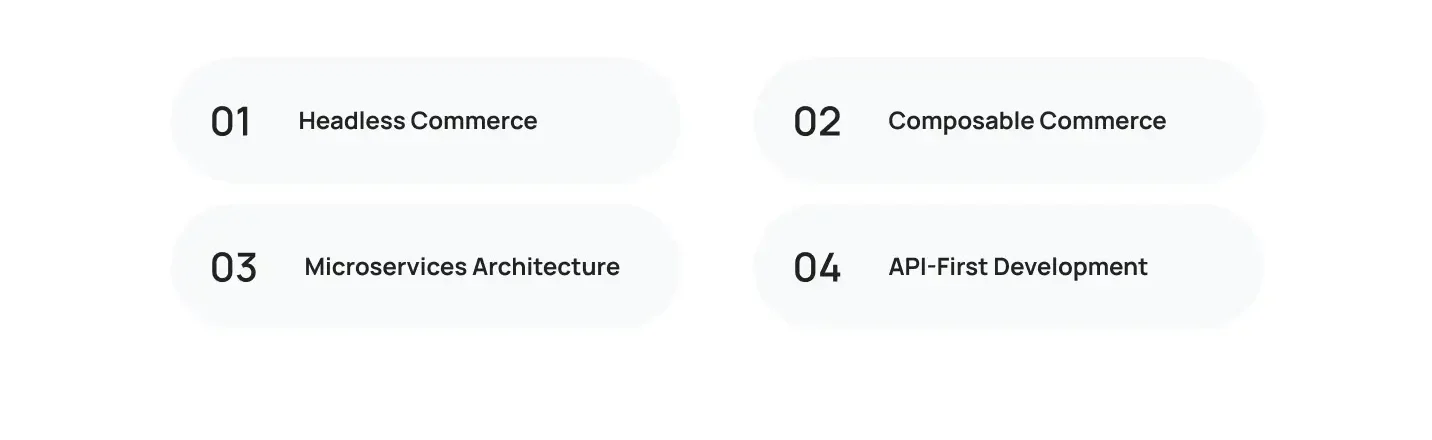
1. Headless Commerce
Headless separates the app front end from the commerce engine. They talk through APIs.
- You change the app design without replatforming
- One backend serves the app, website, and kiosks
- The trade off is more engineering work up front
2. Composable Commerce
Composable commerce lets you pick the best service for each job, such as search, cart, checkout, and content. You swap one part without rebuilding the rest. Gartner’s Hype Cycle for Digital Commerce 2026 ranks composable and modular commerce as transformational. It is a strong fit for mid size and large retailers.
3. Microservices Architecture
This approach splits the backend into small services, such as catalog, orders, and payments. Each service scales on its own.As a result, a traffic spike on search does not slow checkout. However, you need strong DevOps skills to run it.
4. API-First Development
Teams design the APIs before the user interface. This keeps the app, web store, and partner tools on one contract. In addition, API-first work speeds up integrations. New channels connect without major rework.
E-commerce Mobile App Development Process: Step by Step
This flow follows the standard mobile app development process, adapted for retail.
- Discovery and Planning: Define goals, users, features, risks, and success metrics. Produce a scope document and roadmap.
- Architecture and Technology Stack Selection: Choose the architecture, cloud setup, and platforms. Plan integrations and data flow.
- UI/UX Design and Prototyping: Build wireframes and clickable prototypes. Test them with real shoppers before coding.
- Development and Integration: Build in short sprints. Connect payments, ERP, PIM, OMS, and shipping tools.
- Quality Assurance and Performance Testing: Run functional, security, and load tests on real devices.
- Launch and Post-Launch Optimization: Release to the app stores. Then track metrics and improve based on data.
Essential Features That Influence Development
Choose features that support three outcomes: conversion, retention, and operational efficiency. If a feature supports none of them, cut it.
Customer-Facing Features
- Fast search with filters and sorting
- Product pages with images, video, and reviews
- Guest checkout and saved payment methods
- Order tracking and push notifications
- Wishlists and loyalty rewards
Admin and Operations Features
- Catalog, pricing, and promotion management
- Inventory sync and low stock alerts
- Order fulfillment dashboards with status, returns, and refunds
- Sales and customer reports
- Role based access for staff
Advanced Features Worth Considering
- AI product recommendations and chat support
- Augmented reality previews for furniture, fashion, and beauty
- Voice and visual search
- Buy now, pay later options
- Social sharing and in app live shopping
Common Challenges in E-commerce App Development
- Managing complex product catalogs and inventory: Large catalogs with many variants cause data errors. Use a PIM and real time inventory sync to fix this.
- Integrating existing business systems: Old ERP and warehouse tools often lack modern APIs. Use middleware or an API layer to bridge them.
- Protecting customer data and preventing payment fraud: Use encryption, tokenized payments, and rule-based plus machine learning fraud checks.
- Handling traffic spikes and performance issues: Use autoscaling, caching, and regular load tests before sales events.
- Balancing development costs and scalability: Build an MVP on a scalable base. Also set your mobile app pricing strategy early so margins support growth.
Talk to our experts and plan your e-commerce app today.
How to Choose the Right E-commerce Mobile App Solutions
The right path in e-commerce mobile app development depends on your budget, speed, and control needs. Compare the options below.
Custom Build vs. Platform-Based App
| Option | Best for | Strengths | Limits | Time to market |
|---|---|---|---|---|
| Custom development | Unique workflows, large catalogs | Full control, deep integrations | Highest cost | 6 to 12 months |
| Shopify-style platforms | Small and mid-size stores | Fast setup, built in checkout | Limited customization | 1 to 3 months |
| App builders | Simple stores, tight budgets | Low cost, no code | Weak performance and flexibility | 2 to 6 weeks |
| PWAs | Content and catalog browsing | One codebase, no app store | Limited device features | 2 to 4 months |
| Cross-platform frameworks | Most retail apps | Shared code, near native feel | Some platform gaps | 3 to 6 months |
These ranges are typical. Your scope changes them.
Native, Cross-Platform, or PWA?
For mobile shopping app development, use this quick framework. Read the cross-platform app development guide for a deeper comparison.
| Factor | Native | Cross-Platform | PWA |
|---|---|---|---|
| Budget | High | Medium | Low |
| Performance | Best | Very good | Good |
| Device features | Full access | Most features | Limited |
| Time to market | Slowest | Medium | Fastest |
Choose native for heavy animation, AR, or complex device use. Choose cross-platform for most retail needs. Choose a PWA to test demand cheaply.
What to Look for in a Development Partner
A good partner reduces risk. Check these five areas:
- E-commerce and integration experience: Ask for live retail apps and ERP or OMS examples
- Security and compliance expertise: Confirm PCI DSS and data privacy knowledge
- Scalable architecture capability: Ask how they handle peak traffic
- UX and conversion focus: Look for data-driven design and A/B testing
- Post-launch support: Confirm maintenance, monitoring, and update plans
Use this guide to choose a software development company with a clear checklist. Always speak with past clients before you sign.
Why Choose Cubix for E-commerce App Development?
Cubix delivers e-commerce mobile app solutions from strategy through support. One team handles design, development, integration, and testing.
Our team builds Android apps through our android app development services. This covers native Kotlin builds, payment setup, and Play Store release.
What you get:
- Discovery workshops that define scope, risks, and success metrics
- Architecture planning for scale, including headless and API-first setups
- Secure payment flows with tokenization and compliance checks
- Integration with ERP, PIM, OMS, CRM, and shipping systems
- Load testing and monitoring before and after launch
For Apple users, our ios app development company team builds native Swift apps that follow App Store guidelines.
Get a free quote for your mobile shopping app project.
Conclusion
E-commerce mobile app development succeeds when you plan around goals, architecture, integrations, security, and long term support. Start with an MVP, choose a scalable foundation, and measure results after launch. Use this E-commerce App Development Guide as a checklist, and review each factor with your development partner before you commit.
Get a free quote for your mobile shopping app project
Contact UsFrequently Asked Questions
1. What are the key factors that influence successful e-commerce?
Success depends on business goals, user experience, budget, technology stack, architecture, integrations, payment security, product data quality, and ongoing testing. Weakness in any one factor hurts conversion and retention.
2. How to develop an e-commerce app?
Follow six steps: discovery and planning, architecture and stack selection, UI/UX design, development and integration, testing, and launch with optimization. Start with an MVP and expand using user data.
3. E-commerce app development process timeline?
An MVP typically takes three to four months. A full platform with custom integrations takes six to twelve months. See this app development timeline for phase by phase detail.
4. E-commerce app development process cost?
A basic MVP typically costs $30,000 to $80,000. Complex platforms with custom features and integrations cost $100,000 to $300,000 or more. Features, platforms, and integrations drive the final number.
5. Is Headless Commerce in E-commerce Apps?
Yes. Many e-commerce apps use a headless setup, where the app front end connects to the commerce backend through APIs. This lets you update the app experience without changing the backend.
6. Why Are PIM and OMS Important?
A PIM keeps product data accurate across every channel. An OMS tracks orders, stock, and returns. Together, they reduce errors, speed delivery, and keep customers informed.
7. How Can E-commerce Apps Improve Security?
Use payment tokenization, encrypted storage, biometric login, and regular security testing. Meet PCI DSS standards and monitor orders for fraud patterns.
8. What are the top 10 e-commerce apps?
Widely used shopping apps include Amazon, Walmart, Temu, Shein, eBay, Etsy, Target, AliExpress, Shop, and Best Buy. Each offers fast search, simple checkout, and personalized offers.