
Key Takeaways
- Pakistan tech outsourcing gives businesses access to skilled software engineers at competitive development costs.
- Pakistan has a large, growing pool of English-speaking technology professionals across software development, AI, cloud, cybersecurity, and mobile development.
- Government investment in digital infrastructure, technology parks, and the IT sector is helping strengthen the country’s technology ecosystem.
- Businesses can choose flexible outsourcing models, including project-based development, dedicated teams, and staff augmentation.
- Pakistan’s outsourcing capabilities are expanding beyond software development into AI, cybersecurity, mobile apps, BPO, and game development.
Global IT spending is on track to hit $6.37 trillion in 2026, up 14.2% from last year, according to Gartner. Companies everywhere are racing to build software faster and cheaper, and that race is reshaping where they look for talent. This is exactly why Pakistan tech outsourcing has moved from a niche option to a serious contender on every CTO’s shortlist.
You’ve probably heard the pitch before: cheap labor, decent English, and a big population. But that story is outdated. Pakistan’s outsourcing industry today runs on skilled engineers, mature delivery processes, and a government that actively backs the sector. If you’re weighing where to send your next project, here’s why Pakistan deserves a real look and how to structure your blog (or your decision) around it.
Pakistan Tech Outsourcing: A Snapshot of the Opportunity
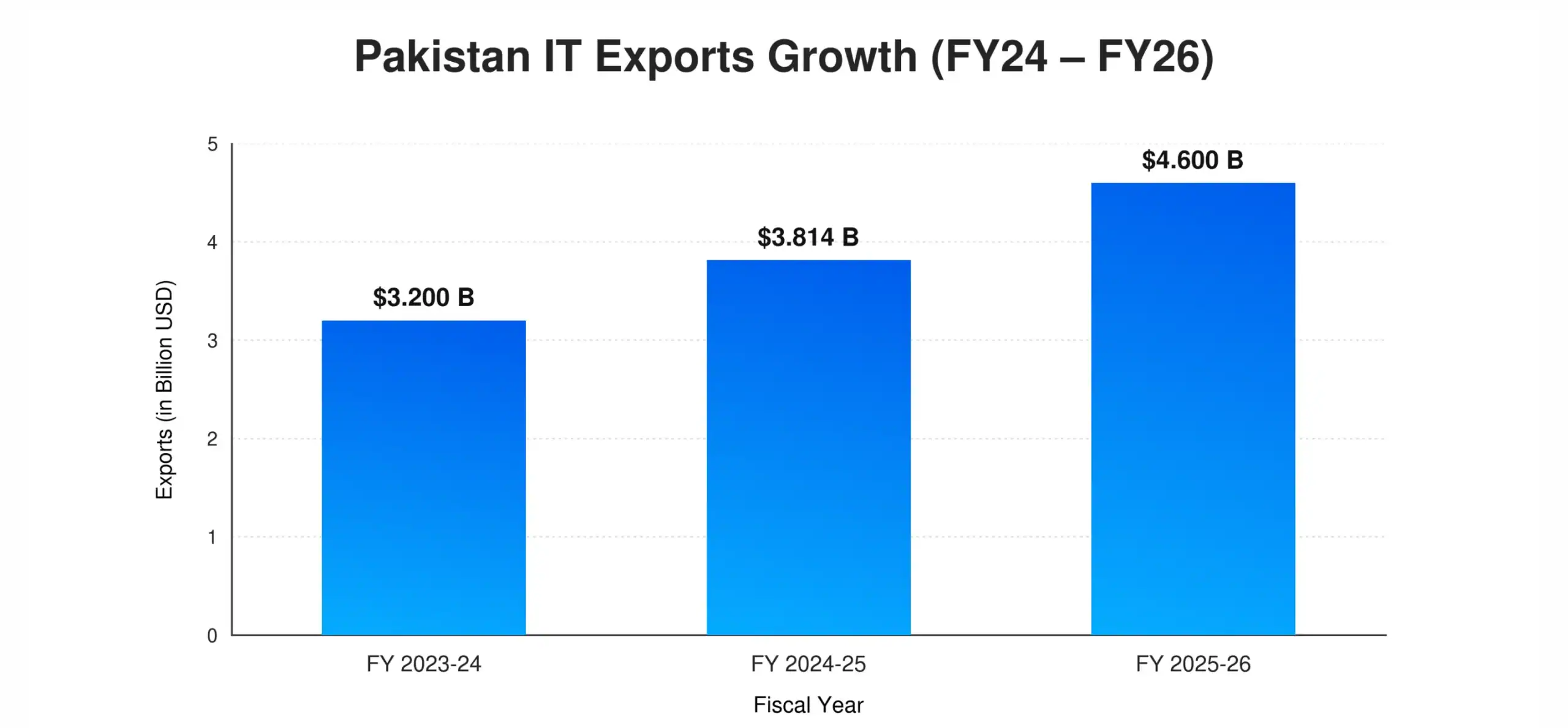
Pakistan’s tech sector isn’t a side story anymore. It’s a genuine economic engine.
- IT and IT-enabled services exports hit a record $4.6 billion in FY2025-26, up 21% year over year, according to the State Bank of Pakistan.
- The sector now ranks among the country’s top sources of foreign exchange.
- Over 2.3 million active freelancers contribute to this growth, placing Pakistan among the world’s top five freelancing markets, per Arab News.
This growth didn’t happen by accident. Government incentives, a young workforce, and rising global demand all pushed in the same direction. As a result, Pakistan tech outsourcing now competes directly with India, the Philippines, and Eastern Europe for enterprise contracts.
Why Global Businesses Are Choosing IT Outsourcing in Pakistan
Companies choose IT outsourcing in Pakistan because it solves three problems at once: talent scarcity, budget pressure, and delivery speed.
A 2025 Deloitte survey found that 78% of high-growth tech firms now integrate offshore teams into their core engineering strategy, not just for cost savings but as a way to close skill gaps, according to Deloitte’s research. Meanwhile, McKinsey reports that outsourcing solves the tech talent gap for 72% of companies surveyed.
1. A Skilled, English-Speaking IT Workforce
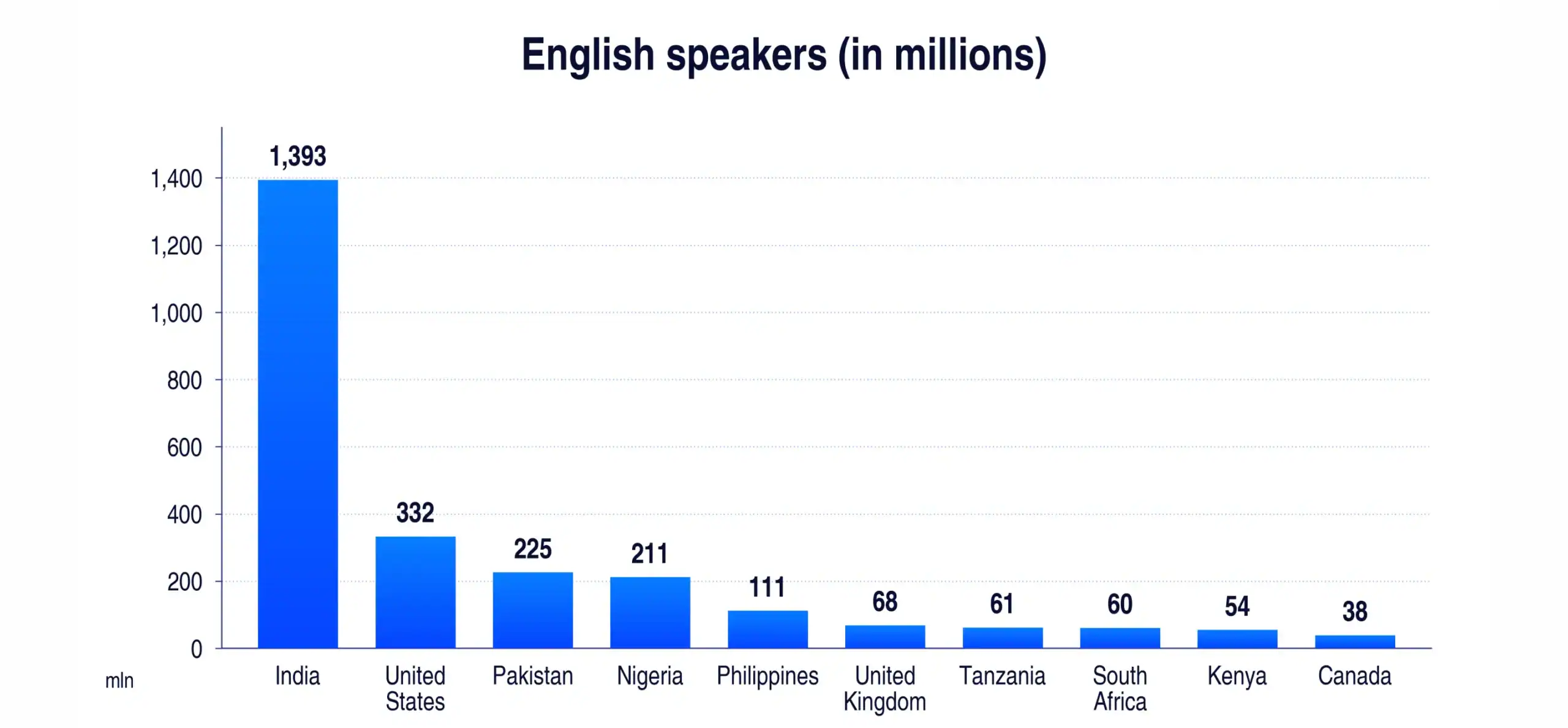
Pakistan graduates tens of thousands of engineers every year, with many coming from computer science and technology programs. According to Transly, Pakistan is the third-largest English-speaking country in the world, giving international businesses a large workforce that can communicate effectively with global teams.
The country’s skilled IT workforce now spans full-stack development, mobile engineering, DevOps, QA automation, and AI. This depth means you’re no longer limited to hiring for basic maintenance work. You can outsource entire product roadmaps.
2. Government Backing and Digital Infrastructure
The Pakistani government has poured resources into tech parks, tax breaks for IT exporters, and startup incubators. In addition, internet infrastructure has improved significantly across major cities, which supports real-time collaboration with international clients.
Because of this backing, technology talent in Pakistan isn’t just growing; it’s growing in the direction global clients actually need: cloud, AI, and cybersecurity.
3. Convenient Time Zone for Global Teams
Pakistan’s GMT+5 time zone offers useful working-hour overlap with businesses across Europe, the Middle East, and Asia. US-based companies can also structure schedules around daily handoffs and planned collaboration.
This makes it easier to coordinate meetings, share updates, and keep development moving across different working hours.
Tech Outsourcing in Pakistan vs. Other Popular Outsourcing Destinations
Let’s talk numbers. Hiring a senior developer in the US or UK often costs three to five times more than hiring an equally experienced engineer in Pakistan. That gap lets startups extend their runway and lets enterprises reallocate budget toward R&D instead of payroll.
However, cheap doesn’t always mean cost-effective. The real value of cost-effective development in Pakistan comes from combining lower rates with genuinely senior talent, not junior teams billed at senior prices.
Here’s how Pakistan stacks up against other popular outsourcing destinations:
| Factor | Pakistan | India | Eastern Europe | Philippines |
| Average hourly rate (senior dev) | $25-$45 | $30-$55 | $40-$70 | $25-$40 |
| English proficiency | High | High | Moderate-High | Very High |
| Time zone overlap with US/EU | Moderate | Moderate | High (EU) | Moderate |
| IT export growth (2025-26) | 21% | ~10-12% | Varies | ~8-10% |
| Strongest domains | Software, AI, gaming | Enterprise IT, BPO | Engineering, fintech | BPO, customer support |
The takeaway is simple. If you need strong engineering talent at a lower burn rate, Pakistan sits in a sweet spot that few other regions match.
Pakistan’s Major Tech Outsourcing Cities
Where your team sits inside Pakistan matters almost as much as the country choice itself. Each city has its own specialty, talent pool, and business culture.
| City | Known For | Talent Focus | Best Fit For |
| Karachi | Pakistan’s largest city and financial hub | Enterprise software, fintech, BPO | Large-scale projects needing broad talent access |
| Lahore | Growing startup and design scene | Product design, mobile apps, SaaS | Startups wanting a partner with product instincts |
| Islamabad and Rawalpindi | Government tech initiatives and R&D | AI, cybersecurity, software engineering | Specialized or research-heavy technical work |
Software Outsourcing Services in Pakistan: What Can You Outsource?
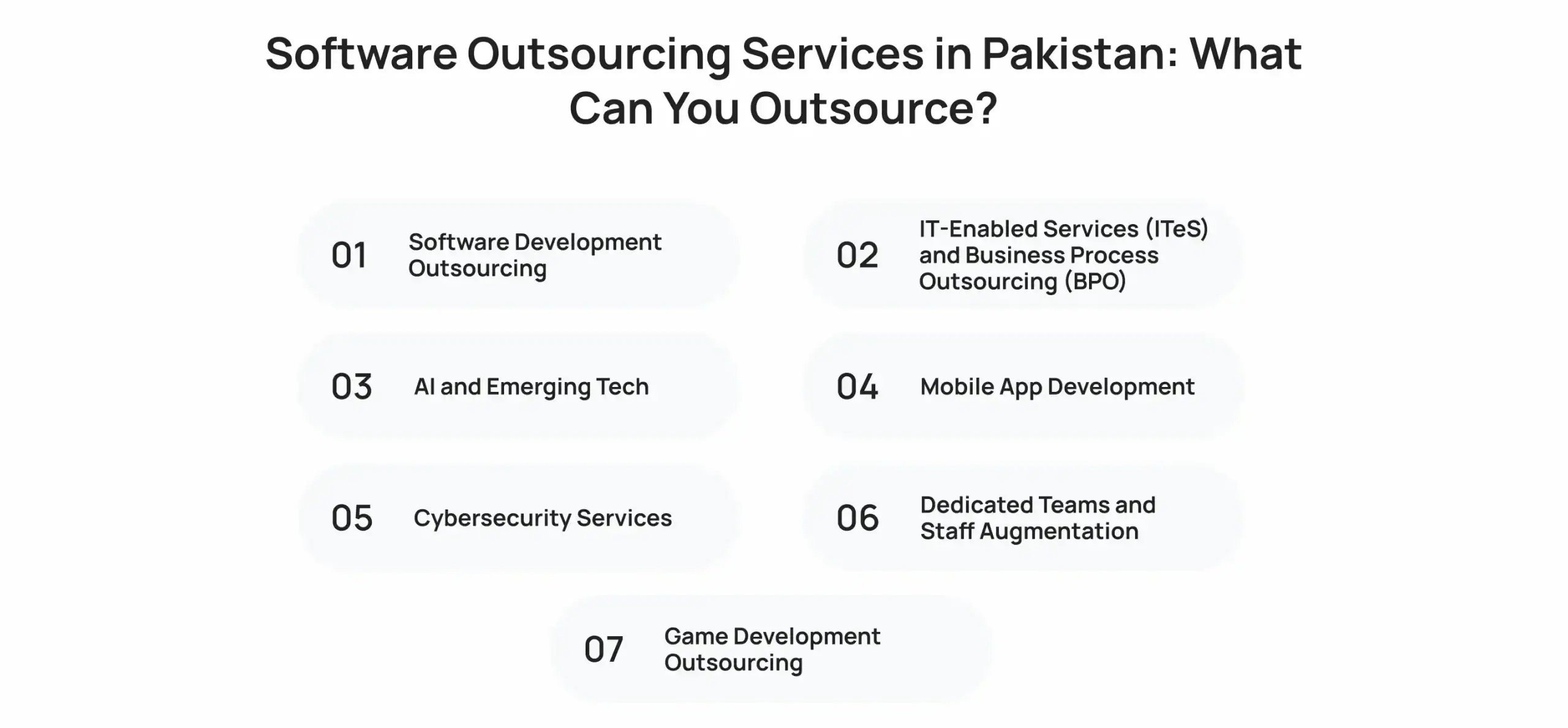
Software outsourcing in the Pakistan style covers far more than basic coding tasks now. Clients typically outsource one or more of these service lines.
1. Software Development Outsourcing
This includes web apps, mobile apps, SaaS products, and custom enterprise software. Teams handle everything from architecture to deployment, often using agile sprints so clients stay involved without micromanaging.
2. IT-Enabled Services (ITeS) and Business Process Outsourcing (BPO)
Beyond development, Pakistan’s IT-enabled services (ITeS) sector covers technical support, data entry, virtual assistance, and back-office operations. Combined with business process outsourcing (BPO) work, this gives companies a way to offload entire operational functions, not just code.
3. AI and Emerging Tech
Pakistani firms increasingly build machine learning pipelines, computer vision models, and generative AI features. If you’re evaluating how to bring an AI outsourcing partner on board, this breakdown of tips for choosing the right technology partner walks through what to check before you sign a contract.
4. Mobile App Development
Pakistani teams build native iOS and Android apps as well as cross-platform products using Flutter and React Native. Because mobile-first design has become the default rather than the exception, most outsourcing firms now staff dedicated mobile squads instead of treating it as an add-on to web work.
5. Cybersecurity Services
As information technology exports climb, so does demand for security work: penetration testing, vulnerability assessments, and compliance support for standards like SOC 2 and ISO 27001. Islamabad in particular has become a hub for this kind of specialized security talent.
6. Dedicated Teams and Staff Augmentation
Rather than a fixed-scope project, many clients prefer to embed Pakistani software engineers directly into their existing team. This staff augmentation model, sometimes called offshore development, works well for companies that already have a product roadmap and simply need more hands to execute it.
7. Game Development Outsourcing
Pakistan’s outsourcing industry also includes game development, with teams working on mobile, PC, and console games. Companies can outsource game development, 2D and 3D art, Unity and Unreal Engine development, game testing, and other production requirements.
If your studio needs extra hands without the overhead of a full in-house team, you can hire Android game developers with experience in mobile game development and platform-specific requirements.
Top Technology Outsourcing Companies in Pakistan
1. Cubix:
A global technology company providing custom software development, mobile app development, AI, and emerging technology solutions. With 18+ years of experience, Cubix has delivered 1,300+ digital products for clients across the US, Europe, and the Middle East.
2. Systems Limited:
Established in 1977, it is a pioneer in Pakistan’s IT sector, offering enterprise resource planning (ERP), cloud consulting, and custom software engineering with thousands of professionals.
3. NetSol Technologies:
A NASDAQ-listed technology company specializing in asset finance and leasing software, serving global automotive, financial, and other enterprise clients.
4. 10 Pearls:
A global custom software development company with major delivery centers in Pakistan, specializing in digital transformation, agile development, and emerging technologies.
5. Ovex Technologies:
A business process outsourcing (BPO) and IT services provider with operations in Islamabad and Lahore, offering customer support, data management, and technology services.
Nearshore vs. Offshore Outsourcing: Where Does Pakistan Fit?
Businesses often debate nearshore vs offshore outsourcing before picking a region. Here’s how Pakistan compares on both fronts. Pakistan primarily serves as an offshore outsourcing destination for global businesses, but its GMT+5 time zone offers nearshore-like advantages for companies in the Middle East and parts of Europe.
| Market | Pakistan’s Position | Typical Time Difference | Collaboration |
| United States | Offshore | Around 9–12 hours | Best suited to asynchronous work, scheduled meetings, and daily handoffs |
| UK and Europe | Offshore with convenient overlap | Around 3–5 hours | Supports regular meetings and real-time collaboration during overlapping hours |
| Gulf and Middle East | Nearshore-like | Around 1–3 hours | Allows easier real-time communication and closely aligned work schedules |
So, rather than treating Pakistan as strictly offshore, it’s more accurate to say the label shifts depending on where your headquarters sit.
Choosing the Right Technology Outsourcing Companies in Pakistan
Not every vendor delivers the same quality. Before you commit, run through this checklist when evaluating technology outsourcing companies in Pakistan.
1. Relevant technical expertise:
Look for experience with the technologies, platforms, and frameworks your project requires.
2. Proven industry experience:
Review case studies and previous projects similar to yours to see whether the company has handled comparable challenges.
3. Team structure:
Understand who will work on your project, their roles, seniority, and whether you will have a dedicated or shared team.
4. Development and QA processes:
Ask how the company handles code reviews, testing, documentation, version control, and project management.
5. Communication and time-zone coverage:
Confirm communication channels, meeting schedules, reporting processes, and available working-hour overlap.
6. Security and IP protection:
Review NDAs, data protection practices, access controls, and intellectual property terms before sharing sensitive information.
7. Client feedback and reputation:
Check independent reviews, references, and long-term client relationships to assess reliability beyond the company’s own website.
8. Engagement flexibility:
Make sure the provider offers a model that fits your project, whether you need a fixed-scope project, dedicated team, or staff augmentation.
Challenges to Watch and How Top Partners Solve Them
No outsourcing destination is perfect, and Pakistan is no exception. Here’s what to watch for, along with how experienced partners typically handle it.
- Time zone gaps: solved through overlap-hour scheduling and async documentation.
- Power or connectivity issues: mitigated by firms investing in backup infrastructure and cloud-based tooling.
- Perception risk: addressed through transparent portfolios, verifiable references, and third-party reviews.
- Data security concerns: handled through NDAs, ISO certifications, and strict access controls.
Therefore, the risks are manageable as long as you choose a partner with a real track record rather than the cheapest bid on a freelance marketplace.
Partner With Cubix for Your Pakistan Tech Outsourcing Needs
At this point, the case for Pakistan tech outsourcing is clear. The talent exists, the cost advantage is real, and the country’s Pakistan IT industry keeps maturing year over year. What matters next is choosing the right partner to execute on it.
Cubix has spent years building software, AI solutions, and mobile products for clients across the US, Europe, and the Middle East. Whether you need a dedicated development team, an AI integration partner, or specialized software development outsourcing support. For a closer look at how AI-specific outsourcing engagements work in practice, this breakdown of artificial intelligence outsourcing is worth a read before your next project kickoff.
Frequently Asked Questions
1. Why are international companies choosing Pakistan for IT outsourcing?
International companies choose Pakistan for its skilled English-speaking workforce, competitive development costs, flexible engagement models, and growing expertise in areas such as AI, cybersecurity, and mobile development.
2. What government support exists for the IT sector?
The Pakistani government supports the IT sector through technology parks, incentives for IT exporters, startup programs, and investments in digital infrastructure.
3. What services do Pakistani tech firms typically handle?
Pakistani tech firms handle software development, mobile app development, AI, cybersecurity, BPO, IT-enabled services, staff augmentation, and game development.
4. How large is Pakistan’s tech and export economy?
Pakistan’s IT and IT-enabled services exports reached $4.6 billion in FY2025-26, highlighting the growing scale of the country’s technology export industry.
5. Is Pakistan’s IT sector growing?
Yes. Pakistan’s IT and IT-enabled services exports grew 21% year over year in FY2025-26, reflecting continued growth in the country’s technology sector.
6. What does outsourcing mean in simple terms?
Outsourcing means hiring an external company or team to handle specific business tasks or projects instead of completing them entirely with an in-house team.