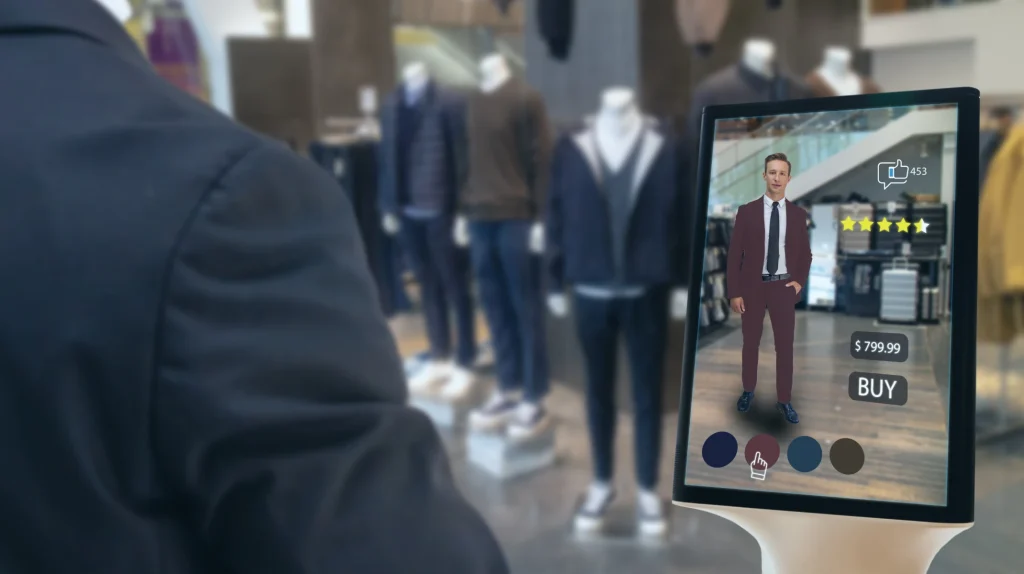
The use of AR in e-commerce continues to grow rapidly. Around 98% of the world’s top retailers are expected to adopt AR by 2027, with the global AR market projected to reach USD 1,716.37 billion by 2032, exhibiting a CAGR of 43.0%. This rapid growth underscores the increasing demand for immersive and interactive shopping experiences.
AR has been a game-changer for online shopping. AR enhances the e-commerce shopping experience by providing customers with an interactive, immersive, hands-on way to shop. It allows them to visualise products in their own space or on themselves before making a purchase. For instance, customers can virtually try on makeup at home or see how a piece of furniture looks in their room. This capability has improved buyers’ decision-making, boosted engagement, and lowered return rates. especially with innovations inspired by AR game development services.
Many leading companies, such as Shopify, WooCommerce, and Magento, make AR technology available to retailers of all sizes. These platforms have realised the importance of AR in e-commerce, and they are working to make AR accessible and accelerate its adoption. In this blog, we will discuss how AR is changing E-commerce by revolutionising the customer experience and transforming the retail landscape.
Read More: The Augmented Reality Boom – Industries Set for Transformation
Transformative Impact of Augmented Reality

Augmented Reality (AR) in e-commerce is transforming online shopping by enabling people to engage more deeply and interactively with products. It helps consumers visualise items in their environment or worn on their person before purchasing. Integrating AR into an e-commerce mobile app can significantly increase user engagement and improve buying decisions.
AR app development focuses on creating applications that superimpose digital items onto the real world, offering features such as virtual try-ons and 3D product previews. The combination of AR and eCommerce allows companies to provide unique and personalised shopping experiences, driving sales and customer satisfaction.
Augmented reality is having a transformative impact on online shopping. Listed below are the 10 advantages of how AR is used while shopping.
10 Key Benefits of Augmented Reality in eCommerce

1. Enhanced Product Visualisation
One of the most significant advantages of AR in e-commerce is immersive 3D product visualisation. Consumers can view products on their mobile devices and see how they fit into their spaces. For instance, furniture buyers can use AR to see how a couch or table will look in their homes or offices. Platforms like Magento and WooCommerce integrate AR tools to enhance product visualization for customers.
Unlike traditional static images or video on e-commerce sites, AR provides customers with a complete understanding of the item because it allows customers to explore products from multiple angles, colour options, textures, zoom in to see the detailing, and try on to check the sizing. This experience enhances customer satisfaction and reduces uncertainty while purchasing products online.
2. Increased Customer Experience
AR enhances user experience and engagement on e-commerce platforms. AR app development helps retain customers on sites longer and increases conversion rates. Whether customers are trying on clothes or shoes, AR makes their shopping experience more enjoyable and drives sales.
AR can make shopping more fun by adding cool features like virtual dress-up tools or providing a virtual tour before buying real estate. This makes shopping exciting and makes you want to come back again and again, helping you like the store even more.
3. Reducing Return Rates
A major challenge in e-commerce is high return rates, often due to products not meeting customer expectations. AR enables virtual try-ons, helping customers ensure products fit correctly before purchasing. Many B2B companies also use AR to verify product orders before shipping, minimising returns.
AR also allows businesses to provide detailed product guidance and demonstrations virtually, which further reduces misunderstandings. When customers understand exactly what they are purchasing, confidence increases, and post-purchase complaints decrease.
4. Cost-Effective Marketing
Traditional marketing methods like print and physical ads are costly. AR enables businesses to create immersive, affordable marketing campaigns, including AR-based product demos, virtual storefronts, and interactive advertisements.
We are in the era of social media, and most e-commerce audiences are present on social apps such as Instagram, Facebook, and Snapchat. For this audience, AR campaigns are engaging and interactive. Businesses can ask social media influencers to create UGC, which will bring a more organic audience to your business while keeping marketing costs lower than traditional channels.
5. Expanding Market Reach
AR shopping allows brands to reach global customers in a virtual space, eliminating the need for physical stores. This is particularly beneficial for B2B companies looking to expand internationally. By delivering AR facilitation to a global audience, your retail business can attract customers across borders without any logistical barriers.
6. Enhancing Brand Image
Brands that integrate AR are seen as innovative and customer-focused, strengthening their reputation and customer loyalty.
In this digital era, adopting AR technology creates a competitive edge over other retailers in the market. The brand will be positioned as tech-savvy, modern, and more credible than any other brand.
7. Personalized Shopping
AR enables personalized shopping experiences by offering customized recommendations based on past selections or virtual try-ons.
With AR, businesses can provide customization options such as the selection of matching accessories with the dress and help customers with a complete outfit selection. This kind of experience encourages users to stay loyal and engage regularly with the brands.
8. Interactive Customer Support
AR can improve customer support by providing interactive troubleshooting and real-time assistance. AR has helped customers to reduce their over-dependency on traditional customer services, because AR provides options to understand product features, such as assembling furniture etc.
9. Improved Shopping Experience
AR reduces the uncertainties of online shopping, making the process more interactive and enjoyable, which boosts customer loyalty. With the integration of AR in e-commerce platforms, brands provide customers with a seamless and satisfying customer journey.
10. Boosting Sales and Conversion Rates
AR-driven shopping experiences remove barriers to buying and increase sales. By using AR, brands can build customer confidence, leading to higher conversion rates
AR content used for targeted marketing is interactive and engaging, which ultimately guides users to complete the sales funnel. It helps businesses to make loyal customers who upsell, cross-sell and maximise their revenue.
Read More: Is Your eCommerce Platform Optimized for Peak Seasons?
Applications of Augmented Reality in E-commerce
Virtual Try-Ons
Fashion, beauty, and eyewear firms have, by and large, welcomed AR technology to allow clients to test the products. Ranging from testing shades of make-up, clothing, to glasses, the clients can utilise their smartphones or webcams to test on the apparel without actually venturing out of the house. This application provides a three-dimensional feel, boosting confidence in purchase decisions while saving time.
AR Product Demos
In e-commerce, AR enables customers to see products in 3D or mimic their usage in a virtual world. For example, a customer may use AR to see how a kitchen appliance functions or observe detailed specifications of a smartphone, enabling them to make more informed choices. This interactive product demonstration provides tremendous value to the e-commerce experience. similar to the immersive techniques used in 3D animation games services.
Virtual Showrooms
With AR technologies, retailers can set up virtual showrooms where customers can experience their products in a virtual format. Customers can walk around, zoom in on, and touch the products they want to purchase, simulating the in-store experience online. This is particularly beneficial for furniture and home décor, where visualization is a large part of making a purchase decision.
AR Navigation in Stores
For companies with physical and digital stores, AR can augment the in-store experience as well. Through AR-capable apps, shoppers can move through physical stores and receive product information and offers on their smartphones, blending physical and digital shopping seamlessly.
Read More: Reimagining the Retail Landscape with AI and Automation
How to Integrate AR into Your E-commerce Platform
- Select the Right AR Technology: Whether you need marker-based AR, location-based AR, or projection-based AR, the right AR technology is important for your business objective.
- Collaborate with Experts: Collaborate with a business AR app development company that knows how to develop smooth AR experiences and verify their device support.
- Ensure User-Friendliness: Make sure that the AR features you integrate are adaptive and easy for users to navigate.
- Test and Optimise: Always test your AR features for performance and optimise them based on user feedback to ensure a smooth shopping experience.
Read More: Future of eCommerce – Top Trends To Watch in 2025 & Beyond
Final Thoughts
AR in e-commerce is a new model for online consumers to shop with an experience that is increasingly interactive, immersive, and personalised. As organisations embrace AR ecommerce, they can significantly boost satisfaction, reduce returns, and optimise sales. With the maturity of AR app development, it has never been simpler to combine AR with e-commerce app development.
Shopify, WooCommerce, and Magento are already integrating AR capabilities into their frameworks so that companies can enable easy shopping experiences. Similarly, B2B organizations have started employing AR to offer better product visualization and customer interaction. With technological advancements, e-commerce using AR will become a game-changer. If you are currently searching for AR app development for your company, this is the time to go and discover this phenomenal technology that’s changing the world of online buying.
Read More: eCommerce App Development – A Potent Revenue Catalyst
Ready to Transform Your Ecommerce Experience with Augmented Reality?

At Cubix, we specialize in developing innovative and scalable ecommerce apps with AR integration. From interactive product visualization to immersive shopping experiences, we help you stand out in the digital marketplace. Boost customer engagement, reduce returns, and enhance conversions with AR-powered solutions.
Contact us today to get started on building your AR-powered ecommerce platform and take your business to the next level!