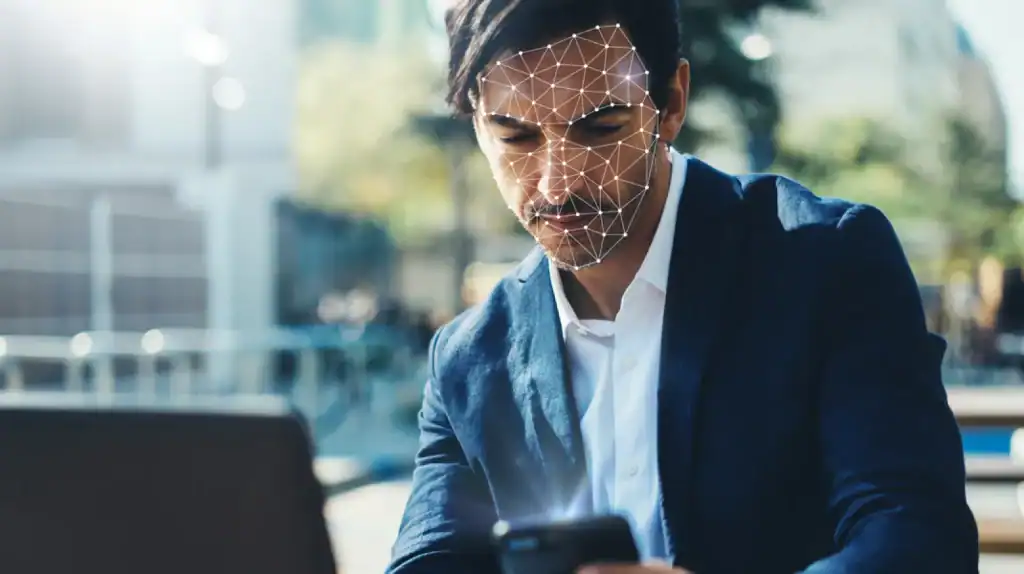
The last few years have witnessed an abundance of ground-breaking innovations for commercial and corporate use. Through the use of algorithms, facial recognition applications can be used to safeguard our private and professional lives.
As reported in the Grand View Research study, the estimated worth of the global market for face recognition was forecast to reach USD 8.5 billion in 2026 and was set to grow at a CAGR of 12.8 percent between 2026 and 2033.
The growth of social media platforms has further driven the use of face recognition technology. For example, Snapchat utilizes face tracking technology for its fun face lenses and filters, and Google Photos automatically organizes photos with similar faces.
Read More: How to Build a Social Media App Like BlueSky
The success of any face recognition app relies on a careful development process, robust security, and the appropriate AI capabilities. Collaborating with the best mobile app development company can help you bring your vision to life in a scalable and user-friendly mobile app. Cubix is about creating intelligent mobile applications, combining highly sophisticated recognition technology with intuitive user experiences, for companies in all kinds of verticals.
Best Face Recognition Apps to Try in 2026
From professional business solutions to playful photo editing apps, the applications listed below are some of the top facial recognition applications in 2025, each with distinct attributes and applications.
1. Luxand
If you’ve had trouble putting names to faces, Luxand is the facial identification app you need. It brings to light a face recognition feature, FaceSDK, that is ideal for surveillance, biometric identification, and other purposes, used by various top-notch organizations around the world.
It can detect any face stored in its memory; you can add names to the images and use the app as a photo gallery whenever you need to remember someone. Additionally, Luxand can recognize faces in live video footage, along with the age and gender of the individual, further authenticating the profile identification.
Furthermore, the face recognition app allows users to experiment with avatars featuring different characteristics, including hair color, facial hair, piercings, and more.
Not only the average folk but developers looking into facial recognition software for their apps can also learn from it. The FaceSDK feature is publicly available with multiple face detection APIs, including:
- Facial recognition API
- Avatar API
- E-cards API
- Baby Prediction API
- Face Aging API
- Zombie API
- Face Enhancement API
For developers interested in building custom recognition systems, Luxand demonstrates how facial recognition can be combined with frameworks like OpenCV to create powerful AI-driven applications for mobile and enterprise environments.
Luxand is considered the best app for facial recognition that allows developers to experiment with emerging technology and permits them to make AR-enabled apps.
Read More: AR Apps for Business: Use Cases and Benefits
2. Blippar
The magic of facial recognition is that it isn’t just to recognize your face for security identification. Blippar, for example, is the best free facial recognition app that uses AR to identify over 370,000 celebrity faces for a quick search of their life, work, and other details. Blippar calls the feature Public Figure Facial Recognition.
Another use of face recognition the app displays is the feature called ‘Halos.’ It enables the users to create their AR facial profiles and use them to share their moods and moments with their followers or customize their features to resemble celebrities.
3. Face2gene
Face2Gene is revolutionizing healthcare through facial recognition to help doctors identify rare genetic disorders. The AI firm behind the app, located in Boston, is developing it to help medical practitioners with genetic evaluations.
Using deep learning algorithms, the platform can then match facial descriptors to large syndrome databases to assist physicians in finding matches that could suggest a particular genetic syndrome.
Facial recognition and Artificial Intelligence (AI) are increasingly being used in healthcare sectors for enhanced diagnostic capabilities, automation of clinical workflows, and patient care.
Read More: How AI-Driven Healthcare Will Transform Patient Care and Diagnostics
4. Faceapp
FaceApp is the best facial recognition app for iPhone users, launched in 2017. If you are curious to know what your future self will look like, it will do the job. Additionally, it can recognize celebrities and allow users to share their old and new photographs like other social platforms.
FaceApp offers a variety of filters that add to the excitement of facial recognition. Some of these filters are:
- Smile Filter: You can edit your smile to be as broad or narrow and add or remove teeth as you want.
- Hairstyles: It allows you to change the color of your hair and your hairstyle. If you are thinking about dyeing your hair, the app will help you decide which color is the best fit for you.
- Genderswap: Curb your curiosity and see what you would look like as a boy or girl.
- Age filter: lets you travel through time to see your older or younger versions.
- Skin tone lightening feature: Lighten your skin tone to change your appearance.
Apps like Remini and Lensa AI have also gained popularity by using AI-powered facial enhancement and portrait generation, highlighting how facial recognition has evolved beyond security into creative photo editing and content creation.
Read More: Steps for Social Media App Success
5. Applock
Applock is another awesome facial recognition app used to upgrade phone security for its users. It allows you to secure your data, social apps, financial information, banking details, and more via face identification. Additionally, the app also uses voice recognition to act as a biometric key adding another layer of security to your smartphone.
As biometric authentication becomes increasingly common, developers must also prioritize application security and user privacy. Following proven app security practices helps ensure facial recognition systems remain secure while protecting sensitive biometric information.
Read More: How to Ensure Security of Mobile Apps
6. Facephi
It’s imperative to enhance smartphone security as the use of mobile banking increases. FacePhi is dedicated to the financial sector, allowing banks to recognize their customers to enhance the mobile experience with an added level of security.
The facial recognition software in the app works under an algorithm that asks users for various personal details during registration. It also records the characteristics of their unique facial patterns.
Therefore, after registration, when users log in, the app asks for a passcode as well as a facial identification. The details are compared to the information in the database before the user is allowed to proceed and use other banking services.
Read More: Technologies Revolutionizing the Financial Service Industry
7. Log me
Log Me uses facial recognition software to help users find people from any part of the world. Like a social networking platform, it enables users to search for old friends and distant relatives from old photographs.
The app extracts any number of faces from a photo and compares it against the numerous images in its database. It will list down the profiles that best match the faces in the photograph along with their information so that you can connect with them.
Furthermore, you can upload photographs from your social accounts or your phone’s gallery, interact with other users, and find out which celebrity you resemble.
As image recognition continues to evolve, developers are integrating similar capabilities into consumer applications for smarter search experiences. Services like Amazon Rekognition further demonstrate how cloud-based facial analysis can simplify face detection, image moderation, and identity verification for businesses building AI-powered applications.
Read More: Image Recognition Apps – A Look at How They Work
8. Facefirst
FaceFirst is one app in the list that uses facial recognition software to identify individuals from a distance, making it ideal for law enforcement, the military, and other organizations. Once a photo is uploaded on the app, it is put against a massive database of known persons to identify the individual.
It provides real-time alerts, accurate details, mobile notifications, emails, and text alerts to the users. Organizations using the app can also add people to a watchlist regardless of an internet connection. Additionally, it protects all data uploaded on the app from third-party access. Businesses planning similar solutions should also prepare for common development problems such as privacy compliance, data quality, and AI model accuracy to ensure long-term success.
Read More: Your Enterprise App Security Checklist
9. DigiPass
Digipass, created by OneSpan, formerly known as VASCO Data Security International Inc. and located in Chicago, is a two-factor authentication system that employs fingerprint and face recognition to protect devices against malware assaults.
This feature allows users to scan a QR code from the website they plan to visit. This is the initial stage in the two-factor authentication procedure. The second phase is a face scan, which consumers may perform using their device’s camera. The scan is matched to the stored biometric template in their app using machine learning methods.
The goal is to protect online transactions, cash withdrawal requests, and other sensitive information. The safe authentication procedure is completed when a proper and genuine match is found. And presto! You are logged in and may conduct your transactions without fear of data theft. It is also regarded as the best facial recognition app for iPhone and Android users.
Read More: Decoding Data Disasters – How Missteps Can Cost Companies Millions!
10. MojiPop
MojiPop, launched by Eureka Studios in the United Kingdom, is the best app for facial recognition that allows users to create personalized avatars using a free facial recognition system. It provides a variety of entertaining animated stickers that users may pick from their interactive keyboard based on their emotions and feelings.
The procedure is straightforward. After downloading the software, you snap a selfie and design your own avatar. To customize your avatar, you may pick from hundreds of various elements such as haircuts, emotions, backgrounds, and moods. It is also available in 58 languages, making it accessible to a wide range of users. The software is free to download from the App Store and Google Play for iOS and Android users.
Read More: Roblox to Include NFT-like Game Items for Avatar Realism
11. BioID
BioID is a multi-factor user authentication facial recognition application created by the same-named German firm. The app uses biometrics to authenticate identities rather than a password. It is regarded as one of the greatest facial recognition services available. It allows you to use facial recognition to log in to several compatible websites and apps.
Thus far, it claims to be able to identify cybercriminals by utilizing its unique Fake Defender function. As a result, it is secure to use for other apps and websites. This facial recognition app is compatible with both iOS and Android devices.
Read More: Rising AI-Driven Cyberattacks – SaaS Data Protection
12. Railer
Railer, a Malaysian firm, developed the best free facial recognition app, an incredible alternative to traditional attendance registration. Using this app, educational and business organizations may control their students’ and workers’ attendance and keep track of them using facial recognition. In short, it manages all of your attendance-related activities directly from your phone, whether you use Android or iOS.
13. IObit Applock
IObit Applock is the best facial recognition app for android users. It enables you to unlock mobile applications with facial recognition software and fingerprint authentication.
The software uses AI and Deep Learning to authenticate your facial ID while accessing your gadgets, applications, and smartphone settings. Plus point of this application is the incredible feature: if someone attempts to unlock your phone, IObit Applock will covertly capture their photo and send it to you via email right away!
Businesses developing similar biometric applications should also consider long-term support, updates, and app maintenance cost to ensure their applications remain secure, compatible, and reliable as operating systems and security standards continue to evolve.
Read More: Top 5 Practices for Mobile App Security
14. FaceVault
FaceVault, formerly known as FaceUnlock, is the best iPhone facial recognition app. It is the iOS-only app that you may use to unlock your iOS devices. However, because iOS does not allow access requests for phone unlocking, the application has turned its attention to giving further protection to the phone gallery. It scans your face using the front camera, regardless of whether or not you are wearing makeup or spectacles.
Read More: Leverage Custom iOS Development for Your Next Project
15. TrueKey
TrueKey is also centered on biometric technology, which protects and manages your passwords using face recognition technology or a fingerprint. It protects your data using the AES-256 encryption system, as well as multi-factor verification, to secure it from unauthorized access.
True Key, a McAfee Security application, is already regarded as one of the greatest face recognition software, allowing you to open your applications if you forget your passwords. Once you’ve checked in using this app, any app that requires a password will be fully synced for optimal security. It has been evaluated as the best iPhone facial recognition app.
Read More: Google Launches New Anti-Theft Features for Android Phones
Partner with Cubix for Custom Mobile App Development
The face recognition technology is reshaping the field of business from healthcare to finance, retail, education, and enterprise security. Developing a trustworthy facial recognition app isn’t quite as simple as using an API, though. Requires knowledge of AI, mobile development, data security, cloud systems, and user experience.
From building a secure biometric authentication system to crafting an AI-powered photo editing tool or a robust enterprise-level identity verification system, Cubix can provide the tools and expertise to make it a reality. We have a team of experts with innovative expertise and intuitive end-user experience capabilities that use cutting-edge technologies to develop a secure, scalable, and future-proof custom mobile application that provides true business value.
To Wrap Up
Face recognition apps have become essential tools for everything from securing your phone to improving your photo organization. With these apps, your phone will be smarter, safer, and even a bit more fun.
Now that you are up to speed on the latest face recognition apps, why not take your tech game to the next level? At Cubix, we possess a proven track record of developing innovative and successful face recognition applications across different industries. Our development team brings a wealth of experience and a history of delivering high-quality, effective solutions. Don’t miss out on this technology; let’s start building today!
FAQs
1. Which is the best face recognition app?
Luxand, AppLock, FaceFirst, and Blippar are among the best face recognition apps available today. The right choice depends on your specific needs, whether it’s biometric security, AI-powered photo editing, attendance tracking, or enterprise identity verification.
2. Is there an app that can recognize faces?
There are various apps available that can recognize faces like:
- Luxand
- Face app
- AppLock
- Blippar
- Railer
- Face2Gene
- Face DNA Test
- MojiPop
- FaceFirst
3. Is there an app to compare facial features?
FaceApp can help you out to compare your facial feature. Furthermore, this app has several face comparisons features like future face pretender, smile filter, and gender swap.
4. What app compares you to a celebrity?
Again, FaceApp and Blippar step in to compare your beautiful face with a renowned celebrity that might help you to feel a bit like them.
5. How much does it cost to build a face recognition app?
The cost of building a face recognition app depends on its features, complexity, AI capabilities, and platform requirements. Learn more about development rates to understand the factors that influence the overall cost.
6. How long does it take to build a face recognition app?
The time required to build a face recognition app varies depending on its complexity, features, and testing requirements. Explore our guide on the development timeline to learn what to expect at each stage of the development process.