Key Takeaways
- Poker game development cost depends mainly on features, platform choice, and team location.
- Multiplayer support, real-money payments, and compliance requirements push the price up the most.
- White label software launches faster and cheaper. Custom builds give you full ownership and control.
- Where you hire from changes your budget more than almost anything else.
- Ongoing maintenance is a real cost. Most first-time founders forget to plan for it.
- Cubix builds poker platforms across every tier, from simple demos to full real-money apps.
The global online poker market crossed $95 billion in 2023. That’s not a typo. Poker apps are big business, and the appetite for new platforms keeps growing every year.
So how much does it actually cost to build one? That depends. A simple poker app costs far less than a real-money platform with live tournaments. Features, platform choice, and your development team all shape the final price. Get the budget wrong early, and you’ll either overspend or launch something half-baked.
This guide breaks down poker game development cost from every angle. You’ll see pricing by project tier, by game variant, and by development stage. We’ll also cover hiring costs, hidden fees, and ways to keep your budget lean. By the end, you’ll know exactly what to ask before you sign with any poker game development company.
Planning a Poker Game? Let’s Build a Platform That Scales
Contact UsPoker Game Market at a Glance
Before you plan a budget, it helps to see the bigger picture. Poker isn’t a niche hobby anymore. It’s a global, mobile-first industry with real money moving through it every day.
Here’s what the numbers say about poker game development services and the market behind them:
| Metric | Figure |
| Global online poker market value (2023) | ~$95 billion |
| Projected market value (2030) | ~$150 billion |
| Market growth rate (CAGR, 2023–2030) | ~12% |
| Global mobile gaming market (2023) | ~$90 billion |
| Share of UK gambling activity on mobile (2023) | 55% |
| Online poker users in India alone | 11 million+ |
More than half of all gambling activity now happens on a phone, not a desktop. That single fact changes how you should plan your build. If your poker app isn’t mobile-first, you’re already behind.
How Much Does Poker Game Development Cost?
Here’s the short answer. Poker game development cost usually falls between $10,000 and $250,000 or more. The exact number depends on your feature list, your platform, and how “real” the money is.
At Cubix, most poker builds land somewhere between $20,000 and $150,000, depending on scope. A basic single-player demo sits at the low end. A licensed, real-money multiplayer platform sits at the high end.
If you’re wondering how much it costs to build a poker app for your specific idea, this table gives you a starting point:
| Tier | What’s Included | Cost Range |
| MVP / Demo | Single game mode, basic UI, one platform | $10,000 – $25,000 |
| Mid-Range | Multiplayer, chat, leaderboards, cross-platform | $25,000 – $60,000 |
| Advanced / Real-Money | Tournaments, AI opponents, live dealer, secure payments | $60,000 – $150,000 |
| Enterprise / Blockchain | Smart contracts, token economy, global compliance | $150,000 – $250,000+ |
Think of these as starting points, not fixed prices. Two “mid-range” poker apps can cost very differently depending on design quality and team location. We’ll get into those factors next.
Cost by Project Type
Not every poker app fits into a neat tier. Your project type also shapes the price. Here’s how the major categories break down.
MVP or Demo Build
This is the fastest, cheapest way to test an idea. You get one game mode, a clean but simple interface, and support for a single platform. Most MVPs launch in six to eight weeks.
Mid-Grade Multiplayer Poker
This is where most commercial poker apps live. Expect real-time multiplayer, in-game chat, leaderboards, and support for both iOS and Android. Development usually takes three to four months.
Real-Money Poker Platform
This is the big one. A real money poker game development company cost climbs fast once you add licensed payments, RNG certification, and live tournaments. Budget $60,000 to $150,000, and sometimes more depending on your target jurisdiction.
White Label vs. Custom Poker Software
This is one of the biggest forks in the road. White label poker game software price sits far below custom development, but you trade away control. Here’s the honest comparison:
| Factor | White Label | Custom Build |
| Starting cost | $8,000 – $50,000 | $40,000 – $200,000+ |
| Time to launch | 4–8 weeks | 3–6 months |
| Branding and customization | Limited | Full control |
| Source code ownership | Usually licensed | Fully owned |
| Long-term scalability | Limited by vendor | Fully scalable |
| Best for | Fast market entry | A long-term, differentiated product |
If you just want to test the waters, white label makes sense. If you’re building a brand you plan to own for years, custom is worth the extra spend.
Blockchain and Play-to-Earn Poker
Adding crypto wallets, smart contracts, and token economies changes the entire cost structure. These builds typically run $60,000 to $200,000, and our team at Cubix has shipped several through our blockchain game development services.
Cost by Poker Game Variant
The game type you pick also affects your budget. Some variants need more logic, more testing, and more UI work than others.
- Texas Hold’em: the most requested variant, and the baseline most quotes are built around.
- Omaha: slightly more complex hand logic, a modest bump over Hold’em.
- 7-Card Stud: simpler betting structure, but different table layout needs.
- Multi-variant apps: supporting three or more game types together, which adds real development time.
A custom Texas Holdem app development cost estimate usually starts around $25,000 for a solid mid-range build and climbs from there with every extra variant you add. Multi-variant platforms can take twelve to twenty-four weeks to build properly, according to industry timelines. Rushing that timeline almost always shows up in the final product.
What Drives the Cost Up
Every poker app shares a few core features. How many of them you include, and how polished each one is, decides a big chunk of your final bill.
Game Modes
Texas Hold’em, Omaha, and 7-Card Stud each need their own logic and design. More modes means more coding, more testing, and a higher price tag.
Multiplayer Support
Real-time multiplayer sounds simple. Underneath, it needs networking, synchronization, and latency handling. This single feature is one of the most common reasons budgets grow.
User Profiles
Registration, login, and player profiles need secure databases behind them. Add avatar customization or account linking, and the cost climbs a bit more.
Chat and Social Features
In-game chat makes poker feel social, which players love. It also means you need moderation tools and anti-spam filters, which take real engineering time.
Leaderboards and Rewards
Tournaments, badges, and reward systems need backend tracking and regular updates. They’re worth it for retention, but they’re not free.
Payment Integration
Whether it’s real cash or in-game coins, payments mean compliance. Expect to budget for encryption, fraud checks, and regulatory requirements here.
Admin Panel
Someone needs to manage users, rooms, and analytics behind the scenes. A solid admin dashboard with custom reporting adds meaningful development time.
QA and testing alone can run $5,000 to $10,000 on a mid-size project, and that’s money well spent. A poker app with only two or three of these features will always cost less than one with all seven. Choose based on what your actual players will use, not what looks impressive on a pitch deck. A good poker game development company will help you prioritize before writing a single line of code.
Other Factors That Affect the Price
Beyond features, a handful of outside factors move your budget just as much.
Platform Choice
Building for iOS, Android, or both changes your cost. Cross-platform frameworks save money upfront but can add complexity later.
Design Quality
A polished, custom UI with animations and branded themes costs more than a template-based design. Poker doesn’t need flashy graphics, but it does need a clean, trustworthy feel.
Team Size and Location
This is the factor most people underestimate. Developers in South Asia typically charge $20 to $40 an hour. Developers in the US or Western Europe often charge $50 to $120 an hour or more for the same work.
Tech Stack
Unity and Unreal are the two most common engines for poker development. The right choice depends on your graphics needs and target platforms, not just what’s trendy.
Compliance and RNG Certification
Real-money poker apps need licensed random number generators and jurisdiction-specific compliance. This step is non-negotiable, and skipping it can shut your app down before it launches. Licensing alone can run $20,000 to $80,000 depending on your target markets.
Poker App Development Cost Breakdown for 2026
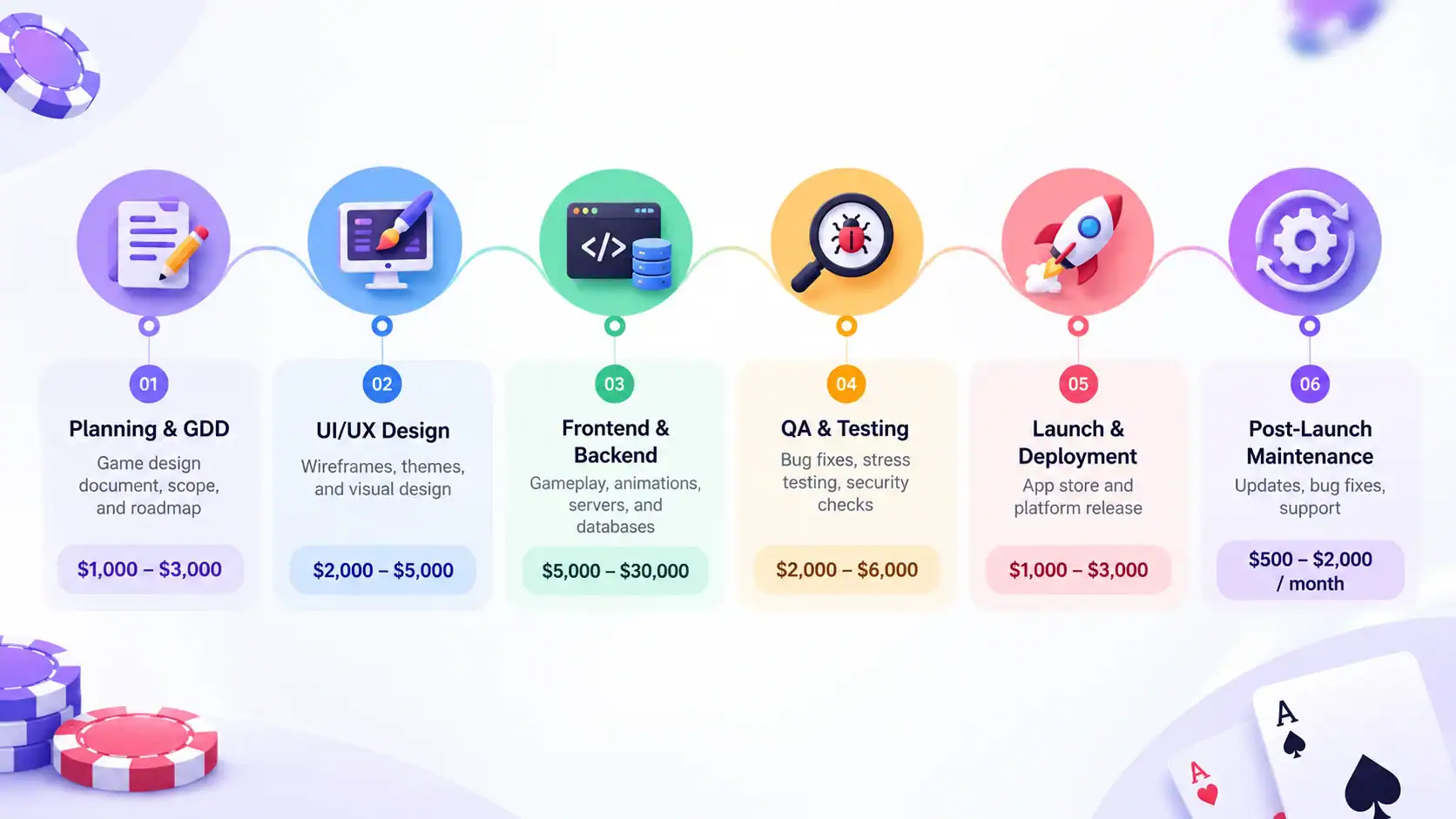
Another way to see where your money goes is stage by stage. Here’s a realistic poker app development cost breakdown for 2026 builds.
| Stage | What Happens | Cost Range |
| Planning & GDD | Game design document, scope, and roadmap | $1,000 – $3,000 |
| UI/UX Design | Wireframes, themes, and visual design | $2,000 – $5,000 |
| Frontend & Backend | Gameplay, animations, servers, and databases | $5,000 – $30,000 |
| QA & Testing | Bug fixes, stress testing, security checks | $2,000 – $6,000 |
| Launch & Deployment | App store and platform release | $1,000 – $3,000 |
| Post-Launch Maintenance | Updates, bug fixes, support | $500 – $2,000 / month |
Notice how much of the budget sits in frontend and backend work. That’s normal. It’s also exactly why cutting corners there tends to backfire later.
Cost to Hire Poker Game Developers
The cost to hire poker game developers depends on experience level just as much as location. Here’s a general breakdown by seniority:
| Developer Level | Hourly Rate |
| Junior Developer | $10 – $40/hr |
| Mid-Level Developer | $40 – $100/hr |
| Senior Developer | $100 – $200+/hr |
You have three main hiring paths:
- Freelancers: cheapest option, best for small, well-defined tasks.
- In-house team: full control, but higher fixed costs like salaries and benefits.
- Outsourced agency: access to specialized poker development experience, without the overhead of a full-time team.
Cubix works with clients across all three tiers, pairing junior developers on repetitive tasks with senior architects on the hard problems, like real-time server infrastructure. If your team needs support scaling a mobile build, our hire mobile game development company page walks through what that engagement looks like.
Hidden Costs and Ongoing Maintenance
What People Forget to Budget For
A lot of poker app quotes only cover development. They skip the costs that show up later:
- Server infrastructure and hosting
- RNG certification renewals
- Payment gateway transaction fees
- Anti-fraud and bot-detection tooling
- Gaming licenses in each target region
- Marketing and user acquisition
These aren’t optional extras. They’re part of running a real poker platform, and they add up fast if you don’t plan for them early.
What Happens After Launch
Launch day isn’t the finish line. Post-launch maintenance typically runs $500 to $2,000 a month, covering bug fixes, server upkeep, and feature updates. Anti-fraud systems need regular tuning too, since cheaters adapt faster than most teams expect. Budget for this the same way you’d budget rent. It’s recurring, and it’s not going away.
How to Keep Your Cost Down
You don’t need to cut quality to control your budget. A few smart choices go a long way:
- Start with an MVP instead of a full-featured platform on day one.
- Use cross-platform frameworks to cover more devices with less code.
- Prioritize the features your players will actually use.
- Outsource to a team with real poker experience instead of a general app shop.
- Add advanced features like live dealer or crypto payments in a later phase.
Starting lean can cut your initial spend by close to half, without hurting your long-term roadmap.
Why Businesses Choose Cubix for Poker Game Development
Poker games look simple from the outside. Building one that’s fast, fair, and secure is a different story. That’s where experience matters.
Cubix has spent years building games across mobile, blockchain, and real-money platforms, with a dedicated poker game development company team behind every project. Here’s what that experience gets you:
- A team that’s shipped multiplayer, real-money, and blockchain poker apps before.
- In-house expertise across Unity, Unreal, and blockchain development.
- Full-cycle service, from the first game design document to post-launch support.
- Transparent, stage-by-stage pricing instead of a vague lump sum.
- A broader games portfolio you can explore at Cubix Games.
You’re not just hiring developers. You’re hiring a team that already knows where poker projects tend to go over budget, and how to avoid it.
Build Your Poker Game With Cubix
Poker game development cost varies a lot, but a clear budget doesn’t have to be complicated. Know your tier, know your must-have features, and know who you’re hiring. That’s most of the battle.
If you’re ready to turn your idea into an actual project plan, Cubix can help you scope it properly from day one. Whether you need a lean MVP or a full real-money platform, our team can walk you through realistic pricing before you commit to anything.
Ready to Launch Your Poker App? Get a Clear Cost Estimate from Cubix
Contact UsFrequently Asked Questions
1. What is the average cost range for developing a custom mobile poker app?
Most custom mobile poker apps cost between $25,000 and $150,000. Simple single-player builds sit at the low end. Full multiplayer platforms with real-money support sit at the high end.
2. How does RNG certification and iGaming compliance impact poker game development pricing?
RNG certification and licensing can add $20,000 to $80,000 to your budget, depending on how many jurisdictions you target. It’s a required step for any real-money app, not an optional add-on.
3. What are the primary cost drivers when choosing between white-label vs custom poker game development?
White label software costs less upfront and launches faster, usually within four to eight weeks. Custom development costs more and takes longer, but gives you full ownership, branding control, and room to scale.
4. How much does backend architecture and real-time multiplayer server infrastructure cost for poker games?
Backend and server work is usually the single largest line item, often $5,000 to $30,000 or more. Real-time multiplayer specifically adds networking, synchronization, and load-testing costs on top of standard backend work.
5. What is the typical timeline and cost breakdown for Texas Hold’em vs multi-variant poker apps?
A single-variant Texas Hold’em app typically takes three to four months and starts around $25,000. Multi-variant apps supporting several game types can take twelve to twenty-four weeks and cost noticeably more due to added logic and testing.
6. How do ongoing maintenance, anti-fraud updates, and server costs scale after launch?
Ongoing maintenance generally runs $500 to $2,000 a month for a mid-size app, and it scales up with your user base. More players means more server load, more transactions to monitor, and more frequent anti-fraud updates.